
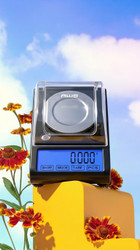
Choosing between a pocket scale and a kitchen scale may seem simple, but the right choice depends on what you need to weigh, how precise the measurements must be, and where you plan to use the scale. Both are digital scales, yet they are designed for very different jobs.
A pocket scale is compact, portable, and typically more precise when weighing small objects. A kitchen scale usually has a larger platform and higher capacity, making it better for food preparation, baking, meal planning, and other household tasks.
If you are comparing a pocket scale vs. kitchen scale, this guide explains their differences, advantages, limitations, and ideal uses so you can confidently choose the best scale for your needs.
What Is a Pocket Scale?
A pocket scale is a small digital scale designed for portable, precise weighing. Most models are compact enough to fit inside a pocket, bag, drawer, toolbox, or travel case. Many include a protective cover that helps shield the weighing platform and controls when the scale is being stored or transported.
Pocket scales generally measure in small increments, such as 0.1 gram or 0.01 gram. Certain precision models can measure even finer increments, although extremely small quantities may require a dedicated milligram scale.
Because pocket scales focus on precision rather than maximum capacity, they are commonly used for:
-
Jewelry and gemstones
-
Coins and precious metals
-
Coffee beans and espresso doses
-
Herbs, spices, and ingredients
-
Crafts and small hardware
-
Collectibles
-
Small packages and components
-
Hobby and laboratory-style projects where legally and safely appropriate
Pocket scales may support several weighing units, including grams, ounces, carats, grains, pennyweights, and troy ounces. Available units vary by model, so it is important to check the product specifications before buying.
What Is a Kitchen Scale?
A kitchen scale, sometimes called a food scale, is designed to weigh ingredients, portions, and food containers. It typically has a wider platform than a pocket scale and can support greater total weight.
Kitchen scales commonly read in 1-gram or 0.1-ounce increments. That level of precision is sufficient for most cooking, portioning, and everyday baking tasks. Some specialized kitchen scales offer finer measurements, but their main advantage is usually capacity and platform size rather than ultra-fine precision.
Kitchen scales are commonly used for:
-
Baking ingredients
-
Meal preparation
-
Portion control
-
Coffee brewing in larger batches
-
Tracking food by weight
-
Measuring produce, meat, and dry goods
-
Weighing bowls, plates, and containers
-
Scaling recipes up or down
Their larger platforms make it easier to use mixing bowls and food containers without crowding the weighing surface.
Pocket Scale vs. Kitchen Scale: Quick Comparison
| Feature | Pocket Scale | Kitchen Scale |
|---|---|---|
| Best for | Small objects and precise quantities | Food, ingredients, portions, and containers |
| Typical readability | 0.1 g or 0.01 g | 1 g or 0.1 oz |
| Typical capacity | Lower | Higher |
| Platform size | Small | Medium to large |
| Portability | Excellent | Moderate |
| Storage | Fits easily in a drawer, bag, or case | Usually stored on a counter or in a cabinet |
| Common units | g, oz, ct, gn, dwt, ozt | g, oz, lb, ml |
| Ideal purchase priority | Precision | Capacity and convenience |
Specifications differ among individual models, but this comparison shows the main distinction: a pocket scale is usually the better precision tool, while a kitchen scale is usually the better general-purpose food scale.
The Biggest Differences Between Pocket Scales and Kitchen Scales
1. Precision and Readability
Readability is the smallest weight increment a scale displays. A scale with 0.01-gram readability shows measurements in hundredths of a gram, while a scale with 1-gram readability displays whole grams.
Pocket scales often offer finer readability because they are built to measure lighter objects. This makes them useful when a small difference in weight matters. For example, a 1-gram kitchen scale may display two objects with slightly different weights as identical, while a 0.01-gram pocket scale may reveal the difference.
A kitchen scale does not necessarily need hundredth-of-a-gram precision. When measuring 500 grams of flour or a large food portion, a 1-gram increment is usually practical and easy to read.
Choose a pocket scale when fine precision is the priority. Choose a kitchen scale when whole-gram accuracy is enough for the task.
2. Maximum Capacity
Capacity refers to the heaviest load a scale can safely weigh. Kitchen scales generally have a higher maximum capacity because they are designed for bowls, food containers, and larger quantities. Many kitchen models can handle several kilograms or multiple pounds.
Pocket scales typically have lower capacities. Common capacities may include 100, 200, 500, or 1,000 grams, depending on the model and its readability. In many scale designs, higher precision and higher capacity involve a tradeoff.
Never exceed a scale's listed maximum capacity. Overloading can damage the load cell, affect calibration, or permanently reduce accuracy. Remember that the container counts toward the total load even if you use the tare function to reset the visible reading to zero.
3. Platform Size
A pocket scale has a smaller weighing platform, which works well for coins, jewelry, coffee beans, and compact containers. However, a large plate or mixing bowl may cover the display, touch the surrounding surface, or extend too far beyond the platform for reliable use.
A kitchen scale provides more room for bowls, dishes, packages, and loose ingredients. The wider platform also makes it easier to add ingredients gradually while watching the display.
If you regularly use full-size bowls or weigh large food portions, a kitchen scale will be more convenient. If you weigh small items, the compact platform of a pocket scale is usually sufficient.
4. Portability
Portability is one of the strongest reasons to buy a pocket scale. Its compact design makes it easy to carry to a coffee shop, craft studio, coin show, jewelry appointment, workspace, or other appropriate location.
Kitchen scales are generally lightweight, but most are not intended to be carried in a pocket. Their larger surface area makes them better suited to a countertop, pantry, cabinet, or dedicated work area.
5. Available Weighing Units
Pocket scales often include units used for specialized objects, such as carats for gemstones, grains for small materials, pennyweights for precious metals, and troy ounces for bullion.
Kitchen scales focus more often on grams, standard ounces, pounds and ounces, and sometimes milliliters. A liquid-volume mode is a convenience feature, but it may rely on an assumed density. For the most accurate recipe results, weighing ingredients in grams is usually the clearest approach.
Check which units a particular model supports instead of assuming that every digital scale includes the same modes.
6. Controls and Everyday Features
Both pocket and kitchen scales commonly include:
-
Tare or zero function
-
Unit conversion
-
Digital display
-
Automatic shutoff
-
Low-battery indicator
-
Overload warning
Pocket scales may add a counting function, protective cover, or calibration feature. Kitchen scales may provide a larger backlit display, touch controls, water or milk volume modes, and an easy-to-clean surface.
When Should You Buy a Pocket Scale?
A digital pocket scale is the better choice when you need to measure lightweight objects with finer precision. Consider buying one if any of the following describes your needs.
You Weigh Jewelry, Gemstones, Coins, or Precious Metals
Small differences can matter when working with valuable materials. A pocket scale with the appropriate readability and units can help weigh rings, chains, loose stones, coins, and bullion. For gemstones, look for a scale with carat mode. For precious metals, troy ounces, pennyweights, or grams may be useful.
A scale can verify weight, but it cannot independently confirm authenticity, purity, or value. Those questions may require professional testing.
You Need Consistent Coffee or Espresso Doses
A pocket scale can be an excellent coffee companion, particularly for measuring espresso doses or small amounts of beans. A 0.1-gram model often provides the control needed to repeat a preferred recipe more consistently.
Before buying, make sure the platform can accommodate your portafilter, dosing cup, or brewing container. For full pour-over setups, a larger coffee or kitchen scale may be more convenient.
You Work With Small Craft Components
Beads, resin additives, pigments, wax, fasteners, and other craft materials may need finer measurements than a standard kitchen scale provides. A pocket scale is easy to keep in a craft box and can help improve repeatability across projects.
You Need a Scale Away From Home
If you frequently travel or work in multiple locations, the compact size and protective design of a pocket scale can be valuable. Always place it on a stable, level surface and allow it to acclimate after a major change in temperature before weighing.
You Need Better Than 1-Gram Readability
This is the clearest dividing line. If a whole gram is too large an increment for your task, a typical kitchen scale may not be sufficient. A 0.1-gram or 0.01-gram pocket scale is likely the better option, provided it also offers enough capacity.
When Should You Buy a Kitchen Scale?
A kitchen scale is the better choice when you need to weigh food, ingredients, or larger containers. It is particularly helpful in the following situations.
You Bake Regularly
Baking by weight can be more consistent than relying only on cups and spoons. Flour can settle or become compressed, producing different amounts in the same measuring cup. A kitchen scale lets you measure ingredients directly in grams and reproduce recipes more reliably.
The tare function also makes it possible to place a bowl on the scale, reset the display to zero, add the first ingredient, tare again, and continue adding ingredients to the same bowl.
You Prepare Meals or Track Portions
A food scale can help divide meals, portion ingredients, and follow nutrition plans that list serving sizes by weight. Choose a model with enough capacity for both the container and the food.
You Frequently Weigh Larger Items
A kitchen scale is more practical for produce, meat, packages of ingredients, mixing bowls, and other bulky items. Its broader platform and higher capacity reduce the likelihood of overloading or blocking the display.
You Want One General-Purpose Household Scale
For most households, a kitchen scale is the more versatile first purchase. It can support cooking, baking, portioning, and many everyday weighing tasks. It will not replace a precision pocket scale for very small quantities, but it covers a broader range of typical household needs.
Can You Use a Pocket Scale as a Kitchen Scale?
You can use a pocket scale for certain kitchen tasks, especially when measuring small amounts of coffee, spices, yeast, salt, or other ingredients. Its fine readability may be helpful when a recipe requires a precise, lightweight quantity.
However, a pocket scale may not be ideal for large bowls, substantial batches, or heavy ingredients. The container may exceed the platform size or push the combined load beyond the scale's capacity.
A pocket scale can complement a kitchen scale, but it does not always replace one.
Can You Use a Kitchen Scale as a Pocket Scale?
A kitchen scale can weigh many small household items as long as they exceed its minimum usable load and do not require fine precision. It may work for a large coin collection, a small package, or a quantity of craft materials.
It is less suitable when hundredths or tenths of a gram matter. A kitchen scale that reads in 1-gram increments cannot provide a reliable 0.01-gram measurement simply because the object is placed carefully on the platform.
Match the scale's actual readability to the task rather than trying to estimate between displayed increments.
How to Choose the Right Digital Scale
Before purchasing a pocket scale or kitchen scale, compare the following specifications.
Determine the Smallest Amount You Need to Measure
Choose a scale with readability fine enough for your lightest typical item. If you commonly need measurements to the nearest tenth of a gram, select 0.1-gram readability or finer. If whole grams are sufficient, a standard kitchen scale may be enough.
Do not automatically buy the model showing the most decimal places. Greater precision usually comes with lower capacity, a smaller platform, or more sensitivity to environmental conditions.
Determine the Heaviest Total Load
Include the weight of bowls, trays, cups, and other containers in your estimate. The tare function subtracts a container's weight from the displayed result, but it does not remove that weight from the physical load placed on the scale.
Choose a capacity comfortably above your expected maximum rather than regularly operating at the limit.
Consider the Size of What You Are Weighing
The weighing surface should support the item without instability. The object should not touch the counter or surrounding equipment, and it should not prevent you from seeing the display.
Check the Measurement Units
Buy a scale that displays the units you actually use. A baker may prioritize grams and pounds and ounces, while a jewelry professional may need carats, pennyweights, or troy ounces.
Look for a Useful Tare Function
Tare is essential when weighing items in a container. It subtracts the visible weight of the bowl, tray, or cup so the display shows the net weight of the contents.
Consider Calibration and Included Accessories
Some scales support user calibration, and certain models may include a calibration weight. If calibration capability is important to you, review the instructions and required weight before purchasing. Use only the correct calibration weight and procedure for the specific model.
Choose a Reputable Scale Brand
The number of decimal places on a product page does not tell the whole story. Build quality, overload protection, consistent performance, clear instructions, warranty coverage, and customer support all contribute to a better ownership experience.
American Weigh Scales offers pocket scales, kitchen scales, milligram scales, counting scales, and other digital weighing solutions for a wide range of everyday and specialized needs. Compare each model's readability, maximum capacity, platform dimensions, and supported units before selecting the best fit.
How to Get More Accurate Results From Any Scale
Whether you choose a pocket scale or a kitchen scale, proper setup improves repeatability.
-
Place the scale on a hard, flat, stable surface.
-
Avoid carpets, soft mats, uneven counters, and vibrating appliances.
-
Keep the scale away from drafts, fans, and open windows.
-
Center the item on the weighing platform.
-
Let the scale reach room temperature after storage or travel.
-
Confirm that the display reads zero before adding an item.
-
Use tare correctly when weighing with a container.
-
Keep the platform clean and dry.
-
Replace weak batteries when readings become unstable or the indicator appears.
-
Calibrate only according to the manufacturer's instructions.
Highly precise pocket scales are more sensitive to air movement, vibration, temperature changes, and an unstable surface. Small changes in the last displayed digit do not always indicate a defect; they may reflect the surrounding environment.
Pocket Scale vs. Kitchen Scale: Which One Is More Accurate?
The answer depends on what you mean by accurate and which specific models you compare. A pocket scale generally offers finer readability, which makes it more suitable for small objects. A kitchen scale can still provide accurate results within its stated specifications, even if it displays fewer decimal places.
A 0.01-gram pocket scale is not automatically the best tool for a heavy mixing bowl, just as a high-capacity kitchen scale is not the best tool for a tiny gemstone. Accuracy begins with choosing a scale designed for the weight range and application.
Should You Own Both?
For many people, owning both a pocket scale and a kitchen scale is the most practical solution. The two tools serve complementary purposes.
Use a kitchen scale for flour, produce, meal portions, mixing bowls, and general food preparation. Use a pocket scale for coffee doses, jewelry, coins, craft materials, and other lightweight items that require finer readings.
Because pocket scales are compact and easy to store, adding one to a household that already has a kitchen scale does not require much space. Together, the two scales cover a much wider range of weighing tasks than either one can handle alone.
Frequently Asked Questions
Is a pocket scale better than a kitchen scale?
A pocket scale is better for small items and fine measurements. A kitchen scale is better for heavier food quantities, bowls, and general cooking. Neither type is universally better; the correct choice depends on the task.
What is the best scale for weighing grams?
Both pocket and kitchen scales can measure grams. Choose based on the increment and capacity you need. For whole grams and larger quantities, a kitchen scale is usually suitable. For tenths or hundredths of a gram, choose a compatible pocket or precision scale.
Is a 0.1-gram or 0.01-gram scale better?
A 0.01-gram scale provides finer readability, while a 0.1-gram scale may offer greater capacity or be less sensitive to minor environmental changes. Buy the level of precision your application actually requires.
Can a kitchen scale weigh jewelry?
A kitchen scale may weigh heavier jewelry, but its readability may be too coarse for small pieces or detailed valuation work. A pocket scale with gram and carat modes is generally more suitable.
Can a pocket scale weigh food?
Yes. A pocket scale can weigh small food quantities such as coffee, spices, salt, yeast, and ingredients used in compact recipes, provided the load stays within its capacity and fits on the platform.
What capacity should I choose?
Choose a capacity above the heaviest item and container you expect to weigh. A pocket scale with a few hundred grams of capacity may suit jewelry or coffee, while a multi-kilogram kitchen scale is more appropriate for mixing bowls and larger food portions.
Does the tare function improve accuracy?
Tare does not increase a scale's underlying accuracy. It resets the displayed value to zero after a container is added, allowing you to view the net weight of the contents more conveniently.
Final Verdict: Pocket Scale or Kitchen Scale?
Buy a pocket scale if you need portability, a compact design, or fine measurements for lightweight items such as jewelry, coins, coffee, gemstones, or craft supplies.
Buy a kitchen scale if you mainly weigh ingredients, meals, produce, baking bowls, or larger household items and need more capacity and platform space.
If your weighing needs include both large food quantities and very small objects, owning one of each is the best answer. Start by identifying the lightest item, the heaviest total load, and the measurement increment you need. Those three details will point you toward the right digital scale far more reliably than size or price alone.
Explore the selection from American Weigh Scales and compare capacity, readability, platform size, and weighing modes to find the right scale for your kitchen, workspace, hobbies, or business.