
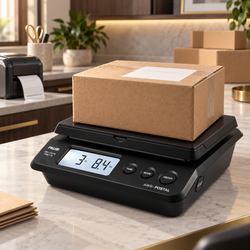
A dependable postal mail scale should accurately and consistently weigh everything from lightweight envelopes to fully packed shipping boxes. Selecting the right model requires more than looking at its maximum capacity. Resolution, repeatability, minimum load, platform size, calibration capability and display placement all influence how effectively the scale performs.
For many home offices and small businesses, a digital postal scale with 25 to 110 pounds of capacity and approximately 0.1-ounce resolution provides a practical balance. Businesses that primarily mail cards, jewelry, samples or other lightweight products may need a smaller scale with gram-level resolution. Operations shipping large boxes may require substantially greater capacity and a separate display.
This postal mail scale buying guide explains how to compare:
-
Accuracy
-
Capacity
-
Resolution
-
Minimum load
-
Repeatability
-
Calibration
-
Verification
-
Platform dimensions
-
Tare and hold functions
-
Power and connectivity
The objective is to select a scale that fits your actual shipments, not simply the model with the highest capacity or most decimal places.
Why Postal Scale Selection Matters
Package weight can influence postal service eligibility, label preparation and postage. An incorrect weight can contribute to:
-
Postage adjustments
-
Unexpected charges
-
Package delays
-
Returned mail
-
Customer-service issues
-
Accounting discrepancies
-
Fulfillment inefficiency
USPS describes how package information may be checked through its Automated Package Verification process. Differences involving weight, dimensions or postage may result in an adjustment.
A suitable scale reduces the need to estimate weight and helps establish a consistent shipping process.
American Weigh Scales offers dedicated digital shipping scales for letters, ecommerce orders, mailrooms and larger packages.
Postal Scale Specifications at a Glance
| Mailing Application | Suggested Capacity | Useful Resolution | Recommended Scale Type |
|---|---|---|---|
| Letters and documents | 500–2,000 g | 0.1–1 g | Compact letter scale |
| Jewelry and lightweight products | 500–5,000 g | 0.1 g | Precision pocket scale |
| Padded envelopes | 5–25 lb | 0.1 oz | Compact postal scale |
| Small ecommerce boxes | 25–55 lb | 0.1 oz | General shipping scale |
| Subscription boxes | 50–110 lb | 0.1–0.2 oz | Medium-capacity shipping scale |
| Heavy commercial packages | 110 lb or more | 0.1–0.2 lb | High-capacity platform scale |
These recommendations are starting points. Your ideal specifications depend on the lightest and heaviest completed mailpieces, not the unwrapped products.
Accuracy, Resolution and Repeatability
These terms describe different aspects of scale performance.
Accuracy
Accuracy describes how closely a scale’s result agrees with an accepted reference value.
Resolution
Resolution is the smallest displayed weight increment. A scale with 0.1-ounce resolution displays weight in tenths of an ounce.
Repeatability
Repeatability describes whether the scale produces similar readings when the same package is weighed multiple times under unchanged conditions.
Linearity
Linearity describes scale performance at different points throughout its weighing range.
A scale can have fine resolution without providing equivalent accuracy. Extra decimal places do not guarantee dependable measurements.
How Accurate Should a Postal Scale Be?
The necessary accuracy depends on the mail being weighed and the decisions made from the result.
Letters
Lightweight letters benefit from gram-level measurement because a small insert or additional pages can represent a meaningful change in total weight.
Padded Mailers
A resolution of approximately 0.1 ounce is often practical for jewelry, cosmetics, accessories, clothing and other lightweight products.
Medium Boxes
Small-business shipping scales commonly balance moderate-to-high capacity with approximately 0.1-ounce readability.
Heavy Packages
Large boxes may not require fine gram-level resolution. Capacity, durability and platform dimensions usually become more important.
The goal is to select a scale that can reliably distinguish the smallest relevant change in your actual shipping workflow.
How to Test Repeatability
A basic repeatability check can reveal whether a scale produces consistent measurements.
-
Place the scale on a solid, level surface.
-
Turn it on with the platform empty.
-
Confirm that the display reads zero.
-
Place a representative package in the center.
-
Wait for the reading to stabilize.
-
Record the result.
-
Remove the package.
-
Allow the display to return to zero.
-
Repeat the process five to ten times.
-
Compare the results.
If readings vary significantly, check for:
-
Weak batteries
-
Vibration
-
Air movement
-
Temperature changes
-
Package contact
-
Platform debris
-
Uneven surfaces
-
Off-center loading
-
Calibration problems
-
Previous overload damage
Repeatability is especially important in fulfillment operations because employees need confidence that a package will not appear to change weight between measurements.
Choosing the Right Capacity
Capacity is the maximum load a scale is designed to support.
Calculate capacity using the completed shipment, including:
-
Product
-
Product packaging
-
Shipping box or envelope
-
Protective materials
-
Inserts
-
Documentation
-
Samples
-
Tape
-
Label
-
Any weighing tray
Capacity Example
Suppose a shipment contains:
-
Product: 28 lb
-
Product packaging: 1.5 lb
-
Shipping carton: 2 lb
-
Protective material and inserts: 1 lb
The completed package weighs approximately 32.5 pounds.
A 30-pound scale would be inadequate. A 50- or 55-pound model would provide a more practical range.
Leave Room Above the Maximum
Avoid choosing a scale that operates at its limit during ordinary use.
Additional capacity provides flexibility for:
-
Larger orders
-
Seasonal bundles
-
Heavier packaging
-
Product-line expansion
-
Multiple-item shipments
-
Unexpected package changes
Do Not Buy Excessive Capacity
A scale rated for several hundred pounds may use increments that are too coarse for lightweight mail.
High capacity is valuable only when your packages require it.
Tare Does Not Restore Capacity
Tare subtracts a container or tray from the displayed weight, but the scale continues to support that physical load.
For example, placing a five-pound bin on a 55-pound scale and pressing tare leaves approximately 50 pounds of physical capacity.
Ignoring this distinction can cause an overload even when the displayed net weight appears to be within range.
Minimum Load Is Equally Important
The maximum tells you the heaviest package the scale can support. The minimum practical load helps determine whether the scale is suitable for lightweight mail.
A high-capacity warehouse scale may not respond dependably to:
-
Greeting cards
-
Jewelry envelopes
-
Trading-card mailers
-
Product samples
-
Small replacement parts
-
Stickers
-
Lightweight documents
For very light mail, compare AWS pocket scales that prioritize fine resolution and portability.
Businesses shipping both letters and heavy boxes may need two scales rather than one model attempting to cover the entire range.
Platform Size and Load Support
The package must fit securely enough that its entire weight is applied to the platform.
A package should not:
-
Touch the table
-
Lean against a wall
-
Rest on a cable
-
Press against the display
-
Cover the controls
-
Tip or rock
-
Shift during measurement
A box can be below the scale’s maximum capacity but still produce an incorrect reading if part of it rests on another surface.
Can Packages Overhang?
A rigid box may overhang the platform if it:
-
Remains stable
-
Stays centered
-
Does not contact another surface
-
Does not interfere with controls or the display
Flexible poly mailers and padded envelopes are more likely to droop onto the surrounding table.
A lightweight rigid tray can support flexible packages. Place the tray on the scale, allow it to stabilize and press tare before adding the mailpiece.
Display Placement
Large boxes frequently block an integrated display.
Useful display configurations include:
-
Pull-out displays
-
Detachable wired displays
-
Wall-mounted displays
-
Angled screens
-
Backlit displays
-
Large digits
The operator should be able to read the result without tilting, lifting or moving the package.
Hold Function
Hold keeps a stable weight on the display after the package is removed or after the reading stabilizes.
This feature is useful when:
-
A box covers the display
-
The scale sits below a counter
-
Weight must be entered manually
-
The computer is several feet away
-
A package is difficult to reposition
Check whether the scale uses manual or automatic hold and how the result is cleared.
Tare Function
Tare is useful for:
-
Reusable product bins
-
Envelope-support trays
-
Mailing baskets
-
Sorting containers
-
Prepackaging calculations
The final shipment should still be weighed after it has been sealed because all packaging contributes to postal weight.
Weight Units and Display Formats
A postal scale may display:
-
Grams
-
Kilograms
-
Ounces
-
Pounds
-
Pounds and ounces
-
Decimal pounds
Confirm that the available format matches the shipping system.
Decimal Pounds Versus Pounds and Ounces
These formats should not be confused.
For example:
-
4 lb 8 oz equals 4.5 decimal pounds.
-
It does not equal 4.8 pounds.
A prominent unit indicator can help prevent data-entry errors.
Actual Weight and Dimensional Weight
A scale measures actual physical weight. It does not calculate dimensional weight without separate package measurements and the applicable carrier formula.
Dimensional weight reflects how much space a package occupies. Depending on the service, postage may be based on actual weight or dimensional weight.
UPS explains dimensional-weight calculations in its package dimensions and weight guide.
FedEx similarly explains dimensional weight and why a large, low-density package may be billed according to size rather than scale weight.
A complete postal workstation should include:
-
Digital scale
-
Measuring tape
-
Current carrier instructions
-
Shipping software
-
Standard packaging process
How to Weigh Postal Mail Correctly
-
Place the scale on a firm, level surface.
-
Keep it away from vibration and drafts.
-
Turn it on with nothing on the platform.
-
Confirm a zero reading.
-
Select the appropriate unit.
-
Complete the package with all contents and materials.
-
Center it on the platform.
-
Make sure it touches nothing else.
-
Wait for a stable result.
-
Record the weight exactly.
-
Measure the package dimensions.
-
Enter the information into the shipping platform.
-
Confirm the service before purchasing the label.
The USPS Postage Price Calculator can use current shipment information to display applicable postal options.
Do Not Guess How to Round Weight
Postal and carrier services may apply specific rules to weight increments. Do not automatically round down or reuse an old value.
The USPS provides current information about parcel size, weight and fee standards.
Avoid:
-
Using the manufacturer’s product weight
-
Excluding the shipping carton
-
Ignoring inserts or tape
-
Estimating by hand
-
Confusing decimal pounds with pounds and ounces
-
Assuming every package of the same product weighs identically
Calibration Versus Verification
Calibration and verification are related but different.
Calibration
Calibration establishes or adjusts the scale’s measurement response using a known reference mass.
Verification
Verification checks the scale against a known reference to determine whether it performs within the required tolerance.
A scale can be verified frequently without being adjusted every time.
How to Calibrate a Postal Scale
Always follow the model-specific instructions. A typical external calibration procedure may involve:
-
Placing the scale on a level surface
-
Allowing it to stabilize at room temperature
-
Confirming that the platform is clean and empty
-
Entering calibration mode
-
Applying the specified reference mass
-
Waiting for confirmation
-
Removing the weight
-
Exiting calibration mode
-
Checking the result
Use the exact mass specified by the manufacturer. Do not substitute a collection of household objects believed to have approximately the correct weight.
AWS offers compatible calibration weights for scales that support external calibration.
Selecting Calibration Weights
A calibration weight should:
-
Match the value required by the scale
-
Be appropriate for the scale’s resolution
-
Remain clean and undamaged
-
Be stored in a protective case
-
Be handled carefully
-
Have suitable documentation when traceability is required
Avoid using:
-
Coins
-
Canned food
-
Hardware
-
Packaged products
-
Exercise weights
-
Unverified household objects
Wear, contamination and manufacturing variation can make those items unreliable references.
When to Verify a Postal Scale
Verification may be appropriate:
-
When the scale is first installed
-
After it is moved
-
After an overload
-
After a drop or impact
-
When results appear inconsistent
-
After long-term storage
-
After significant temperature changes
-
Before a high-volume shipping period
-
At scheduled maintenance intervals
A verification log can include:
-
Date
-
Scale model or identification
-
Reference weight
-
Expected result
-
Observed result
-
Operator
-
Corrective action
Do Not Recalibrate Automatically
An unexpected result does not always mean that the scale requires calibration.
First check:
-
Battery condition
-
Power connection
-
Surface stability
-
Zero setting
-
Active unit
-
Platform cleanliness
-
Package contact
-
Temperature
-
Vibration
-
Reference-weight condition
Consult the correct instructions in the AWS collection of digital scale manuals before entering calibration mode.
Environmental Conditions Affect Accuracy
Vibration
Conveyors, printers, machinery and unstable tables can cause fluctuating readings.
Air Movement
Fans and vents may affect sensitive measurements of lightweight letters.
Temperature
Allow a scale moved from a cold vehicle or hot storage area to acclimate before use.
Static
Plastic mailers and packaging can develop static charges that affect sensitive scales.
Uneven Surfaces
Use a firm, level bench rather than carpet, upholstery or a flexible table.
Package Contact
Make sure the mailpiece touches only the weighing platform or a properly tared tray.
Debris
Remove cardboard dust, labels, tape and packing material from around the platform.
For routine care, consult AWS guidance on scale maintenance.
Power Options
Postal scales may operate with:
-
Disposable batteries
-
Rechargeable batteries
-
AC adapters
-
USB power
-
A combination of power sources
Battery Power
Useful for:
-
Home offices
-
Mobile sellers
-
Craft fairs
-
Temporary fulfillment stations
-
Backup operation
External Power
Useful for:
-
Warehouses
-
Daily ecommerce fulfillment
-
Mailrooms
-
Subscription businesses
-
Long packing sessions
A dual-power model provides flexibility and reduces interruptions.
Auto-Off Settings
Auto-off preserves battery life but can interrupt a shipping workflow.
Look for a scale that allows auto-off to be:
-
Adjusted
-
Extended
-
Disabled
-
Bypassed while using external power
Frequent shippers may prefer continuous operation, while occasional users may prioritize battery conservation.
Durability and Overload Protection
Useful durability features include:
-
Strong platform
-
Stable feet
-
Protected controls
-
Overload indicator
-
Reinforced display cable
-
Easy-to-clean surface
-
Sturdy housing
An overload indicator does not make it safe to exceed the rated capacity. Place packages gently on the platform rather than dropping them.
Software Connectivity
Some scales transfer weight directly to a shipping platform.
Potential benefits include:
-
Faster label preparation
-
Fewer transcription errors
-
Consistent records
-
Reduced manual entry
Before purchasing, confirm:
-
Operating-system compatibility
-
Shipping-platform support
-
Required drivers
-
Connection type
-
Data format
-
Whether extra software is needed
-
Whether USB supplies data or power only
Do not assume that every scale with a USB port can communicate with every shipping application.
Legal-for-Trade Considerations
A scale used internally to prepare your own shipment may be treated differently from one used to calculate a customer’s charge directly by weight.
NIST discusses commercial scale requirements in its weighing and scales FAQs.
The NIST National Type Evaluation Program evaluates commercial weighing devices for legal-for-trade applications.
If weight determines a charge billed directly to a customer, consult the appropriate state or local weights-and-measures authority.
Recommended Postal Scale Configurations
Letters and Lightweight Products
-
Capacity: 500–2,000 g
-
Resolution: 0.1–1 g
-
Features: Tare, compact design and gram/ounce modes
Home Mailing and Returns
-
Capacity: 25–55 lb
-
Resolution: Approximately 0.1 oz
-
Features: Hold, tare and battery power
Small Ecommerce Business
-
Capacity: 50–110 lb
-
Resolution: Approximately 0.1 oz
-
Features: Larger platform, remote display and dual power
Heavy-Package Operation
-
Capacity: 110 lb or more
-
Resolution: Appropriate to the working range
-
Features: Durable platform, separate display and external power
Mixed Shipping Operation
-
Compact precision scale for letters
-
Higher-capacity scale for boxes
-
Measuring tape
-
Standard packaging
-
Verification schedule
For additional model-selection guidance, see the AWS article on the best digital scale for postage.
Common Buying Mistakes
Choosing Capacity Based Only on Product Weight
The completed shipment includes packaging and inserts.
Buying Too Little Capacity
Leave room for heavier orders and packaging changes.
Buying Too Much Capacity
Excessive capacity can come with coarser resolution.
Assuming Resolution Equals Accuracy
Display increments do not describe total measurement performance.
Ignoring Minimum Load
A high-capacity scale may not work well for lightweight letters.
Ignoring Platform Size
A package that touches the table may produce an incorrect result.
Assuming Tare Restores Capacity
A tared container still applies a physical load.
Using Improvised Calibration Objects
Use an appropriate known reference mass.
Ignoring Dimensional Weight
The scale measures actual weight, not volume.
Guessing Software Compatibility
Verify integration before purchasing.
Postal Mail Scale Buying Checklist
Before selecting a scale, confirm:
-
Lightest completed mailpiece
-
Heaviest completed package
-
Required capacity
-
Desired capacity margin
-
Required resolution
-
Minimum practical load
-
Repeatability
-
Platform dimensions
-
Display visibility
-
Hold function
-
Tare function
-
Available units
-
Power options
-
Auto-off controls
-
Overload indicator
-
Calibration capability
-
Required calibration mass
-
Verification procedure
-
Software compatibility
-
Applicable commercial requirements
Frequently Asked Questions
What capacity postal scale should I buy?
Choose a capacity comfortably above the weight of your heaviest completed package. Include all packaging, inserts, tape and labels.
Is 0.1-ounce resolution accurate enough?
It is suitable for many padded mailers and small ecommerce packages. Lightweight letters may benefit from gram-level resolution.
What is the difference between accuracy and resolution?
Accuracy describes closeness to an accepted value. Resolution is the smallest increment displayed.
What is repeatability?
Repeatability is the scale’s ability to produce similar results when the same package is weighed repeatedly under unchanged conditions.
Does tare increase capacity?
No. Tare changes the displayed result but does not remove the container’s physical weight.
Should I calibrate a new postal scale?
Follow the manufacturer’s instructions. Verify the scale with an appropriate reference first, then calibrate only when required.
Can I use coins for calibration?
Purpose-made calibration weights are preferable because coins can vary from wear, contamination and manufacturing differences.
How often should the scale be calibrated?
There is no universal interval. Verify it periodically and after movement, overload, impact or unusual readings. Calibrate when verification indicates a meaningful error.
Does a postal scale calculate dimensional weight?
No. Dimensional weight requires package measurements and the carrier’s applicable formula.
Can I use a kitchen scale for postal mail?
A kitchen scale may work for lightweight packages if its capacity, resolution and platform are suitable. A dedicated shipping scale is usually more convenient for regular fulfillment.
Do I need a legal-for-trade scale?
Possibly, if the scale directly determines a customer charge. Confirm applicable requirements with the local weights-and-measures authority.
Final Thoughts
The best postal mail scale is one that provides dependable performance across your actual range of shipments.
Start with capacity. Make sure the scale supports your heaviest completed package with room to spare. Then evaluate resolution and minimum load so the scale can also handle your lightest letters or mailers.
Do not confuse additional decimal places with accuracy. Repeatability, platform support, environmental conditions and proper calibration all contribute to trustworthy measurements.
For many small businesses, a 25- to 110-pound shipping scale with approximately 0.1-ounce resolution, tare, hold and a visible display provides a practical solution. Lightweight product sellers may benefit from a separate pocket scale, while high-volume operations may need a larger platform and software connectivity.
Finally, verify the scale regularly, use appropriate calibration weights, measure package dimensions separately and follow current carrier requirements. With the right equipment and procedure, a postal scale can support faster fulfillment, more consistent records and fewer weight-related shipping adjustments.