
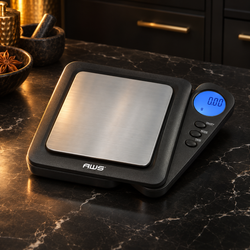
A bowl comes out of the refrigerator, a component has just been cleaned with warm water, or a container is still warm from a preparation step. You place it on a digital scale, wait for a number, and notice the reading changing. The instrument may be working normally while the object creates difficult weighing conditions.
The practical question for this guide is: Should hot or cold objects reach room temperature before you weigh them? For many ordinary precision-weighing tasks, bringing the object and container close to the weighing environment helps improve consistency. The exact preparation must also suit the sample, the task, and the instrument’s instructions.
Temperature differences can influence the air around an object, the instrument, and the object’s actual mass through evaporation or condensation. This guide explains those effects, how to investigate them, and how American Weigh Scales users can build a clear method without assuming that every drifting reading requires calibration.
Define the quantity before choosing the temperature
Start by deciding what you need to know. The mass of an object after cooling is not necessarily the same measurement question as its mass immediately after a heating process. An open sample may change while you wait.
For a stable solid component, reaching conditions close to the weighing room may be a straightforward preparation step. For a material that evaporates, absorbs moisture, or changes during cooling, preparation becomes part of the measurement definition.
Write down whether the container, lid, surface moisture, and other accessories belong in the measured system. A wet exterior or a lid added between measurements can produce a genuine difference unrelated to the quantity you intended to compare.
Avoid applying “always wait until room temperature” as a universal rule for every process. Instead, use a suitable documented preparation method and make its timing and conditions explicit. Ordinary consumer scales should not be assumed suitable for specialized hot-sample measurements.
Understand how a temperature difference affects the reading
A scale responds to the supported load within a physical environment. When an object is warmer or colder than the surrounding air, it can create local air movement and thermal conditions that complicate the indication.
Mettler Toledo’s AT balance operating instructions describe how samples or containers at a different temperature can produce disturbing air currents and buoyancy effects. The manual also identifies changes in surface moisture as a possible source of weight change.
These principles explain why a warm container may behave differently from a room-temperature reference. They do not establish a numerical correction for your scale, container, or sample. The magnitude and behavior depend on the particular setup.
Do not assume a fixed direction for every observed change. Several influences may act together, including actual material loss or gain. A display trend alone does not identify the mechanism or tell you exactly how far the result is from the intended quantity.
Separate sample temperature from room temperature
The instrument’s surroundings and the object being weighed are related but distinct. A stable room does not guarantee that a sample taken from a refrigerator or heated area has reached suitable conditions.
Likewise, an object near room temperature does not eliminate the effect of a changing room. Sunlight, heating outlets, air conditioning, and nearby appliances may affect the instrument and weighing conditions during the session.
Shimadzu’s temperature-related balance FAQ discusses how surrounding temperature changes can contribute to gradually changing indications. That is a separate question from what happens around a locally hot or cold object.
Record both sources when troubleshooting. Note recent relocation, direct airflow, appliance use, and the sample’s preparation history. Improving only one condition may leave the other unresolved, which can make an otherwise reasonable intervention appear ineffective.
Check the model instructions before loading a warm object
Review the operating requirements for your instrument through the AWScales product manuals. Confirm its intended use, preparation requirements, capacity, and any restrictions relevant to the platform or accessories.
Do not treat a room-temperature operating specification as permission to place a much hotter object directly on the weighing surface. Ambient conditions and direct sample contact are different exposures.
Avoid using the platform as a cooling rack. Heat transfer, spills, condensation, and unsuitable containers can create problems beyond a difficult reading. Use an appropriate preparation area and handling method before loading the scale.
If the documentation does not establish suitability for the intended temperature conditions, seek model-specific guidance. A protective mat or improvised spacer should not be assumed to make the operation acceptable; it can change stability, load distribution, clearance, and the total supported mass.
Inspect the container as carefully as the contents
A sample may have cooled while its thick container remains warm. Conversely, a cold vessel may continue collecting moisture after its contents begin warming. The complete loaded assembly matters.
Consider the container’s material, size, shape, and contact with the platform. Large surfaces can interact with the surrounding air differently from a compact reference weight. A wide bowl also has more opportunity to touch nearby objects.
Make sure the container is stable and that its lid or handle does not contact a wall, shield, or countertop. Include every supported component in the capacity calculation, even when the displayed net value is small.
Use the AWScales product FAQ for general operating questions, then follow the exact model’s instructions. If the problem occurs only with one container, investigate that arrangement before blaming the scale’s electronics or calibration.
Recognize condensation as a real addition of mass
A cold object exposed to moist air can acquire water on its surface. That water becomes part of the supported load. The scale may therefore show a genuine mass increase while other temperature-related influences are also present.
Visible droplets make the problem easier to recognize, but the absence of obvious moisture does not establish that surface conditions are unchanged. Keep the object’s exposure history and environmental conditions in mind.
Wiping the object introduces another intervention. It can remove water, transfer residue, warm the surface, or disturb the contents. If wiping belongs in the procedure, define how and when it is done rather than improvising between readings.
Do not repeatedly wipe and reweigh until a familiar number appears. Decide what condition the measurement is meant to represent. A dry exterior and an exterior with condensed water are different states, and the record should distinguish them.
Account for evaporation during cooling
Warm, open materials can lose mass while cooling. Water and other volatile components may leave the sample, so a later measurement can legitimately differ from an earlier one.
Shimadzu’s sample measurement precautions identify evaporation and moisture absorption among sample-related influences. These changes are not necessarily failures of the measuring instrument.
A cover may reduce exposure in some applications, but its suitability depends on the material and procedure. Include the cover consistently if it belongs in the measured system. Follow the material’s handling requirements rather than sealing an unfamiliar heated sample for the sake of a weighing result.
Record whether the sample was open or covered, the preparation sequence, and the interval before measurement. Consistent timing can make comparisons more interpretable, but it does not automatically eliminate changing mass or demonstrate thermal equilibrium.
Do not confuse instrument warm-up with sample acclimation
Instrument warm-up allows the scale to reach the operating condition described by its manufacturer. Sample acclimation concerns the object, container, and references reaching appropriate conditions for the measurement.
Completing one does not necessarily complete the other. A scale may have been operating for hours when a cold object arrives. A room-temperature object may be placed on an instrument that has just moved from a different environment.
Use the exact model instructions for instrument preparation. There is no single warm-up interval that applies to every digital scale, and a time quoted for another manufacturer’s analytical balance should not be transferred to your pocket scale.
For sample preparation, consider the complete object and task. A thick container and a small metal part can change temperature at different rates. A fixed wait that worked for one object may provide insufficient evidence for another.
Establish a practical preparation method
Choose a suitable location where the object can approach the weighing environment without contaminating it or changing the required measurement state unnecessarily. Keep it away from drafts, sunlight, and active heat sources.
Specify the container, cover condition, handling tools, sequence, and timing. If temperature confirmation is necessary for the task, use an appropriate method that does not interfere with the sample or damage the instrument.
Do not rely only on touching an object to decide that it is ready. Touch can transfer heat or contamination, and a surface impression does not fully describe the object’s thermal condition.
Keep the procedure proportionate to the required decision. An informal craft measurement and a demanding laboratory comparison need different evidence. The preparation should support the actual requirement without adding a false claim of certainty or a universal waiting rule.
Treat reference weights as temperature-sensitive objects too
A reference taken from a different room or handled extensively can create its own thermal mismatch. Comparing a prepared sample with an inadequately prepared reference does not provide a clean check.
Shimadzu’s weight handling precautions explain why temperature differences between weight storage and the weighing location matter. Follow the reference’s own preparation and handling instructions.
Use suitable handling tools where required and avoid unnecessary contact. Keep reference identification and condition clear. Contamination, damage, and mixed-up weights can complicate an investigation that initially appears temperature-related.
The NIST mass standards calibration program describes establishing reference mass values with associated uncertainty. A characterized reference remains useful only when its use and condition are appropriate to the check; its documentation does not remove environmental influences.
Compare a stable reference with the actual sample
A stable, suitably prepared reference can help distinguish instrument behavior from sample-specific behavior. Check it using the same support, unit, placement, and waiting method intended for the sample where practical.
If the reference is consistent while a warm sample drifts, investigate sample temperature, evaporation, container effects, and handling. That pattern supports a focused investigation but does not prove one particular cause.
If both the reference and sample change, review the instrument’s preparation, surrounding conditions, power, and platform clearance. More than one issue may be present, so avoid treating a single observation as a complete diagnosis.
Keep the readings in time order. Record whether the reference was checked before or after the sample and whether the instrument was allowed to recover as required. A hot object can alter the local conditions, so the sequence matters.
Understand why a stable display is incomplete evidence
A stability indicator usually reflects the instrument’s own criteria for the displayed signal. It does not independently verify that the sample has reached the desired temperature or stopped changing mass.
A reading can appear steady for a short interval while the object remains unsuitable for a precise comparison. Conversely, a changing indication may reflect genuine evaporation rather than an inability of the scale to settle.
Use stability information as one part of the method. Combine it with preparation requirements, suitable checks, and a defined measurement sequence. Do not replace a required cooling or conditioning step with a quick glance at the indicator.
Repeatedly pressing tare can conceal the visible trend without resolving its cause. Preserve the observations and investigate the change. Zeroing a changing condition does not establish that the next net reading represents the quantity you intended to measure.
Keep tare consistent through temperature changes
Taring a warm container establishes a reference at that moment. As the container cools, collects moisture, dries, or affects surrounding air differently, the measurement conditions may change.
A stored tare determined earlier is not automatically appropriate for a later container state. A dry room-temperature vessel and the same vessel with exterior condensation do not contribute the same supported mass.
Choose a sequence that keeps the relevant tare and gross conditions comparable. If the procedure requires separately determined tare, document how the empty container is prepared and how that condition relates to the loaded measurement.
Maintain clean, unobstructed weighing surfaces using the AWScales maintenance guidance and model instructions. Prevent moisture from reaching the instrument, and do not improvise cleaning or drying methods that could damage accessible components.
Use a troubleshooting record with enough context
A useful record connects the reading with the preparation conditions. “Scale drifted” leaves out most of the information needed to understand what happened.
|
Record area |
Details to preserve |
|---|---|
|
Instrument |
Model, unit, power arrangement, preparation |
|
Sample |
Identity, recent heating or cooling, exposure history |
|
Container |
Material, lid condition, exterior moisture |
|
Environment |
Location, airflow, sunlight, changing room conditions |
|
Sequence |
Preparation, waiting, tare, loading, reading times |
|
Checks |
Reference identity and individual observations |
|
Interventions |
Wiping, covering, relocation, setting changes |
|
Decision |
Result, limitations, next action |
Keep both satisfactory and unsatisfactory observations. If a later prepared measurement becomes consistent, the earlier record helps explain why the method changed.
Use the AWScales knowledge center for supporting operating information. Keep the sample preparation record alongside instrument checks so that future users can repeat the complete process rather than only the button sequence.
Example: a cold jar gains weight on the counter
Imagine a closed jar removed from refrigerated storage. Its first readings differ from those taken later, and moisture appears on the outside. The operator assumes the scale is drifting because the jar remains closed.
Closure does not prevent water from collecting on the exterior. The jar’s complete supported mass can change even when its contents remain contained. Temperature-related air effects may complicate the early indications as well.
A better investigation records exposure time, moisture, preparation, and a suitably prepared control. It also defines whether the desired result includes exterior water or refers to a consistently prepared dry container.
The solution depends on that definition. Waiting, drying, or changing the preparation may be appropriate under a suitable procedure. Arbitrarily choosing the lowest or most familiar reading does not establish which measurement represents the intended quantity.
Example: warm contents give a downward trend
Consider a warm open bowl whose indication decreases over several minutes. The operator repeatedly tares the scale and concludes that calibration is failing because the display will not stay fixed.
A prepared reference behaves consistently when checked appropriately. That observation directs attention toward the bowl, contents, and temperature conditions. Actual evaporation may be one contributor, alongside local air movement and other influences.
The next step is to define the required sample state and use a suitable preparation method. It is not to adjust the instrument against a changing bowl or to average an arbitrary set of drifting readings.
If you are selecting portable equipment for the prepared measurement, compare the AWScales pocket scale options with the actual load, platform arrangement, and required discrimination. Selection does not remove the need for appropriate sample conditions.
Know when to seek model-specific help
Persistent problems after suitable preparation deserve a broader review. Confirm the unit, power source, platform clearance, support, reference condition, and relevant settings before attributing every issue to temperature.
Use AWScales customer support when instructions are unclear or controlled checks remain unsuitable. Provide the model, sample and container details, preparation history, reading sequence, reference observations, and any visible moisture or damage.
Do not attempt to correct a temperature-related effect with an invented calibration factor. The influences may change over time, and an adjustment made under unsuitable conditions can affect later ordinary measurements.
Keep the conclusion specific. You may establish that the original method is unsuitable without identifying every physical contribution. That finding still supports a useful decision to change preparation, obtain appropriate equipment, or seek further evaluation.
Report uncertainty without inventing a correction
A precise-looking number does not establish that temperature effects are negligible. If the decision depends on a small difference, evaluate whether the preparation and measurement method provide enough evidence to support it.
NIST guidance on combined standard uncertainty describes combining relevant contributions through a measurement model. It does not supply a universal temperature correction for consumer scales.
When the necessary influence cannot be evaluated adequately, state the limitation and improve the conditions. Do not attach extra decimal places or an arbitrary plus-or-minus value to make a difficult result appear more certain.
Frequently asked questions about hot and cold objects
How long should I wait before weighing?
There is no universal interval. Follow the instrument and reference instructions, and use sample preparation suitable for the task. Size, material, container, temperature difference, and exposure conditions all matter.
Does a cold object always read heavier?
No universal direction should be assumed. Condensation can add actual mass, while other temperature-related influences can affect the indication. Investigate the complete situation rather than applying a fixed correction.
Can I put a hot container on a mat on the scale?
Only use arrangements supported by the instrument and accessory instructions. An improvised mat does not establish thermal suitability and may introduce instability, clearance problems, or additional load.
Will calibrating fix the changing reading?
Not necessarily. Calibration or adjustment does not stop evaporation, remove condensation, or eliminate a sample temperature mismatch. Verify the method and follow the documented procedure when adjustment is justified.
Is room temperature enough to guarantee accuracy?
No. It addresses one influence. Instrument performance, references, support, placement, tare, sample condition, and the complete method still need to suit the task.
Match preparation to the result you need
Define the sample state and measurement question before choosing a waiting period. Follow the model instructions and keep hot or cold objects from creating unsuitable operating conditions.
Prepare containers and references as carefully as samples. Investigate condensation, evaporation, and changing surroundings separately, using controlled checks and a clear record.
When readings remain difficult to interpret, preserve the evidence and improve the method before making an unsupported accuracy claim. A stable number is useful only when it represents the intended quantity under suitable conditions.
Careful temperature preparation helps turn a changing display into an understandable measurement process. The objective is a result supported by the complete setup, the sample’s defined condition, and the evidence collected during the comparison.