
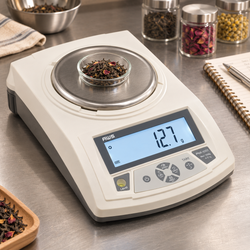
Digital Scale Accuracy Guide 371: A Practical Question Answered
A digital scale may give a convincing result for a heavier reference yet fail to show a tiny addition consistently. The display might remain at zero, jump between increments, or produce a result that changes noticeably when you repeat the measurement.
The practical question in Guide 371 is: Why can a digital scale measure heavier items correctly but struggle with tiny amounts?
Small-load weighing places different demands on the measurement process. Readability, repeatability, required accuracy, sample behavior, environment, and the instrument’s operating features all matter.
A successful check at a heavier load does not establish that every smaller quantity is suitable. Likewise, a fine display does not automatically mean the smallest visible increment is an adequate sample.
This guide explains how to distinguish limited resolution from unsuitable performance or a setup problem. Begin with the American Weigh Scales product manuals for your model’s capacity, display increments, modes, and operating instructions.
The practical answer
A heavier load produces a larger measurement signal, while the same absolute variation can represent a much larger fraction of a tiny sample.
The instrument may not display a small addition clearly, or it may display it without meeting the accuracy requirement. Environmental effects can also become more important relative to the sample.
Define the smallest net quantity and permitted measurement difference. Then assess whether the scale and procedure are suitable using adequate references and controlled conditions.
Do not infer small-load accuracy from a single heavier test weight. Check relevant performance at appropriate loads through a valid procedure.
If the required quantity is below the instrument’s suitable capability, use appropriate equipment or an approved method rather than trying to force a reading.
Readability is only the visible increment
Readability describes the smallest step shown in the active unit and range. It does not independently establish the smallest sample that can be measured adequately.
A scale displaying 0.1-gram steps cannot show every hundredth of a gram. Small additions can therefore be hidden by the available increments.
Even a finer display is not a guarantee. A result shown to 0.001 gram still needs adequate repeatability, reference agreement, and conditions for the task.
NIST’s discussion of measurement resolution explains why resolution must be considered relative to measurement needs.
Check both the actual increment and the required decision. A display that cannot distinguish a relevant change is unsuitable for that decision.
Smallest visible load and smallest suitable load differ
The display may register a tiny quantity without establishing that the result meets your required accuracy.
Minimum suitable weight concerns a performance requirement, not merely the first nonzero value. It depends on the instrument, conditions, and the criterion being applied.
METTLER TOLEDO’s precision balance guidance distinguishes the smallest net sample from the container and discusses minimum weight.
Do not assign a universal minimum by multiplying readability by an arbitrary number. A valid method may use defined calculations and conditions, but those should not be generalized without a basis.
Begin with the quantity and tolerance you need, then establish whether the instrument can support that measurement.
Relative effects grow as the sample becomes smaller
A fixed absolute difference represents a larger proportion of a smaller quantity. This helps explain why a scale can appear satisfactory for one task and inadequate for another.
For illustration, a 0.01-gram difference equals 0.1% of 10 grams, 1% of 1 gram, and 10% of 0.1 gram.
Those percentages are arithmetic examples, not the actual uncertainty of a particular scale. They demonstrate why the same absolute variation can have different practical consequences.
Do not assume a task with a tiny sample has the same tolerance as a larger-load task. Define the requirement explicitly.
A small number on the display can carry a large relative limitation even when the screen looks detailed and stable.
A heavier reference checks only part of performance
A suitable reference near a larger working load can reveal useful information at that point. It does not establish the complete response at every lower load.
The instrument may have acceptable agreement at the checked mass while repeatability or other contributions limit a much smaller measurement.
METTLER TOLEDO’s analytical balance guidance emphasizes choosing equipment suitable for the sample and required performance.
Use a defined procedure to select relevant checks and reference loads. Do not add random household objects to create an assumed exact small standard.
If your task depends on tiny net quantities, include that requirement in the verification plan rather than relying only on a convenient heavier weight.
Repeatability becomes especially important
Repeated placements of the same stable reference can reveal how much the indicated values vary under controlled conditions.
If the spread is substantial relative to the intended sample, individual results may be unsuitable even when an average looks plausible.
Remove and replace the reference as the procedure requires. Repeatedly reading one unchanged display does not assess repeated loading.
Record every valid observation. Do not discard inconvenient values without a documented reason or repeat until a favorable result appears.
Inconsistent behavior should prompt checks of support, airflow, temperature, contact, sample stability, and instrument condition before assuming a fixed adjustment is the answer.
A hypothetical repeatability comparison
Imagine two tasks performed on the same hypothetical instrument. The observed absolute spread is 0.02 gram in each screening example.
|
Task |
Approximate net quantity |
Observed spread as a fraction of quantity |
|---|---|---|
|
Larger item |
20 g |
0.1% |
|
Small item |
0.2 g |
10% |
The spread has very different significance for the two quantities. Neither row is a universal acceptance criterion.
Real assessment requires a suitable reference, valid procedure, and task-specific limits. A range of readings is also not automatically a complete uncertainty evaluation.
The example explains why “it works for heavier objects” does not answer whether it can measure your smallest sample adequately.
The container cannot make the net sample larger
A heavy bowl can provide a substantial gross load while the added contents remain tiny. Taring the bowl does not change the size of the net quantity.
Do not assume a scale performs better for a small addition simply because a large container sits underneath it.
The instrument must support the total gross load while adequately measuring the net change required by the task. Both conditions matter.
METTLER TOLEDO’s jewelry weighing guidance cautions against confusing readability with the minimum quantity that meets an accuracy requirement.
Use a suitable container and verify the actual net-weighing arrangement through an appropriate method.
Check the unit and operating mode
A small quantity may appear differently in grams, ounces, grains, or another supported unit. Read the symbol beside the number and confirm the active increment.
Changing units does not improve the underlying weighing mechanism. A converted display with more decimal places is not an automatic increase in capability.
Confirm ordinary weighing mode. Counting, percentage, or hold functions can change what the display represents.
Do not diagnose small-load performance using an unfamiliar menu state. Return to the documented mode before checking.
The AWScales product FAQ provides general operating guidance, while the model manual determines supported controls and modes.
Very slow additions near zero can complicate interpretation
Some instruments include automatic zero-related functions or filtering. Their behavior depends on the model and settings.
A very gradual addition near zero may not behave like placing a discrete reference, but you should not assume that explains every unresponsive display.
Read the manual and test only through a suitable documented procedure. Do not enter service menus or disable features by copying another model’s instructions.
If tiny additions do not register as expected, record the sequence, approximate quantity, unit, and mode for support.
Do not use a secret button combination as a substitute for determining whether the instrument is appropriate for the sample.
Do not preload the scale as an accuracy shortcut
Adding an arbitrary object and then taring may change how the display responds, but it does not prove improved net accuracy.
The preload remains physically supported and uses capacity. It can also introduce contact, movement, temperature, or handling effects.
Only use a preload arrangement when the instrument and application procedure support it and relevant performance is established.
Do not present a newly visible small reading as proof that the method now meets the requirement. Visibility and suitability remain different questions.
If the original scale cannot support the task adequately, choose suitable equipment or an approved measurement method instead of inventing a workaround.
Control airflow and vibration
A desk fan, ventilation outlet, open window, flexible table, or nearby machine can disturb sensitive measurements. The effect can be large relative to a tiny load.
Use firm support and keep hands away from the work surface. Choose a location free from avoidable disturbances.
Use a supplied draft shield according to the instructions. Do not wrap the scale in fabric or create an enclosure that touches the platform.
Compare a suitable stable reference under improved conditions while keeping the procedure unchanged.
A calmer display is encouraging, but still check agreement and repeatability against appropriate criteria before relying on the result.
Temperature and handling remain part of small-load work
A warm container, chilled sample, or recently transported instrument can create changing conditions. Follow the model’s preparation requirements.
Avoid unnecessary handling of a suitable reference, especially where tools or gloves are specified. Prepare it according to the reference and method.
Do not assume the room thermostat describes the immediate conditions around the pan. Sunlight, lamps, and nearby equipment can create local changes.
Compare sample behavior with a stable adequate reference to distinguish general instrument response from a sample-specific trend.
Keep the test controlled rather than adjusting calibration while conditions are still changing.
Sample loss matters when the quantity is tiny
Particles left on a scoop, residue on a container, spilling, moisture exchange, or evaporation can become significant relative to a small quantity.
The display cannot distinguish intended sample from material lost or gained during handling. A measurement procedure needs to account for the task.
METTLER TOLEDO’s guide to weighing the right way discusses sample characteristics and operating influences.
Do not repeatedly tare to conceal a trend. Investigate whether the sample itself remains unchanged.
If a specialized task requires controlled transfer or weighing by difference, use its valid procedure rather than improvising from a general troubleshooting article.
Choose references suitable for small-load assessment
A small nominal weight is not automatically an adequate reference. Its accepted mass, uncertainty, condition, and handling need to suit the check.
NIST’s overview of mass standard calibration explains how a mass value and associated uncertainty are established.
A coin or package is generally an uncertain substitute when investigating fine differences. Do not assign every discrepancy to the scale using an assumed object mass.
Use the specified reference for adjustment and appropriate references for verification. Those roles may require different considerations.
If you cannot choose an adequate reference confidently, request qualified guidance before making an accuracy claim.
A controlled investigation of small-load behavior
Follow any required formal method. An introductory investigation should preserve original behavior and avoid unsupported adjustment.
-
Identify the model, active unit, and readability.
-
Define the smallest net quantity and required performance.
-
Review operating limits and preparation.
-
Establish suitable support and environmental conditions.
-
Resolve warnings and confirm ordinary weighing mode.
-
Check an appropriate stable reference using a valid procedure.
-
Record repeated placements and zero return.
-
Compare relevant loads where the procedure requires them.
-
Test the actual container arrangement if appropriate.
-
Evaluate results against predefined criteria.
Do not infer a universal minimum load from this sequence alone. It organizes the investigation; it does not replace a complete performance evaluation.
What the observed pattern can tell you
|
Observation |
Useful next check |
|---|---|
|
Heavier reference repeats, tiny reference scatters |
Small-load capability, environment, method, reference suitability |
|
Tiny sample changes but stable reference does not |
Sample handling, moisture, motion, container |
|
Display stays zero with gradual additions |
Readability, mode, documented zero-related behavior |
|
Container arrangement performs worse |
Contact, gross load, tare procedure |
|
Empty platform is unstable |
General setup, power, platform condition |
|
All relevant references show a consistent difference |
Appropriate verification and adjustment guidance |
These are investigation directions, not automatic diagnoses.
Record the actual sequence and conditions. A clear pattern helps support or a qualified provider assess the next step.
Calibration cannot create unlimited small-load capability
Adjustment can address the response covered by its procedure. It does not remove every source of variation or make the instrument suitable for arbitrarily small samples.
A scale can successfully complete its adjustment routine and still fail the performance requirement for a tiny net quantity.
Do not keep recalibrating until one small reading matches an expected value. Preserve the original results and investigate the complete process.
If adjustment is appropriate, use the exact reference and sequence, then verify afterward.
A success message is evidence that the routine completed under its criteria. It is not a blanket statement about every possible load and application.
Inspect accessible condition before replacing equipment
Debris around the pan, a trapped object beneath a foot, or a container touching the case can create problems even when the nominal specifications appear suitable.
With the scale switched off, inspect accessible areas according to the manual. Remove only user-removable accessories.
Use the AWScales maintenance guidance for appropriate external care alongside the product instructions.
Do not pry up the platform, adjust the load cell, or change service parameters. Internal intervention should not be based on a general small-load symptom.
After correcting an identified issue, repeat the relevant controlled check and record the result.
Avoid unsupported averaging or repeated attempts
Averaging can be part of a valid measurement method, but it is not a universal cure for unsuitable individual readings.
A changing sample or uncontrolled drift can violate the assumptions behind a simple average. Selecting only favorable trials creates another problem.
Do not repeat measurements until the desired number appears and discard the rest. That hides the evidence needed to assess suitability.
Keep raw observations and follow the procedure’s rules for calculations and reporting. Extra calculator digits do not create additional measurement knowledge.
If the task needs a result the process cannot support, change the equipment or approved method rather than the presentation of the data.
Choose equipment from the smallest net quantity
Start with the smallest amount you need to measure and the permitted difference. Then consider the largest gross load, including container and accessories.
Review readability, repeatability, relevant performance information, platform fit, environmental needs, and verification requirements.
For portable applications, compare the AWScales pocket scale range with the actual task. Do not select solely by a high capacity or fine screen.
If specifications are unclear, ask what evidence supports suitability at your smallest quantity.
A good choice connects the complete measurement requirement with the instrument’s demonstrated capability and practical conditions.
Consider an approved alternative method where appropriate
Some tasks can use a valid procedure involving a larger quantity, counting, or another measurement approach. The method must still suit the purpose.
Do not automatically weigh multiple items and divide if individual items vary and the task requires each one’s mass. An average does not establish every individual value.
Likewise, dilution or formulation methods belong to controlled application procedures and should not be improvised for consequential tasks.
Obtain appropriate guidance when the required small quantity exceeds the available instrument’s capability.
The goal is a defensible result for the actual decision, not simply a number that the screen can display.
Keep useful records for recurring tasks
Record the model, unit, readability, smallest net quantity, gross load, environment, reference details, and results.
Include the criteria used and the action taken. Keep original observations separate from post-adjustment or post-maintenance checks.
The AWScales Knowledge Center provides additional setup and operating resources.
Review the procedure when the sample size, container, location, or required tolerance changes. A method adequate for a larger quantity may not remain adequate after the task changes.
Comparable records help identify whether a new problem reflects the instrument, conditions, or a more demanding requirement.
When to contact American Weigh Scales
Seek help if suitable references behave inconsistently under appropriate conditions, warnings persist, or the required quantity’s suitability is unclear.
Provide the model, unit, display increment, smallest net amount, heaviest gross load, required performance, references, and repeated readings.
Use the American Weigh Scales contact page for model-specific guidance.
Mention overload, impact, moisture, or recent configuration changes. Keep the main housing closed while the issue is assessed.
For formal small-load assurance, confirm the scope of evaluation and documentation required with an appropriate qualified provider.
Frequently asked questions
Why does my scale register a large item but not a tiny one?
The small addition may be below the visible increment or suitable measurement capability. Check units, mode, setup, and the model’s documented behavior.
Does 0.001-gram readability mean I can accurately weigh 0.001 gram?
Not automatically. Readability is one specification. Suitability depends on actual performance and the required accuracy.
Will a heavy tared bowl improve tiny-sample accuracy?
Do not assume so. The net quantity remains small, while the bowl uses gross capacity and can introduce other effects.
Can calibration fix every small-load problem?
No. Adjustment does not eliminate environmental disturbances, poor repeatability, sample changes, or an unsuitable instrument.
Should I average many unstable readings?
Only use averaging within a valid method. Investigate instability and sample changes rather than hiding them in a calculated result.
What is the practical answer to Guide 371?
Check the smallest net quantity against the complete measurement capability. Passing a heavier reference check does not establish suitability for tiny amounts.
Match the instrument to the small quantity
Small-load weighing needs more than a responsive display. The reference, conditions, sample handling, repeatability, and required performance all contribute.
Define the task before selecting or adjusting the scale. Then use adequate evidence to decide whether the result is suitable, or whether a different instrument or approved method is needed.