
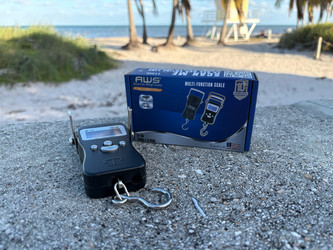
You weigh a suitcase with a handheld luggage scale, then check it on another instrument. The numbers differ. A second lift produces yet another reading, making it difficult to decide whether the bag, technique, or scale is responsible.
The practical question is: Why can a handheld luggage scale disagree with another scale, and how should you compare the results?
A hanging measurement depends on correct attachment, complete clearance, lifting motion, normal operating mode, units, baseline, and the instrument's documented behavior. The other scale has its own conditions and limitations. Disagreement alone does not identify which result is closer to the intended value.
Start with your exact model's instructions in the AWS product manuals. Use the intended strap or hook arrangement and stay within capacity. Do not apply a lifting sequence from a different design merely because both instruments are sold as luggage scales.
Confirm what each number represents
Before comparing, identify the unit and the quantity included. The complete suitcase may include straps, tags, covers, locks, or other accessories in one measurement but not the other.
A retained hold value can also describe an earlier lift rather than the current load. Confirm the active display before recording.
Write the unit beside every observation. A comparison is meaningful only when both numbers describe the same intended bag configuration. Correct interpretation should precede adjustment, replacement, or a conclusion that another instrument is wrong.
A hanging scale measures through its attachment
The bag's load must pass through the intended strap, hook, and handle arrangement. Other support changes the force experienced by the scale.
A wheel touching the floor, a bag resting against a leg, or a second hand carrying part of the load can reduce the intended suspended load.
Inspect the complete arrangement. Follow the model's connection instructions and verify that the bag is fully clear when the reading is recorded. A stable display does not establish that the load is supported only through the intended path.
Smooth lifting matters
A moving load introduces forces associated with motion in addition to the intended steady weight relationship. Jerking, bouncing, or abruptly stopping can complicate the indication.
Salter's luggage scale instructions illustrate a model-specific method involving a gentle lift and a stable-reading alert. Use your own scale's manual for the actual sequence and indicators.
Do not deliberately create a sharp pull to test the response. The goal is a normal controlled measurement rather than a peak caused by acceleration. Keep handling within what can be performed comfortably and securely.
The bag must clear every supporting surface
A suitcase can appear lifted while one wheel, corner, or loose strap still touches the floor. A bulky bag can also lean against furniture.
That contact changes the arrangement and can vary between lifts. A difference need not come from the scale's internal performance.
Check clearance without placing yourself or others under the suspended load. Do not lift higher than the approved method requires merely to create a dramatic test. A suitable measurement should be controlled and practical rather than an endurance exercise.
Avoid supporting the bag with another hand
A hand used to steady the bag can unintentionally carry part of its load. Even light contact can matter when comparing small differences.
Use the instrument as its manual directs. If the load cannot be handled comfortably and securely through the intended method, choose an appropriate alternative.
Do not improvise a two-person arrangement that changes which forces pass through the scale. A larger platform scale or other suitable equipment may be more appropriate for a heavy or awkward bag. The measurement method must fit the user's handling capability as well as the instrument's capacity.
Swinging changes the conditions during the reading
A suspended bag can oscillate, rotate, or move as contents settle. The scale's response can change during that motion.
Keep the setup as steady as the approved method requires and allow its documented measurement sequence to complete. Do not select a moment simply because it displays the preferred number.
If repeated lifts remain difficult to control, document the limitation rather than treating each value as an equivalent static observation. A method that produces inconsistent motion may need different handling or more suitable equipment.
Hold functions are model-specific
Some luggage scales retain a result so it can be read after lowering the bag. That value is not necessarily a continuous live indication.
Salter's luggage scale product guidance describes a hold feature on its model. Other designs can use different triggers, symbols, or clearing procedures.
Read your manual to determine when the value is captured and how a new measurement begins. Do not assume that a number remaining on the screen after unloading is a current zero-return result or evidence that the instrument is stuck.
A held value needs its proper context
A hold result may be captured according to the model's stability or application logic. Its usefulness depends on correct attachment, lifting, and clearance.
An incorrect arrangement can still produce a retained number. The hold function does not independently inspect the bag or identify external support.
Record whether the observation was live or held. If another lift is required, reset or restart through the documented method. Reusing an old captured result can make two trials appear to agree without actually providing a second measurement.
Check pounds and kilograms explicitly
A unit change can produce a large apparent disagreement. A number in kilograms must not be compared directly with one in pounds.
Confirm the full unit label on both instruments, including after restart or automatic shutdown. Do not infer the unit from a familiar-looking value.
Use reliable conversion and appropriate rounding if a common unit is needed. Preserve the original observations. Converted calculator digits do not create more measurement precision than the instruments provided, and repeated rounding can introduce additional numerical differences.
Display increments affect comparison
A luggage scale may display a different step from a platform or bench scale. Two results can therefore appear different partly because of rounding.
Readability is not a complete accuracy guarantee. A smaller increment does not automatically identify the more reliable instrument.
NIST's measurement terminology guidance distinguishes accuracy, precision, repeatability, and uncertainty. Compare those concepts carefully rather than deciding by decimal-place count alone. The task's required tolerance determines what capability is needed.
Establish the prescribed unloaded baseline
A strap, hook, or other intended component can be part of the normal arrangement. Follow the manual for what should be attached and supported at startup.
Do not start with the suitcase already loading the scale unless the model explicitly prescribes that method. Startup behavior and permitted initial loads vary.
The AWS product FAQ explains common operating concepts. Use the exact model's sequence so an initial reference issue is not mistaken for incorrect sensitivity or a failure to register the bag.
Tare should not hide an uncertain arrangement
If the instrument provides tare, use it only as directed for the intended task. Repeatedly zeroing under an unknown partial load can make the subsequent result difficult to interpret.
A negative indication after removal may reflect a stored baseline rather than physical damage. Identify what the display represents before troubleshooting accuracy.
Do not use tare to compensate for a bag touching the floor or being held partly by hand. The external support can change during lifting, so it is not a reliable fixed subtraction.
Capacity includes the complete suspended arrangement
Include the bag and any supported components when checking the instrument's load limit. Do not assume that a modest-looking suitcase is within capacity.
Impact or a sudden pull can also differ from a normal steady load. Rated capacity should not be interpreted as permission for arbitrary jerking or sideways force.
Do not test overload by adding contents until a warning appears. Use the documented limits and normal method. If the intended bag is too heavy or awkward for the arrangement, select suitable alternative equipment.
Power warnings should be resolved before comparison
A low-battery symbol, intermittent shutdown, or unreadable display deserves attention to the specified supply.
Use the approved battery type and installation method. Record the change and repeat the same normal sequence while keeping other conditions consistent.
A disagreement alone does not prove a battery problem. Avoid changing units, adjustment, attachment, and batteries simultaneously, because the outcome becomes difficult to interpret. Damaged contacts or persistent failure can require manufacturer advice rather than another lift.
The bag can change between measurements
A bottle may be removed, a jacket added, or a pocket emptied. Tags, covers, and packing accessories can also differ.
Even when changes seem minor, they prevent a strict comparison of the same load. A wet bag can change condition, and loose contents can affect handling.
Define the bag configuration and preserve it through the comparison. Record any change rather than assuming the same suitcase means the same measured quantity. The instrument cannot distinguish intended contents from incidental accessories.
The comparison scale has its own requirements
A platform scale needs suitable support, clearance, baseline, units, and preparation. A bag resting partly outside its platform can create another source of disagreement.
Do not assume the other instrument is correct solely because it is larger or stationary. Its current performance needs appropriate evidence too.
Keep the bag fully supported by the intended weighing surface without contact elsewhere. If it does not fit, choose a more suitable comparison method. An awkward platform measurement is not an independent truth standard.
A suitable reference provides stronger evidence
An adequately known reference can help assess indication agreement through a safe method appropriate to the instrument. Its value, condition, and uncertainty should support the decision.
The NIST mass standards program describes formal mass calibration. An unknown packed suitcase can reveal disagreement but cannot identify which instrument is accurate.
Do not suspend improvised heavy weight combinations or fragile objects to create a reference. Ask the manufacturer or a qualified provider for an appropriate verification method when suitable handling and reference equipment are unavailable.
Repeated lifts assess a particular workflow
Repeated observations can reveal whether the normal attachment and lifting sequence is consistent. They do not automatically establish agreement with a known value.
Preserve all planned trials. Do not keep only the lowest reading or repeat until a preferred result appears.
If the bag swings or touches another surface during a trial, document the event and handle it according to the chosen method. Do not silently discard inconvenient observations while presenting the remaining values as a complete consistency check.
Use a controlled comparison sequence
Follow the exact manual and any applicable procedure first. For ordinary suitable use, this framework organizes the comparison:
-
Identify the instruments and intended quantity.
-
Confirm capacity, units, power, and normal operating modes.
-
Keep the bag configuration unchanged.
-
Inspect the approved attachment and accessible condition.
-
Establish the prescribed unloaded baseline.
-
Lift through the documented method with complete clearance.
-
Record the appropriate live or held result.
-
Lower the bag in a controlled way and reset as instructed.
-
Repeat planned observations without selecting preferred values.
-
Compare with another suitable prepared method and preserve the sequence.
This framework is not a formal calibration or permission to lift an uncomfortable load. Choose a safer suitable alternative when the arrangement cannot be controlled.
Record an ordered worksheet
A useful record separates the displayed observations from calculated conversions. The following hypothetical example does not establish an AWS tolerance.
|
Trial |
Handheld observation |
Prepared comparison scale |
|---|---|---|
|
1 |
18.6 kg |
18.8 kg |
|
2 |
18.7 kg |
18.8 kg |
|
3 |
18.6 kg |
18.9 kg |
The table shows the observed pattern, not which instrument is correct. Reference information, conditions, rounding, and method still matter.
Keep notes on contact, motion, hold behavior, and bag configuration. Those details can explain more than a final average alone.
Do not average instruments automatically
The midpoint between two disagreeing scales is not guaranteed to be closer to the intended value. Both can share an error, or one can have a setup problem.
NIST's discussion of combining evaluations of the same measurand emphasizes results with associated uncertainty and addresses compatibility.
A formal combination needs an appropriate basis. For routine ownership, investigate the disagreement and use suitable verification rather than treating a numerical compromise as a correction.
A single fixed offset may not apply everywhere
A difference observed with one bag and load does not establish a universal correction for every future suitcase.
Instrument behavior, motion, attachment, range, and rounding can vary. Subtracting the same remembered amount from every reading can create new errors.
Do not adjust a scale to imitate another unverified instrument. Use only the manufacturer's approved procedure and reference. If a consistent concern remains, preserve the evidence and ask which verification or service step is appropriate.
Near-limit decisions need context
A reading close to a required boundary does not establish certainty merely because it is displayed as a neat number.
NIST's metrological traceability guidance explains that traceability alone does not establish fitness for purpose. The method and uncertainty must suit the measurement need.
Use the actual applicable requirement and avoid assuming an unofficial allowable difference. This article does not establish a baggage policy or guarantee acceptance by another operator. The measurement question and the governing requirement are related but distinct.
Inspect the strap, hook, and housing
Wear, damaged attachments, loose parts, and contamination can affect normal use. An attachment problem also changes the practical suitability of the lifting arrangement.
Follow AWS maintenance guidance and the exact model's instructions. Do not repair a strap or hook with improvised knots, tape, or unapproved components.
If damage is present, seek the appropriate replacement or service advice. Do not conduct another loaded lift merely to see whether a questionable attachment holds. A clear accessible inspection belongs before the measurement.
Choose equipment around the real task
Review AWS luggage scales with the actual bag range, handling method, capacity, readability, and documented features in mind.
A compact handheld instrument can be convenient for suitable loads, but it is not automatically the best arrangement for every heavy or bulky item.
If controlled lifting is impractical, consider an appropriate platform method or other suitable equipment. Select around the complete workflow rather than expecting a hold feature or fine display alone to overcome an awkward handling problem.
Keep the method clear for repeated use
Document normal units, attachment, startup condition, lifting sequence, hold interpretation, and recording method.
The AWS Knowledge Center provides related weighing information. Connect that guidance with the exact model rather than relying on memory from a different instrument.
Review the method when the scale, attachment, bag type, or required tolerance changes. Earlier observations may not support the revised arrangement. Consistent instructions make later disagreements easier to investigate.
Ask support with the full sequence
Contact American Weigh Scales support when documented operation does not explain the behavior or suitable controlled checks remain questionable.
Provide the model, units, load range, attachment, lifting observations, hold behavior, comparison method, and any impact or damage history.
Ask for the approved verification, adjustment, or service route. Do not open the housing or create a correction from one pairwise comparison. Specific evidence supports a better assessment than assuming every difference belongs to the handheld instrument.
Preserve the comparison when the arrangement changes
If you change the attachment, replace batteries, move to another comparison scale, or repack the bag, identify the new configuration in the record. Do not combine observations from those states as though the only difference was random variation.
A clear record should say which load was measured, which unit was displayed, whether the result was held, and how the bag was supported. Include any known contact or interrupted lift rather than relying on a final average to summarize everything.
For a shared household instrument, keep the manual and a short operating reminder accessible. Another user may change units or interpret a held number differently without realizing it. Consistent operation makes later comparisons more useful and reduces avoidable disagreement.
When a concern is resolved through a corrected setup, preserve the earlier observations and the correction. This supports a practical conclusion about what changed without claiming that the scale was universally inaccurate beforehand or permanently verified afterward.
Review the method if the load range or intended decision changes. A successful comparison for one comfortably handled suitcase does not establish suitability for every larger, heavier, or differently shaped item that might be attached later.
Frequently asked questions
Why does the reading change each time I lift?
Motion, contact, baseline, rounding, and instrument variability can contribute. Use the documented sequence and preserve the observations.
Is the lowest reading the correct one?
No. Selecting the lowest value is not a valid accuracy assessment. Investigate the full pattern.
Does hold mean the bag was weighed correctly?
It means what the model's capture function defines. Incorrect attachment or external support can still produce a held value.
Can I use a bathroom scale as the reference?
Its suitability depends on the method, load, platform, and performance. Familiarity alone does not make it an adequate standard.
Should I subtract the difference seen on another scale?
Not as a universal correction. One comparison does not characterize every future load or condition.
What if the bag is too awkward to lift steadily?
Use appropriate alternative equipment rather than forcing an uncontrolled measurement. Instrument capacity does not establish comfortable handling.
Compare the complete methods rather than the screens alone
A luggage-scale result depends on the instrument, attachment, motion, clearance, baseline, and bag configuration. The other scale has its own requirements.
Use controlled observations and suitable reference evidence to investigate disagreement. That provides a stronger basis for reliable weighing than choosing the most favorable number or assuming one instrument must be correct by default.