
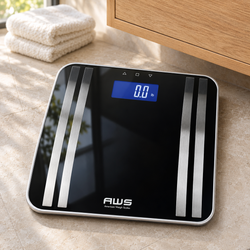
You wipe down a digital scale, replace its tray, and return to weighing. The next reading differs from an earlier observation. Perhaps the number drifts, the platform seems less steady, or a familiar reference no longer agrees. Cleaning was supposed to help, so the change is frustrating.
The practical question is: Why can digital scale readings change after cleaning?
Cleaning can remove material that previously affected the load or platform movement. It can also change support, assembly, temperature, moisture, power, or the operating baseline. Incorrect cleaning may introduce damage or liquid entry. The changed reading therefore needs a controlled investigation rather than an immediate assumption that calibration was erased.
Start with the exact model's cleaning and operating directions in the AWS product manuals. Procedures for a removable laboratory pan do not automatically apply to a compact scale with a fixed platform.
Cleaning changes the physical setup
Even careful cleaning can involve moving the instrument, removing accessories, disconnecting power, and handling the platform. Those actions change several conditions at once.
A difference afterward may therefore relate to relocation or reassembly rather than the cleaning agent itself. Keep the sequence clear when describing the concern.
Record what was cleaned, what was removed, whether liquid was used, and where the scale was placed afterward. This history provides a useful starting point. Without it, repeated adjustment can obscure which change affected the result.
Removed residue may explain a different baseline
Dust, crumbs, dried liquid, or other residue can contribute mass or interfere with normal movement. Removing it changes the arrangement that existed before cleaning.
The earlier reading is not automatically the correct reference merely because it was familiar. A cleaner setup may behave more appropriately than the contaminated one.
Do not adjust the instrument to reproduce a remembered number without an adequate reference. Establish the proper unloaded baseline and verify with a suitable check. The purpose is reliable current performance, not restoration of an unexplained historical display.
Sticky material can interfere beyond its mass
A sticky spill near the platform can create contact or resistance. The resulting effect may depend on loading position or movement rather than behaving like a simple added weight.
Removing the contamination may change both zero return and loaded behavior. That can explain why the difference does not match the apparent amount of residue removed.
Follow AWS maintenance guidance and the exact manual. Do not pry into clearance gaps or force the platform to free it. Persistent sticking or rubbing calls for manufacturer advice rather than increasingly aggressive cleaning.
A removable tray must return correctly
Some models have user-removable trays, pans, mats, or covers. Their placement can affect clearance and the normal loading arrangement.
After cleaning, confirm that each intended component is correctly seated and oriented. A tray resting on the housing can transfer force outside the weighing mechanism.
METTLER TOLEDO's balance cleaning recommendations emphasize correct reassembly and checking operation afterward. Apply the AWS model's actual instructions rather than copying another instrument's disassembly sequence.
Do not assume the platform is user-removable
A visible seam does not establish that a part can be lifted off safely. Pulling a fixed platform can damage the support or sensing arrangement.
Read the manual before removing parts. If the cleaning instructions do not describe removal, ask the manufacturer instead of experimenting.
This distinction matters when following online videos. A laboratory balance with a removable pan can look similar in principle to a compact instrument whose platform is attached differently. The appropriate access is determined by the design, not by how easy a part appears to lift.
Moisture can remain on accessible surfaces
A damp tray or vessel can carry water into the next measurement. Evaporation then changes the load over time, producing an apparently drifting indication.
Dry permitted components as instructed and allow the instrument to return to the required operating condition. Reassembling a visibly wet component and immediately weighing can complicate interpretation.
Do not assume an unchanged exterior means internal areas are dry or safe after a spill. If liquid may have entered the instrument, stop and seek the appropriate guidance. Ordinary drying of accessible parts does not establish that internal exposure has been resolved.
Liquid entry is different from surface cleaning
A scale may tolerate a prescribed lightly damp cloth without being designed for rinsing, spraying, or immersion. Those methods expose openings differently.
A&D's electronic balance cleaning guidance warns against allowing liquid into internal spaces and against spraying or pouring cleaning solution directly onto equipment. Its specific component directions apply only to compatible designs.
Use the method permitted for your model. If liquid entered during cleaning, disconnect or remove power as instructed and obtain manufacturer advice before further use. Do not repeatedly power the instrument to see whether it has recovered.
Cleaning agents must suit the materials
A cleaner appropriate for one surface can damage another. Displays, painted housings, seals, plastics, adhesives, and metal finishes can have different compatibility requirements.
Use only agents and methods allowed by the manufacturer. A stronger cleaner is not automatically a better solution for stubborn residue.
Do not infer chemical resistance from a stainless-looking platform or a general product description. If the manual is unclear, ask before applying a solvent. Damage to accessible materials can also affect fit, clearance, labeling, and later operation.
Force applied during wiping can matter
Pressing hard on the platform, scrubbing an edge, or pulling a tray sideways can apply forces different from normal vertical loading.
A scale's rated capacity does not imply that every sideways or lifting force is acceptable. The mechanism and attachments may have specific handling limits.
Clean gently as directed and support only intended parts. If the behavior changed after forceful handling or the platform now feels loose, report that history. Do not conduct a heavy-load experiment to assess damage; an approved check and manufacturer assessment are more appropriate.
Moving the instrument changes its support
A scale cleaned on a table may return to a different spot, soft mat, or uneven surface. Even a small particle beneath one foot can change support.
Place the unloaded instrument on a suitable firm, level surface. Confirm all intended supports sit correctly and use leveling features only as directed.
Do not press on the housing while recording a reading. That can temporarily hide rocking while adding force. Correct the support first, prepare the instrument again, and then compare results without touching the setup.
The cleaning cloth can leave debris
Fibers, paper fragments, powder, or cleaning residue can remain near the platform or beneath a removable component. A clean-looking surface may still have interference at a clearance gap.
Inspect accessible areas under adequate light without probing into the mechanism. Use the cloth or tool type permitted by the manual.
Avoid blowing debris into openings. Removing visible particles should not drive contamination deeper into the instrument. If the area cannot be cleaned through approved user access, ask about service rather than widening the opening or dismantling the housing.
Temperature can change during cleaning
Handling, a different cleaning location, or a warm or cold cleaning material can change the instrument's thermal conditions. Returning it immediately to use may produce a changing indication.
Follow the model's preparation requirements and keep it within its specified operating range. There is no universal post-cleaning waiting time for every scale.
Shimadzu's installation precautions illustrate why temperature stability, airflow, and leveling matter in balance operation. Use those principles with the actual model's instructions rather than importing another instrument's timing requirements.
Airflow and vibration may have changed too
A cleaned scale may be placed beside a fan, open window, appliance, or frequently used door. Nearby activity can differ from the earlier setup.
Watch whether display movement follows a vent cycle or vibration source. Compare in a suitable calm location while preserving the same reference and loading method.
Do not wrap or enclose the instrument in a way that touches the platform or traps heat. Correct environmental influences through an appropriate working location or approved accessory rather than introducing another uncontrolled arrangement.
Power interruption can change operating state
Cleaning often involves turning the instrument off or disconnecting an adapter. Afterward, the scale may restart with a different baseline or return to a particular unit or mode.
Confirm the display settings rather than relying on what was active before cleaning. Check battery condition and accessible connections as directed.
A reset operating state is not the same as lost calibration. Record what changed and follow the normal setup sequence. Avoid entering adjustment mode merely because the first number looks unfamiliar.
Startup must follow the prescribed load condition
Some instruments establish an initial reference during startup under their operating rules. Starting with a tray missing, a vessel present, or a hand touching the platform can produce confusing results.
Install the required components and remove unintended loads before following the model's startup procedure. Do not assume every instrument accepts the same initial condition.
The AWS product FAQ helps explain common baseline behavior. Use it with the exact manual so a changed startup sequence is not misinterpreted as a mechanical fault.
Tare may no longer describe the arrangement
If a vessel or accessory was cleaned, dried, replaced, or removed, an earlier stored tare may no longer represent the current setup.
Establish the appropriate baseline according to the model and method. Do not continue with an old net reference while changing the physical vessel.
A negative indication after removal can also be normal stored tare behavior. Identify what the display represents before troubleshooting accuracy. A minus sign alone does not establish damage, and a zero after pressing a button does not establish correct loaded performance.
Zero is only one observation
A scale returning to zero can still have unacceptable loaded behavior. Conversely, an expected negative indication from stored tare need not indicate poor performance.
Evaluate the relevant task rather than judging the instrument only by its unloaded screen. Confirm normal mode, units, and reference sequence.
METTLER TOLEDO's routine testing guidance identifies sensitivity, repeatability, and eccentricity as separate considerations. Select appropriate checks instead of treating a reassuring zero as a complete assessment.
Use an adequate reference after preparation
A suitable reference provides stronger evidence than a familiar object with uncertain mass. Its value, condition, and uncertainty should support the required decision.
The NIST mass standards program describes formal mass calibration. An ordinary object may help notice a change in behavior, but it does not establish indication error if its actual mass is unknown.
Keep the reference clean and handle it appropriately. Do not contaminate it while checking a recently cleaned scale. Reference care and instrument care are related responsibilities, but their procedures can differ.
A before-and-after comparison needs comparable conditions
An earlier reading taken with one vessel, location, or unit cannot be compared directly with a different arrangement without accounting for those changes.
If you have a documented pre-cleaning check, preserve its details. Repeat the relevant approved method after correct preparation and reassembly.
Do not assume cleaning alone caused every observed difference. The comparison may include relocation, power changes, different loading position, or a changing sample. Identify what stayed constant and what changed before deciding whether the instrument needs adjustment or service.
Follow a controlled return-to-use sequence
Use any required procedure first. For ordinary troubleshooting, the following framework organizes the main checks:
-
Review the exact model's cleaning and reassembly instructions.
-
Confirm only permitted user-removable parts were handled.
-
Inspect accessible surfaces for residue, moisture, and damage.
-
Reassemble correctly without forcing components.
-
Place the instrument on suitable stable support.
-
Restore the approved power supply and normal operating state.
-
Complete the required preparation and baseline procedure.
-
Apply a suitable reference centrally within capacity.
-
Record the settled result and unloaded return.
-
Repeat relevant checks as needed under the approved method.
This framework is not a substitute for service after suspected liquid entry or damage. Those events require the appropriate manufacturer guidance.
Record the pattern rather than one number
The useful evidence includes whether results are consistently shifted, randomly scattered, slowly drifting, or position-dependent.
|
Observation after cleaning |
Useful next investigation |
|---|---|
|
Tray rubs or sits unevenly |
Correct approved assembly or seek service |
|
Reading changes while accessible moisture evaporates |
Complete permitted drying and preparation |
|
Display unit or mode differs |
Restore the intended operating state |
|
Suitable reference remains inconsistent |
Review conditions and approved verification |
|
Liquid entry or damage is suspected |
Obtain manufacturer advice before continued use |
These are investigation prompts rather than diagnoses. Several influences can occur together, so keep the complete record instead of assigning the symptom to one cause immediately.
Do not recalibrate before correcting interference
Adjustment cannot reliably fix a tray touching the housing, unstable support, changing moisture, or an incorrectly assembled platform.
Establish suitable conditions first. If the manual calls for adjustment after a relevant event, follow the specified procedure with the prescribed reference.
Record what was done and verify performance appropriately afterward. Do not repeat adjustment until one selected reading matches an expectation. A persistent controlled discrepancy needs assessment rather than a cycle of settings changes that conceals the original evidence.
Decide significance from the task requirement
A changed last digit may matter differently for a tiny quantity than for a large batch. Define the permitted error and smallest net amount before accepting or rejecting the result.
NIST's metrological traceability guidance explains that traceability alone does not establish fitness for purpose. The uncertainty associated with the result must also suit the measurement need.
Avoid universal rules such as accepting any difference within one display increment. Use the applicable procedure and qualified assessment where the decision requires it. Readability is not a complete accuracy specification.
Prevent contamination during routine use
A suitable vessel, controlled transfer, and clear work area can reduce the need for difficult cleanup. Keep loose material away from openings and avoid leaving spills to dry around the platform.
Choose accessories compatible with the model. A mat or cover can alter load, clearance, or cleaning access, so use it as intended.
Do not improvise a protective layer that binds the platform or traps liquid. Prevention should preserve normal movement and operation rather than create a different measurement arrangement with unknown effects.
Match cleaning frequency to use
An instrument exposed to frequent powder or sticky material may need a different care routine from one used occasionally for clean objects.
Follow the manufacturer's directions and any applicable workplace procedure. Inspect before use so contamination is addressed before it affects the measurement or spreads elsewhere.
Do not adopt an aggressive daily process simply because another balance manual recommends frequent cleaning. Frequency and method should suit the actual material, exposure, design, and required measurement control.
Choose equipment around cleaning needs
Some tasks involve repeated spills, wet vessels, or difficult residues. Equipment selection should consider those conditions as well as capacity and display increments.
When comparing AWS pocket scales, confirm the intended use, permitted cleaning method, platform fit, and operating requirements. Do not infer washability from appearance or a metal tray.
If the task requires a cleaning process the instrument does not support, select more suitable equipment or revise the workflow. A routine that repeatedly exposes an unsuitable scale to liquid is unlikely to produce dependable long-term results.
Keep the maintenance history with performance records
Record what was cleaned, the method used, removed components, unusual exposure, preparation, and reference observations. Include both successful checks and problems.
The AWS Knowledge Center provides related weighing information. Your own history should make it possible to connect a changed result with the actual maintenance sequence.
This is especially useful when several people share the instrument. A short consistent log prevents later users from assuming that an unfamiliar setup or stored baseline was part of the original verified method.
Ask support when the change remains unexplained
Contact American Weigh Scales support if approved checks remain questionable after correct reassembly and preparation, or if liquid entry, damage, or rubbing is suspected.
Provide the model, cleaning agent and method, parts handled, power state, observed symptoms, reference details, and relevant timing. Describe the sequence rather than only saying that cleaning affected accuracy.
Do not open the housing or apply additional solvents to pursue the problem. Ask which approved verification or service step follows. Clear evidence helps distinguish a correctable setup issue from an instrument requiring attention.
Frequently asked questions
Can cleaning erase calibration?
Ordinary permitted cleaning does not automatically imply that stored adjustment was erased. Reassembly, baseline, environment, and damage should be investigated before drawing that conclusion.
Should I calibrate after every wipe?
Follow the model's instructions and relevant procedure. Correct preparation and appropriate verification matter; repeated adjustment is not a substitute for a sound setup.
Can I rinse a removable tray?
Only if the manufacturer permits that method for the component. Removal alone does not establish chemical or water compatibility, and the instrument body may have different restrictions.
Why does the number drift after cleaning?
Moisture, temperature, airflow, contact, or other conditions may be changing. The pattern needs investigation rather than a diagnosis based on timing alone.
Is a zero display enough to resume use?
No. Use the verification relevant to the task and any required procedure. A correct-looking unloaded screen does not establish loaded performance.
What if liquid entered the scale?
Follow the manufacturer's power and service guidance before further use. Surface drying does not establish that internal exposure is resolved.
Restore the setup and verify the result
Cleaning supports reliable weighing when the method suits the instrument and the platform returns to its intended arrangement.
Reassemble correctly, complete the required drying and preparation, and check performance with appropriate evidence. That gives a clearer basis for returning the scale to use than assuming either the old reading or the newly cleaned appearance proves accuracy.