
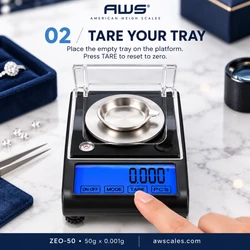
The American Weigh Scales ZEO-50 is worth considering if you regularly weigh small objects and want a generous weighing surface, useful handling accessories and a display that shows milligram increments.
Its main appeal is the combination of a modest maximum load and fine display resolution. However, understanding those specifications is essential: a scale that displays three decimal places does not automatically guarantee an error of only one milligram.
This ZEO-50 review examines the manufacturer’s published specifications and their practical implications. It is a specification-based review, rather than an independent hands-on accuracy test.
ZEO-50 Specifications at a Glance
The AWS ZEO-50 milligram scale has the following listed specifications.
| Specification | Published detail |
|---|---|
| Maximum capacity | 50g |
| Readability | 0.001g |
| Weighing units | g, oz, ozt, dwt, ct and gn |
| Platform | 2.6 × 2.6 inches |
| Display | 1.4 × 3.0 inches |
| Overall dimensions | 5.9 × 3.8 × 2.5 inches |
| Power | Four AAA batteries, included |
| Calibration weight | 50g weight, included |
| Handling accessories | Weighing tray, scoop and tweezers |
| Other features | Tare, automatic shutoff and flip-down protective shield |
| Listed operating temperature | 50°F–86°F / 10°C–30°C |
These features suggest a scale suited to an organized tabletop weighing area, particularly when handling loose objects or transferring small quantities.
What Does 50g × 0.001g Mean?
The two numbers describe different aspects of the scale.
50g is the maximum capacity. The total load on the platform must stay within that limit. A tray, container or weighing paper counts toward the load, even after you press tare.
For example, if a container weighs 12g, the remaining capacity is theoretically 38g. Leaving some headroom makes it easier to avoid accidental overload while adding material.
0.001g is the readability. In gram mode, the display shows increments of one thousandth of a gram, equivalent to one milligram. For background on mass measurement, see NIST’s guide to SI units for mass.
That display increment helps distinguish small changes in indicated weight. It does not establish the smallest sample the scale can reliably measure.
A one-milligram sample should not be assumed measurable with acceptable accuracy simply because the display includes a one-milligram digit.
How Accurate Is the ZEO-50?
The published listing establishes the scale’s capacity and readability. It does not provide enough independently verified performance data to assign a numerical accuracy rating.
Three concepts matter when evaluating any precision scale:
| Concept | What it tells you |
|---|---|
| Readability | The smallest displayed increment |
| Repeatability | How closely repeated measurements of the same object agree |
| Accuracy | How closely a measurement agrees with an appropriate reference value |
A display can show fine increments while readings still vary. Likewise, a scale can repeat the same result consistently while showing an offset from the reference value.
For the ZEO-50, a meaningful accuracy assessment would require measurements using suitable reference weights, repeated trials and checks at relevant loads. This review does not claim that those tests have been performed.
Calibration Helps, but Verification Still Matters
Calibration establishes a relationship between an instrument’s indications and reference values. Some consumer-scale routines also adjust the scale’s response. NIST’s calibration overview explains the role of reference standards in measurement.
The included weight supports the manufacturer’s setup procedure. However, completing that procedure alone does not demonstrate performance across every load you plan to weigh.
Follow the instructions for your exact model through the AWS scale manuals, including the specified weight and sequence. Avoid substituting coins or other objects with assumed masses.
How to Check Repeatability
A useful practical check is to weigh the same suitable reference object several times:
-
Position the scale on a firm, level surface.
-
Follow the manual’s startup instructions.
-
Place the reference object near the platform’s center.
-
Allow the indication to settle and record it.
-
Remove the object and confirm that the display returns to zero.
-
Repeat under the same conditions.
Compare the spread of readings with your application’s tolerance. Repeated readings of an ordinary object can help reveal inconsistency, but they cannot establish absolute accuracy unless its mass is known appropriately.
Maintaining records of a reference check over time can also help identify changes in performance. NIST’s guidance on check standards describes this measurement-control approach.
Features That Matter in Everyday Use
A Platform That Gives You Room to Work
The platform offers space for positioning a lightweight dish or grouping small objects. This can make transferring and centering material more convenient.
A larger platform does not increase capacity or prove better accuracy. Containers must still fit without touching the housing or another surface, which could interfere with weighing.
Included Tools for Handling Small Objects
Tweezers can help position individual pieces, while a scoop and tray can simplify transfers. These accessories are useful when loose material is difficult to handle directly.
Choose the tool that suits the sample. For materials that cling to surfaces, inspect the tray and scoop between measurements so residue does not alter later results.
Tare for Net-Weight Measurements
Tare lets you subtract a container’s indicated weight and display the contents separately.
The important limitation is physical load: taring a container does not restore capacity. Plan around the combined mass of everything resting on the platform.
Multiple Unit Options
Different units support different workflows. Grams are useful for general measurements, while carats are common in gemstone work. Troy ounces and pennyweights may be relevant when recording precious-metal mass.
Select the unit before weighing and confirm it when recording results. Ounces and troy ounces are different units, and grains are different from grams.
For general unit conventions, the NIST SI units reference provides useful background on standardized measurement units.
Best Uses for the ZEO-50
Loose Gemstones and Small Jewelry Components
The ZEO-50 is a candidate for weighing loose stones, beads, findings and other small jewelry components when the total load fits within capacity.
The handling tools can make individual pieces easier to position. Buyers comparing workflows can also consult the digital scale buying guide for jewelry.
Mass measurement does not establish a gemstone’s identity, quality or authenticity, nor does it determine a metal’s purity.
Small Parts and Hobby Materials
The scale may suit hobby tasks involving small fasteners, lightweight components or samples. Its usefulness depends on the amount being weighed and the tolerance required.
Before relying on a result, define what variation your project allows. A task that tolerates a few hundredths of a gram differs substantially from one requiring a verified result within a milligram.
Small Ingredient Quantities
A lightweight container and small ingredient quantity may fit this scale’s working range. It is less convenient for large batches or heavy bowls.
Fine display increments can help with small additions, but tiny quantities still require validation. Do not assume that every change in the final digit represents an equally accurate change in mass.
Educational Weighing Exercises
The ZEO-50 can be considered for demonstrations involving tare, unit selection and repeated measurements.
These exercises are especially useful for showing why additional decimal places do not replace good measurement technique. Formal laboratory work may require documented uncertainty, qualification or equipment beyond this model’s published specifications.
When Another Scale Makes More Sense
The ZEO-50 is a less suitable choice when:
-
Your container and sample approach or exceed its maximum load.
-
You need a compact scale primarily for carrying in a pocket.
-
Your work requires a documented accuracy tolerance that has not been verified.
-
You need certified or approved equipment for a regulated application.
-
You intend to measure extremely small samples without establishing a suitable minimum working load.
For sales conducted by weight, investigate the applicable requirements before choosing equipment. NIST’s weighing and scales FAQs provide background on commercial weighing and device requirements. Fine readability alone does not establish legal-for-trade suitability.
How to Get More Consistent Results
Good technique makes precision weighing easier to evaluate.
Use a stable surface away from fans, open windows and vibration. Keep the platform clean and ensure the container does not touch the surrounding housing. Avoid moving or handling the scale during a measurement.
Add material gradually, allow readings to settle and record the selected unit alongside the result. If results become unstable, check the setup and battery condition before assuming that recalibration will solve the issue.
Choose Reference Weights Carefully
An appropriate reference weight should have a known value and uncertainty suitable for the task. A weight’s appearance or printed nominal mass does not establish its measurement quality.
NIST’s explanation of metrological traceability describes the documented chain of calibrations needed to relate measurement results to a reference. An included weight should not be assumed to have certified traceability unless supporting documentation establishes it.
If you need additional weights, examine the specifications of an AWS calibration weight kit and confirm its suitability for both the scale’s procedure and your verification needs.
ZEO-50 Advantages and Limitations
| Advantages | Limitations |
|---|---|
| Fine display increments for small-object weighing | Readability does not establish numerical accuracy |
| Room for positioning lightweight containers | Container mass reduces available sample capacity |
| Included handling accessories | Transfers require care to avoid residue or losses |
| Supplied calibration weight | Independent performance checks may still be needed |
| Multiple weighing units | Users must confirm the selected unit |
| Tabletop-friendly layout | Less compact than some pocket-oriented designs |
The strongest reason to choose this model is its working layout and accessory package. Buyers should avoid interpreting those conveniences as proof of superior measurement performance.
Frequently Asked Questions
Can the ZEO-50 accurately weigh 1mg?
Its display increment is 1mg, but that does not establish reliable accuracy for a 1mg sample. The smallest suitable working load depends on verified performance and the uncertainty your task allows.
Does the ZEO-50 come with a calibration weight?
Yes. The current product listing includes a weight for the specified calibration procedure. Follow the instructions supplied for your unit.
Does tare increase the capacity?
No. Tare changes the displayed net weight. The container and its contents still contribute to the physical load on the scale.
Is the ZEO-50 suitable for jewelry?
It is a candidate for small jewelry components and loose gemstones when the load and required tolerance fit its capabilities. Commercial use may introduce additional equipment requirements.
Is the ZEO-50 better than other milligram scales?
That depends on your priorities. Its platform and accessories may suit your workflow, but a claim of better accuracy would require comparative testing. Explore the AWS milligram scale range to compare capacity, layout and included equipment.
Should You Buy the ZEO-50?
The AWS ZEO-50 is worth considering for small-object weighing when you value a spacious working surface, handling tools and fine display resolution.
Choose it when your containers and samples fit comfortably within capacity and you can verify that its performance meets your tolerance. For heavier loads, ultra-small samples or work requiring documented measurement assurance, select equipment based on validated capability rather than decimal places alone.