
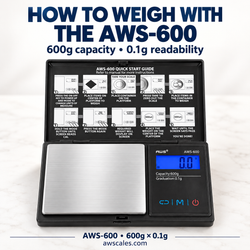
The ZEO-50 is the better candidate for small loads that benefit from fine display resolution, while the AWS-600 is the better candidate for heavier loads and convenient portability.
These American Weigh Scales models serve substantially different weighing needs. Choosing between them starts with two questions: how much will you place on the platform, and what measurement tolerance does your task require?
This comparison uses published manufacturer specifications. It does not include independent accuracy testing.
ZEO-50 vs AWS-600: Specifications Compared
The ZEO-50 precision milligram scale emphasizes fine readability and small-object handling. The AWS-600 digital pocket scale provides substantially more capacity in a slim body.
| Specification | ZEO-50 | AWS-600 |
|---|---|---|
| Maximum capacity | 50g | 600g |
| Readability in grams | 0.001g | 0.1g |
| Equivalent display increment | 1mg | 100mg |
| Listed platform dimensions | 2.6 × 2.6 inches | 1.9 × 3.3 inches |
| Overall dimensions | 5.9 × 3.8 × 2.5 inches | 5 × 3 × 0.9 inches |
| Weighing units | g, oz, ozt, dwt, ct, gn | g, oz, ozt, dwt |
| Specified calibration weight | 50g, included | 500g, not included |
| Power | Four AAA batteries, included | Two AAA batteries, included |
| Handling accessories | Tray, scoop and tweezers | No comparable kit listed |
| Protective feature | Flip-down shield | Hinged cover |
The AWS-600 has 12 times the capacity. The ZEO-50’s gram display increment is 100 times smaller.
Those ratios describe capacity and readability. They do not establish a corresponding difference in accuracy.
Capacity: Start With Your Heaviest Load
A scale’s capacity includes everything resting on its platform: the sample, container and any other weighing accessories.
A 75g collection of components already exceeds the ZEO-50’s limit. The AWS-600 offers room for that collection and a suitable lightweight container.
For a 5g sample in a 10g tray, both models have enough capacity. The decision then depends on the measurement detail you need and how you prefer to work.
Tare Does Not Restore Capacity
Pressing tare subtracts the container’s indicated weight from the display. Its physical weight remains on the scale.
For example, a 15g container leaves a theoretical 35g of sample capacity on the ZEO-50. The same container leaves 585g on the AWS-600.
Leave headroom when adding material. Planning to work at the maximum load makes accidental overload more likely.
Readability: How Much Detail Do You Need?
The ZEO-50 shows gram readings to three decimal places; the AWS-600 shows them to one.
One milligram equals 0.001g. NIST’s guide to mass units provides background on mass measurement and metric units.
Suppose your task involves observing changes of a few hundredths of a gram. The AWS-600’s display increment is too coarse to represent those changes individually. The ZEO-50 has finer readability, although its actual performance still needs to meet your tolerance.
For a heavier sample where tenths of a gram are sufficient, the AWS-600 may be more practical.
Fine Readability Does Not Guarantee Fine Accuracy
Three measurement terms help explain the difference:
| Term | What it describes |
|---|---|
| Readability | The smallest displayed increment |
| Repeatability | Agreement between repeated measurements of the same object |
| Accuracy | Agreement with an appropriate reference value |
A scale can show additional decimal places while readings fluctuate or contain an offset.
Neither model’s capacity-and-readability specification alone establishes a minimum reliable sample weight. In particular, the ZEO-50’s one-milligram display increment does not prove that it can accurately measure a one-milligram sample.
Which Scale Is Better for Jewelry?
Consider the ZEO-50 for Small Components and Loose Stones
The ZEO-50 is a candidate for lightweight jewelry components and loose gemstones when fine indicated increments are useful.
Its handling accessories can help position individual pieces and transfer loose material. Direct carat selection may also suit gemstone weighing.
For a broader selection guide, read the AWS digital scale buying guide for jewelry.
Consider the AWS-600 for Heavier Groups
The AWS-600 may better accommodate grouped jewelry items or larger collections when its readability and verified performance are sufficient.
Both models list troy ounces and pennyweights. However, the AWS-600’s current specification does not list carats or grains.
Mass alone does not establish metal purity, gemstone quality or authenticity.
Which Scale Is Better for Coins, Crafts and Ingredients?
The AWS-600 is generally the more practical candidate for groups of coins, heavier hobby materials and modest ingredient quantities because it has more capacity.
The ZEO-50 may suit lighter samples where finer display resolution is relevant. Before buying, define the smallest mass difference that matters to your task.
| Example task | Model to consider | Main consideration |
|---|---|---|
| Lightweight jewelry findings | ZEO-50 | Fine readability and handling tools |
| A coin collection exceeding 50g | AWS-600 | Sufficient capacity |
| Small hobby samples | Depends on tolerance | Verify performance at the intended load |
| Moderate ingredient quantities | AWS-600 | Container and contents must fit |
| Very small additions | ZEO-50, subject to validation | Readability alone is insufficient |
Neither model is a convenient replacement for a larger kitchen scale when using heavy mixing bowls or weighing substantial batches.
Portability and Working Layout
The AWS-600’s slim body and hinged lid make it the stronger candidate for carrying between locations. Its cover protects the weighing surface during storage.
The ZEO-50 is better suited to an organized tabletop workflow where a tray, scoop and tweezers are useful.
For either model, portability should be separated from weighing conditions. Place the scale on a firm, level surface before measuring. Avoid drafts, vibration and containers that touch the surrounding housing.
Select your weighing unit before recording results. Ounces and troy ounces differ, as do grams and grains. The NIST SI units reference provides background on standardized units and notation.
Calibration and Reference Checks
The ZEO-50 includes its specified calibration weight. The AWS-600 requires a weight that is not included in the standard listing.
Follow the procedure for your exact unit through the AWS scale manuals. Do not substitute an object whose mass you merely assume.
NIST’s calibration overview explains the relationship between instrument indications and reference values. Consumer-scale procedures may also adjust the instrument’s response.
Check Performance at Your Typical Loads
Completing a calibration procedure does not demonstrate acceptable performance across every load.
Use suitable reference weights near your usual working loads, repeat measurements and compare the results with your tolerance. Keep records if consistency over time matters.
NIST’s guidance on check standards describes how reference checks can help monitor measurement performance.
When considering an AWS calibration weight kit, confirm that its masses and specifications suit the procedure and your verification needs.
An included weight should not be assumed to have certified traceability without supporting documentation. NIST’s metrological traceability guidance explains the documented calibration chain needed to relate results to a reference.
Can You Use Either Scale for Commercial Sales?
If goods are sold by weight, check the applicable equipment requirements before purchasing.
Fine display resolution and a calibration function do not establish legal-for-trade approval. NIST’s weighing and scales FAQs provide background on commercial weighing requirements.
Frequently Asked Questions
Is the ZEO-50 more accurate than the AWS-600?
It has finer readability. Independent comparative testing would be needed to establish an accuracy advantage for specific loads and conditions.
Which scale can weigh more?
The AWS-600 has substantially greater capacity. Remember to include container weight when calculating the total load.
Which scale is better for travel?
The AWS-600 is the stronger candidate because of its slimmer design and hinged protective cover.
Which model includes a calibration weight?
The ZEO-50 includes its specified weight. The standard AWS-600 listing does not.
Should I choose a milligram scale for every small object?
Choose according to the tolerance your task requires. Explore the AWS milligram scale range if fine readability is a priority, then compare capacity, layout and verified performance.
ZEO-50 vs AWS-600: The Buying Decision
Choose the ZEO-50 when your loads are comfortably within its limit and you value fine readability, additional units and small-object handling tools.
Choose the AWS-600 when you need greater capacity and a convenient scale to carry, provided tenths-of-a-gram readability and verified performance meet your task’s needs.
The best choice is the model that accommodates your full load and meets your measurement tolerance under actual working conditions.