
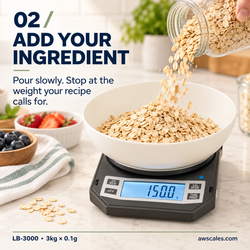
A 3000g x 0.1g digital scale supports a maximum rated load of 3000 grams and displays gram measurements in increments of 0.1 gram.
That combination offers a useful balance for many everyday weighing tasks: enough capacity for moderately sized containers and batches, with finer displayed increments than a whole-gram scale.
However, those two numbers do not tell you everything about the scale. They do not establish guaranteed accuracy, minimum usable load, platform size, or repeatability.
Before buying a 3kg digital scale, consider what you weigh, how small a difference matters, and how much the complete load weighs—including its container.
This guide explains the specification and the features that help you choose an appropriate American Weigh Scales model.
What Does 3000g x 0.1g Mean?
The specification contains two separate pieces of information.
3000g Is the Maximum Rated Capacity
The first number describes the maximum rated load the scale can support during weighing.
3000g equals 3 kilograms, or approximately 6.61 pounds. NIST’s guide to SI mass units explains the relationship between grams and kilograms.
The capacity applies to the total load resting on the platform. That includes:
-
The weighing container.
-
The material inside it.
-
Any lid, tray, or accessory supported by the platform.
A 3kg capacity does not mean you can weigh 3kg of ingredients in a heavy bowl without exceeding the limit.
0.1g Is the Displayed Gram Increment
The second number describes readability: the smallest step between displayed readings in grams.
A scale with 0.1g readability can display results such as:
-
25.0g
-
25.1g
-
25.2g
-
25.3g
It does not display hundredths of a gram, such as 25.14g, in gram mode.
Importantly, 0.1g readability does not guarantee ±0.1g accuracy. It also does not prove that the scale can reliably measure a standalone 0.1g object.
3000g x 0.1g Specifications at a Glance
| Specification | Meaning | Buying implication |
|---|---|---|
| 3000g capacity | Maximum rated load is 3000 grams | Include containers and accessories in your calculation |
| 3kg capacity | Another expression of 3000g | Useful when comparing products listed in kilograms |
| 0.1g readability | Display changes in tenths of a gram | Supports finer displayed measurements than 1g readability |
| 30,000 nominal display increments | 3000g divided by 0.1g | Does not establish accuracy or certified verification divisions |
| Accuracy | Not established by capacity and readability alone | Check additional model specifications |
| Minimum usable load | Not established by the headline specification | Confirm suitability for your smallest quantity |
| Platform size | Separate specification | Check container fit and display visibility |
| Calibration requirements | Model specific | Read the manufacturer’s instructions |
Readability, Accuracy, and Repeatability Explained
These terms describe different aspects of weighing performance.
Readability: How Finely the Result Is Displayed
Readability is the smallest displayed increment.
A 0.1g scale provides a finer gram display than a 1g scale. That can be useful when your target quantity includes a decimal, such as 18.5g.
It does not establish how closely the result agrees with the actual mass.
Accuracy: Agreement With the Reference Value
Accuracy concerns agreement between a measurement and the reference value.
If a suitable reference weight has a known mass of 100g, a displayed result of 100.0g is encouraging. However, one measurement at one load does not establish performance across the entire range.
Calibration, environmental conditions, and the scale’s design influence the result.
Repeatability: Agreement Between Repeated Readings
Repeatability concerns how closely repeated measurements agree under the same conditions.
If you remove and replace the same object several times, consistent readings can help demonstrate repeatability at that load. They do not, by themselves, establish accuracy.
NIST’s weighing and scales FAQs provide additional background on weighing terminology and scale divisions.
When comparing products, look for performance information rather than relying entirely on the number of decimal places.
Who Should Consider a 3000g x 0.1g Digital Scale?
A 3kg scale with 0.1g readability may suit users who need decimal gram readings and enough capacity for a container plus a moderate batch.
Coffee Preparation
Tenths-of-a-gram readings can be useful when weighing coffee portions.
For brewing directly on the scale, calculate the combined weight of the vessel, coffee, water, and any other supported equipment. Also consider response time, display visibility, and whether the model includes the brewing features you need.
The AWS BARISTA-3KG Coffee/Kitchen Scale is listed with a 3kg capacity and 0.1g readability. Review its full specifications to assess its fit for your setup.
Cooking and Baking
A 3000g scale may accommodate many bowls and ingredient batches while displaying finer increments than a whole-gram kitchen scale.
For larger dough batches or particularly heavy vessels, you may need more capacity. For very small ingredient additions, you may need finer readability and suitable low-load performance.
Meal Preparation
Weighing food portions can help make serving sizes more consistent.
Choose a scale that accommodates the container and portion together. A clear display, easy tare operation, and a practical platform can matter as much as readability during repeated use.
Craft Materials and Small Components
A 3kg x 0.1g scale may be useful for weighing groups of beads, hardware, or craft materials.
Its suitability depends on the quantity and tolerance required. If individual pieces weigh much less than 0.1g, the specification alone does not make it appropriate for measuring them individually.
How Much Capacity Do You Actually Need?
Calculate your heaviest expected complete load before shopping.
Use this formula:
Required capacity = container weight + contents weight + other supported items
For example:
450g bowl + 1800g ingredients = 2250g total load
That load fits within a 3000g rated capacity.
However:
900g bowl + 2300g ingredients = 3200g total load
That exceeds the capacity, even though the ingredients alone weigh less than 3000g.
Practical Load Examples
| Container weight | Contents weight | Total platform load | Within 3000g capacity? |
|---|---|---|---|
| 100g | 250g | 350g | Yes |
| 300g | 1000g | 1300g | Yes |
| 600g | 1800g | 2400g | Yes |
| 800g | 2200g | 3000g | At the rated maximum |
| 900g | 2300g | 3200g | No |
Allow practical room for variations in containers and batch sizes. If your usual setup approaches the maximum, a higher-capacity model may make the workflow easier.
What Does the Tare Function Do?
Tare subtracts the container’s weight from the displayed result so you can read the net contents weight.
A typical process is:
-
Place the empty container on the scale.
-
Press the tare button.
-
Confirm the display returns to zero.
-
Add the material.
-
Read the displayed contents weight.
Tare does not increase available physical capacity.
If a bowl weighs 700g, it leaves 2300g of rated capacity on a 3000g scale—even after you tare it.
The same principle applies when adding ingredients sequentially. Pressing tare between additions changes the displayed net reading, while the ingredients already in the bowl remain part of the physical load.
AWS’s scale FAQs address overload precautions and common weighing issues.
Is 0.1g Readability Enough?
The answer depends on your smallest important quantity and your acceptable tolerance.
A 0.1g increment is relatively small compared with a 1000g batch, but substantial compared with a 1g sample.
| Quantity | One 0.1g increment as a percentage of the quantity |
|---|---|
| 1g | 10% |
| 5g | 2% |
| 10g | 1% |
| 100g | 0.1% |
| 1000g | 0.01% |
These percentages describe the relative size of the display increment. They are not accuracy ratings or estimates of total measurement uncertainty.
If your process requires distinguishing 0.01g differences, a scale displaying 0.1g increments cannot show that detail in gram mode. Compare finer-readability models and confirm their performance at your working loads.
The AWS product FAQ offers further guidance on selecting appropriate readability.
Features to Check Before Buying a 3kg Digital Scale
Platform Size and Container Support
The container should sit securely without touching nearby surfaces.
A vessel that overhangs the platform may obscure the display or become unstable. Check platform dimensions and the manufacturer’s guidance for supported loads.
Display Visibility
Consider where the display sits relative to your bowl or vessel.
A backlit display can improve visibility, but its location also matters. You should be able to read the result without moving the container.
Tare Controls
For frequent ingredient additions, straightforward tare operation can make weighing easier.
Check that the controls are accessible with your usual vessel in place.
Power Options
Compare battery operation, adapter compatibility, and any included power accessories.
Also check automatic shutoff behavior. A short shutoff interval may interrupt a slower weighing process.
Cleaning and Spill Protection
Kitchen and craft tasks can create spills.
Check the cleaning instructions and whether removable containers or trays are included. Do not assume a scale is waterproof because it has a smooth platform.
Additional Functions
Some models include counting functions, additional units, or other features.
A parts-counting function estimates quantity from a sample’s average piece weight. Its usefulness depends on consistent component weights and an appropriate sample.
Choose features that support your actual process.
Calibration: What Buyers Need to Know
Calibration establishes the relationship between instrument readings and reference values. Some user calibration procedures also adjust the scale’s response.
NIST’s introduction to calibration explains calibration in relation to reference standards.
Before purchasing, check:
-
Whether user calibration is supported.
-
The required calibration weight.
-
Whether that weight is included.
-
The preparation and operating conditions.
-
Any recommended performance-check procedure.
Capacity Does Not Determine the Calibration Weight
A 3000g capacity does not automatically mean the scale requires a 3000g calibration weight.
Use the weight specified for the exact model. The required weight’s quality should also suit the scale and your application.
Consult the American Weigh Scales manuals for model-specific procedures.
Routine Checks Help Monitor Performance
A check with a suitable reference weight can help identify changes in readings. Checks at representative loads are more informative than assuming one successful result proves performance everywhere.
NIST’s guidance on check standards explains their role in monitoring bias and variability over time.
Traceability Must Fit Your Measurement Needs
Traceability relates a measurement result to a reference through a documented calibration chain. It does not automatically establish that the uncertainty is small enough for your task.
NIST’s metrological traceability guidance explains this distinction.
For purchasing, focus on whether the complete measurement process can meet your acceptance criteria.
An AWS Model to Explore: The LB-3000
The American Weigh Scales LB-3000 is an example of a digital bowl scale with a 3000g x 0.1g specification.
AWS describes the model as offering a removable bowl, backlit display, tare function, parts counting, multiple weighing units, and battery or adapter power options. Its published review also identifies a separately sold 2000g calibration weight requirement. Confirm the current package contents and instructions before purchasing.
Read the AWS LB-3000 review and application guide for a closer look at its features and limitations.
The headline specification makes it worth considering for moderate loads requiring decimal gram readings. Your final choice should also account for platform fit and the performance required by your application.
How a 3000g x 0.1g Scale Compares With Other Options
| Scale specification | Capacity | Readability | Main difference from 3000g x 0.1g |
|---|---|---|---|
| 500g x 0.01g | 500g | 0.01g | Lower capacity, finer display increment |
| 1500g x 0.1g | 1500g | 0.1g | Half the capacity, same display increment |
| 3000g x 0.1g | 3000g | 0.1g | Reference specification |
| 5000g x 1g | 5000g | 1g | Higher capacity, coarser display increment |
| 5000g x 0.1g | 5000g | 0.1g | Higher capacity, same display increment |
These comparisons describe capacity and readability. They do not rank accuracy, repeatability, or overall product quality.
A 3000g x 0.1g scale can be a practical middle option when 1500g is insufficient and whole-gram readability is too coarse.
Common Buying Mistakes
Assuming 0.1g Means Guaranteed Accuracy
Readability describes the display. Accuracy requires additional performance information.
Ignoring the Container
The bowl counts toward the maximum load even when its weight is removed from the displayed reading.
Choosing Capacity Without Checking Small Loads
A scale capable of supporting 3kg may still be unsuitable for your smallest quantity.
Buying More Decimal Places Than the Task Requires
Finer readability can be useful, but it should match your process. Capacity, platform size, and ease of use also matter.
Overlooking Calibration Accessories
If the required reference weight is sold separately, include it in your purchasing plan.
Assuming Unit Changes Improve Resolution
Displaying another unit does not establish better underlying measurement performance.
How to Use Your Scale More Consistently
Follow the manufacturer’s instructions and build a repeatable routine:
-
Place the scale on a stable, level surface as instructed.
-
Use it within the specified operating conditions.
-
Allow any required stabilization time.
-
Check that the unloaded display is ready.
-
Center the container and keep it clear of surrounding objects.
-
Tare before adding contents when appropriate.
-
Wait for a stable result.
-
Keep the complete load within capacity.
-
Perform suitable checks when required by your process.
-
Clean and store the scale according to its instructions.
Unexpected readings should prompt a check of the setup, power, environmental conditions, and calibration procedure.
Frequently Asked Questions
What does 3000g x 0.1g mean on a digital scale?
It means the scale has a maximum rated capacity of 3000 grams and displays gram readings in 0.1g increments.
Is 3000g the same as 3kg?
Yes. There are 1000 grams in a kilogram, so 3000g equals 3kg.
Does 0.1g mean the scale is accurate to ±0.1g?
No. It describes readability. Check the individual model’s accuracy and other performance information.
Can a 3000g scale weigh 3000g of ingredients in a bowl?
The bowl and ingredients together must stay within the rated capacity. A bowl containing 3000g of ingredients exceeds that limit.
Can a 0.1g scale reliably weigh a 0.1g object?
The display increment alone does not establish that capability. Check minimum-load suitability and performance at very small quantities.
Is a 3000g x 0.1g scale suitable for coffee?
It may be suitable when its performance, response, platform, and features meet your needs. Include the vessel and any liquid in the total load calculation.
Is it suitable for selling products by weight?
Capacity and readability do not establish legal-for-trade suitability. Confirm the specific model’s approval and applicable requirements before using it for transactions based on weight.
What calibration weight does a 3000g scale need?
The required weight depends on the model. Follow its instructions rather than assuming the calibration load equals maximum capacity.
Choosing Your 3000g x 0.1g Digital Scale
Start with three questions:
-
What is the smallest quantity or difference I need to measure?
-
What is the heaviest complete load, including its container?
-
What measurement tolerance does my process require?
A 3000g x 0.1g digital scale is worth considering when you need tenths-of-a-gram readings and enough capacity for moderate batches or vessels.
Compare individual American Weigh Scales models for platform fit, display visibility, calibration requirements, and measurement performance. Those details determine whether the specification translates into a useful scale for your work.