
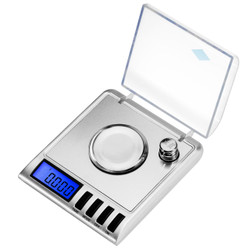
The best 20g x 0.001g digital scales combine one-milligram readability with portable designs, useful accessories and straightforward calibration. Within the current American Weigh Scales selection, the two primary models matching this exact specification are:
-
GEMINI-20 Precision Milligram Scale: Best compact option for portability, unit flexibility and a simple accessory kit
-
GPR-20 Precision Digital Milligram Scale: Best for a larger display, multiple weighing trays, two included 10-gram calibration weights and optional external power
Both scales provide:
-
20-gram maximum capacity
-
0.001-gram readability
-
Tare functionality
-
Multiple weighing units
-
Included calibration equipment
-
Protective carrying or storage accessories
-
Battery operation
The better choice depends on the platform, display, power source, calibration procedure and units your work requires.
A 20g x 0.001g specification means the scale displays weight in one-milligram increments up to a maximum load of 20 grams. It does not automatically mean that every reading is accurate within exactly one milligram. Accuracy, repeatability, minimum load and environmental stability must be considered separately.
Best 20g x 0.001g Scales at a Glance
| Model | Capacity | Readability | Platform | Calibration Equipment | Power | Best For |
|---|---|---|---|---|---|---|
| GEMINI-20 | 20 g | 0.001 g | 1.3 × 1.3 in | One 20 g weight | 2 AAA batteries | Compact portable precision |
| GPR-20 | 20 g | 0.001 g | 1.8 × 1.8 in | Two 10 g weights | 4 AAA batteries; optional adapter | Larger display, trays and bench flexibility |
Both products appear in the AWS collection of digital milligram scales.
What Does 20g x 0.001g Mean?
The specification follows a common scale format:
Capacity × readability
Therefore:
-
20 g is the maximum rated load.
-
0.001 g is the smallest displayed gram increment.
-
0.001 g equals 1 mg.
-
The scale provides 20,000 displayed increments across its stated range.
NIST explains that the kilogram is the SI base unit of mass and that smaller units are expressed using gram-based prefixes in its overview of SI units for mass.
Capacity Includes Everything on the Platform
The 20-gram limit includes:
-
Sample
-
Container
-
Weighing tray
-
Paper
-
Scoop
-
Protective liner
If a container weighs seven grams, only approximately 13 grams of physical capacity remain—even after pressing tare.
Best Overall Compact Option: GEMINI-20
The GEMINI-20 Precision Milligram Scale is a compact option for users who prioritize portability and multiple weighing units.
GEMINI-20 Specifications
-
Capacity: 20 g
-
Readability: 0.001 g
-
Calibration: 20 g calibration weight included
-
Units: g, oz, ozt, dwt, ct and gn
-
Platform: 1.3 × 1.3 inches
-
Scale dimensions: 3.5 × 4.0 × 0.8 inches
-
Power: Two AAA batteries
-
Accessories: Carrying case, tweezers and weighing tray
-
Listed operating temperature: 50°F to 86°F
Why Choose the GEMINI-20?
The GEMINI-20 is a strong choice for:
-
Gemstones
-
Small jewelry components
-
Precious-metal samples
-
Tiny electronic components
-
Lightweight hobby materials
-
Small laboratory-style samples
-
Portable precision work
Its six weighing units provide flexibility for applications involving grams, carats, grains, pennyweight and troy ounces.
The compact body and included carrying case make it easy to move between:
-
Workshop
-
Jewelry bench
-
Trade show
-
Classroom
-
Field kit
-
Hobby station
GEMINI-20 Limitations
Its compact platform requires small, lightweight containers. A large tray can touch the scale housing, create off-center loading or consume too much of the 20-gram capacity.
The scale is battery-powered, so users conducting long stationary sessions may prefer a model with an external-power option.
Best for Accessories and Display Size: GPR-20
The GPR-20 Precision Digital Milligram Scale provides the same 20g x 0.001g weighing specification with a different physical design and accessory package.
GPR-20 Specifications
-
Capacity: 20 g
-
Readability: 0.001 g
-
Calibration: 10 g and 20 g using two included 10 g weights
-
Units: g, dwt, ct and gn
-
Platform: 1.8 × 1.8 inches
-
Display: 0.6 × 2.2 inches
-
Scale dimensions: 2.8 × 5.9 × 1.6 inches
-
Power: Four AAA batteries
-
Optional AC adapter
-
Accessories: Protective case, tweezers and two weighing trays
-
Listed operating temperature: 50°F to 86°F
Why Choose the GPR-20?
The GPR-20 is the better option when you prioritize:
-
Larger display
-
Larger platform
-
Multiple trays
-
Two included calibration weights
-
Optional external power
-
Longer bench-based weighing sessions
Its two 10-gram calibration weights can be used individually or together according to the model’s calibration procedure.
The included trays are useful for:
-
Loose gemstones
-
Tiny fasteners
-
Powders
-
Pigments
-
Electronic components
-
Small craft materials
GPR-20 Limitations
The GPR-20 supports fewer weighing-unit modes than the GEMINI-20. Users who specifically need ounces or troy ounces may prefer the Gemini.
Although the platform is larger, the total capacity remains 20 grams. A larger container can still consume most of the available range.
GEMINI-20 Versus GPR-20
| Feature | GEMINI-20 | GPR-20 |
|---|---|---|
| Maximum capacity | 20 g | 20 g |
| Readability | 0.001 g | 0.001 g |
| Gram increments | 1 mg | 1 mg |
| Calibration equipment | One 20 g weight | Two 10 g weights |
| Weighing units | Six | Four |
| Platform | Smaller | Larger |
| Display | More compact | Larger |
| Trays | One | Two |
| Battery requirement | Two AAA | Four AAA |
| External power | Not listed | Optional adapter |
| Best advantage | Portability and units | Accessories and bench use |
For an additional side-by-side capacity discussion, read the AWS comparison of the Gemini-20 and Gemini-50.
Which Model Should You Choose?
Choose the GEMINI-20 if:
-
You want the smallest, most portable option.
-
You need ounces or troy ounces.
-
You prefer fewer batteries.
-
Your containers fit the smaller platform.
-
You primarily perform short weighing sessions.
Choose the GPR-20 if:
-
You want a larger display.
-
You prefer a larger platform.
-
You need two weighing trays.
-
You value two included 10-gram weights.
-
You want optional external power.
-
You perform longer bench-based sessions.
Choose a Higher-Capacity Scale if:
-
The combined sample and container regularly exceed 15 grams.
-
You need larger weighing dishes.
-
You measure batches rather than individual pieces.
-
Accidental overload is likely.
-
You want more operating margin.
Best Applications for 20g x 0.001g Scales
Gemstones and Jewelry Components
These scales can display small differences among:
-
Loose gemstones
-
Small diamonds
-
Clasps
-
Beads
-
Findings
-
Chain sections
-
Precious-metal samples
Because one carat equals 0.2 gram, the 20-gram capacity corresponds to 100 carats.
The scale should not be assumed to determine authenticity, grade or value. It measures mass only.
Electronics Components
A one-milligram display can help compare:
-
Small resistors
-
Capacitors
-
Diodes
-
Connectors
-
Tiny fasteners
-
Lightweight integrated circuits
The 20-gram capacity is too low for many complete circuit boards and assembled modules.
Small Hardware
Potential applications include:
-
Miniature screws
-
Clips
-
Pins
-
Springs
-
Watch components
-
Model-making hardware
Weight differences may help with sorting, but they cannot confirm material, thread size or component identity.
Powders and Pigments
A 0.001-gram scale can display fine additions, but powders can be affected by:
-
Air movement
-
Static
-
Moisture
-
Material loss during transfer
-
Residue on containers
Use a suitable tray and controlled environment.
Laboratory and Educational Samples
A consumer milligram scale may support general demonstrations and nonregulated sample work.
Do not automatically treat it as:
-
A certified laboratory balance
-
A pharmaceutical dosing instrument
-
A medical device
-
A legal-for-trade scale
-
A substitute for validated analytical equipment
Applications requiring traceability, documented uncertainty or regulated procedures may need specialized equipment.
Readability Is Not the Same as Accuracy
The 0.001-gram value describes the scale’s displayed increment.
It does not by itself establish:
-
Measurement uncertainty
-
Accuracy tolerance
-
Minimum sample weight
-
Linearity
-
Repeatability
-
Legal-metrology class
NIST distinguishes the displayed scale division from the verification scale division used to establish commercial tolerances. A finer displayed digit does not necessarily indicate greater verified accuracy.
When evaluating a scale, consider:
-
Stated accuracy
-
Repeatability
-
Calibration procedure
-
Minimum load
-
Environmental conditions
-
Platform design
-
Intended use
Understanding the 20-Gram Limitation
A 20-gram capacity provides excellent sensitivity within a narrow range.
Examples of total loads that fit:
| Container | Sample | Total Load | Within Capacity? |
|---|---|---|---|
| 2 g | 5 g | 7 g | Yes |
| 5 g | 10 g | 15 g | Yes |
| 7 g | 12 g | 19 g | Yes, but little margin |
| 8 g | 13 g | 21 g | No |
| 15 g | 5 g | 20 g | At maximum; not ideal |
Choose the lightest suitable container.
Why Tare Does Not Restore Capacity
Tare resets the displayed result but does not unload the weighing mechanism.
Example:
-
Scale capacity: 20 g
-
Empty dish: 6 g
-
Display after tare: 0.000 g
-
Remaining physical capacity: Approximately 14 g
Attempting to add 20 grams after taring the dish would overload the scale.
Minimum Practical Load
The smallest displayed increment is not necessarily the smallest dependable sample.
A scale may show 0.001 gram while requiring a larger sample to provide acceptable measurement confidence.
Minimum practical load depends on:
-
Repeatability
-
Environmental stability
-
Application tolerance
-
Scale design
-
Calibration
-
Required uncertainty
If the distinction matters, test repeated measurements at the low end and establish an internal minimum for the application.
Repeatability Testing
Perform this simple evaluation:
-
Place the scale on a rigid, level surface.
-
Protect it from drafts.
-
Allow it to acclimate.
-
Confirm that the platform is empty.
-
Turn the scale on.
-
Wait for a stable zero.
-
Apply a suitable reference weight.
-
Record the reading.
-
Remove the weight.
-
Wait for zero.
-
Repeat at least ten times.
-
Compare the values.
A useful scale should provide consistent results within the tolerance required for your task.
Linearity Testing
A scale may perform differently at various points in its range.
For a 20-gram model, verification can include suitable values near:
-
2 g
-
5 g
-
10 g
-
15 g
-
The upper working range
Use appropriate reference weights and never exceed the rated capacity.
Calibration Features
Both the GEMINI-20 and GPR-20 include calibration equipment.
GEMINI-20 Calibration
The Gemini includes one 20-gram calibration weight.
GPR-20 Calibration
The GPR includes two 10-gram weights, supporting calibration at 10 or 20 grams as directed by its procedure.
AWS offers additional calibration weights for compatible scale models.
Calibration Is Not Verification
Calibration adjusts or establishes scale response.
Verification checks the scale against a known reference.
A scale can be verified regularly without being recalibrated each time.
Proper Calibration Weight Handling
At milligram readability:
-
Use tweezers or clean gloves.
-
Avoid touching weights with bare fingers.
-
Store weights in protective cases.
-
Keep them dry and clean.
-
Allow them to reach room temperature.
-
Place them gently in the platform center.
-
Do not slide them across the platform.
Oil, moisture, dust and corrosion can influence small reference masses.
Follow the Manual
Calibration sequences vary by model. Use the correct model instructions in the AWS digital scale manuals collection.
A typical procedure includes:
-
Level and stabilize the scale.
-
Protect it from drafts.
-
Allow it to reach room temperature.
-
Turn it on and wait for stabilization.
-
Confirm the platform is empty.
-
Enter calibration mode.
-
Apply the requested weight.
-
Wait for confirmation.
-
Remove the weight.
-
Verify the result.
Do not guess button combinations or use an incorrect weight.
Environmental Control
A one-milligram display is sensitive to the surrounding environment.
Air Currents
Fans, vents, doors and operator movement can make the final digit fluctuate.
Use:
-
Draft shield
-
Sheltered area
-
Slow movements
-
Closed windows
-
Stable HVAC conditions
Vibration
Sources include:
-
Foot traffic
-
Machinery
-
Printers
-
Flexible furniture
-
Slamming doors
-
Nearby appliances
A rigid, isolated bench provides better results.
Temperature
Allow the scale, sample and calibration weight to acclimate together before precision work.
Static Electricity
Plastic containers and dry powders can develop static charge. Use suitable anti-static containers and avoid rubbing plastic near the platform.
Humidity
Humidity changes may affect moisture-sensitive samples and static behavior.
Platform and Tray Selection
The Gemini platform is smaller than the GPR platform. This may influence your choice more than the identical capacity specification.
A weighing container should:
-
Fit completely
-
Remain centered
-
Avoid the scale housing
-
Stay within the draft-shield area
-
Use minimal capacity
-
Resist static where possible
-
Suit the material being weighed
An oversized container can touch the housing and produce unreliable readings.
Power Options
GEMINI-20
The two-AAA design emphasizes compact portable operation.
GPR-20
The four-AAA design supports portable use, while an optional adapter can make it more convenient for a permanent bench.
When using an adapter:
-
Use only the specified type.
-
Keep the cable from touching the platform.
-
Avoid pulling on the housing.
-
Route cables away from the weighing area.
Auto-Off and Workflow
Auto-off conserves batteries but can interrupt:
-
Warm-up
-
Calibration
-
Repeated measurements
-
Long sample preparation
-
Documentation
Review the manual for available power-management settings.
Units of Measurement
The Gemini offers:
-
Grams
-
Ounces
-
Troy ounces
-
Pennyweight
-
Carats
-
Grains
The GPR offers:
-
Grams
-
Pennyweight
-
Carats
-
Grains
NIST provides guidance on metric SI prefixes, including milligrams and micrograms.
Make sure the selected unit matches the procedure. Do not confuse:
-
Milligram and microgram
-
Ounce and troy ounce
-
Grain and gram
-
Carat and gram
Cleaning and Maintenance
Keep the scale free from:
-
Powder
-
Dust
-
Oil
-
Adhesive residue
-
Metal fragments
-
Moisture
Use a soft brush, microfiber cloth or another manufacturer-approved method. Prevent material from entering gaps around the platform.
Never spray cleaning solution directly onto the scale or immerse it unless specifically permitted.
Storage and Transport
Protect the load cell by:
-
Using the case
-
Closing the protective cover
-
Removing loose trays
-
Keeping calibration weights separate
-
Avoiding heavy objects on the scale
-
Preventing platform pressure
-
Avoiding extreme temperatures
-
Removing batteries for long storage when recommended
A milligram scale is more vulnerable to impact than a general kitchen scale.
Legal-for-Trade and Regulated Uses
Neither 0.001-gram readability nor included calibration weights automatically establish legal-for-trade status.
NIST addresses commercial weighing devices and approval requirements in its weighing and scales FAQs.
Current model requirements for commercial weighing devices appear in NIST Handbook 44.
For regulated laboratory, medical, pharmaceutical or commercial work, use equipment and procedures specifically approved for that application.
Common Buying Mistakes
Assuming 0.001g Means ±0.001g Accuracy
Readability and accuracy are different specifications.
Ignoring Container Weight
The tray and sample must remain below 20 grams together.
Buying Too Little Capacity
A 20-gram model may be restrictive if samples routinely approach 15 grams.
Buying Too Much Resolution
If 0.01 gram is sufficient, a higher-capacity model may be more practical.
Ignoring Platform Size
A container that touches the housing can distort the result.
Calibrating With Coins
Use the included or specified calibration weight.
Weighing Near Drafts
Air movement can affect the final digits.
Using an Unstable Table
Milligram readings require a rigid surface.
Treating a Consumer Scale as Laboratory-Certified
Formal applications may require traceable calibration and documented uncertainty.
Buying Checklist
Before choosing between 20g x 0.001g scales, compare:
-
Maximum combined load
-
Desired capacity margin
-
Platform dimensions
-
Container dimensions
-
Display size
-
Available units
-
Calibration weights
-
Number of trays
-
Tweezers
-
Protective case
-
Battery type
-
External-power option
-
Operating environment
-
Auto-off behavior
-
Manual availability
-
Warranty
-
Intended regulated or nonregulated use
Frequently Asked Questions
What are the best AWS 20g x 0.001g scales?
The GEMINI-20 is the best compact choice for portability and unit flexibility. The GPR-20 is the stronger option for a larger display, larger platform, multiple trays and optional external power.
What does 20g x 0.001g mean?
The scale supports up to 20 grams and displays weight in 0.001-gram, or one-milligram, increments.
Is the GEMINI-20 more accurate than the GPR-20?
Both share the same capacity and readability specification. The best choice depends on platform size, display, units, power and accessories. Review the manufacturer’s specifications and test repeatability for your application.
Does 0.001g mean one milligram?
Yes. One milligram equals 0.001 gram.
Can either scale hold 20 grams plus a tray?
No. The tray and sample together must remain within the 20-gram capacity.
Does tare restore the full 20-gram range?
No. Tare changes the display but the container continues to use physical capacity.
Which scale has the larger platform?
The GPR-20 lists a 1.8 × 1.8-inch platform, while the GEMINI-20 lists a 1.3 × 1.3-inch platform.
Which model has more weighing units?
The GEMINI-20 offers six listed units. The GPR-20 offers four.
Which model is better for bench use?
The GPR-20 may be better for stationary use because it has a larger display and an optional AC adapter.
Which model is easier to carry?
The GEMINI-20 has a more compact body and uses two AAA batteries.
Can I calibrate these scales with coins?
No. Use the included calibration equipment and follow the correct manual.
Are these scales legal for trade?
Do not assume so. Confirm the required approval with the appropriate weights-and-measures authority before commercial use.
Final Verdict
Both the GEMINI-20 and GPR-20 deliver the same core specification: 20 grams of maximum capacity with one-milligram readability.
Choose the GEMINI-20 if you prioritize:
-
Compact portability
-
Six weighing units
-
Lower battery count
-
A straightforward travel kit
Choose the GPR-20 if you prioritize:
-
Larger platform
-
Larger display
-
Two weighing trays
-
Two 10-gram calibration weights
-
Optional external power
Neither model is universally better. The correct choice depends on the sample, container, work environment and required units.
Whichever model you select, remember that the 0.001-gram value describes readability—not guaranteed accuracy. Use lightweight containers, control drafts and vibration, calibrate according to the manual and verify performance with suitable reference weights.