
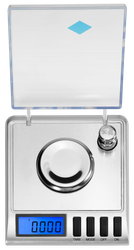
The best digital scale for coins should provide enough capacity for the
coins, holders, capsules, or groups you plan to weigh while offering
fine enough readability to make useful comparisons with published
specifications.
For many coin collectors, 0.01g readability is a practical
general-purpose choice. It provides substantially more detail than a
typical kitchen scale while remaining available in compact pocket-scale
formats with enough capacity for individual coins and small groups.
American Weigh Scales identifies collectible coins as a common
application for its digital pocket
scales. AWS's current pocket-scale
guide recommends approximately 0.01g readability with 100g--600g
capacity for collectible coins, depending on how many coins, holders,
or other objects are weighed together.
A digital scale cannot authenticate a coin on its own. Weight is one
useful characteristic that collectors can compare with an authoritative
specification alongside diameter, thickness, composition, condition,
provenance, and professional evaluation.
This guide explains how to choose the best digital scale for coins,
including capacity, readability, calibration, tare, platform size,
repeatability, and the difference between weighing a single coin and a
larger collection.
Quick Answer: What Is the Best Digital Scale for Coins?
For many collectors, a strong general-purpose specification is:
250g x 0.01g
That combination offers:
-
Hundredth-of-a-gram readability
-
Enough capacity for most individual coins
-
Room for small groups
-
Capacity for many capsules and holders
-
Portable pocket-scale dimensions
-
Practical headroom
AWS specifically highlights a 250g x 0.01g pocket scale as a strong
format for coin collectors in its Best Pocket Scales for Jewelry,
Coins, Coffee and Crafts
guide.
Collectors who frequently weigh larger groups, heavy medals, or
containers may prefer 500g x 0.01g or greater capacity.
Coin Scale Comparison Guide
Coin-weighing Suggested capacity Suggested readability
application
Individual U.S. 100g+ 0.01g
coins
Individual world 100--250g 0.01g
coins
Gold coins 100--250g 0.01g
Silver coins 100--250g 0.01g
Coins in capsules 100--250g 0.01g
Small groups of 250--500g 0.01g
coins
Tokens and small 250--500g 0.01g
medals
Larger groups 500g+ 0.01g or 0.1g
These are starting points rather than universal requirements. The best
specification depends on the actual collection and purpose.
Why Coin Collectors Use Digital Scales
Coins are manufactured to defined physical specifications. Depending on
the issue, those specifications can include:
-
Mass
-
Diameter
-
Thickness
-
Composition
-
Edge design
The U.S. Mint's Coin
Specifications
page, for example, lists official weights and dimensions for current
U.S. coin denominations.
A collector can measure a coin and compare the result with an
authoritative specification.
That does not mean a matching weight proves authenticity.
A scale is best treated as one measurement tool within a broader
identification or cataloging process.
Why 0.01g Readability Is Useful for Coins
A 0.01g scale displays weight in hundredths of a gram.
Examples:
-
2.50g
-
5.00g
-
5.67g
-
11.34g
Those happen to correspond to the nominal weights the U.S. Mint
currently publishes for several circulating denominations, demonstrating
why hundredth-of-a-gram display resolution is convenient when comparing
measured values with detailed specifications.
A scale that only reads whole grams would display dramatically less
information.
A 0.1g scale provides more detail than a whole-gram scale but still
rounds to tenths.
For many collectors, 0.01g offers a useful balance between detail,
portability, capacity, and ease of use.
Do You Need 0.001g for Coins?
Usually, not for general coin collecting.
A 0.001g scale displays thousandths of a gram. This can be useful for
extremely small samples or specialized measurement tasks, but it
introduces tradeoffs:
-
Lower capacity
-
Smaller weighing pans
-
Greater sensitivity to drafts
-
Greater sensitivity to vibration
-
Greater sensitivity to static
-
More demanding setup
For ordinary collectible coins, 0.01g is generally easier to work with.
AWS similarly explains in its jewelry capacity and resolution
guide
that finer 0.001g instruments are more environmentally sensitive and
should be chosen when the application genuinely requires milligram-level
readability.
Readability Is Not the Same as Accuracy
A digital display with two or three decimal places does not
automatically guarantee accuracy to the final displayed digit.
Readability is the smallest display increment.
Accuracy concerns how close the measurement is to the relevant
reference value within the scale's stated performance.
Repeatability concerns whether the same stable object produces
consistent measurements under similar conditions.
When comparing coin scales, consider all three.
Also review:
-
Calibration
-
Minimum usable load
-
Platform stability
-
Environmental conditions
-
Manufacturer tolerance
-
Intended operating range
Do not choose a scale solely by counting decimal places. The BIPM SI
Brochure provides the
international reference framework for SI measurement units.
How Much Capacity Does a Coin Scale Need?
Capacity is the maximum total load the scale is designed to support.
For a single coin, even 100g is generally substantial capacity.
But collectors often weigh more than bare individual coins.
Your total load may include:
-
Coin
-
Capsule
-
Holder
-
Tray
-
Multiple coins
-
Token
-
Medal
If you weigh several coins together, the load can increase quickly.
100g Capacity
A 100g x 0.01g scale is suitable for many individual coins.
Advantages include:
-
Compact dimensions
-
Fine readability
-
Easy portability
-
Plenty of capacity for most individual circulating coins
The limitation appears when you start weighing multiple coins, larger
medals, or containers.
200g Capacity
A 200g x 0.01g scale gives collectors additional flexibility.
It can accommodate:
-
Individual coins
-
Capsules
-
Holders
-
Small groups
-
Tokens
-
Lightweight medals
For collectors who rarely weigh larger groups, 200g can be a practical
balance.
250g Capacity
A 250g x 0.01g scale is one of the strongest all-purpose
configurations for coin collectors.
It provides enough capacity for:
-
Individual coins
-
Multiple coins
-
Capsules
-
Small holders
-
Tokens
-
Small medals
while preserving hundredth-of-a-gram readability.
This is why AWS currently identifies its 250g x 0.01g Micro pocket-scale
format as particularly suitable for coin collecting.
500g Capacity
A 500g x 0.01g scale is useful when you want more headroom.
Consider 500g when weighing:
-
Groups of coins
-
Larger medals
-
Heavy tokens
-
Containers
-
Mixed collectibles
-
Coins plus accessories
AWS explains in its 200g vs. 500g Pocket Scale
comparison
that both capacities can provide 0.01g readability; the primary
difference is how much total load they support.
Is Higher Capacity Less Accurate?
Not necessarily.
Capacity alone does not determine accuracy.
A 500g scale can provide the same 0.01g readability as a 200g scale.
Compare:
-
Readability
-
Stated accuracy/tolerance
-
Repeatability
-
Calibration
-
Minimum load
-
Platform stability
-
Environmental sensitivity
rather than assuming the smaller-capacity model must be better.
Capacity Headroom
Do not select a scale that will constantly operate near its maximum
capacity.
Suppose a group of coins weighs 225g and your tray weighs 20g.
The complete physical load is:
225g + 20g = 245g
A 250g scale technically supports that nominal load but leaves very
little headroom.
A 500g model would be more flexible.
Tare for Coin Holders and Trays
Tare lets you subtract the displayed weight of a container.
For example:
-
Place the empty tray on the scale.
-
Wait for the reading to stabilize.
-
Press tare.
-
Confirm zero.
-
Add the coin.
-
Record the net reading.
Remember that tare does not physically remove the tray's mass.
If a tray weighs 40g on a 250g scale, the scale is already supporting
40g even after the display returns to zero.
Calibration Matters for Coin Collectors
Calibration compares the scale's response with an appropriate known
reference mass according to the manufacturer's procedure.
A collector should know:
-
Whether the scale supports calibration
-
Which calibration mass is required
-
Whether that mass is included
-
How calibration mode works
-
What operating conditions are recommended
AWS provides a detailed process in How to Calibrate a Digital Scale for
Accurate
Results.
Do Not Calibrate With a Coin
A coin should not substitute for the reference mass specified by the
scale manufacturer.
Even when an official nominal coin weight is published, individual coins
can be affected by:
-
Wear
-
Damage
-
Contamination
-
Manufacturing tolerances
-
Alteration
Use the calibration mass and procedure specified for the scale.
Coins are objects to measure, not universal calibration standards.
Repeatability
Repeatability is particularly useful when evaluating whether your scale
is behaving consistently.
Try this basic test:
-
Place the scale on a stable surface.
-
Confirm zero.
-
Place the same coin in the center.
-
Record the reading.
-
Remove the coin.
-
Wait for zero.
-
Repeat several times.
If the readings vary unexpectedly, investigate the setup.
AWS discusses common causes in Why Does My Digital Scale Give Different
Readings?.
Common Causes of Changing Coin Weights
A coin does not change mass every few seconds, but a sensitive scale can
display changing results if the environment is unstable.
Common causes include:
-
Fans
-
HVAC airflow
-
Open windows
-
Vibrating tables
-
Weak batteries
-
Temperature changes
-
Static electricity
-
Uneven surfaces
-
Incorrect calibration
-
Dirt around the platform
-
Off-center loading
Control these variables before concluding that the scale is defective.
Platform Size
Coins are compact, so they are easier to accommodate than chains or
large jewelry.
Still, platform size matters for:
-
Large medals
-
Coin trays
-
Groups of coins
-
Holders
-
Capsules
The entire load must be supported by the scale.
Nothing should rest partly on the counter.
Stainless Steel Platforms
A stainless steel weighing platform is useful because it provides a
smooth, durable surface that is easy to keep clean.
Collectors should avoid abrasive cleaning methods that could damage the
scale or create debris around the weighing mechanism.
If a valuable coin should not contact the platform directly, use an
appropriate holder or tray and tare it correctly.
Protective Covers
Pocket-scale covers help protect the weighing platform during storage
and transportation.
This is useful for collectors who take scales to:
-
Coin shows
-
Auctions
-
Shops
-
Club meetings
-
Estate evaluations
-
Travel
Some protective covers can also function as trays depending on the scale
design.
Backlit Display
A clear backlit display makes readings easier to see under changing
lighting conditions.
For coin collecting, useful display characteristics include:
-
Large digits
-
Clear decimal placement
-
Visible unit indicator
-
Stable reading indication
-
Easy tare access
A technically precise scale is frustrating if the display is difficult
to read.
Which Units Do Coin Collectors Need?
Grams
Grams are the most useful general-purpose unit for coin collecting.
The U.S. Mint publishes current coin specifications in grams, making
direct comparison straightforward.
NIST's SI Units -- Mass
resource explains the SI framework for mass measurement.
Ounces
Some scales also provide ordinary ounces.
This can be useful for general weighing, but grams usually provide a
more convenient level of detail for individual coins.
Troy Ounces
Troy ounces are associated with precious metals and bullion.
A scale with ozt mode can be useful for collectors who also weigh
bullion or precious-metal items.
Pennyweight
Pennyweight, abbreviated dwt, is used in parts of the precious-metals
and jewelry industries.
It is less essential for ordinary circulating-coin collecting but can be
useful for collectors who also handle gold and silver.
Carats and Grains
Some pocket scales include additional units such as carats or grains.
These can expand versatility, although grams remain the core unit for
most coin comparison tasks.
U.S. Coin Weight Examples
The U.S. Mint currently publishes the following nominal weights for
several U.S. denominations:
Denomination Published weight
One-cent coin 2.50g
Nickel 5.00g
Dime 2.268g
Quarter 5.67g
Half dollar 11.34g
Native American / Innovation dollar 8.10g
These examples illustrate why a scale that reads to 0.01g is much more
informative for coin collecting than a whole-gram kitchen scale.
However, do not interpret a difference between your reading and a
published nominal specification without considering wear, tolerances,
the particular coin issue, and measurement uncertainty.
Best Scale for Pennies
A 100g x 0.01g pocket scale provides far more capacity than necessary
for a single modern U.S. one-cent coin.
The additional capacity becomes useful if you weigh:
-
Multiple coins
-
Holders
-
Small batches
When identifying older issues, use authoritative specifications for the
specific date and type rather than assuming all pennies have the same
composition and nominal mass.
Best Scale for Nickels
A nickel's compact size and 5.00g nominal current specification make it
easy to weigh on almost any 0.01g pocket scale.
A 100g model is enough for individual coins, while 250g or 500g provides
flexibility for groups.
Best Scale for Dimes
Dimes are lightweight.
A 0.01g pocket scale provides useful detail for comparison with
published specifications.
For collectors examining historical silver dimes, use specifications
appropriate to the exact issue because composition and standards have
changed over U.S. coinage history.
Best Scale for Quarters
A 100g x 0.01g scale easily handles individual quarters.
Collectors who frequently compare groups, silver issues, proof coins, or
encapsulated coins may prefer 250g capacity for greater flexibility.
Best Scale for Half Dollars
Half dollars remain well within the capacity of a typical precision
pocket scale.
A 100g scale can handle individual pieces; 250g or 500g is useful when
weighing several at once.
Best Scale for Dollar Coins
Individual U.S. dollar coins are also easily accommodated by a 100g
scale.
Collectors working with multiple dollar coins, large holders, medals, or
mixed collections may prefer a higher-capacity model.
Best Digital Scale for Silver Coins
For individual silver coins, 0.01g readability with 100--250g
capacity is a strong starting point.
Silver coin collectors may also appreciate:
-
Troy-ounce mode
-
Tare
-
Calibration
-
Protective cover
-
Stable platform
-
250g+ capacity for groups
Historical silver coins vary widely, so use an authoritative catalog,
mint source, or specialist reference for the exact issue.
Best Digital Scale for Gold Coins
For individual gold coins, a 0.01g precision scale is generally a
useful choice.
Capacity requirements remain modest for individual coins, so 100--250g
can provide ample headroom.
A troy-ounce mode may be convenient for bullion-related workflows.
Weight alone does not establish gold purity or authenticity.
Best Scale for Bullion Coins
Bullion coin collectors should look for:
-
0.01g readability for individual pieces
-
Adequate capacity
-
Grams
-
Troy ounces
-
Tare
-
Calibration
-
Stable platform
If you weigh multiple one-ounce bullion pieces together, capacity
becomes more important.
Calculate the complete group weight before selecting a scale.
Best Scale for Ancient Coins
Ancient coins can be small and irregular.
A 0.01g scale is useful for many examples, while particularly small
pieces may justify finer resolution depending on the numismatic purpose.
Ancient-coin identification should never rely on weight alone. Style,
fabric, diameter, metal, provenance, and expert evaluation can all
matter.
Best Scale for Tokens and Medals
Tokens and medals can be larger and heavier than ordinary coins.
A 250g or 500g x 0.01g scale is often more flexible.
Before buying, check both:
-
Maximum capacity
-
Platform dimensions
A heavy medal that technically falls below capacity still needs to fit
securely on the weighing surface.
Can Weight Tell You Whether a Coin Is Fake?
Not by itself.
Weight can reveal that a coin differs from an expected specification,
but a matching weight does not prove authenticity.
A counterfeit could potentially be manufactured to approximate:
-
Weight
-
Diameter
-
Appearance
Coin authentication may involve:
-
Dimensions
-
Composition
-
Edge details
-
Surface characteristics
-
Die diagnostics
-
Provenance
-
Professional grading or authentication
Use scale readings as one data point. For valuable U.S. coins,
professional authentication and grading resources such as PCGS
CoinFacts can provide issue-specific
numismatic context.
Weight and Coin Condition
Circulated coins can lose material through wear.
Damage, corrosion, cleaning, deposits, attachments, or alterations can
also affect measured mass.
This is one reason a scale should not be treated as a simple pass/fail
authentication device.
When a measured value differs from a nominal specification, interpret
the result in context.
Why a Kitchen Scale Is Usually Not Ideal for Coins
Many kitchen scales read to:
-
1g
-
0.5g
-
0.1g
That may be adequate for food but too coarse for detailed coin
comparison.
A precision pocket scale reading to 0.01g provides substantially more
useful information for most collectible-coin applications.
Kitchen scales can also have:
-
Large platforms
-
High capacity
-
Less fine resolution
Those characteristics are optimized for food rather than small
collectibles.
Pocket Scale vs. Milligram Scale for Coins
For most collectors:
Pocket scale: 0.01g readability, moderate capacity, easy
portability.
Milligram scale: 0.001g readability, lower capacity, more
environmental sensitivity.
The pocket scale is usually the better first purchase.
Choose a milligram scale only when your specific numismatic work
benefits from thousandth-of-a-gram readings.
How to Weigh a Coin Correctly
For repeatable results:
-
Place the scale on a hard, level surface.
-
Keep it away from fans and vents.
-
Turn it on with the platform empty.
-
Allow the reading to stabilize.
-
Select grams.
-
Confirm zero.
-
Place the coin near the center.
-
Wait for a stable reading.
-
Record the result.
-
Remove the coin.
-
Confirm the scale returns to zero.
-
Repeat if the measurement is important.
If using a holder or tray, tare it first.
Should You Weigh Coins in Capsules?
You can, but the result includes the capsule unless it is tared
appropriately.
If you know the empty capsule's mass and use tare correctly, the scale
can display the net mass of the coin.
For the cleanest comparison with official specifications, weighing the
bare coin may be preferable when handling the coin outside its holder is
appropriate and safe.
Do not remove a valuable coin from professional encapsulation simply to
weigh it.
Calibration vs. Verification
Calibration and routine verification are related but not identical
ideas.
Calibration adjusts or establishes the scale's response according to the
manufacturer's procedure.
Verification can involve checking whether an appropriate reference mass
produces the expected result within the scale's stated performance.
Collectors who use their scales regularly can benefit from periodically
checking repeatability and reference-mass performance.
Environmental Factors
Drafts
Moving air can influence fine measurements.
Keep the scale away from:
-
Fans
-
Air-conditioning vents
-
Open windows
-
Doors
Vibration
Use a rigid, stable table rather than a soft or flexible surface.
Temperature
Allow the scale to acclimate after moving between substantially
different temperatures.
Static
Static electricity can affect very lightweight objects and
fine-resolution instruments.
These factors become more significant as readability becomes finer.
Battery Condition
Weak batteries can contribute to unstable or unusual behavior in
electronic scales.
If readings suddenly become inconsistent:
-
Check the surface.
-
Check for drafts.
-
Check battery condition.
-
Check calibration.
-
Inspect the platform for contamination.
-
Repeat the measurement.
Do not immediately assume the load cell has failed.
Cleaning a Coin Scale
Keep the weighing platform clean.
Use methods consistent with the manufacturer's instructions.
Avoid:
-
Flooding the scale with liquid
-
Abrasive cleaners
-
Pressing heavily on the platform
-
Allowing debris into the mechanism
A protective cover can reduce dust accumulation during storage.
Portability for Coin Shows
Pocket scales are especially useful for collectors who travel.
Useful travel features include:
-
Protective clamshell or cover
-
Battery operation
-
Compact dimensions
-
Backlit display
-
Durable controls
-
0.01g readability
-
100--500g capacity
A 250g model can be a particularly versatile compromise for a collector
who wants one portable scale.
Do Coin Dealers Need Legal-for-Trade Scales?
The answer depends on how the scale is being used and applicable law.
A collector using a scale for identification or cataloging is different
from a business using weight to determine the price in a commercial
transaction.
The current 2026 NIST Handbook
44
contains specifications, tolerances, and technical requirements for
weighing and measuring devices used in regulated contexts. NIST states
that the handbook's requirements are designed to support accurate,
repeatable measurements and transparent transactions and are adopted by
many state, local, and some federal weights-and-measures authorities.
If a transaction is based directly on weight, verify applicable state
and local requirements and whether an approved legal-for-trade device is
required.
Coin Scale Buying Checklist
Before buying, ask:
-
Will I weigh individual coins or groups?
-
What is my heaviest expected load?
-
Will I use capsules or trays?
-
Do I need 100g, 200g, 250g, or 500g+ capacity?
-
Is 0.01g readability sufficient?
-
Do I genuinely need 0.001g?
-
What accuracy or tolerance does the manufacturer specify?
-
How repeatable is the scale?
-
Can it be calibrated?
-
Which calibration mass is required?
-
Does it have tare?
-
Does it measure grams?
-
Do I need troy ounces?
-
Is the platform large enough?
-
Does it have a protective cover?
-
Is the display easy to read?
-
Is it portable?
-
What batteries does it use?
-
Will it be used only for collecting or in a commercial transaction?
-
Does the manufacturer provide clear specifications and support?
Common Mistakes When Buying a Coin Scale
Choosing a Whole-Gram Scale
Whole-gram resolution is usually too coarse for detailed coin
comparisons.
Assuming 0.001g Is Always Better
Milligram resolution can add complexity without meaningful benefit for
ordinary coins.
Ignoring Capacity
Individual coins are light, but groups, medals, and trays can exceed
low-capacity limits.
Forgetting Holder Weight
A capsule or tray contributes to the physical load.
Confusing Readability With Accuracy
Decimal places alone do not define measurement quality.
Skipping Calibration
A precision scale should be checked and calibrated according to its
instructions.
Calibrating With a Coin
Use the specified reference mass.
Ignoring Repeatability
A scale should produce consistent readings under controlled conditions.
Using Weight as Proof of Authenticity
Weight is only one characteristic.
Buying a Scale With an Undersized Platform
Large medals and groups need complete support.
Frequently Asked Questions
What is the best digital scale for coins?
For many collectors, a 250g x 0.01g pocket scale provides an excellent
balance of capacity, readability, portability, and headroom.
Is 0.01g accurate enough for coins?
0.01g readability is a strong general-purpose choice for many coin
applications. Remember that readability and accuracy are different
specifications.
Do I need a 0.001g scale for coins?
Usually not for ordinary collecting. Choose milligram resolution only
when your specific application benefits from it.
Is 100g capacity enough?
For most individual coins, yes. Choose 250g or 500g if you weigh groups,
holders, tokens, or medals.
Is 500g better than 250g?
It provides more capacity but is not automatically more accurate. If
both scales offer 0.01g readability, choose based on the loads you
expect to weigh.
Can a digital scale identify a fake coin?
No. It can help compare measured mass with expected specifications, but
weight alone cannot authenticate a coin.
Can I weigh silver coins?
Yes. A 0.01g scale with sufficient capacity is useful for many silver
coins.
Can I weigh gold coins?
Yes. A precision pocket scale can be useful for gold coins, provided its
capacity and performance suit the application.
Should a coin scale have troy ounces?
It is optional for general collecting but useful if you also work with
bullion or precious metals.
Should I weigh coins in grams?
Grams are the most convenient general-purpose unit because many mint and
numismatic specifications are published in grams.
Can I use a kitchen scale?
You can, but many kitchen scales are too coarse for detailed coin
comparison.
Can I calibrate a scale with a nickel?
Use the calibration mass specified by the scale manufacturer instead.
Why does my coin weigh differently from the published specification?
Possible factors include wear, damage, deposits, manufacturing
tolerances, incorrect identification, measurement conditions, or scale
performance. A difference should be investigated rather than interpreted
automatically as proof of authenticity or counterfeit status.
Does a matching weight prove a coin is genuine?
No.
What capacity is best for coin shows?
A compact 250g x 0.01g pocket scale is a versatile choice for many
traveling collectors.
Final Verdict: Best Digital Scale for Coins
For most coin collectors, the best digital scale combines 0.01g
readability with approximately 100g to 500g of capacity.
If you primarily weigh individual coins, 100g x 0.01g can be
sufficient.
If you want a versatile all-purpose collector scale, 250g x 0.01g is
an excellent target.
If you regularly weigh groups, larger medals, containers, or mixed
collectibles, 500g x 0.01g provides more headroom.
A 0.001g milligram scale is usually unnecessary for ordinary coin
collecting and is best reserved for specialized applications that
genuinely benefit from finer readings.
Beyond capacity and readability, prioritize:
-
Calibration
-
Repeatability
-
Tare
-
Stable zero
-
Platform size
-
Grams
-
Protective cover
-
Clear display
-
Battery condition
-
Stable operating environment
Most importantly, remember what a coin scale can and cannot tell you.
A good digital scale can provide a useful, repeatable mass measurement
and help you compare a coin with authoritative specifications. It cannot
independently establish authenticity, composition, grade, rarity, or
value.
For collectors who want one portable scale that balances detail and
flexibility, a 250g x 0.01g precision pocket scale is a particularly
strong place to start.