
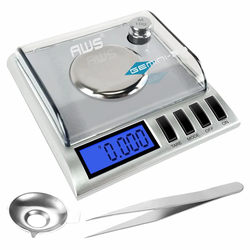
The best digital scale for jewelry needs to do more than show a number on a screen. Jewelry weighing can involve finished rings, chains, bracelets, loose gemstones, precious-metal findings, scrap gold, beads, watch parts, and extremely small components. The right scale needs enough capacity for the heaviest item you expect to weigh while providing fine enough readability for the smallest difference that matters.
For many everyday jewelry tasks, a 0.01g digital pocket scale offers an excellent balance of portability, capacity, and precision. Jewelers working with loose gemstones, tiny findings, or very small weight differences may benefit from a 0.001g milligram scale. Larger finished pieces, batches of findings, or heavier precious-metal items may require additional capacity even if that means using 0.1g readability.
American Weigh Scales offers both pocket scales and milligram scales for these different weighing ranges.
Precision matters because jewelry materials can have substantial value relative to their size. The Gemological Institute of America explains that a metric carat equals 0.2 gram and that carat weight can meaningfully influence diamond pricing. Its guide to diamond carat weight is a useful reference when choosing a scale for gemstones.
This guide explains how to choose the best digital scale for jewelry, when to use 0.1g, 0.01g, or 0.001g readability, which weighing units matter, how to improve repeatability, how to calibrate a jewelry scale, and what to consider when a scale will be used in commercial transactions.
Why Jewelry Requires a Precision Scale
Jewelry is one of the clearest examples of why scale capacity and scale readability need to be matched to the application.
A kitchen scale may be perfectly capable of weighing a box or a large bowl, but a model that changes only in 1g increments can hide meaningful differences between small jewelry items. A ring weighing 4.82g and another weighing 5.21g could both be displayed simply as 5g on a whole-gram scale.
A precision jewelry scale provides finer resolution.
Depending on the job, you may be weighing:
-
Gold or silver rings
-
Chains and necklaces
-
Bracelets
-
Earrings
-
Loose gemstones
-
Diamonds
-
Precious-metal findings
-
Scrap jewelry
-
Small watch components
-
Beads
-
Wax models
-
Finished jewelry for inventory
-
Small groups of components during manufacturing
The Federal Trade Commission's Jewelry Guides address representations involving jewelry characteristics such as metallic content, size, weight, quality, and other product attributes. For a jewelry business, accurate weighing is therefore not merely convenient; the way weight is measured and represented can matter in customer-facing transactions and product descriptions.
Quick Jewelry Scale Recommendations by Task
| Jewelry task | Suggested capacity | Suggested readability |
|---|---|---|
| Finished rings and earrings | 100–500g | 0.01g |
| Chains and bracelets | 200–1,000g | 0.01g or 0.1g |
| Loose gemstones | 20–100g | 0.001g or carat-capable precision scale |
| Tiny findings and components | 20–100g | 0.001g |
| Scrap gold or silver lots | 500–2,000g | 0.01g or 0.1g |
| Jewelry-making materials | 500–2,000g | 0.01g or 0.1g |
| Larger finished pieces | 1,000g+ | 0.1g may be suitable |
These are general starting points rather than universal requirements. The correct scale depends on the smallest difference you need to detect, the largest load you need to support, the weighing units you use, and whether the measurement is simply for personal or production use versus a regulated commercial transaction.
What Is the Best Precision for a Jewelry Scale?
The three common readability levels for jewelry work are 0.1g, 0.01g, and 0.001g.
0.1g Jewelry Scale
A scale with 0.1g readability displays weight in tenths of a gram.
Examples include:
-
8.2g
-
24.7g
-
115.4g
This level can work for heavier jewelry, batches of findings, larger silver items, craft materials, and situations where hundredths of a gram do not affect the task.
Its advantage is that 0.1g scales often offer higher capacity and a larger platform than extremely fine milligram models.
Its limitation is that it may be too coarse for loose gemstones, very light findings, small precious-metal differences, or detailed production work.
0.01g Jewelry Scale
For many consumers, jewelry makers, collectors, and repair benches, 0.01g is the most versatile jewelry-scale readability.
A 0.01g scale displays hundredths of a gram:
-
4.82g
-
17.36g
-
88.04g
That provides 100 displayed divisions within a single gram, giving far more detail than a 1g kitchen scale and ten times finer readability than a 0.1g model.
A 0.01g scale is often useful for:
-
Rings
-
Earrings
-
Chains
-
Pendants
-
Precious-metal pieces
-
Small scrap lots
-
Jewelry findings
-
Beads
-
Wax models
-
Collectible coins
-
General jewelry bench work
A common specification is 500g x 0.01g. In that notation, 500g is the maximum capacity and 0.01g is the display increment. AWS explains this distinction in its guide to what 500g x 0.01g means on a digital scale.
Remember that readability is not identical to guaranteed accuracy. A scale showing two decimal places does not automatically mean every displayed digit is correct under every condition.
0.001g Jewelry Scale
A 0.001g scale displays thousandths of a gram, or one milligram.
Examples include:
-
0.247g
-
1.386g
-
8.004g
This level is useful for very small components, loose stones, fine production work, and applications where differences below 0.01g matter.
The tradeoff is sensitivity. Milligram scales typically have lower capacities and react more noticeably to:
-
Drafts
-
Air-conditioning
-
Breathing over the platform
-
Table vibration
-
Static
-
Temperature change
-
Off-center loading
-
Movement around the workbench
For very fine jewelry work, a milligram model with a draft shield can provide a more controlled weighing environment. AWS compares this category in its guide to 0.001g milligram scales.
Carats, Grams, Pennyweights and Troy Ounces
A useful jewelry scale should support the units required by your workflow.
Grams
Grams are convenient for general jewelry manufacturing, inventory, repair work, findings, precious-metal pieces, and many gemstone calculations.
The National Institute of Standards and Technology provides an official overview of SI units for mass, including the relationship between grams, milligrams, and kilograms.
Carats
Carats are commonly used for diamonds and other gemstones.
One metric carat equals 200 milligrams, or 0.2 gram. A carat is divided into 100 points. A 0.50ct diamond can therefore be described as a 50-point diamond.
GIA's consumer guidance on diamond carat weight also emphasizes an important distinction: carat describes weight, not physical dimensions. Two stones can have the same carat weight while appearing different in size because cut proportions and shape affect how their dimensions are distributed.
Pennyweight
Pennyweight, abbreviated dwt, remains familiar in parts of the precious-metals and jewelry trade.
If you rely on dwt, select a scale that supports it directly or use a verified conversion method. Do not assume that every compact digital scale includes every jewelry unit.
Troy Ounces
Precious metals may also be discussed in troy ounces. A troy ounce is different from the ordinary avoirdupois ounce used for many everyday goods.
A jewelry or precious-metal scale should clearly indicate the selected unit. Before recording a result, verify the unit symbol on the display rather than relying on memory.
Capacity Matters Just as Much as Precision
Choosing the finest possible readability is not always the best strategy.
A tiny 0.001g scale may be excellent for a loose gemstone but completely unsuitable for a large silver bracelet or a container holding multiple pieces. Conversely, a high-capacity scale may support the jewelry physically while failing to show sufficiently small differences.
Maximum capacity includes everything resting on the platform:
-
Jewelry
-
Tray
-
Weighing boat
-
Container
-
Protective mat, if permitted
-
Multiple pieces weighed together
Taring a container does not remove its weight from the load cell. It only subtracts that weight from the displayed result.
For example, if a scale has a 500g maximum capacity and your tray weighs 120g, approximately 380g of capacity remains for the jewelry.
Choose enough headroom that normal use does not repeatedly push the scale to its limit.
Best Overall Jewelry Scale Setup
For people who weigh many types of jewelry, one scale may not cover every task ideally.
A practical two-scale setup consists of:
A 0.01g pocket scale with moderate capacity for rings, chains, bracelets, earrings, finished pieces, scrap lots, and general jewelry work.
A 0.001g milligram scale with lower capacity for loose stones, tiny components, and highly detail-sensitive measurements.
This combination allows each scale to operate in the range where it is most useful rather than expecting one device to provide both extremely high capacity and extremely fine resolution.
AWS discusses similar selection tradeoffs in its guide to the best pocket scales for jewelry, coins, coffee and crafts.
What to Look for in the Best Digital Scale for Jewelry
1. Readability
Readability is the smallest increment shown on the display.
For most jewelry, 0.01g is a strong general-purpose choice. For extremely small stones and components, 0.001g may be preferable. For heavier batches, 0.1g may be sufficient.
Do not choose solely by the number of decimal places. Review the scale's stated tolerance and intended weighing range.
2. Maximum Capacity
Think about the heaviest realistic load, including containers.
A 100g scale can be excellent for stones but restrictive for finished pieces. A 500g or 1,000g pocket scale provides more flexibility for general jewelry tasks.
3. Minimum Usable Load
The smallest displayed increment is not necessarily the smallest load the scale can measure reliably.
For example, a scale that displays 0.01g increments should not automatically be assumed to provide a trustworthy result for an object whose entire mass is 0.01g.
When extremely small measurements matter, examine the manufacturer's performance specifications rather than judging the scale only by its display.
4. Platform Size
A jewelry item should rest fully on the platform or in a supported weighing tray.
A chain hanging over the edge and touching the counter can produce an incorrect result because the scale is no longer supporting the complete load.
Likewise, a large bracelet should not press against the scale housing or surrounding objects.
5. Tare Function
Tare is particularly useful when weighing:
-
Loose stones in a tray
-
Chains in a small cup
-
Findings in a weighing boat
-
Scrap jewelry in a container
-
Groups of tiny components
Place the empty container on the scale, wait for stability, press tare, verify zero, then add the jewelry.
6. Jewelry-Specific Units
Depending on your work, look for support for:
-
g
-
ct
-
dwt
-
ozt
-
oz
-
gn
Not every unit is necessary for every buyer, but direct unit support reduces unnecessary manual conversion.
7. Calibration
A jewelry scale should have a clear calibration procedure appropriate to its design.
Calibration compares the scale against a known reference mass. It is different from zeroing or taring.
Use the exact calibration weight and procedure specified by the manufacturer. AWS provides a detailed guide on how to calibrate a digital scale.
8. Repeatability
Repeatability asks a simple question: when the same item is weighed several times under the same conditions, does the scale return substantially the same result?
For a practical check:
-
Place the scale on a hard, stable surface.
-
Allow it to stabilize.
-
Confirm zero.
-
Place an appropriate check weight or stable item in the center.
-
Record the reading.
-
Remove the item.
-
Wait for the display to return to zero.
-
Repeat several times.
Large unexplained changes deserve troubleshooting before the scale is used for important jewelry measurements.
9. Draft Protection
Draft protection matters most at 0.001g and other fine resolutions.
Moving air can produce visible changes in the final digits. A draft shield helps isolate the weighing pan from air-conditioning, open windows, fans, and normal air movement around the bench.
10. Portability and Protective Cover
For estate jewelry, buying appointments, craft shows, workshops, auctions, or field use, a compact pocket scale can be convenient.
A protective cover helps prevent pressure on the load cell and shields the platform during transport. Never store heavy objects on top of a precision scale.
How to Weigh Jewelry Correctly
A good scale can still produce poor results when used improperly.
Start by placing the scale on a hard, flat, level, stable surface. Avoid fabric, carpet, flexible mats, unstable trays, or tables that move when touched.
Keep the scale away from direct airflow and vibration.
Turn it on with the platform empty and allow the display to reach zero.
Place the jewelry in the center of the platform. If the item is awkwardly shaped, use a compatible lightweight container and tare it before adding the item.
Wait for the reading to stabilize before recording the weight.
Remove the item and verify that the scale returns to zero before the next measurement.
For high-value or detail-sensitive items, repeat the measurement several times.
Why Does a Jewelry Scale Give Different Readings?
Small variations can come from the environment rather than a defect.
Common causes include:
-
Uneven surfaces
-
Drafts
-
Vibration
-
Weak batteries
-
Temperature changes
-
Static
-
Dirt around the platform
-
Off-center placement
-
Overloading
-
A load below the useful measuring range
-
Moving the scale between readings
-
Failure to let the display stabilize
-
Incorrect calibration
Highly precise scales expose environmental effects that lower-resolution scales may simply round away.
If your scale fluctuates, AWS's troubleshooting guide explains why digital scales give different readings.
How to Calibrate a Jewelry Scale
There is no universal calibration sequence for every model.
Before beginning, check:
-
Whether the scale supports user calibration
-
The exact calibration weight required
-
The correct unit
-
The button sequence
-
Whether the scale needs a warm-up period
-
Whether one or multiple calibration weights are required
Then place the scale on a stable surface, eliminate airflow and vibration, verify power, clean the platform, and allow the equipment to reach room temperature.
Enter calibration mode according to the model instructions and place the specified reference weight in the center only when prompted.
After calibration, perform a repeatability check using an appropriate reference weight.
Do not calibrate with random jewelry, coins, batteries, or household objects. Their real masses may differ from assumed values.
How Often Should a Jewelry Scale Be Checked?
There is no single schedule that fits every user.
Check the scale more frequently when it:
-
Is transported often
-
Is used for high-value measurements
-
Experiences major temperature changes
-
Has been dropped or overloaded
-
Has been stored for a long period
-
Shows a persistent offset
-
Fails to return consistently to zero
-
Is part of a documented quality-control process
A simple check before important work can identify an obvious problem before it affects records or production.
Jewelry Scale vs Kitchen Scale
A kitchen scale and a jewelry scale are designed around different priorities.
A kitchen scale usually emphasizes:
-
Higher capacity
-
Larger platforms
-
Bowls and food containers
-
Whole-gram or 0.1g readings
A jewelry scale usually emphasizes:
-
Lower to moderate capacity
-
Finer readability
-
Compact platforms
-
Small-object measurement
-
Units such as carats, pennyweights, or troy ounces on selected models
A kitchen scale that reads only to 1g can weigh a heavy necklace in the broad sense, but it may not provide enough detail for inventory, materials tracking, or precious-metal work.
For general jewelry tasks, 0.01g is usually more useful than 1g.
Pocket Scale vs Milligram Scale for Jewelry
Choose a pocket scale when portability, moderate capacity, and 0.01g readability are the priority.
Choose a milligram scale when 0.001g readability and very small samples are the priority.
A pocket scale is usually better for:
-
Finished jewelry
-
Rings
-
Chains
-
Bracelets
-
Earrings
-
Scrap jewelry
-
Beads
-
General repairs
A milligram scale is usually better for:
-
Loose gemstones
-
Tiny findings
-
Very small components
-
Detailed formulation or manufacturing tasks
-
Situations where 0.01g is too coarse
For many jewelry benches, both types are useful.
Jewelry Weighing and Legal-for-Trade Requirements
A crucial distinction exists between using a scale for internal reference and using weight to determine the amount charged in a commercial transaction.
In the United States, commercial weighing devices may be subject to state and local weights-and-measures rules. NIST publishes Handbook 44, which contains specifications, tolerances, and technical requirements for weighing and measuring devices and is adopted or referenced by many weights-and-measures authorities.
Do not assume that a consumer pocket scale is approved for buying or selling precious metal by weight simply because it is accurate enough for hobby use.
If weight determines the transaction price, verify the rules that apply in your jurisdiction and confirm whether the specific device requires legal-for-trade approval, inspection, sealing, or certification.
Understanding Mass Standards
Jewelry scales ultimately operate within a broader measurement system.
The BIPM SI Brochure describes the International System of Units, the globally agreed measurement framework that includes the kilogram as the SI base unit of mass.
For everyday jewelry users, the important practical takeaway is simpler: use clearly defined units, choose equipment designed for the required range, calibrate with suitable reference masses, and record measurements consistently.
Common Jewelry Scale Mistakes
Choosing the Highest Capacity Available
More capacity is not automatically better. A very high-capacity scale may provide less useful readability for tiny jewelry items.
Choosing Based Only on Decimal Places
A display showing 0.001g does not guarantee laboratory-grade accuracy. Readability, tolerance, repeatability, calibration, minimum load, and operating environment all matter.
Weighing on a Soft Surface
Fabric, foam, carpet, and flexible mats can interfere with load transfer. Use a rigid surface.
Letting Jewelry Touch the Counter
If part of a chain or bracelet rests outside the platform, the scale does not support the entire item's mass.
Ignoring the Container Weight
Tare removes the container from the displayed result but not from total scale capacity.
Weighing in Front of a Fan
Drafts can cause the last digits of a precision scale to move continuously.
Using Weak Batteries
A scale may still turn on even when its batteries are too weak for stable operation.
Measuring Immediately After a Temperature Change
A scale moved from a cold vehicle into a warm shop may drift while the internal components equalize with room temperature.
Confusing Carat and Karat
Carat is a unit of gemstone mass. Karat refers to gold purity. They describe different properties.
Assuming Carat Means Gemstone Size
Carat is weight, not physical dimensions. Two stones with equal carat weight can have different visible dimensions.
Best Digital Scale for Jewelry Makers
A jewelry maker typically needs flexibility.
For general bench work, start with a scale offering approximately:
-
500g or greater capacity
-
0.01g readability
-
Tare
-
Grams
-
A stable platform
-
Straightforward calibration
-
A protective cover or tray
Add a 0.001g milligram scale if your work includes loose stones, very small findings, or other components where hundredths of a gram do not provide enough detail.
Best Digital Scale for Gold and Silver
For finished gold and silver jewelry, a 0.01g scale is often a practical choice because it balances useful capacity with fine readings.
For larger scrap lots, consider more capacity. If weighing very small fragments, choose finer readability.
If the scale is used to determine a purchase or sale price by weight, verify all applicable legal-for-trade requirements before using it commercially.
Best Digital Scale for Gemstones
Gemstones are a stronger case for higher precision.
Because one carat equals 0.2g, a scale that reads only whole grams is far too coarse for most loose-stone work.
A carat-capable precision or milligram scale is typically more appropriate. Look for:
-
0.001g readability or suitable carat readability
-
Draft protection
-
Stable platform
-
Appropriate calibration weight
-
Low minimum usable load
-
Carat unit support
-
A small tray that can be tared
For professional diamond grading, specialized laboratory balances may operate at substantially finer levels than ordinary consumer jewelry scales. GIA also discusses the importance of precision and rounding when reporting diamond carat weight.
Best Digital Scale for Jewelry Repair
Repair benches often weigh complete pieces before and after work, replacement parts, solder, findings, stones, and small precious-metal components.
A 0.01g pocket scale can cover many of these tasks. A 0.001g scale can supplement it for very small parts.
Keeping consistent pre-repair and post-repair records can also make shop documentation clearer.
Frequently Asked Questions
What is the best digital scale for jewelry?
For most general jewelry weighing, a digital scale with 0.01g readability and approximately 200g to 1,000g capacity provides a useful balance. Add a 0.001g scale for tiny components and loose gemstones.
Is 0.01g accurate enough for jewelry?
It is suitable for many rings, chains, earrings, precious-metal pieces, findings, and general jewelry-making tasks. Loose gemstones or extremely small components may benefit from 0.001g readability.
Is 0.001g better than 0.01g?
It is finer, but not automatically better for every task. A 0.001g scale normally has lower capacity and greater sensitivity to airflow, vibration, static, and temperature. Choose the resolution that matches the item.
What does 500g x 0.01g mean?
It means the scale has a maximum capacity of 500 grams and displays weight in increments of 0.01 gram.
Can I weigh diamonds on a 0.01g scale?
A 0.01g scale can provide a general gram measurement, but loose-diamond work often calls for finer carat resolution. For more detailed gemstone weighing, use a scale designed for that range.
How many grams are in one carat?
One metric carat equals 0.2 gram, or 200 milligrams.
Is carat the same as karat?
No. Carat measures gemstone weight. Karat describes gold purity.
Can I use a kitchen scale for jewelry?
A kitchen scale can weigh heavier pieces, but many kitchen scales read only to 1g or 0.1g. That can be too coarse for detailed jewelry work.
Do I need a scale that measures pennyweight?
Only if pennyweight is part of your workflow. Many precious-metal buyers and jewelers use grams, dwt, or troy ounces. Choose units based on your actual process.
Does tare increase a scale's capacity?
No. Tare subtracts the container weight from the display, but the scale still physically supports the container and its contents.
Why does my jewelry scale keep changing?
Drafts, vibration, static, weak batteries, temperature changes, an unstable surface, off-center loading, or calibration problems can cause fluctuating readings.
Should I calibrate my jewelry scale every day?
Not necessarily. Follow the manufacturer's recommendations and the requirements of your quality program. Check calibration after transport, major temperature changes, impact, overload, or when a known reference no longer reads correctly.
Can I use coins to calibrate a jewelry scale?
Coins are not a substitute for the calibration mass specified by the scale manufacturer. Manufacturing tolerances, wear, contamination, and damage can change an individual coin's mass.
Can a pocket scale be used to buy gold from customers?
Do not assume so. If the transaction price is determined by weight, commercial weighing regulations may apply. Confirm local requirements and whether the scale is approved for legal-for-trade use.
Final Verdict: The Best Digital Scale for Jewelry
For most jewelry makers, collectors, repair benches, and general-purpose users, the best starting point is a 0.01g digital pocket scale with enough capacity for the largest finished piece or container you expect to weigh.
A 500g x 0.01g format is particularly versatile for rings, earrings, chains, pendants, findings, beads, small precious-metal pieces, and many general jewelry tasks.
For loose gemstones, very small findings, and measurements where a hundredth of a gram is too coarse, add a 0.001g milligram scale with appropriate draft protection and calibration.
Do not choose a jewelry scale based on decimal places alone. Compare:
-
Capacity
-
Readability
-
Minimum usable load
-
Stated tolerance
-
Repeatability
-
Platform size
-
Supported units
-
Calibration requirements
-
Draft protection
-
Portability
-
Warranty and support
-
Legal-for-trade status when applicable
American Weigh Scales offers multiple precision formats suitable for jewelry, gemstones, precious metals, coins, and small components. Matching the scale to the actual weighing range will give you more useful results than simply buying the model with the highest capacity or the greatest number of decimal places.
For jewelry work, precision starts with the right scale—but repeatable measurement also depends on a stable environment, correct calibration, proper item placement, and consistent weighing technique.