
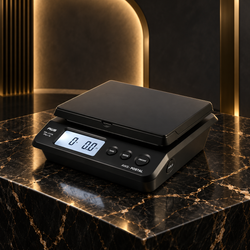
The best digital scale for small packages should give you enough capacity for the entire packed parcel while still providing useful resolution for lightweight shipments.
For many small eCommerce packages, you do not need milligram precision.
You need a practical balance of:
capacity + readability + repeatability + platform size + tare + calibration
For businesses that consistently ship lightweight products:
around 13 lb capacity with 0.1 oz or 1 g readability
can be an excellent compact starting point.
For sellers whose orders vary more widely:
55 lb × 0.1 oz
provides significantly more flexibility while remaining suitable for small packages.
And if your supposedly "small-package" business sometimes creates heavy multi-item cartons, moving to:
110 lb × 0.1 oz
may be more practical than repeatedly running out of capacity.
The key is to choose your scale according to the:
heaviest fully packed order—not the weight of a single product.
Quick Answer: What Scale Do You Need for Small Packages?
| Small-Package Application | Capacity to Consider | Useful Readability |
|---|---|---|
| Jewelry mailers | 5–13 lb | 0.1 oz or finer |
| Small accessories | 5–13 lb | 0.1 oz |
| Cosmetics | 13 lb | 0.1 oz / 1 g |
| Small electronics | 13 lb | 0.1 oz / 1 g |
| Books | 13–25 lb | 0.1 oz |
| Apparel mailers | 13–25 lb | 0.1 oz |
| Subscription boxes | 13–25 lb | 0.1 oz |
| Small eCommerce cartons | 13–25 lb | 0.1 oz |
| Multi-item orders | 25–55 lb | 0.1 oz |
| Growing small-business shipping | 55 lb | 0.1 oz |
| Occasional heavier cartons | 55–110 lb | 0.1 oz |
For consistently lightweight packages:
13 lb capacity
can be enough.
For a wider range of small and medium parcels:
55 lb × 0.1 oz
is especially versatile.
What Is a Small Package Scale?
A small package scale is a digital weighing device used for parcels such as:
-
Poly mailers
-
Padded envelopes
-
Small cardboard boxes
-
Product bundles
-
Subscription boxes
-
Marketplace orders
-
Returns
-
Small wholesale samples
It sits between two extremes.
A tiny precision pocket scale may have excellent:
0.01g readability
but insufficient capacity for shipping.
A large industrial platform scale may support hundreds of pounds but be unnecessary for a home seller shipping two-pound cartons.
The best small-package scale falls somewhere between these extremes.
Why Small Packages Still Need Accurate Weighing
A parcel may look lightweight but still cross an important shipping weight boundary once it is completely packed.
Suppose:
Product = 14.8 oz
Mailer = 0.9 oz
Protective wrap = 0.5 oz
Insert = 0.2 oz
Tape and label = 0.1 oz
Final package:
16.5 oz
If you weighed only the product, you would record:
14.8 oz
instead of the actual packed weight.
USPS recommends weighing the complete prepared shipment when determining package weight. See the official USPS package-shipping guidance.
Product Weight Is Not Shipping Weight
One of the easiest eCommerce mistakes is entering the product's catalog weight as the parcel weight.
These are not necessarily the same.
Shipping weight can include:
-
Product
-
Retail packaging
-
Shipping box
-
Poly mailer
-
Bubble wrap
-
Kraft paper
-
Foam
-
Instructions
-
Thank-you card
-
Promotional material
-
Tape
-
Label
If it travels with the package, it contributes to actual mass.
Best Capacity for Small Packages
The right scale capacity depends on the upper end of your actual shipping range.
Common possibilities include:
5 lb
13 lb
25 lb
55 lb
and higher.
Do not automatically choose the smallest capacity simply because your packages are described as "small."
Physical dimensions and weight are different things.
A relatively compact box can still be heavy.
Is a 5 lb Scale Enough for Small Packages?
A 5 lb scale may be sufficient if you almost exclusively ship:
-
Jewelry
-
Small accessories
-
Trading cards
-
Small electronics accessories
-
Replacement parts
-
Lightweight beauty products
Suppose your shipping history looks like:
Average package = 11 oz
Heaviest package = 2.2 lb
A 5 lb scale gives reasonable headroom.
But a single multi-item order could push the package beyond capacity.
Is a 13 lb Scale Better for Small Packages?
For many lightweight eCommerce businesses:
yes.
A 13 lb scale provides significantly more flexibility without requiring a large shipping platform.
It can work well for:
-
Beauty products
-
Jewelry
-
Accessories
-
Books
-
Small electronics
-
Apparel
-
Collectibles
-
Small home products
-
Product bundles
For these applications, the AWS AMW-13 Compact Digital Bench Scale offers a useful small-package configuration.
Its approximately:
13 lb / 6000 g capacity
combined with:
0.1 oz / 1 g readability
makes it particularly relevant for lightweight parcel weighing.
Why 13 lb Is a Useful Middle Ground
Consider a seller whose packages range from:
4 oz to 8 lb
A tiny 500g scale cannot cover that workflow.
A 100 lb industrial scale is unnecessary.
A 13 lb bench scale provides:
-
Useful capacity
-
Compact size
-
Fine enough shipping resolution
-
Room for packaging
-
Room for multi-item orders
That makes this range particularly attractive for small online sellers.
When 13 lb Is Not Enough
Suppose an online store sells three products:
Product A = 4 lb
Product B = 3 lb
Product C = 5 lb
One customer buys all three.
Products:
12 lb
Box and packing:
1.4 lb
Final shipment:
13.4 lb
A 13 lb scale can no longer weigh the completed order.
This is why:
maximum realistic order weight
matters more than:
average product weight.
Should You Buy a 25 lb Scale?
A 25 lb scale may work well for businesses that regularly ship:
-
Multiple apparel items
-
Books
-
Cosmetics bundles
-
Subscription boxes
-
Small household products
-
Medium product kits
It provides substantially more capacity than a lightweight bench scale.
However, businesses expecting rapid catalog growth may benefit from moving directly to the 50–55 lb class.
Why 55 lb Is Excellent for Growing eCommerce Businesses
A:
55 lb × 0.1 oz
scale gives a small-business seller a very broad usable range.
It can weigh:
-
Tiny mailers
-
Small boxes
-
Subscription boxes
-
Product bundles
-
Medium cartons
-
Returns
-
Multi-item orders
-
Small wholesale shipments
The AWS PS-25 Digital Package Postage Scale provides this 55 lb × 0.1 oz configuration.
For a business whose order weights fluctuate substantially, this can be more future-proof than a 13 lb model.
13 lb vs. 55 lb for Small Packages
| Feature | 13 lb Scale | 55 lb Scale |
|---|---|---|
| Jewelry mailers | Excellent | Excellent |
| Cosmetics parcels | Excellent | Excellent |
| Lightweight apparel | Excellent | Excellent |
| Small boxes | Excellent | Excellent |
| Multi-item orders | Moderate | Excellent |
| Larger bundles | Limited | Excellent |
| Medium cartons | Limited | Better |
| Storage footprint | Usually smaller | Usually larger |
| Growth flexibility | Moderate | High |
Choose:
13 lb
when virtually all shipments remain lightweight.
Choose:
55 lb
when you want significantly more flexibility.
Do Small Packages Ever Need 110 lb Capacity?
Usually not.
But businesses do not always stay inside one package class.
You may normally ship:
2–5 lb parcels
while occasionally receiving:
-
Wholesale orders
-
Large returns
-
Multi-product bundles
-
Bulk purchases
If these orders regularly exceed 55 lb, a higher-capacity model becomes useful.
The AWS SE-50 Digital Shipping Scale provides:
110 lb × 0.1 oz
for businesses that need substantially more shipping capacity.
Leave Capacity Headroom
Avoid choosing a scale that your normal packages nearly max out.
Suppose:
Scale capacity = 13 lb
Typical heavy order = 12.7 lb
Remaining headroom:
0.3 lb
That leaves very little room for:
-
Different packaging
-
Additional products
-
Promotional inserts
-
Future order growth
A higher-capacity model is more practical.
What Resolution Do Small Packages Need?
Readability or resolution describes the smallest increment displayed by the scale.
For shipping scales, common units include:
-
Ounces
-
Pounds
-
Pounds and ounces
-
Grams
-
Kilograms
For lightweight parcels:
0.1 oz readability
is highly useful.
Gram-level measurement can also be useful for small packages.
Is 1 oz Readability Enough?
For larger packages, perhaps.
For very small parcels, whole-ounce resolution can be coarse.
Suppose:
Package A = 4.1 oz
Package B = 4.8 oz
A whole-ounce scale may provide less detailed information than you want.
A:
0.1 oz
shipping scale makes lightweight package measurements easier to distinguish.
Is 0.1 oz Good for Small Packages?
For many eCommerce applications:
yes.
0.1 oz readability provides useful detail for:
-
Jewelry mailers
-
Cosmetics
-
Accessories
-
Lightweight clothing
-
Collectibles
-
Small electronics
-
Subscription products
It offers an effective compromise between shipping detail and higher package capacity.
Is 1g Readability Good for Small Packages?
Yes.
One-gram readability can be especially useful for lightweight parcels.
Suppose:
Package A = 425 g
Package B = 438 g
Package C = 451 g
A one-gram scale makes these differences easy to measure.
Gram mode is also helpful when working with:
-
Metric product specifications
-
International records
-
Packaging comparisons
Do You Need 0.1g for Small Packages?
Usually not.
For shipping, the difference between:
425.0 g
and:
425.1 g
rarely changes the usefulness of the package measurement.
0.1g resolution is much more relevant for applications such as:
-
Ingredients
-
Craft formulations
-
Components
-
Coffee
than normal parcel shipping.
Do You Need 0.01g?
For ordinary small packages:
no.
Hundredth-of-a-gram readability is excessive for most shipping applications.
A scale might display:
425.00 g
but your carrier does not need the same weighing resolution required for fine jewelry or formulation work.
Higher useful capacity is usually more valuable.
More Decimal Places Are Not Automatically Better
Consider:
Scale A
500g × 0.01g
Scale B
13 lb × 0.1 oz
Scale A displays much finer increments.
But if your package weighs:
3 lb
Scale A cannot weigh it at all.
Scale B can.
For small-package shipping:
useful precision means sufficient resolution within sufficient capacity.
Readability Is Not the Same as Accuracy
A scale that displays:
3 lb 4.2 oz
has 0.1 oz readability.
That does not automatically mean its measurement error is guaranteed to be ±0.1 oz.
Readability describes display increments.
Accuracy is a separate characteristic.
For technical background on mass measurement and traceability, see NIST's Calibration of Mass Standards. NIST's current mass calibration program traces mass to the SI and supports calibrated mass standards across a wide range.
Repeatability Matters for Package Shipping
A useful scale should give similar readings when you repeatedly weigh the same stable package.
For example:
3 lb 5.2 oz
3 lb 5.2 oz
3 lb 5.3 oz
is much more useful than:
3 lb 5.2 oz
3 lb 10.8 oz
3 lb 1.4 oz
If your measurements change unexpectedly, AWS covers common causes in Why Does My Digital Scale Give Different Readings?.
What Can Cause Changing Package Weights?
Possible causes include:
-
Unstable work surface
-
Package leaning against another object
-
Box touching the table
-
Uneven load placement
-
Weak batteries
-
Platform interference
-
Calibration issues
-
Damage from overloading
Always confirm that the parcel is supported only by the weighing platform.
Platform Size Matters for Small Packages
A small package can still be physically wide.
Suppose:
Package weight = 4 lb
Scale capacity = 13 lb
The capacity is fine.
But if the carton:
-
Blocks the display
-
Touches the surrounding table
-
Hangs awkwardly
-
Cannot sit securely
the scale may not be practical for that package.
Evaluate:
platform dimensions as well as capacity.
The Entire Package Should Be Supported
Avoid weighing a parcel that is partly resting on:
-
Wall
-
Table
-
Shelf
-
Another package
-
Packing equipment
External support can reduce how much load reaches the scale.
The package should be fully supported by the weighing setup.
Package Shape Matters Too
Small parcels can include:
-
Poly mailers
-
Cubic boxes
-
Long narrow cartons
-
Mailing tubes
-
Padded envelopes
-
Irregular product packaging
A good scale should accommodate the shapes you regularly ship.
The ideal platform for a 6 × 4-inch mailer may not be ideal for a long poster tube.
Why Display Placement Matters
Large packages can obscure an integrated scale display.
For compact parcels, an integrated display is generally fine.
As boxes become larger, features such as:
-
Raised display
-
Tilt-up platform
-
Remote display
become more valuable.
This is another reason to choose your scale according to the largest package—not just the average one.
What Is Tare?
Tare allows you to reset the displayed value to zero while an object remains on the platform.
Example:
Reusable bin = 2 lb
Press tare.
Display:
0 lb
Add merchandise.
The displayed number now reflects the added products.
This can be useful for:
-
Packing
-
Order preparation
-
Inventory
-
Product grouping
Does Tare Increase Scale Capacity?
No.
Suppose:
Scale capacity = 13 lb
Container = 2 lb
After tare:
Display = 0 lb
But the scale is still physically supporting:
2 lb
Only approximately:
11 lb
of nominal capacity remains before reaching the original maximum.
Tare changes the displayed zero.
It does not change physical capacity.
Do Not Tare Away Packaging When Buying a Shipping Label
When entering final shipment weight, you generally want:
everything the carrier will transport.
That means:
Product + package + protective materials + inserts.
Weigh the parcel:
after it is completely packed.
Calibration Is Important
A package scale should provide a clear calibration process when user calibration is supported.
Before buying, determine:
-
Can the scale be calibrated?
-
What calibration mass does it require?
-
Is the calibration weight included?
-
Are instructions available?
AWS explains the general process in How to Calibrate a Digital Scale for Accurate Results.
Always follow the exact procedure for your model.
Do Not Guess the Calibration Weight
Scale capacity does not automatically determine calibration mass.
A 13 lb scale does not necessarily require a 13 lb reference.
A 55 lb scale does not necessarily require a 55 lb reference.
Calibration requirements depend on the scale design.
NIST's Calibration Procedures for Weights and Measures Laboratories provides broader technical context on standardized calibration procedures and metrological traceability.
Use a Stable Shipping Station
Place the scale on a:
-
Hard
-
Flat
-
Rigid
-
Stable
surface.
Avoid:
-
Carpeting
-
Foam
-
Flexible packing mats
-
Soft furniture
-
Unstable folding tables
A dedicated packing desk or bench provides a much better weighing environment.
Actual Weight Is Not Always Billable Weight
Your digital scale measures:
actual package weight.
But shipping charges can also depend on:
-
Package dimensions
-
Destination
-
Service
-
Dimensional weight
-
Additional carrier rules
This is particularly important for small packages that are lightweight but bulky.
What Is Dimensional Weight?
Dimensional weight compares:
the space a package occupies
with:
its actual mass.
UPS explains that dimensional weight may apply when package size is large relative to actual weight and instructs shippers to measure package length, width and height. UPS Package Dimensions and Weight
That means:
a scale alone does not provide every piece of shipping information you need.
Example of a Lightweight but Bulky Package
Suppose your scale reads:
4 lb
The package is very large.
The actual mass is still 4 lb.
However, the carrier may calculate a dimensional weight greater than four pounds.
FedEx explains that applicable shipments are rated using actual or dimensional weight based on its rules, with the greater relevant value affecting the charge. See FedEx's dimensional-weight guide.
Your Small-Package Shipping Station Needs Three Things
For many eCommerce businesses, a practical setup includes:
1. Digital package scale
for actual mass.
2. Measuring tape
for:
-
Length
-
Width
-
Height
3. Shipping software
for current carrier calculations.
This is more useful than relying on a scale alone.
Best Digital Scale for Jewelry Packages
Jewelry itself may weigh only a few grams.
But a shipment may also contain:
-
Gift box
-
Jewelry pouch
-
Protective material
-
Mailer
-
Insert
Suppose:
Jewelry = 0.7 oz
Gift box = 2.2 oz
Mailer and packing = 1.4 oz
Final package:
4.3 oz
A shipping scale with:
0.1 oz readability
provides plenty of useful detail.
You do not need 0.01g precision just because the item inside is jewelry.
Best Digital Scale for Cosmetics Packages
Cosmetics can become surprisingly heavy.
Consider:
Three bottles = 3.4 lb
Retail packaging = 0.4 lb
Shipping carton = 0.5 lb
Protective material = 0.2 lb
Final package:
4.5 lb
A 13 lb scale handles this easily.
Multi-item beauty businesses may benefit from 25–55 lb capacity as order sizes grow.
Best Digital Scale for Apparel Packages
A single shirt is lightweight.
A multi-item order may not be.
Suppose:
4 shirts = 2.8 lb
2 hoodies = 3.6 lb
Packaging = 0.8 lb
Total:
7.2 lb
A 13 lb scale remains appropriate.
A seller handling jackets, bulk apparel or wholesale orders may eventually need more capacity.
Best Scale for Small Electronics Packages
Small electronics shipments may contain:
-
Product
-
Charger
-
Cable
-
Manual
-
Retail box
-
Protective material
-
Shipping carton
Do not base scale capacity on the device alone.
Use the final packed shipping weight.
For many small electronics businesses:
13–25 lb capacity
is a reasonable range.
Best Scale for Books
Books are compact but dense.
A box that looks small may weigh substantially more than an apparel parcel of similar dimensions.
For sellers shipping:
-
Multiple books
-
Textbooks
-
Box sets
a:
25–55 lb
scale may be more practical than a 5–13 lb model.
This illustrates why:
small package does not automatically mean lightweight package.
Best Scale for Subscription Boxes
Subscription-box sellers need to consider consistency and combined weight.
Suppose each box contains:
Product A = 1.2 lb
Product B = 0.8 lb
Product C = 0.6 lb
Packaging = 0.7 lb
Total:
3.3 lb
A 13 lb scale provides generous capacity.
But if product configurations vary significantly from month to month, 25–55 lb may provide better flexibility.
Best Scale for Etsy Small Packages
Etsy businesses may ship:
-
Jewelry
-
Candles
-
Crafts
-
Accessories
-
Clothing
-
Art
-
Ceramics
For jewelry and lightweight crafts:
13 lb
can be plenty.
For candles, ceramics and multi-item orders:
25–55 lb
offers more flexibility.
Best Scale for eBay Small Packages
eBay inventories can change quickly.
A seller may ship:
-
Collectibles today
-
Electronics tomorrow
-
Tools next week
A 13 lb scale can work if the product range remains lightweight.
For general reselling:
55 lb capacity
can reduce the risk of outgrowing the scale.
Best Scale for Marketplace Sellers
Amazon, Walmart, Etsy, eBay and other marketplace sellers often need package data for:
-
Shipping labels
-
Product fulfillment
-
Returns
-
Inventory planning
A versatile small-package scale should provide:
-
Appropriate capacity
-
Easy-to-read display
-
Ounce measurements
-
Gram measurements
-
Stable repeatability
-
Useful platform size
For many sellers, 13–55 lb covers the most practical range.
Best Scale for Home Businesses
A home-business scale should balance:
-
Capacity
-
Compact footprint
-
Easy storage
-
Portability
-
Power options
-
Platform size
If storage space matters and all orders are lightweight:
13 lb
can be an excellent choice.
If you have room for a slightly larger shipping station:
55 lb
offers substantially more flexibility.
Compact Scale vs. Full Shipping Scale
Compact 13 lb Scale
Best when:
-
Packages are consistently light.
-
Workspace is limited.
-
Easy storage matters.
-
Orders are mostly small.
55 lb Shipping Scale
Best when:
-
Order weights vary.
-
Multi-item purchases are common.
-
Medium boxes occasionally appear.
-
Business growth is expected.
Neither is universally superior.
Choose based on your actual order history.
How to Determine Your Ideal Capacity From Order History
If you already operate an online store, review approximately:
30–90 days of shipments.
Identify:
-
Average shipment weight
-
90th-percentile type shipment
-
Heaviest completed package
-
Heaviest realistic future package
Then add reasonable headroom.
For example:
Average package = 2.1 lb
Heavy normal order = 5.8 lb
Maximum = 8.4 lb
A:
13 lb scale
may be appropriate.
If maximum package = 21 lb, move higher.
Example 1: Jewelry Order
Jewelry = 0.8 oz
Gift box = 1.7 oz
Mailer and inserts = 1.2 oz
Total:
3.7 oz
A compact digital parcel scale is ideal.
Example 2: Beauty Order
Products = 4.6 lb
Packaging = 0.8 lb
Final shipment:
5.4 lb
A 13 lb scale provides adequate capacity.
Example 3: Apparel Bundle
Products = 10.4 lb
Shipping box = 1.2 lb
Packing material = 0.4 lb
Total:
12.0 lb
A 13 lb scale can weigh it, but the order is getting close enough to capacity that a larger model may become worthwhile.
Example 4: Small but Heavy Book Box
Books = 17 lb
Box and packaging = 1.5 lb
Total:
18.5 lb
A 13 lb scale cannot handle it.
A 25 lb or 55 lb model is needed.
Example 5: Growing eCommerce Order
Products = 31 lb
Packaging = 3 lb
Total:
34 lb
A:
55 lb shipping scale
provides adequate capacity and useful headroom.
Example 6: Wholesale Order
Products = 61 lb
Packaging = 4 lb
Total:
65 lb
A 55 lb scale cannot handle the completed package.
A:
110 lb scale
is more appropriate.
Common Small-Package Scale Buying Mistakes
Buying by Product Weight Instead of Package Weight
The shipping box and packing materials count.
Buying Too Little Capacity
Combined orders can be much heavier than individual products.
Buying Extreme Precision You Do Not Need
0.01g readability is usually unnecessary for postage.
Confusing Readability With Accuracy
They are separate specifications.
Ignoring Repeatability
The same package should produce stable measurements.
Ignoring Capacity Headroom
Do not operate routinely at the maximum load.
Ignoring Platform Dimensions
Small packages can still be physically wide.
Letting the Package Touch the Table
The full load must reach the scale.
Blocking the Display
Larger cartons may require a different display arrangement.
Taring Away Final Packaging
For actual shipment weight, include the finished packaging.
Assuming Tare Increases Capacity
It does not.
Ignoring Calibration
Follow model-specific instructions.
Guessing Calibration Weight
Use the correct specified reference.
Ignoring Dimensional Weight
Actual weight may not be the only factor used for shipping rates.
Buying Only for Today's Business
Choose enough capacity for realistic growth.
Small Package Scale Buying Checklist
Before buying, ask:
-
What products do I ship?
-
What is my lightest completed package?
-
What is my average package?
-
What is my heaviest package?
-
What is my heaviest multi-item order?
-
How much does packaging add?
-
Do I need 5 lb capacity?
-
Is 13 lb enough?
-
Would 25 lb provide better headroom?
-
Should I choose 55 lb instead?
-
Do I occasionally exceed 55 lb?
-
Is 0.1 oz readability sufficient?
-
Do I need 1 g readability?
-
Do I genuinely need 0.1g?
-
Do I genuinely need 0.01g?
-
What accuracy specifications are provided?
-
Are readings repeatable?
-
Is the platform large enough?
-
Can the parcel sit entirely on the scale?
-
Will the package cover the display?
-
Do I need tare?
-
Can the scale be calibrated?
-
What calibration mass does it require?
-
Is the calibration weight included?
-
Does it support lb:oz?
-
Does it support grams?
-
Is the scale easy to store?
-
Do I need battery operation?
-
Do I want continuous power?
-
Is my packing surface stable?
-
Do I measure package dimensions?
-
Could dimensional weight apply?
-
Will this capacity still make sense as my store grows?
Frequently Asked Questions
What is the best digital scale for small packages?
For consistently lightweight eCommerce parcels:
around 13 lb capacity with approximately 0.1 oz / 1 g readability
can be a strong compact option.
For a broader shipping range:
55 lb × 0.1 oz
provides substantially more flexibility.
How much capacity do I need for small packages?
Choose capacity according to your:
heaviest fully packed order.
For many lightweight sellers:
13 lb
may be sufficient.
For growing eCommerce businesses:
25–55 lb
can be more practical.
Is 13 lb enough for shipping?
It can be.
If every completed order remains safely below 13 lb, this capacity can work very well.
If packages regularly exceed 10–12 lb, consider moving higher.
Is a 55 lb scale too big for small packages?
Not necessarily.
A 55 lb scale can still weigh lightweight packages while providing far more capacity for larger orders.
What resolution should a small package scale have?
For many shipping applications:
0.1 oz
is a practical readability level.
One-gram resolution can also be useful for lightweight parcels.
Do I need a 0.01g scale for small packages?
Usually no.
Hundredth-of-a-gram resolution provides much more precision than ordinary parcel shipping requires.
Can I use a kitchen scale for small packages?
Possibly.
If the package fits securely and remains within capacity, a suitable kitchen or bench scale may work for lightweight shipping.
A dedicated shipping scale becomes more useful as package size, frequency and weight increase.
Should I weigh the product or finished package?
For shipping:
weigh the finished package.
Include the box, mailer, padding and other materials being transported.
Does tape affect shipping weight?
Yes.
Everything included in the shipment contributes to actual mass.
Does tare increase scale capacity?
No.
Tare changes the displayed value but does not alter physical load capacity.
Is calibration important for a small package scale?
Yes, particularly when you rely on the scale regularly.
Follow the calibration procedure specified for your exact model.
Why does my package scale show different weights?
Possible reasons include:
-
Unstable surface
-
Package touching another object
-
Uneven placement
-
Weak batteries
-
Platform interference
-
Calibration problems
-
Overloading
Does package size matter if the weight is accurate?
Yes.
Carriers can apply size and dimensional-weight rules.
UPS instructs shippers to determine package dimensions and weight when preparing shipments.
Does a scale calculate dimensional weight?
No.
A standard shipping scale measures:
actual mass.
Dimensional weight also requires the package's length, width and height.
What scale is best for an Etsy seller?
For consistently lightweight Etsy parcels:
13 lb capacity
may provide a compact solution.
For candles, ceramics, bundles or larger orders:
25–55 lb
may provide better flexibility.
What scale is best for an eBay seller?
Because inventory can vary significantly, many resellers benefit from:
55 lb capacity
even when most packages are much lighter.
What scale is best for a small eCommerce business?
For lightweight catalogs:
13 lb
can work well.
For a growing catalog with multi-item orders:
55 lb × 0.1 oz
is a particularly versatile range.
Can I use the same scale for small and medium packages?
Yes, provided the scale:
-
Has adequate capacity
-
Provides useful readability
-
Has a suitable platform
-
Supports the package securely
A 55 lb-class shipping scale can cover a wide range of small and medium packages.
Final Verdict: What Is the Best Digital Scale for Small Packages?
The best digital scale for small packages is not necessarily the smallest or most precise scale available.
It is the scale that covers:
your complete real-world shipping range
with enough resolution to measure lightweight parcels reliably.
For businesses shipping:
-
Jewelry
-
Accessories
-
Cosmetics
-
Small electronics
-
Lightweight apparel
-
Collectibles
approximately 13 lb capacity with 0.1 oz / 1 g readability
can provide an excellent compact setup.
For businesses handling:
-
Larger product bundles
-
Books
-
Subscription boxes
-
Multi-item orders
-
Medium cartons
55 lb × 0.1 oz
provides much greater flexibility.
And when heavier cartons become part of the workflow:
110 lb × 0.1 oz
may be necessary.
When comparing scales, prioritize:
capacity, readability, repeatability, platform size, tare, calibration, display visibility and power options.
Avoid paying for ultra-fine 0.01g resolution when your actual requirement is several pounds of useful shipping capacity.
Most importantly:
weigh the completely packed parcel.
The product alone is not the shipment.
And remember that a digital scale measures:
actual package weight
while carriers may also consider:
dimensions and dimensional weight.
For many lightweight eCommerce operations, the strongest starting point is therefore:
a compact 13 lb digital scale for consistently light parcels
with a move to:
55 lb × 0.1 oz
when product bundles, order sizes or business growth require more capacity.
For additional shipping-scale selection guidance, see AWS's Best Digital Scale for Postage.