
The best digital scale for watch parts depends on one fundamental question:
How small are the components you need to weigh, and how heavy is the largest complete load?
Watchmaking can involve an unusually broad weight range.
At one end are extremely small components such as:
-
Screws
-
Springs
-
Pins
-
Washers
-
Gears
-
Jewels
-
Hands
-
Small movement components
At the other end are:
-
Complete movements
-
Cases
-
Bracelets
-
Straps
-
Buckles
-
Complete watches
-
Batches of replacement parts
Because of this range, the scale with the most decimal places is not automatically the best watchmaking scale.
For many general watch-parts applications:
500g × 0.01g
provides an excellent combination of capacity and fine readability.
For extremely lightweight individual watch components:
0.001g readability
may be more appropriate.
The strongest approach is:
identify the lightest component → determine the heaviest complete load → choose readability → choose capacity → evaluate platform size → check tare and calibration → test repeatability.
Quick Answer: What Is the Best Digital Scale for Watch Parts?
A practical starting point is:
| Watchmaking Application | Readability to Consider | Capacity to Consider |
|---|---|---|
| Tiny screws | 0.001g | 20–100g |
| Springs | 0.001g | 20–100g |
| Tiny gears | 0.001g | 20–100g |
| Small movement parts | 0.001g | 20–100g |
| Watch hands | 0.001g | 20–100g |
| Crowns | 0.001–0.01g | 20–500g |
| Stems | 0.001–0.01g | 20–500g |
| Movement components | 0.001–0.01g | 50–500g |
| Complete movements | 0.01g | 100–500g |
| Cases | 0.01g | 200–500g+ |
| Bracelets | 0.01g | 200–500g+ |
| Complete watches | 0.01g | 500g |
| Batches of watch parts | 0.01g | 500g+ |
These are starting points rather than universal requirements.
The correct specification depends on the actual parts and measurement purpose.
Why Watch Parts Need a Precision Scale
Mechanical and electronic watches can contain numerous small components.
For a watchmaker, repair specialist, collector, parts reseller or hobbyist, weight can provide useful information for:
-
Component comparison
-
Inventory organization
-
Batch measurement
-
Documentation
-
Parts sorting
-
Shipping preparation
-
Project records
Weight can also help document differences between:
similar components.
However:
weight alone does not identify a watch part, establish authenticity or determine value.
0.001g vs. 0.01g for Watch Parts
This is one of the most important buying decisions.
0.001g
Displays changes in:
one-thousandth of a gram
or:
1 milligram.
0.01g
Displays changes in:
one-hundredth of a gram
or:
10 milligrams.
The difference is:
10× finer displayed increments.
But finer readability usually comes with:
lower capacity and greater sensitivity.
When 0.001g Makes Sense for Watch Parts
Consider a milligram scale when weighing:
-
Tiny screws
-
Small washers
-
Springs
-
Lightweight gears
-
Pins
-
Jewels
-
Hands
-
Very small movement components
AWS's Best Milligram Scales: 0.001g Models Compared identifies small mechanical components, screws, jewelry components and other detail-sensitive objects among appropriate milligram-scale applications.
What Does 0.001g Mean?
A scale with:
0.001g readability
displays weight in increments of:
one milligram.
For example:
0.125g
0.126g
0.127g
But remember:
readability is not automatically the same thing as accuracy.
A display capable of showing:
0.001g
does not automatically guarantee:
±0.001g accuracy under every operating condition.
When 0.01g Makes Sense for Watch Parts
For broader watchmaking work:
0.01g can be substantially more versatile.
It can work well for:
-
Movements
-
Cases
-
Bracelets
-
Buckles
-
Larger replacement components
-
Complete watches
-
Batches of components
AWS's broader digital scale for jewelry guide specifically includes watch parts among jewelry-related weighing applications and notes that 0.01g provides a useful balance for many everyday jewelry tasks.
Best All-Around Digital Scale for Watch Parts
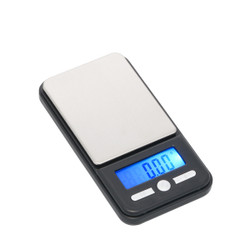
For broad watchmaking applications, the AWS SC501g Precision Digital Pocket Scale is a particularly versatile option.
Its specifications include:
Capacity: 500g
Readability: 0.01g
It also provides:
-
3.9 × 3.7-inch stainless-steel platform
-
Backlit LCD
-
Tare function
-
Two expansion trays
-
Multiple weighing units
-
Battery operation
-
Compact design
AWS specifies:
500g calibration weight required
and the calibration weight is:
not included.
For watch parts, the 500g capacity gives considerably more flexibility than a 20g or 50g milligram scale.
Why 500g × 0.01g Works Well for Watchmaking
A 500g × 0.01g scale can potentially cover:
Tiny component batch = 3.25g
Movement = 28.74g
Case = 52.16g
Bracelet = 91.42g
Complete watch = 168.37g
All remain:
within capacity.
This makes the configuration useful when you want:
one general-purpose watchmaking scale.
When 500g × 0.01g Is Not Fine Enough
Suppose you need to compare:
two extremely lightweight screws
whose weight difference is less than:
0.01g.
A hundredth-gram scale may not provide sufficient displayed detail.
This is where:
0.001g readability
can become useful.
Best Milligram Scale for Watch Parts
For highly detailed component work, the:
GEMINI-50
is a strong option.
AWS currently specifies:
-
50g capacity
-
0.001g readability
-
1.3 × 1.3-inch platform
-
g, oz, ozt, dwt, ct and gn
-
20g calibration weight included
-
Two AAA batteries
The 50g capacity makes it more versatile than the 20g version while preserving the same:
0.001g readability.
AWS's comparison of the GEMINI-20 vs. GEMINI-50 notes that the GEMINI-50 provides an additional 30g of capacity while maintaining the same one-milligram readability.
Best Scale for Watch Screws
Tiny watch screws can weigh:
very little.
If the purpose is:
comparing individual screw weights,
0.001g may be useful.
If the purpose is:
weighing batches of screws,
0.01g may be sufficient.
The correct choice depends on:
the measurement objective.
Best Scale for Watch Springs
Watch springs can also be extremely lightweight.
For individual spring comparison:
consider:
0.001g readability.
For grouped inventory:
higher capacity may matter more.
Best Scale for Watch Gears
Tiny gears can benefit from:
milligram readability
when comparing individual components.
Larger movement components may work comfortably with:
0.01g.
Best Scale for Watch Hands
Watch hands are lightweight.
If individual weight differences matter:
a milligram scale can provide more useful displayed detail.
Use:
a suitable tray or weighing surface
to prevent loss of tiny components.
Best Scale for Watch Jewels
Watch movements can contain very small jewels.
For individual measurement:
0.001g may be more appropriate than:
0.01g.
However, weight alone cannot establish:
-
Material
-
Authenticity
-
Quality
-
Correct watch application
Best Scale for Watch Crowns
Crowns are typically heavier than:
tiny screws or jewels.
Depending on the crown:
0.01g may provide sufficient detail.
For extremely small crowns:
0.001g may still be useful.
Best Scale for Watch Stems
Watch stems are:
small and narrow.
For individual comparison:
a milligram scale may be useful.
For batches:
0.01g with greater capacity can be more practical.
Best Scale for Watch Movement Parts
Movement parts vary significantly.
Some are:
extremely light.
Others are:
large enough that 0.01g provides adequate detail.
If your work includes:
many different movement components,
a two-scale setup can provide greater flexibility.
Best Scale for Complete Watch Movements
Complete movements usually do not require:
milligram readability.
A:
500g × 0.01g
scale provides significantly more capacity.
This also leaves room for:
a tray or holder.
Best Scale for Watch Cases
Watch cases can weigh:
tens of grams or more.
For cases:
0.01g readability is generally more practical than:
0.001g.
Prioritize:
-
Capacity
-
Platform size
-
Stability
Best Scale for Watch Bracelets
Metal bracelets can become relatively heavy.
A 20g or 50g milligram scale may be:
far too limited.
For bracelet weighing:
500g × 0.01g
provides much more flexibility.
Best Scale for Complete Watches
A complete watch can include:
-
Case
-
Movement
-
Crystal
-
Dial
-
Hands
-
Crown
-
Bracelet or strap
-
Clasp
For complete watches:
capacity becomes much more important.
A:
500g × 0.01g
scale is generally more useful than:
a low-capacity milligram scale.
Watch Parts Scale Comparison
| Scale Type | Capacity | Readability | Best Use |
|---|---|---|---|
| Milligram scale | 20g | 0.001g | Extremely lightweight parts |
| Milligram scale | 50g | 0.001g | Screws, gears, springs, small components |
| Milligram scale | 100g | 0.001g | Small parts with more capacity |
| Precision pocket scale | 500g | 0.01g | General watchmaking |
| Higher-capacity scale | 1kg+ | 0.1g | Large batches and heavier items |
Do More Decimal Places Mean Better Accuracy?
No.
This is an important distinction.
Suppose:
Scale A displays:
10.123g
Scale B displays:
10.12g.
Scale A has:
finer readability.
That alone does not establish:
better overall accuracy.
Evaluate:
-
Accuracy specification
-
Repeatability
-
Calibration
-
Minimum usable load
-
Stability
-
Environmental conditions
Readability vs. Accuracy
Readability
is the smallest increment shown on the display.
Accuracy
relates to how closely a measured value corresponds to the actual value within the instrument's specifications and conditions.
Do not use these terms interchangeably.
Repeatability Matters for Watch Parts
For tiny mechanical components:
repeatability is particularly important.
Suppose you weigh one watch screw five times:
0.083g
0.083g
0.083g
0.083g
0.083g
That demonstrates:
consistent repeatability under those conditions.
If the readings fluctuate significantly:
the additional decimal places become less useful.
Minimum Usable Load Matters
A scale displaying:
0.001g increments
does not automatically mean:
every 0.001g quantity can be reliably measured.
Review the manufacturer's:
-
Minimum load
-
Accuracy
-
Repeatability
-
Tolerance
where available.
Capacity Matters More Than Many Buyers Expect
Always calculate:
part + tray + container = total physical load.
Suppose:
Watch parts = 42g
Tray = 14g
Total =
56g.
A:
50g milligram scale
cannot support the complete load.
Tare Does Not Restore Capacity
Suppose:
Scale capacity = 50g
Tray = 15g
You place the tray on the scale and press:
tare.
The display becomes:
0.000g.
You do not suddenly have:
50g
of remaining physical capacity.
Approximately:
35g
of capacity remains.
Platform Size Matters for Watch Parts
Tiny parts need:
a controlled working surface.
Complete watches and bracelets need:
enough platform area.
The ideal platform depends on:
the object.
A small 1.3 × 1.3-inch milligram platform can work well for:
tiny components.
A 3.9 × 3.7-inch platform can be considerably more practical for:
-
Movements
-
Cases
-
Bracelets
-
Complete watches
Use a Tray for Tiny Watch Components
Tiny components can:
roll, slide or disappear.
A lightweight weighing tray can make measurement easier.
The process is:
-
Place tray on scale.
-
Allow reading to stabilize.
-
Press tare.
-
Confirm zero.
-
Place component in tray.
-
Record measurement.
Remember:
the tray still counts toward physical capacity.
Calibration Matters
Precision scales should be calibrated according to:
the manufacturer's procedure.
Calibration requirements are:
model-specific.
The SC501g specifies:
a 500g calibration weight.
The GEMINI-50 uses:
a 20g calibration weight, which is included.
Do not assume:
every precision scale uses the same calibration mass.
Do Not Calibrate With a Watch Part
A watch component is not:
a calibration standard.
Do not use:
-
Watch screws
-
Coins
-
Batteries
-
Jewelry
-
Household objects
as substitutes for an appropriate calibration mass.
Stable Surfaces Matter
Fine measurements require:
a stable environment.
Place the scale on:
a rigid, level surface.
Avoid:
-
Flexible watchmaker mats under the scale
-
Unstable tables
-
Moving benches
-
Uneven surfaces
Avoid Vibration
Watchmaking benches may contain:
equipment that produces vibration.
Vibration can affect:
fine measurements.
This is particularly relevant for:
0.001g scales.
Avoid Airflow
Air conditioning, fans and open windows can influence:
very lightweight measurements.
For milligram-scale work:
reduce direct airflow around the weighing platform.
Watch Out for Static
Small lightweight components can be affected by:
static electricity.
If a tiny part produces unstable readings:
consider environmental effects.
Temperature Matters
Allow the scale to operate within:
its specified temperature range.
The SC501g currently specifies:
50°F–86°F.
The GEMINI models use the same published operating range.
Piece Counting for Watch Parts
Some precision scales include:
piece-counting functionality.
AWS's:
AWS-ULTRA-50G
provides:
50g × 0.001g
plus:
piece counting.
This can be useful for batches of:
-
Screws
-
Washers
-
Pins
-
Similar hardware
How Piece Counting Works
The scale estimates:
average individual weight
from a sample.
It then uses total weight to estimate:
quantity.
Piece Counting Works Best With Identical Parts
Suppose:
100 identical screws
have highly consistent individual weights.
Piece counting may be useful.
But if the batch contains:
different screw sizes,
the estimate becomes less meaningful.
Piece Counting Is Not Visual Identification
A scale cannot tell whether:
the correct screw
is in the batch.
Piece counting should supplement:
physical inventory control.
Best Scale for Watch Parts Inventory
For general inventory:
500g × 0.01g
can provide a useful combination of:
capacity + fine readability.
For batches of extremely tiny identical parts:
0.001g with piece counting may be useful.
Best Scale for Watch Repair Shops
A repair shop may handle:
-
Screws
-
Pins
-
Springs
-
Crowns
-
Stems
-
Movements
-
Cases
-
Bracelets
-
Complete watches
Because the range is broad:
one scale may not optimally handle every task.
Best Scale for Watchmakers
For a watchmaker needing one general-purpose scale:
500g × 0.01g
is a strong starting specification.
For specialist component analysis:
add:
0.001g milligram capability.
Best Scale for Watch Collectors
Collectors may primarily weigh:
complete watches.
In that case:
500g × 0.01g
provides considerably more useful capacity than:
20g × 0.001g.
Best Scale for Watch Parts Sellers
Parts sellers may benefit from:
both precision and piece counting.
For:
individual component documentation,
0.001g may help.
For:
batch inventory,
higher capacity becomes more important.
Best Scale for Vintage Watch Parts
Vintage parts can be:
-
Tiny
-
Difficult to replace
-
Mixed
-
Irregular
Use:
a tray
and avoid unnecessary handling.
Weight can help with:
documentation,
but it cannot establish:
part identity or authenticity.
Can Weight Identify a Genuine Watch Part?
No.
A component weighing:
0.285g
cannot be declared genuine based solely on:
weight.
Authentication may require:
-
Dimensions
-
Markings
-
Material analysis
-
Manufacturer documentation
-
Expert inspection
Can Weight Authenticate a Watch?
No.
A complete watch's weight can be:
one reference point.
But weight alone cannot prove:
authenticity.
Counterfeit products can be designed to approximate:
expected weights.
Can Weight Identify a Watch Movement?
No.
Movement weight may be useful for:
documentation or comparison.
It does not independently establish:
movement identity.
Can Weight Determine Watch Value?
No.
Value depends on factors including:
-
Brand
-
Model
-
Reference
-
Rarity
-
Condition
-
Provenance
-
Materials
-
Market demand
Weight alone is:
not a valuation method.
Stainless Steel vs. Precious-Metal Watch Parts
Some watch components may contain:
-
Stainless steel
-
Gold
-
Platinum
-
Titanium
-
Brass
-
Other alloys
Weight can help document:
mass.
It cannot independently determine:
metal composition.
Grams vs. Other Weighing Units
For most watch-parts work:
grams
are straightforward.
Milligram-scale measurements can still be expressed in grams:
0.001g
0.025g
0.347g.
AWS precision scales may also support units such as:
-
oz
-
ozt
-
dwt
-
ct
-
gn
depending on the model.
Should You Use Grains for Watch Parts?
Usually:
grams are simpler.
Use another unit only when:
your workflow specifically requires it.
Should Watchmakers Buy One Scale or Two?
For broad professional or hobby work:
two scales can be extremely practical.
Scale 1: Milligram Scale
20–100g × 0.001g
Use for:
-
Screws
-
Springs
-
Gears
-
Hands
-
Pins
-
Jewels
-
Tiny movement components
Scale 2: General Precision Scale
500g × 0.01g
Use for:
-
Movements
-
Cases
-
Bracelets
-
Complete watches
-
Batches
-
Larger components
This avoids forcing one scale to cover:
an extremely wide measurement range.
Example Watchmaker Setup
Suppose your inventory includes:
Tiny screw = 0.035g
Gear = 0.125g
Crown = 1.84g
Movement = 29.75g
Case = 58.42g
Bracelet = 94.60g
Complete watch = 174.25g
A:
50g × 0.001g
scale is useful for the:
small components.
A:
500g × 0.01g
scale handles:
the larger components and complete watch.
Why One Milligram Scale Is Not Enough
A 50g × 0.001g scale cannot weigh:
a 174g complete watch.
Its extra decimal place is irrelevant if:
the object exceeds capacity.
Why One 500g Scale May Not Be Enough
A 500g × 0.01g scale may not provide sufficient displayed detail for:
a 0.025g component.
This is why a two-scale setup can be ideal.
Best AWS Scale Setup for Watch Parts
For general work:
SC501g — 500g × 0.01g
For fine components:
GEMINI-50 — 50g × 0.001g
For users wanting greater milligram-scale capacity:
AWS-ELITE-100G — 100g × 0.001g
For piece-counting workflows:
AWS-ULTRA-50G — 50g × 0.001g with piece counting.
This creates several options depending on whether the priority is:
capacity, fine readability or inventory counting.
Watch Parts Scale Buying Checklist
Before choosing a scale, ask:
-
What watch components will I weigh?
-
What is the lightest component?
-
What is the heaviest component?
-
Will I weigh complete movements?
-
Will I weigh cases?
-
Will I weigh bracelets?
-
Will I weigh complete watches?
-
Will I weigh batches of components?
-
Do I need 0.01g readability?
-
Do I genuinely need 0.001g?
-
What is the maximum capacity?
-
What does my tray weigh?
-
What is the complete physical load?
-
Is there enough capacity headroom?
-
What is the platform size?
-
Will the complete watch fit securely?
-
Does the scale have tare?
-
What calibration weight is required?
-
Is the calibration weight included?
-
What calibration procedure is specified?
-
What accuracy specifications are available?
-
What is the minimum usable load?
-
How repeatable are measurements?
-
Is the workbench stable?
-
Is vibration present?
-
Is there direct airflow?
-
Could static affect tiny components?
-
Is temperature stable?
-
Do I need piece counting?
-
Are the components consistent enough for piece counting?
-
Do I need multiple weighing units?
-
Will I use the scale for inventory?
-
Will I use it for documentation?
-
Am I incorrectly using weight for authentication?
-
Am I incorrectly using weight for valuation?
-
Would a two-scale setup be more practical?
Frequently Asked Questions
What is the best digital scale for watch parts?
For general watchmaking:
500g × 0.01g
is a strong starting specification.
For extremely small components:
0.001g readability
may be more appropriate.
Is 0.01g accurate enough for watch parts?
For many:
-
Movements
-
Cases
-
Bracelets
-
Complete watches
-
Larger components
0.01g readability provides useful measurement detail.
Tiny screws and springs may benefit from:
0.001g readability.
Do I need a 0.001g scale for watchmaking?
Not for everything.
Use 0.001g when:
milligram-level displayed increments genuinely matter.
What is the best scale for tiny watch screws?
A:
20–100g × 0.001g
milligram scale is a strong option.
What is the best scale for complete watches?
A:
500g × 0.01g
precision scale provides more appropriate capacity for many complete watches.
Is the AWS SC501g good for watch parts?
For general watch-parts weighing:
yes.
It provides:
500g capacity, 0.01g readability, tare, a 3.9 × 3.7-inch platform, multiple units and expansion trays.
Is the GEMINI-50 good for watch parts?
For tiny components:
yes.
It provides:
50g × 0.001g
and includes a 20g calibration weight.
What is better: GEMINI-20 or GEMINI-50?
Both provide:
0.001g readability.
The GEMINI-50 provides:
50g capacity
versus:
20g.
That makes the GEMINI-50 more versatile for many users.
Does 0.001g mean the scale is accurate to ±0.001g?
Not automatically.
0.001g describes:
readability.
Accuracy and repeatability are separate specifications.
Does tare increase scale capacity?
No.
Tare removes the container from:
the displayed result.
The container still contributes to:
physical load.
Can I use a tray for watch screws?
Yes.
A lightweight tray can help prevent tiny components from:
rolling or being lost.
Can a digital scale count watch screws?
Some scales offer:
piece counting.
This works best when:
the components have consistent individual weights.
Can weight authenticate a Rolex or another watch?
No.
Weight can provide:
one reference measurement,
but cannot independently establish authenticity.
Can weight identify genuine watch parts?
No.
Weight alone cannot establish:
manufacturer, model or authenticity.
Can weight tell me what metal a watch case is made from?
No.
Different materials have different densities, but mass alone cannot determine composition without additional information and testing.
How often should I calibrate my watch-parts scale?
Follow:
the manufacturer's instructions
and recalibrate when appropriate for your measurement workflow, particularly if the scale has been moved or readings appear inconsistent.
Can I calibrate a scale with a coin?
Use the:
specified calibration mass
rather than a random household object or coin.
Should I buy one or two scales for watch repair?
If you routinely work with both:
tiny movement components
and:
complete watches,
two scales can provide a much better measurement range.
Final Verdict: Best Digital Scale for Watch Parts
The best digital scale for watch parts depends primarily on:
the smallest component you need to measure and the heaviest complete load you need to support.
For general watchmaking, repair, collecting and parts inventory:
500g × 0.01g
is an excellent starting specification.
It provides enough capacity for many:
-
Movements
-
Cases
-
Bracelets
-
Complete watches
-
Component batches
while maintaining:
hundredth-of-a-gram readability.
For a versatile AWS option, the:
SC501g Precision Digital Pocket Scale
provides:
500g × 0.01g
with:
-
3.9 × 3.7-inch stainless-steel platform
-
Tare
-
Expansion trays
-
Backlit LCD
-
Multiple units
-
Battery operation
For tiny watch components requiring finer displayed increments:
consider:
0.001g milligram readability.
AWS options include:
-
GEMINI-20 — 20g × 0.001g
-
GEMINI-50 — 50g × 0.001g
-
AWS-ULTRA-50G — 50g × 0.001g
-
AWS-ELITE-100G — 100g × 0.001g
For many watchmakers, the strongest setup is:
0.001g milligram scale for tiny components + 500g × 0.01g precision scale for movements, cases, bracelets and complete watches.
Whatever scale you choose, evaluate:
-
Capacity
-
Readability
-
Accuracy specifications
-
Repeatability
-
Minimum usable load
-
Platform size
-
Tare
-
Calibration
-
Environmental stability
And remember:
more decimal places do not automatically mean better accuracy.
The best watch-parts scale is the one whose:
capacity + readability + platform + calibration requirements
match the components you actually work with.