
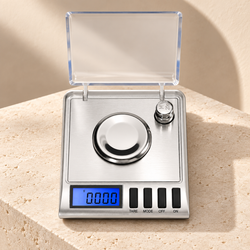
The best precision scale for gemstones is not necessarily the model with the most decimal places.
A useful gemstone scale must balance several specifications:
-
Resolution
-
Capacity
-
Repeatability
-
Calibration
-
Carat mode
-
Platform size
-
Tare
-
Environmental stability
-
Portability
-
Display readability
For many jewelers, collectors and gemstone sellers, a scale with:
0.01 g readability
offers an excellent balance between fine measurement and practical capacity.
For extremely small gemstones or situations where finer distinctions matter:
0.001 g readability
may be more appropriate.
But resolution alone should never determine the purchase.
A scale displaying three decimal places can still produce poor results if it is:
-
Improperly calibrated
-
Sitting on an unstable surface
-
Exposed to airflow
-
Overloaded
-
Used outside its intended measuring range
American Weigh Scales offers a wide selection of precision pocket scales designed for small-object weighing applications including jewelry, gemstones, coins and collectibles.
The most important question is therefore not:
“Which scale has the most decimals?”
It is:
“Which features match the gemstones and jewelry I actually weigh?”
Quick Answer: Which Features Matter Most?
For gemstone weighing, prioritize these features:
| Feature | Why It Matters |
|---|---|
| Resolution | Determines the smallest displayed increment |
| Capacity | Determines total physical load supported |
| Repeatability | Helps confirm consistent measurements |
| Carat mode | Simplifies gemstone weight display |
| Calibration | Helps maintain measurement reference |
| Platform size | Determines whether stones, trays and jewelry fit properly |
| Tare | Allows containers to be zeroed on the display |
| Draft protection | Important for milligram-level measurements |
| Stable construction | Reduces movement-related variation |
| Multiple units | Useful for grams, carats, grains and jewelry applications |
| Protective cover | Useful for travel and storage |
| Battery life | Important for portable dealer use |
For many general gemstone applications, a versatile starting specification is:
500 g × 0.01 g.
For very small loose stones:
20–50 g × 0.001 g
may be a better fit.
Feature 1: Resolution
Resolution is one of the first specifications buyers notice.
It describes:
the smallest increment shown on the scale's display.
For example:
1 g Resolution
The display changes in increments such as:
21 g
22 g
23 g
This is useful for food or larger objects, but generally too coarse for individual loose gemstones.
0.1 g Resolution
The display changes in increments such as:
2.1 g
2.2 g
2.3 g
This can be useful for larger jewelry pieces but is still relatively coarse for many individual gemstones.
0.01 g Resolution
The display can show:
1.21 g
1.22 g
1.23 g
This is a practical level for many everyday gemstone and jewelry applications.
0.001 g Resolution
The display can show:
0.251 g
0.252 g
0.253 g
This is milligram readability and is more appropriate for very small loose stones.
What Is the Best Resolution for Gemstones?
There is no single correct resolution for every gemstone application.
Use:
0.01 g
for many:
-
Loose gemstones
-
Larger diamonds
-
Jewelry components
-
Rings
-
Pendants
-
Gemstone inventory
-
Jewelry making
Consider:
0.001 g
for:
-
Very small diamonds
-
Tiny colored gemstones
-
Gem parcels
-
Fine sorting
-
Milligram-level comparison
The finer the resolution, the more environmental stability becomes important.
Resolution Is Not Accuracy
This is one of the most important concepts when buying a precision scale.
If a scale displays:
0.001 g
that does not automatically mean it is guaranteed accurate to:
±0.001 g
under every condition.
Resolution describes:
display increment.
Accuracy describes:
how close the reading is to the true mass.
Repeatability describes:
how consistently the instrument produces similar readings when the same object is weighed repeatedly.
Those three concepts should not be confused.
Why More Decimal Places Are Not Always Better
Suppose you weigh finished gemstone necklaces and bracelets.
A:
20 g × 0.001 g
scale might provide extremely fine resolution but insufficient capacity.
A:
500 g × 0.01 g
scale may be much more useful.
The technically finer display does not make the lower-capacity scale the better tool.
Choose resolution within the context of the entire workflow.
Feature 2: Carat Mode
Carat mode is especially useful for gemstone work.
The metric carat is the standard unit commonly used for gemstone weight.
According to the Gemological Institute of America:
1 carat = 0.2 gram.
That also means:
1 gram = 5 carats.
Examples:
| Grams | Carats |
|---|---|
| 0.02 g | 0.10 ct |
| 0.05 g | 0.25 ct |
| 0.10 g | 0.50 ct |
| 0.20 g | 1.00 ct |
| 0.40 g | 2.00 ct |
| 1.00 g | 5.00 ct |
| 2.00 g | 10.00 ct |
A scale with direct:
ct
mode eliminates the need to manually convert every measurement.
Is Carat Mode Necessary?
Not strictly.
A scale displaying grams can still be used because:
carats = grams × 5.
However, built-in carat mode can improve convenience for:
-
Gem dealers
-
Jewelers
-
Collectors
-
Jewelry makers
-
Auction sellers
especially when weighing multiple stones.
Feature 3: Capacity
Capacity is just as important as resolution.
Scale capacity means:
the maximum total physical load the scale is designed to support.
For gemstone scales, common useful ranges include:
-
20 g
-
50 g
-
100 g
-
200 g
-
500 g
Higher capacities may be useful for finished jewelry and larger parcels.
How Much Capacity Do Loose Gemstones Need?
Individual gemstones are usually light.
Consider:
10 ct = 2 g
25 ct = 5 g
50 ct = 10 g
100 ct = 20 g
Therefore:
20 g capacity already equals 100 carats.
For many individual gemstones, that is substantial.
But the gemstone itself is not always the only thing on the scale.
You may also add:
-
Gem cup
-
Tray
-
Container
-
Parcel envelope
-
Jewelry setting
That additional weight matters.
Why 500 g Capacity Can Still Be Useful
A 500 g scale may seem excessive for individual gemstones.
But it becomes practical if you also weigh:
-
Rings
-
Bracelets
-
Necklaces
-
Watches
-
Gem parcels
-
Silver jewelry
-
Gold jewelry
-
Large trays
For mixed gemstone and jewelry work, higher capacity provides flexibility.
Capacity vs. Resolution
There is often a tradeoff.
A scale optimized for:
500 g capacity
may offer:
0.01 g readability.
A scale optimized for:
0.001 g readability
may offer only:
20 or 50 g capacity.
Neither is inherently better.
Choose according to the job.
Feature 4: Repeatability
Repeatability is one of the most underrated scale features.
Suppose you place the same gemstone on a scale five times.
You might expect measurements such as:
1.26 g
1.26 g
1.26 g
1.26 g
1.26 g
If instead you see:
1.22 g
1.29 g
1.24 g
1.31 g
1.25 g
something needs investigation.
Possible causes include:
-
Drafts
-
Vibration
-
Static
-
Temperature changes
-
Calibration issues
-
Low battery
-
Contaminated platform
-
Unstable work surface
A precision scale should not merely display fine digits.
Those digits should also be reasonably repeatable under proper operating conditions.
Repeatability Matters More as Stones Get Smaller
A variation of:
0.01 g
may represent a meaningful percentage of a very small gemstone.
Therefore, repeatability becomes increasingly important as the measured object becomes lighter.
Feature 5: Calibration
Calibration helps establish the scale's measurement reference.
Different scales require different calibration procedures.
Always use:
the calibration weight specified by the manufacturer.
Do not assume that every precision scale uses:
-
20 g
-
50 g
-
100 g
-
500 g
calibration.
The correct value is model specific.
Do Not Calibrate With Coins
A common mistake is using coins as calibration weights.
Coins are not ideal precision calibration references because actual mass can vary through:
-
Manufacturing tolerance
-
Wear
-
Dirt
-
Damage
-
Corrosion
Use a proper calibration mass.
Calibration Weight Quality Matters
A precision scale deserves an appropriate reference weight.
A random object labeled:
“approximately 50 g”
is not equivalent to a proper calibration weight.
For fine gemstone work, the reference should be appropriate to the scale's instructions.
Feature 6: Platform Size
Platform size affects usability more than many buyers expect.
A tiny platform may be perfect for:
-
Loose gemstones
-
Small diamonds
but inconvenient for:
-
Large trays
-
Bracelets
-
Pendants
-
Larger jewelry
A broader platform provides more flexibility.
SC501g as a General Gemstone Example
The SC501g Precision Digital Pocket Scale provides:
-
500 g capacity
-
0.01 g readability
-
Carat mode
-
Stainless-steel platform
-
Tare
-
Multiple units
-
Approximately 3.9 × 3.7-inch platform
That combination makes it useful when the same scale may be used for:
-
Loose gemstones
-
Gemstone parcels
-
Rings
-
Pendants
-
Jewelry components
Smaller Platforms for Milligram Work
A smaller platform can be completely appropriate when the scale is primarily used for:
-
Individual gems
-
Tiny diamonds
-
Small gem trays
The important point is:
the complete weighing setup must fit comfortably.
Feature 7: Tare
Tare is essential when using a:
-
Gem cup
-
Tray
-
Container
-
Paper
-
Holder
The process is simple:
-
Place the empty container on the scale.
-
Press tare.
-
Display returns to zero.
-
Add gemstones.
-
Read the displayed net mass.
This makes gemstone weighing much more convenient.
Tare Does Not Restore Capacity
This deserves special attention.
Suppose your scale has:
50 g capacity.
You place a:
12 g tray
on it.
You press tare.
The display returns to:
0.000 g.
But physically the scale is still supporting:
12 g.
Therefore, approximately:
38 g
of physical capacity remains.
Tare changes:
the displayed zero point.
It does not change:
the load cell's maximum capacity.
Feature 8: Multiple Weighing Units
Gemstone professionals may use more than one weighing unit.
Useful modes can include:
-
g
-
ct
-
oz
-
ozt
-
dwt
-
gn
For gemstone-focused work, the two most important are usually:
grams + carats.
For precious metals and broader jewelry applications, additional units can be useful.
Grams
Useful for:
-
General measurement
-
Calibration
-
Jewelry
-
Parcels
Carats
Useful for:
-
Diamonds
-
Rubies
-
Sapphires
-
Emeralds
-
Loose colored stones
Troy Ounces and Pennyweight
These may be useful when the same scale is also used for:
-
Gold
-
Silver
-
Precious-metal jewelry
Feature 9: Draft Protection
Air movement may seem insignificant.
At milligram resolution, it is not.
A scale displaying:
0.001 g
can react to subtle airflow.
Possible sources include:
-
Ceiling fans
-
Air-conditioning vents
-
Open windows
-
Portable fans
-
Breathing near the weighing platform
For milligram-level gemstone work, protect the scale from drafts.
Why Draft Shields Matter
Some milligram scales include protective covers that can also help reduce airflow around the weighing area.
This is particularly useful when measuring very small stones.
The finer the resolution:
the more controlled the environment should be.
Feature 10: Stable Work Surface
Place a gemstone scale on a:
-
Hard
-
Level
-
Stable
-
Vibration-resistant
surface.
Avoid:
-
Flexible tables
-
Soft mats
-
Shaking desks
-
Shelves that move
-
Counters beside machinery
A high-resolution scale cannot compensate for an unstable workbench.
Feature 11: Temperature Stability
Sensitive electronics and load cells may react to temperature changes.
If a scale has been moved from:
cold environment → warm jewelry room
allow it to stabilize according to manufacturer instructions before demanding the finest measurements.
Consistent room conditions help improve consistency.
Feature 12: Static Control
Static electricity can affect very fine weighing.
This can become noticeable with:
-
Plastic containers
-
Dry rooms
-
Synthetic materials
If a 0.001 g scale appears unstable despite:
-
Proper calibration
-
No drafts
-
Stable surface
static may be worth investigating.
Feature 13: Protective Cover
A protective cover is particularly useful for portable gemstone scales.
It can help protect:
-
Platform
-
Display
-
Buttons
-
Scale body
during:
-
Transport
-
Trade shows
-
Auctions
-
Storage
Some covers can also function as weighing trays.
Feature 14: Portability
Gem dealers may need a scale in:
-
Jewelry stores
-
Trade shows
-
Auctions
-
Customer meetings
-
Buying appointments
Useful portability features include:
-
Compact size
-
Battery power
-
Protective cover
-
Lightweight housing
A bench user may care less about portability and more about:
-
Larger platform
-
Power options
-
Permanent workspace stability
Compact Option: SM-501-BLK
The SM-501-BLK ScaleMate offers:
500 g × 0.01 g
in a compact format.
It also supports:
-
g
-
oz
-
gn
-
ct
-
ozt
-
dwt
and includes a magnetic protective cover.
This makes it a useful option for:
-
Gem collectors
-
Jewelry makers
-
Traveling sellers
-
Trade-show use
Feature 15: Milligram Capability
For extremely small gemstones, 0.01 g may not provide enough displayed detail.
This is where milligram scales become useful.
American Weigh Scales' milligram scale comparison covers models designed around:
0.001 g readability.
0.001 g in Carats
Because:
1 ct = 0.2 g
then:
0.001 g =
0.005 ct.
That is:
half of one carat point.
This provides substantially finer displayed resolution than:
0.01 g = 0.05 ct.
Milligram Scales for Tiny Gemstones
A 0.001 g scale can be useful for:
-
Tiny diamonds
-
Small sapphires
-
Small rubies
-
Gemstone parcels
-
Fine sorting
However, it requires greater attention to environmental conditions.
Gemini-20 vs. Gemini-50
For users who need 0.001 g readability, AWS offers models such as the Gemini series.
The Gemini-20 vs. Gemini-50 comparison highlights the main capacity difference:
Gemini-20
20 g × 0.001 g
Gemini-50
50 g × 0.001 g
Both capacities are substantial when expressed in gemstone carats.
20 g Equals 100 Carats
Remember:
1 g = 5 ct.
Therefore:
20 g =
100 ct.
For many individual gemstones, 20 g is more than enough.
50 g Equals 250 Carats
Likewise:
50 g =
250 ct.
That extra capacity can become useful when weighing:
-
Gem parcels
-
Larger trays
-
Groups of stones
while still retaining 0.001 g readability.
Feature 16: Readable Display
The display should be:
-
Clear
-
Easy to see
-
Large enough to read comfortably
A backlit display can be especially useful under:
-
Jewelry-store lighting
-
Workshop lighting
-
Trade-show environments
Poor display readability can lead to avoidable transcription mistakes.
Feature 17: Battery and Power Options
Portable gemstone scales usually use batteries.
This is convenient for:
-
Travel
-
Trade shows
-
Auctions
A scale used permanently at a jewelry bench may benefit from:
-
Long battery life
-
Optional AC power
depending on the model.
Feature 18: Expansion Tray
An expansion tray can be particularly useful for gemstones.
Benefits include:
-
Containing rolling stones
-
Holding parcels
-
Preventing tiny stones from falling
-
Increasing usable weighing area
A protective cover that doubles as a tray can add significant practical value.
Gemstone Tray Best Practice
When using a tray:
-
Place the empty tray on the scale.
-
Allow the reading to stabilize.
-
Press tare.
-
Add the gemstones.
-
Wait for a stable reading.
Remember:
tray weight still contributes to physical capacity.
Feature 19: Appropriate Capacity Headroom
Do not routinely operate a scale directly at its maximum limit.
Suppose you need to weigh:
450 g.
A:
500 g scale
technically has enough capacity.
But if you add:
-
Tray
-
Container
-
Packaging
you could exceed the limit.
Choose enough headroom for the entire weighing setup.
Feature 20: Ability to Handle Finished Jewelry
A gemstone scale may also need to weigh:
-
Rings
-
Pendants
-
Earrings
-
Bracelets
-
Necklaces
If so, do not choose capacity based solely on loose stones.
A:
20 g milligram scale
may be perfect for loose gemstones but impractical for heavier jewelry.
Loose Gemstone Scale vs. Jewelry Scale
Loose Gemstone Priority
Focus on:
-
Fine resolution
-
Carat mode
-
Draft protection
Finished Jewelry Priority
Focus more on:
-
Higher capacity
-
Larger platform
-
Tare
-
Versatility
This is why one scale may not be optimal for every jewelry task.
A Two-Scale Setup Can Make Sense
Professional users may benefit from:
General Precision Scale
500 g × 0.01 g
for:
-
Jewelry
-
Larger stones
-
Parcels
-
Trays
plus:
Milligram Scale
20–50 g × 0.001 g
for:
-
Tiny gemstones
-
Small diamonds
-
Fine comparison work
This gives each instrument a specific job.
Do Not Choose a Scale From Gemstone Size Alone
A gemstone's physical dimensions do not directly determine its weight.
Different gemstones have different densities.
The International Gem Society's standard gem size chart demonstrates how stones with the same dimensions can have different carat weights depending on gem material and specific gravity.
Therefore:
6 mm does not equal one universal carat weight.
Density Matters
A sapphire and opal of similar dimensions can weigh differently.
Likewise:
-
Diamond
-
Topaz
-
Emerald
-
Quartz
-
Garnet
have different densities.
A scale measures actual mass.
Dimensions provide only part of the picture.
Do Not Use Weight Alone to Identify a Gemstone
A scale cannot tell you whether a stone is:
-
Natural
-
Laboratory-created
-
Imitation
-
Treated
-
Synthetic
The Federal Trade Commission's consumer guidance for buying gemstones explains the importance of understanding characteristics such as gemstone type and treatment.
Weight is useful.
It is not an identification test.
Commercial Gemstone Weight Claims Need Care
If a business advertises gemstone weight, that information should accurately describe the merchandise.
The FTC Jewelry Guides provide guidance regarding representations involving:
-
Gemstones
-
Precious metals
-
Pearls
-
Jewelry characteristics
A precision scale can support accurate recordkeeping, but the seller remains responsible for truthful product representation.
Carat Weight Does Not Equal Value
A heavier gemstone is not automatically more valuable.
Gemstone value can also depend on:
-
Material
-
Color
-
Clarity
-
Cut
-
Treatment
-
Origin
-
Rarity
-
Market demand
For diamonds, GIA emphasizes that carat is only one element of the familiar:
4Cs.
Weight should therefore be interpreted within the broader gemstone context.
Best Precision Scale for Diamonds
For general diamond weighing:
0.01 g
may be sufficient for some jewelry and inventory tasks.
For smaller loose diamonds:
0.001 g
provides much finer displayed resolution.
Professional commercial grading may require specialized equipment and industry procedures beyond a general consumer precision scale.
Best Precision Scale for Sapphires
For larger loose sapphires:
0.01 g
may provide practical everyday resolution.
For:
-
Tiny sapphires
-
Small calibrated stones
-
Fine parcels
consider:
0.001 g.
Best Precision Scale for Rubies
Rubies often require the same general scale considerations as sapphires.
Prioritize:
-
Resolution
-
Carat mode
-
Repeatability
-
Calibration
-
Stable environment
Best Precision Scale for Emeralds
Emeralds can be valuable even at relatively small sizes.
For fine loose-stone work:
0.001 g may be useful.
For general inventory:
0.01 g may provide an adequate balance of precision and capacity.
Best Precision Scale for Opals
Opal density differs from several other commonly traded gemstones.
Do not estimate its mass only from visual size.
A correctly selected precision scale provides the actual weight.
Best Precision Scale for Gemstone Parcels
Parcel weighing requires a balance between:
fine resolution + sufficient capacity.
If the parcel may exceed:
20 g,
a:
20 g × 0.001 g
scale is obviously unsuitable.
Choose either:
-
50 g × 0.001 g
or:
-
Higher capacity × 0.01 g
depending on the precision required.
Best Precision Scale for Jewelers
For a jeweler handling:
-
Loose gemstones
-
Finished jewelry
-
Findings
-
Precious metals
a:
500 g × 0.01 g
scale can provide excellent versatility.
For exceptionally small stones:
add a milligram scale.
AWS's digital jewelry scale guide covers the differences between scales for jewelry, precious metals and gemstones.
Best Precision Scale for Gemstone Collectors
Collectors should prioritize:
-
0.01 g readability
-
Carat mode
-
Protective cover
-
Portable size
-
Tare
-
Calibration capability
A 500 g capacity model leaves plenty of room for:
-
Loose stones
-
Small collections
-
Containers
-
Jewelry
Best Precision Scale for Gem Dealers
Dealers may benefit from:
-
Carat mode
-
Portable design
-
0.001 g secondary scale
-
Repeatable readings
-
Protective cover
-
Expansion tray
If working at trade shows, portability becomes especially important.
Best Precision Scale for Jewelry Makers
Jewelry makers often weigh more than gemstones.
They may also handle:
-
Findings
-
Chains
-
Wire
-
Pendants
-
Finished products
For that reason:
higher capacity + 0.01 g readability
is often more useful than ultra-fine low-capacity measurement alone.
Common Mistakes When Buying a Gemstone Scale
Choosing the Most Decimal Places
More digits do not guarantee better measurements.
Ignoring Maximum Capacity
Fine resolution is useless if the scale cannot support the item.
Forgetting the Tray Weight
The tray consumes capacity.
Assuming Tare Restores Capacity
It does not.
Buying a 1 g Scale for Loose Gems
That resolution is too coarse for many gemstones.
Ignoring Carat Mode
Direct ct measurement can make gemstone workflows easier.
Ignoring Repeatability
Consistent readings matter.
Using Coins for Calibration
Use the manufacturer's specified calibration weight.
Measuring Near an Air Vent
Drafts matter at fine resolution.
Using a Shaky Workbench
Vibration can influence readings.
Ignoring Static
Static can matter at milligram resolution.
Assuming Gemstone Diameter Determines Carat Weight
Different gem materials have different densities.
Weighing Mounted Jewelry and Calling It Gemstone Weight
The reading includes the setting and metal.
Assuming Weight Identifies a Gemstone
It does not.
Precision Gemstone Scale Buying Checklist
Before buying, ask:
-
What gemstones will I weigh?
-
How small are the smallest stones?
-
What is the largest total load?
-
Do I need 0.01 g resolution?
-
Do I need 0.001 g resolution?
-
Do I need carat mode?
-
Does the scale display grams?
-
Do I need jewelry-related units?
-
What is the maximum capacity?
-
Will I weigh stone parcels?
-
Will I weigh finished jewelry?
-
Will I use a tray?
-
How much does the tray weigh?
-
Is the platform large enough?
-
Does the scale provide tare?
-
What calibration weight is required?
-
Is calibration straightforward?
-
Is the scale repeatable?
-
Will airflow be a problem?
-
Do I need a draft shield?
-
Is the work surface stable?
-
Could static become an issue?
-
Is temperature reasonably stable?
-
Is the display easy to read?
-
Do I need a protective cover?
-
Will I travel with the scale?
-
Is battery power important?
-
Do I need optional AC operation?
-
Would an expansion tray help?
-
Can the scale comfortably handle the full workflow?
-
Would a second milligram scale be useful?
-
Am I confusing resolution with accuracy?
-
Am I relying on gemstone dimensions instead of actual mass?
-
Will the scale support accurate product records?
Frequently Asked Questions
What is the best precision scale for gemstones?
For many general-purpose gemstone and jewelry tasks:
500 g × 0.01 g
provides a strong balance of resolution and capacity.
For extremely small loose stones:
20–50 g × 0.001 g
may be more appropriate.
Is 0.01 g precise enough for gemstones?
For many general inventory, jewelry-making and collector applications, yes.
For very small stones or fine professional measurements, 0.001 g may be preferable.
Is 0.001 g better than 0.01 g?
It provides finer displayed resolution.
However, it also typically means:
-
Lower capacity
-
Greater sensitivity to airflow
-
Greater sensitivity to vibration
-
More demanding operating conditions
Use it when that level of resolution is genuinely needed.
What does 0.01 g equal in carats?
Because:
1 ct = 0.2 g,
0.01 g equals:
0.05 ct.
What does 0.001 g equal in carats?
0.001 g equals:
0.005 ct.
How many carats equal one gram?
5 carats.
Should a gemstone scale have carat mode?
It is not mandatory, but it is very convenient.
How much capacity do I need?
For individual loose gemstones, 20–100 g can already provide substantial capacity.
For:
-
Jewelry
-
Larger trays
-
Parcels
500 g may provide more flexibility.
Is 500 g too much capacity for gemstones?
No.
It can be extremely useful when one scale also handles finished jewelry and larger containers.
Do I need a milligram scale?
Consider one if your smallest gemstones require:
0.001 g readability.
What is more important: resolution or capacity?
Neither should be considered alone.
The correct scale balances:
resolution + capacity.
Why is repeatability important?
Because a useful precision scale should produce reasonably consistent measurements when the same object is weighed repeatedly under stable conditions.
Why does my gemstone scale keep changing?
Possible causes include:
-
Drafts
-
Vibration
-
Static
-
Temperature
-
Calibration
-
Weak battery
-
Unstable surface
Should I use a weighing tray?
A tray can be useful for:
-
Tiny stones
-
Parcels
-
Rolling gemstones
Remember to tare it and account for its physical weight.
Does tare increase the scale's capacity?
No.
The tray remains part of the physical load.
Can I calibrate a gemstone scale with a coin?
Use the specified calibration weight rather than relying on ordinary objects.
Is carat weight the same as gemstone size?
No.
Carat measures mass.
Physical size depends on:
-
Density
-
Shape
-
Cut
-
Proportions
Can two gemstones of the same size weigh differently?
Yes.
Different gemstone materials have different densities.
Can a precision scale identify gemstones?
No.
It measures mass only.
Can I weigh a gemstone inside a ring?
You can weigh the complete ring, but the result includes:
-
Gemstone
-
Metal
-
Setting
-
Other components
It does not represent the loose gemstone's individual weight.
Final Verdict: Which Features Matter Most?
The best precision scale for gemstones is determined by the complete feature set—not simply the number of decimal places on the display.
Start with:
resolution.
For many general applications:
0.01 g
offers a strong balance.
For extremely small loose gemstones:
0.001 g
provides significantly finer displayed increments.
Then determine:
capacity.
For loose gems alone:
20–50 g may be plenty.
For mixed gemstone and jewelry work:
500 g
can provide much greater flexibility.
Then look for:
-
Carat mode
-
Repeatability
-
Proper calibration
-
Tare
-
Suitable platform size
-
Multiple units
-
Protective cover
-
Stable construction
-
Clear display
For milligram weighing, also pay close attention to:
-
Drafts
-
Vibration
-
Static
-
Temperature stability
A strong general-purpose gemstone setup is:
500 g × 0.01 g
for:
-
Larger gemstones
-
General gem inventory
-
Jewelry
-
Parcels
-
Trays
combined, when necessary, with:
20–50 g × 0.001 g
for:
-
Tiny loose gemstones
-
Small diamonds
-
Fine comparison work
The most useful selection process is:
define the smallest stone → determine required resolution → estimate maximum total load → include tray weight → choose capacity → verify carat mode → check platform → confirm calibration → evaluate repeatability.
That approach produces a much better result than simply buying the scale with:
the most decimal places.