
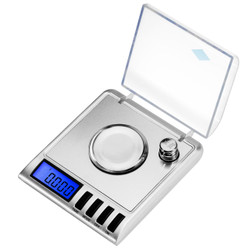
The best precision scale for jewelry is not necessarily the model with the most decimal places. The right choice depends on what you weigh, how heavy those items are, how small a difference you need to detect, and the environment where the scale will be used.
For many jewelry makers, collectors, repair professionals, and hobbyists, 0.01g readability provides an excellent balance between precision and usable capacity. Loose gemstones, tiny findings, and very small components may require 0.001g readability, while heavier jewelry and larger batches of material may be better suited to a higher-capacity scale with 0.1g readability.
American Weigh Scales offers precision formats ranging from compact pocket scales to fine-resolution milligram scales. Choosing between them should start with the application rather than the number printed after the decimal point.
This guide explains the features that matter most when selecting a precision scale for jewelry, including readability, capacity, repeatability, calibration, tare, weighing units, platform design, environmental sensitivity, portability, and commercial-use considerations.
Why Jewelry Needs a Precision Scale
Jewelry pieces are often small but can contain valuable materials. A difference that looks insignificant on an ordinary household scale may be relevant when weighing gold, silver, gemstones, findings, or small components.
A whole-gram kitchen scale might display both a 5.2g and a 5.4g item as approximately 5g depending on its design and rounding behavior. A precision scale provides much finer information.
Common jewelry weighing tasks include:
-
Rings
-
Earrings
-
Pendants
-
Chains
-
Bracelets
-
Loose gemstones
-
Diamonds
-
Gold and silver components
-
Findings
-
Beads
-
Watch parts
-
Scrap precious metals
-
Wax models
-
Small batches of components
-
Finished pieces for inventory
The best scale should be selected around the smallest meaningful measurement and the largest realistic load.
Quick Guide: Which Precision Does Jewelry Need?
| Jewelry application | Typical useful capacity | Suggested readability |
|---|---|---|
| Finished rings and earrings | 100–500g | 0.01g |
| Chains, pendants and bracelets | 200–1,000g | 0.01g |
| Loose gemstones | 20–100g | 0.001g or suitable carat resolution |
| Tiny findings | 20–100g | 0.001g |
| Jewelry-making materials | 500–2,000g | 0.01g or 0.1g |
| Scrap gold and silver lots | 500–2,000g | 0.01g or 0.1g |
| Larger decorative pieces | 1,000g+ | 0.1g may be practical |
These are starting points, not universal specifications. Always compare the scale manufacturer's stated performance with your actual application.
Feature #1: Readability
Readability is one of the first specifications shoppers notice. It describes the smallest increment shown on the display.
A scale might read in:
-
1g increments
-
0.1g increments
-
0.01g increments
-
0.001g increments
For jewelry, 0.01g and 0.001g are especially common precision categories.
Is 0.1g Enough for Jewelry?
A 0.1g scale displays tenths of a gram.
It may be suitable for:
-
Larger jewelry pieces
-
Bulk findings
-
Beads
-
Heavier silver items
-
Larger scrap-metal batches
-
Production materials where hundredths of a gram are not significant
The advantage is that 0.1g models can often provide greater capacity than finer-resolution scales.
The disadvantage is that they may not show enough detail for small rings, lightweight components, gemstones, or situations where hundredths of a gram matter.
Why 0.01g Is a Strong General Jewelry Choice
A 0.01g scale displays hundredths of a gram.
Examples include:
-
3.82g
-
14.27g
-
86.05g
For general jewelry work, this level provides a useful combination of precision, portability, and capacity.
A 0.01g precision scale can be useful for:
-
Rings
-
Earrings
-
Chains
-
Pendants
-
Bracelets
-
Precious-metal pieces
-
Findings
-
Beads
-
Small scrap lots
-
Wax models
-
Coins
-
General jewelry repair work
A common specification is 500g x 0.01g. This means the scale can support up to 500 grams and displays changes in 0.01-gram increments. For a deeper explanation, see the AWS guide to what 500g x 0.01g means on a digital scale.
When 0.001g Matters
A 0.001g scale reads to one milligram.
This finer resolution can be valuable for:
-
Loose gemstones
-
Tiny findings
-
Very lightweight components
-
Small precious-metal pieces
-
Detailed jewelry development
-
Applications where 0.01g is too coarse
However, finer readability brings greater environmental sensitivity. Air movement, vibration, static, temperature change, and even movement near the scale can affect the final displayed digits.
A milligram scale therefore works best on a stable bench in a controlled area. AWS's guide to 0.001g milligram scales explains the tradeoffs involved in this precision class.
Feature #2: Capacity
Capacity is the maximum total load a scale can support.
This sounds straightforward, but jewelry users sometimes focus so heavily on precision that they overlook capacity.
Everything on the platform counts toward the maximum:
-
Jewelry
-
Trays
-
Cups
-
Weighing boats
-
Gemstone dishes
-
Containers
-
Multiple pieces weighed together
Suppose you have a 500g scale and use a 100g tray. Even after pressing tare, the physical tray still uses 100g of the scale's capacity.
That leaves approximately 400g for the jewelry and other material.
Do Not Buy More Capacity Than You Need
Higher capacity is not always better.
Scale design involves tradeoffs. A compact scale designed to measure tiny masses finely may have much less capacity than a bench scale designed for larger loads.
Start with two questions:
-
What is the heaviest object or container-plus-object combination I will realistically weigh?
-
What is the smallest difference I need the scale to display?
The ideal scale provides comfortable capacity above the first number and sufficient readability for the second.
Feature #3: Accuracy
Readability and accuracy are related but are not interchangeable.
A scale that displays 0.001g increments does not automatically guarantee that every displayed digit is accurate to 0.001g under all operating conditions.
Accuracy depends on factors including:
-
Scale design
-
Calibration
-
Load range
-
Temperature
-
Surface stability
-
Air movement
-
Electronic condition
-
Proper operation
When comparing scales, do not judge performance only by the number of decimal places.
Look for manufacturer specifications concerning tolerance, repeatability, calibration, and recommended operating conditions.
Feature #4: Repeatability
Repeatability is especially important for jewelry.
A repeatable scale should return similar readings when the same stable object is weighed repeatedly under substantially the same conditions.
You can perform a simple repeatability check:
-
Put the scale on a hard, stable surface.
-
Turn it on and allow it to stabilize.
-
Confirm that it reads zero.
-
Place an appropriate reference weight in the center.
-
Record the result.
-
Remove the weight.
-
Wait for the display to return to zero.
-
Repeat several times.
If the readings vary substantially, investigate the environment, batteries, calibration, platform, and condition of the scale before relying on it.
Feature #5: Minimum Usable Load
A common misunderstanding is that the smallest display increment equals the smallest amount the scale can reliably measure.
That is not necessarily true.
A scale displaying 0.01g increments should not automatically be assumed to reliably measure an object whose entire mass is only 0.01g.
For extremely light jewelry components, review the manufacturer's specifications and intended operating range.
This matters especially when weighing:
-
Tiny stones
-
Very small findings
-
Solder
-
Lightweight metal fragments
-
Micro-components
When your work approaches the bottom of a scale's useful range, a lower-capacity, finer-resolution model may be more appropriate.
Feature #6: Tare
Tare is one of the most useful functions on a jewelry scale.
It allows the scale to subtract the displayed weight of a container so you can see the net weight of the jewelry.
For example:
-
Place a gemstone tray on the scale.
-
Wait for the reading to stabilize.
-
Press tare.
-
Confirm zero.
-
Add the gemstone.
-
Read the gemstone weight directly.
Tare is useful for:
-
Gemstone trays
-
Loose findings
-
Chains
-
Scrap-metal containers
-
Beads
-
Small parts
-
Multiple components
Remember: tare does not increase maximum capacity. The scale still physically supports the container.
Feature #7: Jewelry Weighing Units
A good precision scale should support the units relevant to your workflow.
Common jewelry and precious-material units include:
-
Grams (g)
-
Carats (ct)
-
Pennyweight (dwt)
-
Troy ounces (ozt)
-
Ounces (oz)
-
Grains (gn)
Not every jewelry user needs every unit.
Grams
Grams are convenient for jewelry making, repairs, inventory, components, scrap pieces, and general weighing. NIST provides an official overview of SI units for mass.
Carats
Carats are used for gemstones.
One metric carat equals 0.2 gram, or 200 milligrams. The Gemological Institute of America explains carat weight as the standard unit used for diamond weight.
For loose gemstones, direct carat display can make weighing more convenient and reduce manual conversions.
Pennyweight
Pennyweight remains familiar in parts of the jewelry and precious-metals trade.
If your workflow uses dwt, look for direct support rather than relying on repeated mental conversions.
Troy Ounces
Precious metals may be quoted in troy ounces.
A troy ounce is not the same as the ordinary avoirdupois ounce used for many everyday products. NIST publishes guidance on SI and customary unit conversion for users who need standardized measurement references. Always confirm the unit symbol before recording a result.
Feature #8: Calibration
Calibration is fundamental to precision weighing.
Calibration compares the scale's response against a known reference mass and adjusts the instrument according to the manufacturer's procedure. The BIPM SI Brochure provides the international framework for SI measurement units.
Calibration is not the same as:
-
Taring
-
Zeroing
-
Turning the scale off and back on
A precision jewelry scale should provide a clear calibration procedure and specify the correct calibration weight.
Do not improvise with random household objects.
AWS explains the general process in its guide on how to calibrate a digital scale for accurate results.
When Should You Check Calibration?
Consider checking performance when:
-
The scale has been moved
-
It has been transported
-
It has experienced a large temperature change
-
It has been dropped
-
It has been overloaded
-
Batteries were replaced
-
It was stored for a long period
-
A known reference no longer reads as expected
-
Repeatability becomes poor
Follow the manufacturer's instructions rather than using an arbitrary calibration schedule.
Feature #9: Platform Size
Platform size affects both convenience and measurement quality.
The jewelry must be completely supported by the scale or by a properly placed container.
Problems occur when:
-
A chain touches the counter
-
A bracelet rests partly outside the platform
-
A tray touches the scale housing
-
A large item blocks the display
-
A container presses against another object
If part of the load is supported by something other than the scale, the displayed weight can be wrong.
For loose stones and tiny findings, a smaller platform may be ideal.
For bracelets, chains, and larger pieces, a wider platform or compatible tray can be more convenient.
Feature #10: Draft Protection
Draft protection becomes increasingly important as readability becomes finer.
A 0.001g scale can respond visibly to moving air from:
-
Air-conditioning vents
-
Fans
-
Open windows
-
Doors
-
Breathing over the platform
-
People walking past the workbench
A draft shield surrounds the weighing pan and reduces these effects.
For general 0.01g jewelry weighing, a full draft shield may not always be necessary. For milligram-level work, it can be a major advantage.
Feature #11: Stable Zero
A good precision scale should return consistently to zero after an item is removed.
If the empty scale continually displays changing values, investigate before weighing valuable material.
Potential causes include:
-
Air movement
-
Vibration
-
Residue around the platform
-
Temperature instability
-
Weak batteries
-
Static
-
Mechanical damage
-
Overload history
AWS covers common causes in its guide on why digital scales give different readings.
Feature #12: Display Visibility
Jewelry pieces and weighing trays can easily block a small display.
Look for:
-
Large digits
-
Backlighting
-
Good contrast
-
A display positioned away from the weighing platform
-
Controls that remain accessible with a tray installed
Display quality is especially useful when measurements are taken repeatedly throughout the day.
Feature #13: Protective Cover
A protective cover serves two purposes.
First, it protects the scale during storage and transport.
Second, on some pocket-scale designs, the cover can serve as a weighing tray when the manufacturer intends it for that use.
A cover helps protect the sensitive platform from:
-
Pressure in a bag
-
Dust
-
Scratches
-
Small impacts
-
Accidental loading during storage
Never store heavy jewelry boxes or tools on top of the scale.
Feature #14: Portability
Portability matters for jewelers who work away from a permanent bench.
A compact pocket scale can be useful for:
-
Craft shows
-
Estate evaluations
-
Buying appointments
-
Auctions
-
Workshops
-
Travel
-
Mobile repair work
Portable models should still be transported carefully. A precision load cell can be damaged by impact or excessive pressure.
If portability is a priority, compare compact models designed with protective covers and travel-friendly dimensions.
Feature #15: Power Source
A scale with unstable power can produce unreliable behavior.
Depending on the model, power may come from:
-
Replaceable batteries
-
Rechargeable batteries
-
USB
-
AC adapter
For portable jewelry scales, batteries are convenient.
For a permanent workbench, external power may reduce battery replacement.
Whichever system you use, replace weak batteries promptly and use only the power source approved by the manufacturer.
Feature #16: Auto-Off Settings
Auto-off conserves battery power but can become inconvenient during a long jewelry workflow.
If you:
-
Sort multiple gemstones
-
Document inventory
-
Weigh several components
-
Record measurements between steps
an extremely short auto-off period may interrupt your process.
Check whether the scale allows the auto-off behavior to be changed.
Feature #17: Build Quality
Precision equipment should be treated carefully, but practical construction still matters.
Look for:
-
A rigid housing
-
Stable feet
-
A platform that does not rock
-
Buttons that do not require excessive force
-
A cover or case for transport
-
A platform surface suitable for your intended items
A scale does not need to be heavy to be useful, but it should remain stable during operation.
Precision Scale vs Pocket Scale for Jewelry
These categories overlap.
Many pocket scales are precision scales, but not every precision scale is designed for pocket portability.
A pocket scale generally prioritizes:
-
Compact dimensions
-
Portability
-
Protective cover
-
Moderate capacity
-
0.1g or 0.01g readability
A milligram precision scale generally prioritizes:
-
0.001g readability
-
Lower capacity
-
Small weighing pans
-
Greater environmental control
-
Draft protection on some models
For general jewelry work, a 0.01g pocket scale is often the more flexible first purchase.
For very small components and loose stones, a milligram scale is a useful addition.
Best Precision Scale for Rings
Rings are generally well suited to a 0.01g scale.
They are small enough to fit comfortably on most pocket-scale platforms and typically fall well within the capacity of compact models.
Useful features include:
-
0.01g readability
-
100g to 500g+ capacity
-
Tare
-
Grams
-
Stable platform
-
Protective cover
-
Easy calibration
For extremely light ring components or production work involving tiny additions, a 0.001g scale may supplement the general-purpose scale.
Best Precision Scale for Chains and Bracelets
Chains and bracelets create a different challenge: physical size.
The total weight may be easy for a pocket scale to handle, but part of the item can hang off the platform and touch the table.
Use a tray or container that:
-
Fits entirely on the platform
-
Does not touch surrounding surfaces
-
Keeps the jewelry contained
-
Leaves the display visible
Tare the empty tray before adding the piece.
Best Precision Scale for Gold and Silver
For general finished gold and silver jewelry, 0.01g readability is often a practical choice.
For larger scrap lots, capacity becomes more important. A higher-capacity 0.1g model may be useful alongside a smaller precision scale.
For very small fragments or findings, 0.001g may provide more useful detail.
The right scale therefore depends on whether you are weighing a complete bracelet, a small ring, a tiny finding, or a bulk scrap lot.
Best Precision Scale for Gemstones
Gemstones often justify finer resolution.
One metric carat equals 0.2 gram, so whole-gram scales are far too coarse for most loose gemstone applications.
Features to prioritize include:
-
Fine readability
-
Carat mode
-
Low minimum usable load
-
Draft protection
-
Calibration capability
-
Small stable weighing pan
-
Tare
-
Repeatability
For demanding professional gemological work, specialized balances may be more appropriate than a general consumer pocket scale.
Best Precision Scale for Jewelry Making
Jewelry makers often work with a wider range of materials than collectors.
A typical bench may involve:
-
Wire
-
Findings
-
Beads
-
Stones
-
Metal components
-
Wax
-
Resin components
-
Finished jewelry
A 0.01g scale with moderate capacity is a strong general-purpose option.
If very small components are routinely measured, add a 0.001g model.
A two-scale setup avoids forcing one scale to cover both high-capacity and extremely fine-resolution tasks.
Best Precision Scale for Jewelry Repair
Jewelry repair may involve weighing:
-
Complete pieces
-
Replacement parts
-
Stones
-
Findings
-
Metal removed during work
-
Metal added during work
A 0.01g pocket scale can handle many routine measurements.
Consistent weighing practices also make pre-repair and post-repair documentation easier to compare.
Best Precision Scale for Scrap Jewelry
Scrap jewelry can vary from tiny fragments to large batches.
If weighing small individual pieces, 0.01g can be useful.
If weighing large lots, prioritize capacity and consider a second higher-capacity scale.
Never exceed the maximum capacity. Overloading can damage the load cell even if the scale appears to operate afterward.
Environmental Factors That Affect Jewelry Scales
Precision scales are sensitive instruments.
Vibration
Do not place the scale on a table that shakes when someone walks nearby or operates machinery.
Air Movement
Keep the scale away from fans, vents, windows, and doors.
Temperature
Allow a scale moved between environments to acclimate before critical measurements.
Static
Static electricity can affect very small measurements, particularly with lightweight materials and plastic containers.
Surface
Use a hard, rigid, level surface.
Avoid beds, sofas, carpet, flexible mats, and unstable tables.
Contamination
Dust, metal filings, polishing residue, and other debris around the weighing platform can interfere with movement and repeatability.
Keep the scale clean according to the manufacturer's instructions.
How to Use a Precision Jewelry Scale
-
Place the scale on a hard, level, stable surface.
-
Keep it away from drafts and vibration.
-
Turn it on with an empty platform.
-
Allow the display to stabilize.
-
Confirm the correct weighing unit.
-
Place a tray on the platform if needed.
-
Press tare and confirm zero.
-
Place the jewelry in the center.
-
Ensure nothing touches the counter or scale housing.
-
Wait for a stable reading.
-
Record the measurement.
-
Remove the jewelry.
-
Confirm the scale returns to zero.
-
Repeat the measurement when greater confidence is required.
Commercial Jewelry Weighing and Legal-for-Trade Scales
A scale used internally for jewelry making is not necessarily suitable for determining a customer's purchase or sale price.
Commercial weighing can be regulated. The National Conference on Weights and Measures works with weights-and-measures officials and stakeholders on legal metrology standards and uniformity in U.S. commerce.
NIST Handbook 44 contains specifications, tolerances, and technical requirements for weighing and measuring devices. The current 2026 edition states that these requirements are intended to support accurate, repeatable measurement and clear transactions, and it is adopted by many state, local, and some federal weights-and-measures authorities.
See the official NIST Handbook 44 current edition for current technical information.
If a jewelry business buys or sells precious metal based on weight, do not assume that an ordinary consumer precision scale qualifies for commercial use.
Check:
-
State requirements
-
Local weights-and-measures rules
-
Required device certification
-
Inspection requirements
-
Legal-for-trade approval
-
Applicable scale class and division requirements
Common Mistakes When Buying a Jewelry Scale
Mistake 1: Choosing Only by Decimal Places
More decimal places do not automatically mean better performance.
Consider accuracy, repeatability, capacity, minimum usable load, calibration, and environment.
Mistake 2: Ignoring Capacity
A 0.001g scale is not useful if the jewelry plus its tray exceeds the maximum load.
Mistake 3: Buying a Whole-Gram Scale for Tiny Jewelry
A 1g scale may hide meaningful differences in small pieces.
Mistake 4: Assuming Tare Creates More Capacity
It does not.
Mistake 5: Ignoring Platform Size
An item touching the counter is not being fully weighed by the scale.
Mistake 6: Using Random Objects for Calibration
Use the calibration mass specified by the manufacturer.
Mistake 7: Weighing in Moving Air
Drafts can make precision readings unstable.
Mistake 8: Assuming a Consumer Scale Is Legal for Trade
Commercial transactions based on weight may require approved equipment.
A Practical Jewelry Scale Buying Checklist
Before buying, ask:
-
What is my smallest item?
-
What is my heaviest item?
-
Do I need 0.1g, 0.01g, or 0.001g?
-
Do I need grams?
-
Do I need carats?
-
Do I need pennyweight?
-
Do I need troy ounces?
-
Will I use a tray?
-
Is the platform large enough?
-
Does the scale have tare?
-
How is it calibrated?
-
What calibration weight does it require?
-
Does it have a protective cover?
-
Will it be transported?
-
Is draft protection necessary?
-
What is the stated tolerance?
-
What is the useful minimum load?
-
Is it intended only for internal use?
-
If used commercially, does it meet applicable legal requirements?
Frequently Asked Questions
What is the best precision scale for jewelry?
For many general jewelry applications, a 0.01g scale with roughly 200g to 1,000g capacity offers a useful balance between fine readability and practical capacity. Tiny gemstones and components may require 0.001g.
Is 0.01g precision good for jewelry?
Yes, 0.01g readability is useful for many rings, earrings, chains, pendants, findings, precious-metal pieces, and repair tasks.
Is 0.001g better for jewelry?
It is finer, but it is not automatically better. A 0.001g scale usually has lower capacity and is more sensitive to environmental conditions. Use it when milligram-level readability is genuinely needed.
What scale should I use for gemstones?
A fine-resolution scale with carat support, low usable load, good repeatability, calibration capability, and appropriate draft protection is a strong choice for loose gemstones.
What scale should I use for gold jewelry?
A 0.01g scale is a practical general option for many finished gold pieces. Tiny components may require 0.001g, while larger scrap lots may require more capacity.
Is a pocket scale accurate enough for jewelry?
A quality pocket scale can be suitable for many jewelry tasks when its stated specifications match the application and it is properly calibrated and used on a stable surface.
What does 0.01g mean on a scale?
It means the scale displays weight in increments of one-hundredth of a gram.
What does 0.001g mean?
It means the scale displays weight in increments of one-thousandth of a gram, equal to one milligram.
Does a jewelry scale need carat mode?
Not necessarily. Carat mode is convenient for gemstones. Jewelry makers working mainly with metals may prefer grams, dwt, or troy ounces.
Why does my precision scale fluctuate?
Common causes include drafts, vibration, static, temperature changes, weak batteries, unstable surfaces, contamination, or calibration issues.
How do I know whether my jewelry scale is accurate?
Check it using an appropriate reference weight according to the manufacturer's instructions and test repeatability. If it fails the specified tolerance, troubleshoot or recalibrate as directed.
Can I calibrate a jewelry scale with a coin?
Coins are not ideal calibration standards. Use the exact calibration mass specified by the manufacturer.
Can I use a jewelry scale to buy gold?
If the purchase price is determined by weight, commercial weights-and-measures requirements may apply. Verify your jurisdiction's requirements and whether the device is approved for legal-for-trade use.
Final Verdict: Features That Matter Most
The best precision scale for jewelry is the one that matches the actual job.
For most general jewelry work, 0.01g readability is the strongest starting point because it offers considerably more detail than an ordinary household scale while still allowing practical capacity.
For loose gemstones, tiny findings, and very small components, a 0.001g milligram scale may be the better tool.
For heavier pieces or larger batches, capacity may matter more than adding another decimal place.
When comparing jewelry scales, prioritize:
-
Appropriate readability
-
Enough capacity
-
Repeatability
-
Stated accuracy or tolerance
-
Minimum usable load
-
Tare
-
Useful jewelry units
-
Calibration
-
Platform size
-
Draft protection when needed
-
Stable zero
-
Display visibility
-
Protective design
-
Portability
-
Reliable power
-
Commercial approval when applicable
American Weigh Scales offers precision scales across multiple capacities and readability levels. Rather than choosing solely by price or the number of displayed decimals, match the scale to the jewelry, gemstones, precious metals, and components you actually intend to weigh.
A well-matched scale, used on a stable surface and checked regularly, makes jewelry measurements more repeatable, easier to document, and more useful.