
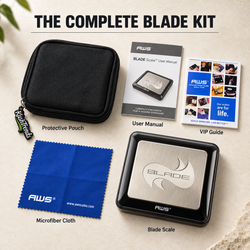
The best precision scale for watch parts is not automatically the scale with the most decimal places.
Watchmaking involves components across an unusually broad weight range.
You might weigh:
-
Tiny screws
-
Springs
-
Pins
-
Washers
-
Watch hands
-
Gears
-
Jewels
-
Crowns
-
Stems
-
Movement components
-
Complete movements
-
Cases
-
Buckles
-
Bracelets
-
Complete watches
-
Batches of replacement parts
A scale optimized for a tiny movement screw may not have enough capacity for a complete watch.
Likewise, a scale designed for a 200g watch may not provide enough displayed detail for an extremely lightweight individual component.
The best precision scale therefore balances:
readability + capacity + repeatability + calibration + minimum usable load + platform size + tare + environmental stability.
For many general watchmaking and watch-parts applications:
500g × 0.01g
is an especially versatile specification.
For extremely lightweight components where milligram-level displayed increments genuinely matter:
20–100g × 0.001g
may be more appropriate.
The right scale is the one whose specifications match:
the components you actually weigh.
Quick Answer: What Features Matter Most in a Watch Parts Scale?
| Feature | Why It Matters |
|---|---|
| Readability | Determines smallest displayed increment |
| Capacity | Determines maximum physical load |
| Repeatability | Helps produce consistent measurements |
| Minimum usable load | Matters for extremely light components |
| Calibration | Helps maintain measurement performance |
| Platform size | Determines what physically fits |
| Tare | Allows use of trays and containers |
| Stable display | Important for tiny components |
| Draft protection | Useful for milligram-level work |
| Multiple units | Useful for different workflows |
| Piece counting | Helpful for identical component batches |
| Portable power | Useful for mobile work |
| AC power | Useful for permanent workstations |
| Protective cover | Helps protect portable scales |
| Trays | Useful for screws, pins and rolling parts |
Do not select a scale based on:
decimal places alone.
Feature 1: Appropriate Readability
Readability describes:
the smallest increment shown by the scale.
Common specifications for watch-parts work include:
0.1g
0.01g
0.001g
Each serves a different purpose.
What Does 0.01g Readability Mean?
A 0.01g scale displays weight in:
hundredths of a gram.
Examples:
1.25g
18.47g
152.83g
For general watchmaking:
0.01g can provide a strong balance between:
fine displayed increments and useful capacity.
What Does 0.001g Readability Mean?
A 0.001g scale displays weight in:
thousandths of a gram.
Because:
0.001g = 1 milligram,
this is commonly described as:
milligram readability.
Examples:
0.025g
0.126g
1.847g
American Weigh Scales' milligram scale comparison covers 0.001g models for applications including small mechanical components and other detail-sensitive objects.
When 0.001g Matters for Watch Parts
Consider 0.001g readability for:
-
Tiny screws
-
Lightweight springs
-
Small washers
-
Pins
-
Watch hands
-
Tiny gears
-
Jewels
-
Lightweight movement components
The finer readability can make small weight differences visible.
When 0.01g Is More Practical
For:
-
Complete movements
-
Cases
-
Bracelets
-
Buckles
-
Complete watches
-
Larger parts
-
Component batches
0.01g often provides a more practical combination of:
readability + capacity.
Feature 2: Do Not Confuse Readability With Accuracy
This is one of the most important concepts when buying a precision scale.
Suppose a scale displays:
0.125g.
That means it provides:
0.001g readability.
It does not automatically mean:
the true mass is guaranteed within ±0.001g.
Readability tells you:
how finely the display changes.
Overall measurement performance can also depend on:
-
Accuracy specifications
-
Repeatability
-
Calibration
-
Minimum usable load
-
Linearity
-
Stability
-
Environment
AWS explains the distinction between capacity and readability in What Does 500g × 0.01g Mean on a Digital Scale?.
Feature 3: Capacity
Capacity is the maximum physical load the scale is designed to support.
This matters enormously in watchmaking because:
watch components vary from milligrams to hundreds of grams.
Example
Suppose:
Tiny screw = 0.04g
Crown = 1.8g
Movement = 31g
Case = 65g
Bracelet = 92g
Complete watch = 176g
A:
50g × 0.001g
scale can handle the tiny components.
It cannot handle:
the case, bracelet or complete watch.
A:
500g × 0.01g
scale can handle the entire example range,
but it does not provide the same milligram-level readability for the tiniest components.
Feature 4: Capacity Includes the Tray
This is frequently misunderstood.
Suppose:
scale capacity = 50g
tray = 12g
watch components = 40g
Total physical load:
52g.
The scale is overloaded.
It does not matter that:
you pressed tare first.
Feature 5: Tare Does Not Restore Capacity
Tare changes:
the displayed reference point.
It does not physically remove:
the tray.
Example:
50g scale
15g tray
Press tare.
Display:
0.000g
Approximate remaining physical capacity:
35g.
Not:
50g.
This becomes particularly important with:
low-capacity milligram scales.
Feature 6: Capacity Headroom
Avoid choosing a scale where your normal measurement regularly approaches:
maximum capacity.
Suppose your complete watch normally weighs:
480g
including the holder.
A:
500g scale
provides very little headroom.
A higher-capacity model may be more practical.
Feature 7: Minimum Usable Load
Maximum capacity is only:
one end of the measurement range.
The lower end matters too.
A scale that displays:
0.001g increments
does not automatically guarantee that:
every 0.001g quantity
is an appropriate working load.
When weighing extremely light components:
review available specifications for:
-
Minimum load
-
Accuracy
-
Repeatability
where provided.
Feature 8: Repeatability
Repeatability describes how consistently a scale produces:
the same result
when the same object is measured repeatedly under the same conditions.
For precision watch work:
this can matter more than simply having another decimal place.
Example
Watch screw measured five times:
0.087g
0.087g
0.087g
0.087g
0.087g
That is a highly consistent set of displayed readings.
Now compare:
0.081g
0.090g
0.085g
0.092g
0.079g
The extra decimal places are less useful when:
the reading is unstable.
Feature 9: Test Repeatability
A simple practical check is:
-
Place the component on the scale.
-
Allow the reading to stabilize.
-
Record it.
-
Remove the component.
-
Confirm the scale returns to zero.
-
Replace the component.
-
Repeat several times.
Look for:
consistent results.
Feature 10: Calibration
Precision scales require:
appropriate calibration procedures.
Calibration helps relate the scale's measurement response to:
a known reference mass.
But calibration requirements are:
model-specific.
Do not assume every scale uses:
the same weight.
Feature 11: Correct Calibration Weight
A scale might require:
20g
50g
100g
200g
500g
or another specified calibration mass.
Use:
the manufacturer's specified procedure.
Do not guess.
Feature 12: Do Not Use Watch Parts as Calibration Weights
A watch case is not:
a calibration standard.
Neither is:
-
A coin
-
Screw
-
Battery
-
Bracelet
-
Piece of jewelry
-
Household object
Use an appropriate calibration mass.
Feature 13: Calibration Is Not Tare
These functions solve different problems.
Calibration
relates scale response to:
a known reference mass.
Tare
subtracts the displayed weight of:
a container or tray.
They are not interchangeable.
Feature 14: Platform Size
Platform dimensions matter almost as much as:
capacity.
A scale can technically support:
200g
but still be awkward if:
a bracelet hangs over every edge.
Tiny Watch Parts
A small platform can work well for:
-
Screws
-
Springs
-
Jewels
-
Pins
-
Hands
especially when paired with:
a weighing tray.
Complete Watches
For:
-
Cases
-
Bracelets
-
Complete watches
a larger platform becomes much more useful.
Feature 15: A Practical General-Purpose Platform
The AWS SC501g Precision Digital Pocket Scale provides:
500g × 0.01g
with a:
3.9 × 3.7-inch platform.
It also includes:
-
Stainless-steel weighing surface
-
Backlit LCD
-
Tare
-
Two expansion trays
-
Battery operation
-
Multiple weighing units
AWS specifies calibration using:
a 500g calibration weight,
which is not included.
This combination makes it particularly practical for:
general watchmaking and watch-parts work.
Feature 16: Small Platforms for Milligram Work
Milligram scales generally prioritize:
fine readability
over:
large platforms.
For example, the GEMINI-50 uses a:
1.3 × 1.3-inch platform.
That can work well for:
tiny watch components.
It is not intended to provide the same physical working area as:
the SC501g.
Feature 17: Tare
Tare is especially useful for watch parts because:
tiny components can roll or become difficult to handle directly on a flat platform.
Use:
-
Small tray
-
Weighing pan
-
Lightweight container
Then press:
tare.
Feature 18: Expansion Trays
Expansion trays can serve two functions:
weighing container
and:
protective accessory.
For watch parts:
a tray can help contain:
-
Screws
-
Pins
-
Washers
-
Crowns
-
Springs
-
Small gears
Feature 19: Backlit Display
A clear display improves:
day-to-day usability.
Watchmaking frequently involves:
small components and visually demanding bench work.
A readable backlit LCD can make:
weight recording easier.
Feature 20: Multiple Weighing Units
For most watch-parts work:
grams
are the simplest unit.
However, some precision scales also provide:
-
oz
-
ozt
-
dwt
-
ct
-
gn
The SC501g supports:
g, oz, gn, ct, dwt and ozt.
Multiple units can be useful when:
the same scale is used for jewelry or precious-metal work.
Feature 21: Piece Counting
Piece-counting functionality can be useful for:
batches of identical watch parts.
Examples:
-
Screws
-
Pins
-
Washers
-
Small identical hardware
The scale estimates quantity based on:
average piece weight.
Feature 22: Piece Counting Requires Consistent Components
Suppose:
100 identical screws
have very similar individual weights.
Piece counting may work well.
Now suppose the batch includes:
three different screw sizes.
Weight-based counting becomes much less useful.
Use piece counting only when:
components are sufficiently consistent.
Feature 23: Stable Work Surface
Precision scales need:
stable support.
Do not place the scale on:
-
Soft bench padding
-
Flexible surfaces
-
Unstable tables
-
Uneven surfaces
A watchmaker's mat can be useful for:
protecting parts,
but the scale itself should sit on:
a firm, stable surface.
Feature 24: Vibration Resistance
Watchmaking workspaces can contain:
tools and equipment that create vibration.
Fine scales can react to:
small disturbances.
Keep the scale away from:
-
Vibrating machinery
-
Speakers
-
Moving equipment
-
Unstable tables
Feature 25: Airflow Protection
Air movement can affect:
very lightweight measurements.
This becomes increasingly important at:
0.001g readability.
Avoid positioning a milligram scale directly beneath:
-
Air-conditioning vent
-
Fan
-
Open window
Feature 26: Draft Shields
For very fine measurements:
a draft shield can be valuable.
It helps reduce:
air movement around the weighing platform.
AWS notes draft protection among the factors worth considering when selecting a milligram scale.
Feature 27: Static Control
Extremely lightweight watch parts can also be affected by:
static electricity.
If measurements appear unstable:
consider:
-
Static
-
Air movement
-
Vibration
before assuming:
the scale itself is defective.
Feature 28: Temperature Stability
Precision measurement benefits from:
a reasonably stable operating environment.
Avoid moving the scale directly from:
one extreme temperature
to:
another
and immediately expecting optimal precision.
Feature 29: Off-Center Loading
Try to place the item:
near the intended weighing area
rather than balancing it awkwardly against one side.
NIST identifies off-center loading among factors that can contribute to weighing uncertainty.
For larger watch cases and bracelets:
platform size becomes especially important for this reason.
Feature 30: Battery vs. AC Power
Power source can affect:
workflow convenience.
Battery Power
Useful for:
-
Portable repairs
-
Watch shows
-
Auctions
-
Traveling
-
Temporary workstations
AC Power
Useful for:
-
Permanent watchmaking benches
-
Repair departments
-
High-frequency daily use
Feature 31: Portability
A watch parts scale may need to travel between:
-
Workbench
-
Store
-
Trade show
-
Auction
-
Collection
-
Repair location
Compact scales are easier to:
transport and store.
AWS's Pocket Scales collection includes compact formats designed around portability.
Feature 32: Protective Cover
A protective cover can help protect:
the platform
during:
storage and transport.
Some pocket scales use the cover as:
an expansion tray.
Feature 33: Stainless-Steel Platform
A stainless-steel weighing surface can be practical because it is:
-
Smooth
-
Easy to wipe
-
Durable
-
Appropriate for repeated everyday use
The SC501g uses:
a stainless-steel platform.
Feature 34: Scale Size
Do not confuse:
compact
with:
underpowered.
A compact scale can still provide:
500g capacity.
Likewise:
a larger-looking scale
is not automatically more precise.
Compare:
specifications rather than appearance.
Feature 35: 500g × 0.01g for General Watchmaking
For many watchmakers:
this is the sweet spot.
It can accommodate:
-
Crowns
-
Stems
-
Movement parts
-
Complete movements
-
Cases
-
Bracelets
-
Complete watches
-
Component batches
while displaying:
hundredths of a gram.
Feature 36: SC501g for General Watch Parts
The SC501g is particularly strong when:
one scale needs to cover many types of watch components.
Its:
500g capacity
provides much more flexibility than:
20g or 50g milligram scales.
Its:
0.01g readability
still provides fine measurement for many everyday watchmaking tasks.
Feature 37: 0.001g for Tiny Components
For tiny movement parts:
milligram readability may provide more useful detail.
The GEMINI-50 Precision Milligram Scale provides:
50g × 0.001g
with:
-
1.3 × 1.3-inch platform
-
20g calibration weight included
-
Tweezers
-
Weighing pan/funnel
-
Multiple weighing units
-
Battery operation
This makes it better suited to:
small component work
than:
complete watches.
Feature 38: GEMINI-20 vs. GEMINI-50
Both provide:
0.001g readability.
The key difference is:
capacity.
GEMINI-20:
20g
GEMINI-50:
50g
AWS's GEMINI-20 vs. GEMINI-50 comparison explains that the 50g model provides more flexibility while maintaining the same 0.001g readability.
Feature 39: Higher-Capacity Milligram Scales
Some users need:
0.001g readability
but find:
20–50g
too restrictive.
AWS's milligram range also includes:
AWS-ELITE-100G
with:
100g × 0.001g.
This provides more capacity for:
-
Larger trays
-
Groups of components
-
Heavier small parts
while retaining:
milligram readability.
Feature 40: Two-Scale Setup
For professional watchmaking:
one scale does not necessarily need to do everything.
A highly practical setup is:
Scale 1: 50–100g × 0.001g
for:
-
Screws
-
Springs
-
Hands
-
Pins
-
Gears
-
Jewels
-
Tiny components
and:
Scale 2: 500g × 0.01g
for:
-
Movements
-
Cases
-
Bracelets
-
Complete watches
-
Larger batches
Why Two Scales Can Be Better
Suppose your working range is:
Tiny screw = 0.032g
Gear = 0.148g
Crown = 2.14g
Movement = 32.45g
Case = 61.28g
Bracelet = 98.47g
Complete watch = 183.26g
A:
50g × 0.001g
scale gives useful fine readability for:
the smallest components.
A:
500g × 0.01g
scale handles:
everything larger.
Trying to make one scale cover:
0.03g to 183g
can create unnecessary compromises.
Feature 41: Easy Calibration
If a scale is used frequently:
calibration should be straightforward.
Consider:
-
Required mass
-
Whether weight is included
-
Calibration procedure
-
Ease of recalibration
For example:
GEMINI-50 includes:
a 20g calibration weight.
SC501g specifies:
500g calibration weight,
not included.
Feature 42: Accessories
Accessories can materially improve watch-parts weighing.
Useful accessories include:
-
Tweezers
-
Tray
-
Weighing pan
-
Calibration mass
-
Protective cover
For tiny components:
tweezers can reduce:
handling difficulty.
Feature 43: Easy Cleaning
Watch benches can accumulate:
-
Dust
-
Metal particles
-
Polishing residue
-
Oils
A smooth platform is easier to:
inspect and clean.
Keep debris away from:
the weighing mechanism.
Feature 44: Fast Stabilization
A practical precision scale should reach:
a stable reading
without unnecessary delay under normal conditions.
If the display constantly fluctuates:
check:
-
Vibration
-
Airflow
-
Static
-
Surface stability
-
Temperature
Feature 45: Auto-Off
Auto-off can help:
preserve battery life.
However, users performing extended watchmaking work may prefer:
a model or workflow that does not repeatedly interrupt measurements.
Check the specific model's operating behavior.
Feature 46: Overload Awareness
Do not repeatedly push a precision scale beyond:
maximum capacity.
Overloading can:
damage the weighing mechanism.
Always calculate:
watch part + tray + accessories = total physical load.
Feature 47: Appropriate Working Range
Do not buy a scale whose capacity barely covers:
your normal load.
Likewise:
do not buy an extremely high-capacity scale with coarse readability if:
you primarily weigh tiny screws.
Match the scale to:
your real working range.
Feature 48: Legal-for-Trade Considerations
If the scale is used only for:
-
Watch repair
-
Component comparison
-
Inventory
-
Hobby work
-
Internal documentation
consumer precision scales may be suitable depending on the task.
But if weight directly determines:
a regulated commercial transaction,
additional requirements may apply.
NIST's current Handbook 44 covers specifications, tolerances and technical requirements used by weights-and-measures authorities for commercial weighing equipment.
Do not assume:
a consumer pocket scale is automatically legal for trade.
Feature 49: Weight Is a Measurement, Not Authentication
A precision scale can tell you:
mass.
It cannot independently tell you:
whether a watch component is genuine.
Weight alone cannot prove:
-
Brand
-
Reference
-
Authenticity
-
Material
-
Manufacturing origin
Feature 50: Weight Does Not Determine Watch Value
A scale cannot tell you whether:
a watch is valuable.
Watch value can depend on:
-
Manufacturer
-
Reference
-
Age
-
Rarity
-
Condition
-
Provenance
-
Materials
-
Market demand
Use weight as:
one documented measurement.
Precision Scale Feature Comparison for Watch Parts
| Feature | Tiny Components | General Watch Parts | Complete Watches |
|---|---|---|---|
| 0.001g readability | Excellent | Sometimes useful | Usually unnecessary |
| 0.01g readability | Limited for tiniest parts | Excellent | Excellent |
| 20–50g capacity | Good | Limited | Poor |
| 100g capacity | Excellent | Good | Limited |
| 500g capacity | Excellent flexibility | Excellent | Excellent |
| Small platform | Excellent | Moderate | Poor |
| Larger platform | Good with tray | Excellent | Excellent |
| Tare | Excellent | Excellent | Excellent |
| Calibration | Essential | Essential | Essential |
| Draft protection | Useful | Sometimes | Usually less important |
| Piece counting | Useful | Useful | Not relevant |
Which Features Matter Most by User?
Professional Watchmaker
Prioritize:
-
Repeatability
-
0.001g + 0.01g options
-
Calibration
-
Stable platform
-
Trays
-
Environmental control
Watch Repair Shop
Prioritize:
-
500g capacity
-
0.01g readability
-
Tare
-
Larger platform
-
Easy cleaning
-
Optional milligram scale for tiny parts
Watch Parts Seller
Prioritize:
-
Readability
-
Piece counting
-
Tare
-
Capacity
-
Inventory consistency
Watch Collector
Prioritize:
-
500g capacity
-
0.01g readability
-
Platform size
-
Easy calibration
-
Portability
Traveling Watch Dealer
Prioritize:
-
Compact design
-
Battery operation
-
Protective cover
-
500g capacity
-
0.01g readability
Common Mistakes When Buying a Precision Scale for Watch Parts
Buying the Scale With the Most Decimal Places
More decimal places do not automatically mean:
better scale.
Confusing Readability With Accuracy
They are:
different concepts.
Ignoring Maximum Capacity
Always include:
the complete physical load.
Forgetting Tray Weight
The tray counts.
Assuming Tare Restores Capacity
It does not.
Ignoring Minimum Usable Load
Maximum capacity is not:
the only limit.
Ignoring Repeatability
Consistency matters.
Ignoring Platform Size
The object needs to:
sit securely.
Using the Wrong Calibration Weight
Follow the model's:
actual instructions.
Using Coins for Calibration
Use:
appropriate calibration masses.
Ignoring Vibration
Fine scales need:
stable environments.
Weighing Under an HVAC Vent
Air movement can affect:
milligram measurements.
Ignoring Static
Tiny lightweight components may be sensitive to:
static effects.
Using Piece Counting for Mixed Parts
Piece counting works best for:
consistent items.
Buying One Scale for Every Possible Weight
Sometimes:
two scales are better.
Assuming Weight Proves Authenticity
It does not.
Assuming Weight Determines Material
It does not.
Assuming a Consumer Scale Is Automatically Legal for Trade
Commercial requirements may differ.
Watch Parts Precision Scale Buying Checklist
Before purchasing, ask:
-
What parts will I weigh?
-
What is the lightest component?
-
What is the heaviest component?
-
Will I weigh complete movements?
-
Will I weigh cases?
-
Will I weigh bracelets?
-
Will I weigh complete watches?
-
Do I need 0.01g readability?
-
Do I genuinely need 0.001g?
-
What is the maximum capacity?
-
What is the minimum usable load?
-
What accuracy specifications are available?
-
What repeatability can I expect?
-
What is the platform size?
-
Will the part sit securely?
-
Do I need a tray?
-
What does the tray weigh?
-
Is there enough capacity headroom?
-
Does the scale have tare?
-
What calibration weight is required?
-
Is the calibration weight included?
-
Is calibration straightforward?
-
Is the work surface rigid?
-
Is there vibration?
-
Is there direct airflow?
-
Is static likely to matter?
-
Is the environment temperature-stable?
-
Would a draft shield help?
-
Do I need piece counting?
-
Are the components consistent enough for piece counting?
-
Do I need grams only?
-
Do I need additional weighing units?
-
Do I need battery power?
-
Would AC power be preferable?
-
Do I need portability?
-
Does the scale have a protective cover?
-
Are trays included?
-
Are tweezers useful?
-
Is the platform easy to clean?
-
Will I use it for inventory?
-
Will I use it for documentation?
-
Will I use it for commercial weight-based transactions?
-
Am I incorrectly treating weight as authentication?
-
Would a two-scale setup be better?
Frequently Asked Questions
What is the best precision scale for watch parts?
For broad watchmaking:
500g × 0.01g
is a strong general-purpose specification.
For tiny individual components:
0.001g readability
may be useful.
What features matter most?
Prioritize:
readability, capacity, repeatability, calibration, minimum usable load, platform size, tare and environmental stability.
Is 0.001g better than 0.01g?
Not automatically.
0.001g provides:
finer readability.
But it usually comes with:
lower capacity and greater environmental sensitivity.
What is the best scale for watch screws?
For extremely small individual screws:
consider:
0.001g readability.
What is the best scale for complete watches?
For many complete watches:
500g × 0.01g
provides a useful combination.
Is the SC501g good for watchmaking?
For general-purpose watch work:
yes.
It combines:
500g capacity
with:
0.01g readability
and a:
3.9 × 3.7-inch platform.
Is the GEMINI-50 good for watchmaking?
It is particularly useful for:
tiny components.
It combines:
50g capacity
with:
0.001g readability.
Does the GEMINI-50 include a calibration weight?
Yes.
AWS currently lists:
a 20g calibration weight
as included.
Does the SC501g include a calibration weight?
No.
AWS specifies:
500g calibration weight required,
but:
not included.
Does tare increase capacity?
No.
Tare changes:
the displayed zero.
It does not change:
maximum physical capacity.
Why does platform size matter?
A component, movement, bracelet or complete watch should sit:
securely
without contacting:
the surrounding work surface.
Why does repeatability matter?
A scale is more useful when:
the same object produces consistent measurements under the same conditions.
Does airflow affect a 0.001g scale?
It can.
Milligram-level measurements are more sensitive to:
air movement and environmental conditions.
Does vibration affect precision scales?
Yes.
Use:
a stable surface
away from significant vibration.
Can a precision scale count watch screws?
Some models with:
piece-counting functionality
can estimate quantities of consistent components.
Can a precision scale authenticate a watch?
No.
Weight is only:
one measurement.
It cannot independently prove authenticity.
Can weight tell whether a watch is gold?
Not by itself.
Material identification requires:
additional information or testing.
Should a watchmaker have two scales?
If the workflow includes both:
tiny movement components
and:
complete watches,
a two-scale setup can be particularly practical.
Final Verdict: Best Precision Scale for Watch Parts
The best precision scale for watch parts is not necessarily:
the scale with the most decimal places.
Instead, prioritize:
readability + capacity + repeatability + calibration + minimum usable load + platform size + tare + environmental stability.
For broad watchmaking and repair work:
500g × 0.01g
is one of the most practical general-purpose specifications.
It provides enough capacity for many:
-
Movements
-
Cases
-
Bracelets
-
Complete watches
-
Component batches
while still displaying:
hundredth-of-a-gram increments.
The AWS SC501g is particularly well suited to this role with:
-
500g × 0.01g
-
3.9 × 3.7-inch platform
-
Stainless-steel surface
-
Tare
-
Expansion trays
-
Backlit LCD
-
Multiple units
-
Battery operation
For extremely lightweight components:
consider:
0.001g milligram readability.
The GEMINI-50 provides:
-
50g × 0.001g
-
Compact platform
-
Included 20g calibration weight
-
Weighing pan
-
Tweezers
-
Multiple units
For users requiring more milligram-scale capacity:
the AWS-ELITE-100G provides:
100g × 0.001g.
For professional workflows spanning tiny screws through complete watches, the strongest setup may therefore be:
0.001g milligram scale for tiny movement components + 500g × 0.01g precision scale for larger watch parts and complete watches.
Whatever model you choose:
do not confuse readability with accuracy.
Do not ignore:
tray weight.
Do not assume:
tare restores capacity.
Do not calibrate using:
random household objects.
And do not use weight alone to:
authenticate or value a watch.
Choose the scale whose features match:
your lightest meaningful component, your heaviest complete load and the precision your actual watchmaking workflow requires.