
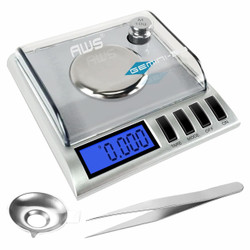
The American Weigh Scales Gemini-20 is a compact digital milligram scale with a 20g capacity and 0.001g readability. Its small size, multiple weighing units, and included accessories make it worth considering for lightweight objects and small samples.
Its main advantage is displayed detail: it shows gram readings to three decimal places. Its main limitation is capacity. The complete load—including a tray or container—must remain within 20 grams.
However, one-milligram readability does not guarantee one-milligram accuracy. Buyers should assess the scale’s performance at their working loads and use it under suitable conditions.
This Gemini-20 review examines published specifications, practical features, and potential applications. It is based on manufacturer information rather than independent hands-on testing.
Gemini-20 Specifications at a Glance
| Feature | Current AWS product listing |
|---|---|
| Maximum capacity | 20g |
| Gram readability | 0.001g |
| Weighing units | g, oz, ozt, dwt, ct, gn |
| Calibration equipment | 20g weight listed as included |
| Accessories | Carrying case, tweezers, weighing tray |
| Display | Backlit LCD |
| Listed display dimensions | 0.4 x 1.2 inches |
| Listed platform dimensions | 1.3 x 1.3 inches |
| Listed overall dimensions | 3.5 x 4.0 x 0.8 inches |
| Power | Two AAA batteries, listed as included |
| Operating temperature | 50°F–86°F / 10°C–30°C |
These details come from the current Gemini-20 Precision Milligram Scale product listing. Confirm the selected version’s specifications and package contents before purchasing.
What Does 20g x 0.001g Mean?
The specification describes capacity and readability.
20g Is the Maximum Rated Load
The scale supports a complete load of up to 20 grams.
That includes:
-
The object or sample.
-
A weighing tray.
-
Weighing paper.
-
Any other supported container or accessory.
A small capacity can be appropriate for lightweight objects, but it leaves little room for heavy containers.
0.001g Is the Display Increment
The Gemini-20 displays gram readings in increments of 0.001g, equivalent to 1 milligram.
For example, it can display:
-
1.250g
-
1.251g
-
1.252g
NIST’s guide to SI mass units explains the relationship between grams and milligrams.
This displayed resolution does not establish that the scale can reliably measure a standalone 1mg sample or that every reading is accurate within ±1mg.
Gemini-20 Accuracy: What Can You Conclude?
The published 20g x 0.001g specification establishes capacity and readability, not a complete accuracy rating.
The product information reviewed does not provide enough quantified performance data to assign a universal error limit across the weighing range.
Three characteristics matter.
Readability
Readability describes the smallest displayed increment. On the Gemini-20, the gram increment is 0.001g.
Repeatability
Repeatability describes agreement between repeated readings under the same conditions.
Repeatedly weighing the same reference object can help reveal consistency at that load. Stable results do not automatically establish accuracy.
Accuracy
Accuracy concerns agreement with the reference value.
A display showing 10.000g does not prove the load’s actual mass is exactly 10.000g. Reference quality, calibration, setup, and environmental effects all matter.
NIST’s weighing and scales FAQs explain scale divisions and related terminology.
For buyers, the important question is whether the scale performs adequately at the quantities and tolerances their task requires.
Key Features of the Gemini-20
Compact, Portable Design
The Gemini-20’s small footprint makes it convenient to store or carry between locations.
Portability does not remove the need for a stable weighing environment. Use it on a firm surface rather than holding it in your hand or placing it on fabric.
Included Handling Accessories
AWS lists a carrying case, tweezers, weighing tray, and calibration weight with the current product.
Tweezers can make handling small objects easier, while the tray helps contain lightweight material.
Protective Shield
The product description identifies a flip-down shield that protects the weighing surface.
It is a useful protective feature, but it should not be treated as equivalent to a fully enclosed laboratory draft shield.
Backlit Display
The backlit LCD helps make readings visible. Display visibility matters when observing small changes or recording repeated measurements.
Multiple Weighing Units
The Gemini-20 lists grams, ounces, troy ounces, pennyweights, carats, and grains.
These options can be useful for different workflows. Switching units does not establish better underlying measurement performance.
Best Uses for the Gemini-20
Lightweight Jewelry and Loose Gemstones
The combination of low capacity, fine displayed increments, and carat mode makes the Gemini-20 worth considering for lightweight jewelry components and loose stones.
Its suitability depends on the required tolerance. For transactions based on weight, do not infer legal-for-trade approval from the display or unit options.
Beads and Small Craft Components
The scale may be useful for comparing lightweight beads, findings, or other small materials when the required measurement performance has been verified.
For larger quantities or heavier containers, a higher-capacity scale may be more practical.
Small Noncritical Samples
The Gemini-20 may suit small samples for hobby work or general comparisons where its performance meets the task’s requirements.
A milligram display alone does not establish suitability for validated laboratory methods.
Educational Measurement Activities
The scale can support demonstrations involving mass, unit conversion, repeated measurements, and environmental effects.
Students can compare readings under controlled conditions and learn why displayed detail is different from accuracy.
When Another Scale Is a Better Fit
Loads Above 20g
A 20g maximum is restrictive if you regularly weigh larger objects or batches.
Choose a higher-capacity model when the complete load exceeds the limit.
Heavy Containers
A container can consume much of the available capacity.
For example:
8g container + 10g sample = 18g total load
That fits within capacity.
But:
8g container + 15g sample = 23g total load
That exceeds it.
Safety-Critical Dosing
Do not treat 0.001g readability as proof that the Gemini-20 is suitable for medication preparation or other safety-critical dosing. Those applications require independently established measurement performance and appropriate procedures.
Applications With Strict Measurement Requirements
If your process requires documented uncertainty, a specified minimum weight, or validated performance, choose equipment and calibration services that meet those requirements.
NIST’s metrological traceability guidance explains that traceability alone does not guarantee uncertainty is adequate for a particular purpose.
Gemini-20 Calibration: Follow the Supplied Instructions
The current product listing identifies a 20g calibration weight as included.
An older AWS-hosted Gemini-20 manual describes different dimensions and calibration options. This means buyers should follow the instructions supplied with their exact version rather than combine procedures from different listings.
The American Weigh Scales manuals provide access to model documentation.
Calibration and Checking Serve Different Purposes
Calibration establishes the relationship between instrument readings and reference values. Some user procedures also adjust the response.
A routine check compares the scale’s reading with a suitable reference to help identify a problem.
NIST’s introduction to calibration explains calibration in relation to reference standards.
Check More Than One Working Load
A successful check near maximum capacity does not establish performance at very small loads.
Where your task requires it, use suitable reference weights at representative points within the working range.
NIST’s guidance on check standards explains their role in monitoring measurement bias and variability.
How to Get More Consistent Gemini-20 Readings
Milligram displays make setup particularly important.
The AWS manual warns that air currents, vibration, moisture, temperature changes, and rough handling can affect results. It also recommends allowing the scale to adjust to room temperature and giving it stabilization time before calibration.
Use a repeatable routine:
-
Place the scale on a firm, stable surface.
-
Keep it away from fans, vents, and vibration.
-
Allow it to adjust after temperature changes.
-
Follow the supplied stabilization instructions.
-
Keep the platform and tray clean.
-
Center the load carefully.
-
Avoid touching or leaning on the weighing surface.
-
Wait for a stable reading.
-
Repeat important measurements.
-
Never exceed 20g.
For the best results, keep the weighing setup consistent between measurements.
Tare Does Not Restore Capacity
Tare subtracts a tray or container from the displayed reading. Its physical weight remains on the scale.
If the supported tray and container weigh 6g, the remaining rated capacity is:
20g − 6g = 14g
Pressing tare does not create another 20g of capacity.
Use lightweight containers, and calculate the complete load before weighing.
Gemini-20 vs GPR-20
The GPR-20 Precision Digital Milligram Scale is another AWS option listed with 20g capacity and 0.001g readability.
Matching headline specifications do not prove equal accuracy or repeatability.
Compare:
-
Platform and tray design.
-
Display size.
-
Included calibration equipment.
-
Power options.
-
Physical footprint.
-
Model-specific performance information.
For a broader comparison, read the AWS guide to 20g x 0.001g digital scales.
Gemini-20 vs Higher-Capacity Milligram Scales
If your loads regularly approach 20g, a higher-capacity milligram model may offer more practical room.
The AWS Gemini-20 vs Gemini-50 comparison discusses the difference between those capacity options.
More capacity does not automatically improve accuracy. Evaluate performance at your actual loads alongside readability and features.
Gemini-20 Strengths and Limitations
| Strengths | Limitations |
|---|---|
| 0.001g displayed gram increments | Readability does not guarantee ±0.001g accuracy |
| Compact format | Complete load limited to 20g |
| Multiple weighing units | Small platform restricts container choices |
| Included tray and handling accessories | Stable environmental conditions are important |
| Calibration weight listed as included | Procedures must match the exact version |
Frequently Asked Questions
What is the Gemini-20’s capacity?
The maximum rated capacity is 20 grams, including supported trays, containers, and contents.
What does 0.001g mean?
It means gram readings are displayed in one-milligram increments.
Is the Gemini-20 accurate to one milligram?
That cannot be established from readability alone. Performance must be assessed at the required loads and under suitable conditions.
Does it include a calibration weight?
The current AWS listing identifies a 20g calibration weight as included. Confirm the package for the selected version.
Is it suitable for gemstones?
It offers carat mode and may suit lightweight stones when its performance meets the task’s requirements.
Can it weigh 20g of material in a tray?
The complete supported load must remain within 20g. The tray’s physical weight counts even after tare.
Why might the readings change?
Drafts, vibration, temperature changes, handling, power, and calibration issues can affect readings. Follow the supplied instructions and investigate the setup.
Is the Gemini-20 Worth Considering?
The Gemini-20 is worth considering when you need a compact scale for lightweight objects, three-decimal-place gram readings, and a practical accessory kit.
Its 20g capacity requires lightweight containers and careful load management. Its milligram readability also calls for a stable environment and appropriate performance checks.
Explore the American Weigh Scales milligram scale collection and choose a model that meets your complete-load capacity, smallest working quantity, and measurement tolerance.