
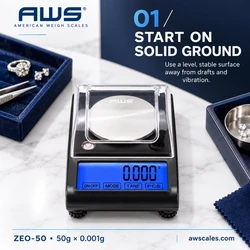
The American Weigh Scales Gemini-50 and ZEO-50 both offer 50g capacity and 0.001g readability. Their main differences are physical size, platform space, display dimensions, included accessories, and calibration requirements.
Choose the Gemini-50 when compact storage and portability are your priorities. Choose the ZEO-50 when a larger platform and display would make regular tabletop weighing easier.
Neither model gains an accuracy advantage simply from its size. Matching capacity and readability also do not prove identical measurement performance.
This comparison examines published AWS specifications and features rather than independent hands-on testing.
Gemini-50 vs ZEO-50: Quick Comparison
| Feature | Gemini-50 | ZEO-50 |
|---|---|---|
| Maximum rated capacity | 50g | 50g |
| Gram readability | 0.001g | 0.001g |
| Equivalent display increment | 1mg | 1mg |
| Listed platform dimensions | 1.3 x 1.3 inches | 2.6 x 2.6 inches |
| Listed display dimensions | 0.4 x 1.2 inches | 1.4 x 3.0 inches |
| Listed overall dimensions | 3.5 x 4.0 x 0.8 inches | 5.9 x 3.8 x 2.5 inches |
| Calibration weight listed | 20g included | 50g included |
| Power | Two AAA batteries | Four AAA batteries |
| Weighing units | g, oz, ozt, dwt, ct, gn | g, oz, ozt, dwt, ct, gn |
| Listed operating temperature | 50°F–86°F | 50°F–86°F |
| Main design advantage | Smaller overall format | Larger platform and display |
These specifications come from the AWS product listings. Confirm the selected version and package contents before purchasing.
What Does 50g x 0.001g Mean?
Both models support a maximum rated load of 50 grams and display gram readings in increments of 0.001g.
One displayed increment equals one milligram. NIST’s guide to SI mass units explains the relationship between grams and milligrams.
For example, either model can display:
-
1.250g
-
1.251g
-
1.252g
However, 0.001g readability does not guarantee accuracy within ±0.001g. It also does not establish reliable measurement of a standalone 1mg sample.
The complete supported load—including its container—must remain within 50g.
Gemini-50: Best Fit for Compact Weighing
The Gemini-50 Precision Milligram Scale is worth considering when you want a small device for lightweight objects and containers.
Its Main Advantages
The Gemini-50 has smaller listed overall dimensions than the ZEO-50 and uses two AAA batteries.
AWS lists a 20g calibration weight, tweezers, weighing pan or funnel, microfiber cloth, and batteries with the current package.
Its compact format may suit:
-
Individual gemstones.
-
Small jewelry findings.
-
Miniature hardware.
-
Lightweight craft materials.
-
Small noncritical samples.
-
Occasional weighing in different locations.
Its Main Limitation
The listed 1.3 x 1.3-inch platform provides less positioning space than the ZEO-50.
A load may fit within 50g yet be awkward to support because its container is too broad or irregular.
Choose the Gemini-50 when smaller size matters and your objects fit comfortably on its platform.
ZEO-50: Best Fit for More Working Space
The ZEO-50 High-Precision Digital Milligram Scale offers the same capacity and gram readability in a larger body.
Its Main Advantages
The ZEO-50 lists a 2.6 x 2.6-inch platform and a larger display.
That additional platform space may make it easier to position:
-
Wider weighing trays.
-
Small containers.
-
Irregular jewelry pieces.
-
Groups of components.
-
Broader objects within capacity.
AWS lists a 50g calibration weight, weighing tray, scoop, tweezers, tare, and automatic shutoff. The model uses four AAA batteries.
Its Main Limitation
The ZEO-50 takes up more space and is less compact for storage or transport.
Its larger platform does not increase capacity beyond 50g or independently establish better accuracy.
Choose the ZEO-50 when platform space and display size are more useful than the smallest overall format.
Platform Size: The Most Practical Difference
The ZEO-50’s listed platform dimensions are twice those of the Gemini-50 in each direction.
Using the listed dimensions, that represents four times the nominal rectangular area:
-
Gemini-50: 1.3 × 1.3 = 1.69 square inches.
-
ZEO-50: 2.6 × 2.6 = 6.76 square inches.
This is a comparison of published dimensions, not a guarantee of usable container area. Tray shape, protective covers, and object placement can affect the actual fit.
Check How Your Container Sits
A suitable container should:
-
Rest securely.
-
Remain clear of surrounding surfaces.
-
Stay within the rated load.
-
Allow operation according to the instructions.
-
Leave the display visible.
If your usual tray already fits easily on the Gemini-50, the ZEO-50’s extra space may offer little benefit. If positioning is awkward, the larger model may simplify the task.
Display Size and Viewing Comfort
The ZEO-50 has a larger listed display than the Gemini-50.
That may be useful when reading measurements repeatedly from a tabletop position. The Gemini-50’s smaller display supports its compact design.
Display size does not establish accuracy. Consider viewing distance, angle, lighting, and whether the container blocks the reading.
For many buyers, ease of reading and recording results is a practical reason to compare the models in person.
Which Scale Is More Accurate?
The reviewed headline specifications do not establish an accuracy winner.
Both list 50g capacity and 0.001g readability, but three characteristics must be considered separately.
Readability
Readability describes the smallest displayed increment. Both display grams in 0.001g steps.
Repeatability
Repeatability describes agreement between repeated measurements under the same conditions.
Closely agreeing readings indicate consistency at that load, but they can still contain a systematic error.
Accuracy
Accuracy concerns agreement with the reference value.
NIST’s weighing and scales FAQs provide background on scale divisions and measurement terminology.
Do not assume the ZEO-50 is more accurate because it is larger or the Gemini-50 performs identically because the headline specifications match. Evaluate performance at your working quantities.
Capacity Includes the Container on Both Models
Both scales have the same 50g complete-load limit.
Use this formula:
Complete load = container + contents + other supported items
Example Loads
| Container weight | Contents weight | Complete load | Within either model’s capacity? |
|---|---|---|---|
| 3g | 10g | 13g | Yes |
| 8g | 25g | 33g | Yes |
| 12g | 35g | 47g | Yes |
| 15g | 40g | 55g | No |
These examples assess capacity only.
Tare Does Not Restore Capacity
Tare removes container weight from the displayed reading. Its physical load remains.
An 8g container leaves 42g of rated capacity on either model, even after the display returns to zero.
A larger ZEO-50 platform may accommodate a wider container, but that container’s weight can still consume much of the available capacity.
Calibration Requirements Are Different
The current AWS listings identify:
-
Gemini-50: 20g calibration weight included.
-
ZEO-50: 50g calibration weight included.
Follow the procedure supplied with your exact model. Do not substitute one model’s sequence or required reference for the other’s.
Consult the American Weigh Scales manuals for documentation.
Calibration and Routine Checks
Calibration establishes the relationship between readings and reference values. Some user procedures also adjust the instrument’s response.
A routine check compares a reading with a suitable reference to help identify changes.
NIST’s introduction to calibration explains calibration in relation to reference standards.
A Larger Calibration Weight Does Not Prove Better Accuracy
The ZEO-50’s listed 50g calibration weight does not, by itself, establish superior performance.
Likewise, a successful Gemini-50 check at 20g does not verify its entire range.
Where required, use appropriate references at representative working loads and compare repeated results.
NIST’s guidance on check standards explains how checks help monitor bias and variability over time.
Which Is Better for Gemstones and Jewelry?
Both models list carats, troy ounces, and pennyweights among their supported units.
The Gemini-50 may suit individual small stones and findings that fit its compact platform. The ZEO-50 may be more convenient for wider trays, irregular pieces, or grouped objects.
For broader selection guidance, read the AWS digital jewelry scale buying guide.
Choose according to fit and required tolerance. Unit modes do not establish approval for transactions based on weight.
Which Is Better for Components and Craft Materials?
The Gemini-50 may suit compact objects and small quantities where portability matters.
The ZEO-50 may be more comfortable for regular tabletop work involving broader trays or repeated transfers.
Its listed scoop can help handle loose material. Accessories improve convenience, but they do not establish measurement accuracy.
Do not assume either model offers parts counting. Confirm any required function before purchasing.
How to Get More Consistent Results
For either scale:
-
Use a firm, stable surface.
-
Keep it away from fans, vents, and vibration.
-
Allow adjustment after temperature changes.
-
Follow the supplied stabilization instructions.
-
Keep the platform and tray clean.
-
Center the load carefully.
-
Avoid touching the platform during measurement.
-
Wait for a stable reading.
-
Repeat important measurements.
-
Keep the complete load within 50g.
Milligram displays make small changes visible, including changes caused by the environment.
When Neither Model Is the Right Choice
Loads Above 50g
Choose a higher-capacity model if the complete supported load exceeds 50g.
Very Small Quantities With Tight Tolerances
A 0.001g display does not establish a suitable minimum working quantity. Verify performance at the intended load.
Safety-Critical Dosing
Do not treat milligram readability as proof of suitability for medication preparation or other safety-critical dosing. Such tasks require independently established performance and appropriate procedures.
Validated Measurement Processes
If your work requires documented uncertainty or validated minimum-weight performance, choose equipment and calibration services that meet those requirements.
NIST’s metrological traceability guidance explains that traceability alone does not guarantee uncertainty is adequate for a particular purpose.
Gemini-50 vs ZEO-50: Which Should You Choose?
| Your priority | Model to consider |
|---|---|
| Smaller overall format | Gemini-50 |
| Wider weighing platform | ZEO-50 |
| Larger listed display | ZEO-50 |
| Fewer batteries | Gemini-50 |
| Regular work with broader trays | ZEO-50 |
| Compact storage and transport | Gemini-50 |
| Capacity above 50g | Neither |
| Proven application-specific accuracy | Compare quantified performance and verification results |
For additional alternatives, explore the AWS guide to 50g x 0.001g digital scales.
Frequently Asked Questions
What is the main difference between the Gemini-50 and ZEO-50?
They share 50g capacity and 0.001g readability. The ZEO-50 has a larger listed platform, display, and overall body, while the Gemini-50 is more compact.
Is the ZEO-50 more accurate?
That cannot be concluded from size or headline specifications. Assess measurement performance separately.
Do both include calibration weights?
Current listings identify a 20g weight with the Gemini-50 and a 50g weight with the ZEO-50.
Which uses fewer batteries?
The Gemini-50 uses two AAA batteries. The ZEO-50 uses four.
Does the larger ZEO-50 platform allow heavier loads?
No. Both have a maximum rated capacity of 50g.
Does tare increase available capacity?
No. The container remains part of the physical load.
Can either reliably weigh a 1mg sample?
One-milligram readability alone does not establish that capability. Minimum-load suitability and uncertainty must be assessed separately.
Choose Compactness or More Working Space
Choose the Gemini-50 when compact storage and portability matter most and your objects fit comfortably on its platform.
Choose the ZEO-50 when a larger platform and display would make regular weighing easier.
Explore the American Weigh Scales milligram scale collection and compare each model with your container dimensions, complete loads, and required measurement tolerance.