
Buying a scale for gemstones becomes much easier when you focus on three fundamentals:
accuracy, capacity and calibration.
A scale must have enough capacity for the heaviest gemstone, parcel, tray or jewelry piece you plan to place on it.
It must provide fine enough readability for the smallest weight difference that matters.
And it needs a reliable calibration process so its performance can be checked and maintained.
For many general gemstone and jewelry applications:
0.01 g readability
provides a practical balance between fine measurement and usable capacity.
For:
-
Tiny gemstones
-
Small diamonds
-
Fine sorting
-
Lightweight gem parcels
0.001 g readability
may be more appropriate.
But additional decimal places are not automatically better.
The correct scale depends on:
what you weigh + how much it weighs + how fine a measurement you require.
American Weigh Scales offers multiple options through its precision pocket scale collection, including models suited to gemstones, jewelry, coins and other small precision-weighing applications.
This guide explains how to evaluate gemstone scales by the specifications that actually matter.
Gemstone Scale Buying Guide: Quick Recommendations
| Application | Practical Capacity | Suggested Readability |
|---|---|---|
| General loose gemstones | 50–500 g | 0.01 g |
| Tiny gemstones | 20–50 g | 0.001 g |
| Small diamonds | 20–50 g | 0.001 g |
| Larger loose stones | 100–500 g | 0.01 g |
| Gemstone parcels | 50–500 g | 0.001–0.01 g |
| Rings and pendants | 100–500 g | 0.01 g |
| Jewelry making | 200–500 g | 0.01 g |
| Finished gemstone jewelry | 200–500 g+ | 0.01 g |
| Fine gemstone sorting | 20–50 g | 0.001 g |
| Mixed gemstone/jewelry use | Around 500 g | 0.01 g |
These are starting points rather than universal requirements.
Your ideal scale depends on:
lightest meaningful measurement + heaviest complete load + required measurement detail.
Start With What You Actually Weigh
Before comparing scale specifications, make a list of what will actually go on the platform.
This might include:
-
Diamonds
-
Rubies
-
Sapphires
-
Emeralds
-
Opals
-
Tourmalines
-
Topaz
-
Loose gemstone parcels
-
Rings
-
Earrings
-
Pendants
-
Bracelets
-
Gemstone beads
-
Jewelry components
Then determine two things.
Your Smallest Meaningful Measurement
How small a weight difference do you need the scale to display?
This helps determine:
resolution/readability.
Your Heaviest Complete Load
What is the heaviest combination of:
gemstone + tray + container + jewelry
that you expect to place on the scale?
This determines:
capacity.
Those two numbers immediately narrow your choices.
Accuracy: What Does It Actually Mean?
“Accuracy” is often used loosely in scale marketing.
But several different concepts need to be separated.
Accuracy
Accuracy describes how close a measured result is to the true value.
Readability
Readability describes the smallest increment the scale displays.
Repeatability
Repeatability describes how consistently the scale produces similar measurements when the same object is weighed repeatedly under similar conditions.
Calibration
Calibration establishes or checks the scale's measurement relationship using an appropriate reference standard.
These terms should not be treated as interchangeable.
Why Readability Is Not the Same as Accuracy
Suppose a scale is labeled:
500 g × 0.01 g.
This tells you:
-
Maximum capacity = 500 g
-
Display readability = 0.01 g
It does not automatically mean:
every measurement is guaranteed accurate to ±0.01 g.
Likewise:
50 g × 0.001 g
does not automatically mean every reading is guaranteed accurate to ±0.001 g.
More digits on the display do not eliminate:
-
Measurement uncertainty
-
Calibration effects
-
Repeatability variation
-
Environmental influences
-
User error
Why Repeatability Matters for Gemstones
Imagine weighing the same loose stone several times.
If you repeatedly see:
0.842 g
0.842 g
0.842 g
the measurement appears stable under those conditions.
If you see:
0.837 g
0.846 g
0.840 g
0.851 g
you should investigate why the reading is moving.
Possible causes include:
-
Air movement
-
Vibration
-
Static electricity
-
Temperature variation
-
Calibration problems
-
Low battery
-
Dirty weighing platform
-
Unstable surface
Fine resolution is valuable only when readings are sufficiently stable for the intended task.
Carat Weight and Gemstone Scales
Gemstones are commonly weighed in metric carats.
The Gemological Institute of America defines:
1 carat = 0.20 gram.
A carat is also divided into:
100 points.
This makes precision particularly important when dealing with smaller stones.
Gram-to-Carat Conversion
Because:
1 gram = 5 carats
the conversion is:
grams × 5 = carats.
Examples:
| Grams | Carats |
|---|---|
| 0.01 g | 0.05 ct |
| 0.02 g | 0.10 ct |
| 0.05 g | 0.25 ct |
| 0.10 g | 0.50 ct |
| 0.20 g | 1.00 ct |
| 0.50 g | 2.50 ct |
| 1.00 g | 5.00 ct |
| 5.00 g | 25.00 ct |
For gemstone work, direct:
ct mode
can make repeated weighing much more convenient.
What Does 0.01 g Readability Mean for Gemstones?
A 0.01 g scale displays hundredths of a gram.
For example:
0.51 g
0.52 g
0.53 g
Since:
0.01 g = 0.05 ct,
each displayed increment corresponds to:
five carat points.
This can be useful for many:
-
General gemstone measurements
-
Larger loose stones
-
Jewelry-making applications
-
Gemstone inventory
-
Finished jewelry
What Does 0.001 g Mean?
A 0.001 g scale displays thousandths of a gram.
For example:
0.511 g
0.512 g
0.513 g
Because:
0.001 g = 0.005 ct,
milligram readability provides ten times finer displayed increments than 0.01 g readability.
This can be useful for:
-
Tiny gemstones
-
Small diamonds
-
Lightweight parcels
-
Fine sorting
-
Very small jewelry components
0.01 g vs. 0.001 g
| Specification | 0.01 g | 0.001 g |
|---|---|---|
| Display increment | 0.01 g | 0.001 g |
| Carat equivalent | 0.05 ct | 0.005 ct |
| Typical capacity | Higher | Lower |
| General gemstones | Excellent | Often unnecessary |
| Tiny gemstones | Limited for very fine work | Better |
| Finished jewelry | Better capacity options | Often limited |
| Draft sensitivity | Lower | Higher |
| Vibration sensitivity | Lower | Higher |
| Best use | General gemstone/jewelry work | Fine loose-stone work |
Do not automatically buy 0.001 g because the specification appears more precise.
Ask whether you genuinely need that resolution.
Capacity: How Much Do You Need?
Capacity describes the maximum total load the scale can physically support.
For gemstone applications, common useful capacities include:
-
20 g
-
50 g
-
100 g
-
200 g
-
500 g
There is no universal ideal.
20 g Capacity
Twenty grams equals:
100 carats.
That can already accommodate many individual loose gemstones.
A 20 g scale can make sense when:
-
Stones are very small
-
Milligram readability is important
-
Trays are lightweight
-
Finished jewelry is not normally weighed
50 g Capacity
Fifty grams equals:
250 carats.
This provides more flexibility for:
-
Multiple stones
-
Gem parcels
-
Larger trays
while still allowing 0.001 g readability on suitable scales.
100–200 g Capacity
This middle range can work well for:
-
Loose gemstones
-
Rings
-
Pendants
-
Smaller jewelry
-
Moderate parcels
It provides more capacity than most individual stones require without necessarily moving into a larger bench-scale format.
500 g Capacity
A 500 g scale provides:
2,500 carats of theoretical capacity.
Obviously, most individual gemstones will never require this.
The advantage is versatility.
A 500 g scale can accommodate:
-
Loose gemstones
-
Larger parcels
-
Rings
-
Pendants
-
Chains
-
Bracelets
-
Trays
-
Containers
-
Finished jewelry
For mixed gemstone and jewelry work:
500 g × 0.01 g
is therefore a highly practical general-purpose combination.
A General-Purpose 500 g × 0.01 g Example
The SC501g Precision Digital Pocket Scale combines:
-
500 g capacity
-
0.01 g readability
-
Carat mode
-
Gram mode
-
Tare
-
Multiple weighing units
-
Stainless-steel weighing platform
This type of specification is useful when the same scale must handle both:
loose gemstones and finished jewelry.
A Compact Gemstone Scale Option
The SM-501-BLK ScaleMate also provides:
500 g × 0.01 g
in a compact format.
It supports several weighing units including:
-
g
-
ct
-
oz
-
gn
-
ozt
-
dwt
This makes it useful for gemstone users who also work with:
-
Jewelry
-
Coins
-
Precious-metal items
Its compact form factor is particularly practical for portable use.
Capacity Includes the Tray
This is one of the most important buying rules.
Suppose your scale has:
50 g capacity.
Your gemstone tray weighs:
15 g.
Your parcel weighs:
30 g.
The actual load is:
15 + 30 =
45 g.
That leaves only:
5 g of capacity.
Tare Does Not Restore Physical Capacity
Place the 15 g tray on the scale.
Press:
TARE.
The display returns to:
0.000 g.
But the scale is still physically supporting:
15 g.
Therefore, tare changes the displayed zero reference.
It does not magically turn the 50 g scale into a scale capable of holding an additional 50 g.
Build in Capacity Headroom
Avoid choosing a scale whose maximum capacity barely exceeds your normal load.
If your heaviest combination is:
48 g,
a 50 g scale leaves almost no flexibility.
A heavier tray or slightly larger parcel could exceed capacity.
Choose a scale with reasonable headroom for your actual workflow.
Calibration: Why It Matters
Calibration is fundamental to precision weighing.
A scale relies on a known reference to establish or check its measurement response.
For gemstone weighing, follow:
the calibration procedure specified for the exact model.
Do not assume every scale calibrates the same way.
Calibration Is Model-Specific
One scale may require:
20 g.
Another may require:
50 g.
Another may require:
500 g.
Use the calibration mass specified by the manufacturer.
American Weigh Scales' broader jewelry scale buying guide similarly emphasizes matching capacity, readability and calibration to the application.
Do Not Calibrate With Coins
It can be tempting to use a coin because its nominal mass is easy to look up.
But ordinary coins are not ideal calibration standards.
Actual mass can change through:
-
Manufacturing tolerance
-
Wear
-
Dirt
-
Damage
-
Corrosion
Use an appropriate calibration weight rather than a random household object.
Reference Weights Matter
NIST explains that professional scale inspection relies on reference standard weights, and those standards themselves are periodically compared and calibrated because their mass can change slightly through factors such as wear.
The practical lesson for gemstone users is simple:
your measurement reference matters.
Use the proper reference mass for the scale rather than an estimated object.
Calibration vs. Verification
These concepts are related but different.
Calibration
Establishes or adjusts the scale's relationship to a known reference according to its procedure.
Verification
Checks whether the scale produces an expected result when measuring an appropriate known reference.
For regular gemstone work, periodic verification can help identify:
-
Drift
-
Damage
-
Calibration problems
-
Environmental issues
When Should You Check Your Scale?
Follow the manufacturer's instructions.
Additional checks may be sensible after:
-
Moving the scale
-
Long-term storage
-
Significant temperature change
-
Accidental impact
-
Battery replacement if behavior changes
-
Unexpected readings
If measurements suddenly appear inconsistent:
do not simply assume the gemstone's recorded weight was wrong.
Check the weighing system.
Platform Size Matters
A gemstone itself may be tiny.
The weighing setup may not be.
You might use:
-
Gem cup
-
Tray
-
Parcel container
-
Jewelry box
-
Finished jewelry
The platform should comfortably accommodate the complete load without the container touching surrounding surfaces.
Small Platforms
Best suited to:
-
Individual loose gems
-
Tiny diamonds
-
Milligram work
Larger Platforms
More convenient for:
-
Parcels
-
Rings
-
Pendants
-
Bracelets
-
Larger trays
A scale with excellent resolution can still be frustrating if its platform is wrong for your workflow.
Tare Is an Essential Feature
For gemstone work, tare is particularly useful because tiny stones are often easier to handle in:
-
Trays
-
Cups
-
Containers
The basic workflow is:
-
Place empty tray on platform.
-
Allow reading to stabilize.
-
Press tare.
-
Add gemstone.
-
Allow reading to stabilize.
-
Record result.
This provides the displayed net weight of the gemstone.
Carat Mode Is Worth Having
Direct carat mode is not absolutely necessary.
You can always convert:
grams × 5 = carats.
But direct carat display is extremely convenient for:
-
Gem dealers
-
Jewelers
-
Collectors
-
Jewelry makers
especially when dozens of stones need to be weighed.
Multiple Units Increase Versatility
A gemstone scale may also support:
-
g
-
ct
-
oz
-
gn
-
ozt
-
dwt
For gemstone work:
g + ct
are particularly valuable.
For broader jewelry or precious-metal applications:
ozt and dwt
can add flexibility.
Minimum Usable Load Matters Too
Buyers naturally focus on maximum capacity.
But extremely light objects create another question:
Can the scale produce useful measurements at the low end of its range?
This becomes especially important for:
-
Tiny gemstones
-
Very small diamonds
-
Lightweight fragments
Do not assume that enormous maximum capacity automatically makes a scale suitable for extremely light objects.
The weighing range should match the actual task.
Drafts Can Affect Fine Measurements
The finer the resolution, the more environmental conditions matter.
A milligram scale can react to airflow from:
-
Ceiling fans
-
Air-conditioning
-
Open windows
-
Portable fans
-
Breathing near the platform
For 0.001 g work:
use the scale in a calm environment.
Vibration Can Affect Measurements
Place the scale on a:
-
Firm
-
Level
-
Stable
surface.
Avoid:
-
Wobbly tables
-
Flexible shelves
-
Moving counters
-
Workbenches next to vibrating equipment
A scale cannot compensate for a physically unstable work surface.
Static Electricity Can Matter
Static can become more noticeable at fine resolution.
Potential contributors include:
-
Plastic weighing trays
-
Synthetic materials
-
Dry indoor air
If readings remain unstable after checking:
-
Calibration
-
Drafts
-
Surface stability
consider whether static may be contributing.
Temperature Stability Matters
Moving a precision scale between significantly different temperatures can affect its behavior.
For consistent measurements:
-
Keep the environment reasonably stable
-
Allow the scale to acclimate when appropriate
-
Follow manufacturer instructions
This becomes more important as resolution gets finer.
Battery Condition Matters
Portable gemstone scales commonly rely on batteries.
Weak power can contribute to unreliable operation in some electronic instruments.
Before assuming a scale has failed:
-
Check battery condition
-
Check calibration
-
Check the work surface
-
Check environmental conditions
Protective Covers Are Useful
A pocket scale may travel between:
-
Jewelry store
-
Trade show
-
Auction
-
Workshop
-
Customer appointment
A protective cover can help protect:
-
Platform
-
Display
-
Buttons
during storage and transportation.
Some designs also allow the cover to function as a weighing tray.
Portability vs. Platform Size
A smaller scale is easier to carry.
A larger scale may be easier to use with:
-
Jewelry
-
Parcels
-
Larger trays
Therefore, portability introduces another tradeoff:
compactness vs. workspace.
Gem dealers traveling frequently may prioritize portability.
Jewelry makers working permanently at a bench may prefer a larger platform.
When 0.001 g Makes Sense
American Weigh Scales' milligram-scale comparison covers scales designed around 0.001 g readability.
Choose this class when:
-
0.01 g is genuinely too coarse
-
Tiny stones are routinely measured
-
Milligram differences matter
-
Environmental conditions can be controlled
Do not choose it solely because:
three decimal places look better than two.
20 g vs. 50 g Milligram Capacity
If you need 0.001 g readability, the next decision is often capacity.
20 g × 0.001 g
Best for:
-
Tiny individual gemstones
-
Small diamonds
-
Lightweight trays
20 g equals:
100 ct.
50 g × 0.001 g
Best for:
-
Larger parcels
-
Multiple stones
-
Heavier trays
-
Greater flexibility
50 g equals:
250 ct.
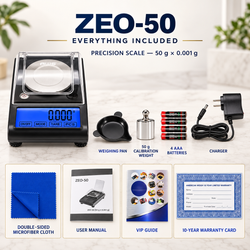
The Gemini-20 vs. Gemini-50 comparison illustrates this capacity tradeoff while maintaining milligram readability.
When 500 g × 0.01 g Makes More Sense
Choose higher capacity when the scale also handles:
-
Finished rings
-
Pendants
-
Bracelets
-
Necklaces
-
Larger gemstone parcels
-
Containers
For many mixed jewelry workflows:
500 g × 0.01 g
is more useful than:
20 g × 0.001 g.
Why?
Because the extra decimal place is worthless if the item exceeds the scale's capacity.
One Scale or Two?
Some gemstone professionals may benefit from two complementary instruments.
General-Purpose Scale
500 g × 0.01 g
Use for:
-
General gemstones
-
Jewelry
-
Larger parcels
-
Trays
Fine Scale
20–50 g × 0.001 g
Use for:
-
Tiny loose stones
-
Small diamonds
-
Fine sorting
This avoids forcing one scale to perform two very different jobs.
Do Not Estimate Gemstone Weight From Size Alone
A gemstone's physical dimensions do not uniquely determine its mass.
Different gemstone materials have different:
-
Densities
-
Cuts
-
Proportions
A visually similar stone can therefore have a different weight.
Use dimensions to describe:
physical size.
Use a scale to measure:
mass.
Weight Does Not Determine Gemstone Identity
A precision scale cannot tell you whether a stone is:
-
Natural
-
Laboratory-created
-
Treated
-
Imitation
FTC consumer guidance explains that gemstone descriptions may need to distinguish natural stones from laboratory-created and imitation products.
A scale contributes one piece of information:
weight.
It is not a complete gemological identification instrument.
Weight Does Not Equal Value
A heavier gemstone is not automatically worth more.
Gemstone value can depend on factors including:
-
Material
-
Color
-
Clarity
-
Cut
-
Treatment
-
Origin
-
Rarity
-
Market demand
For diamonds, carat weight is only one of the familiar 4Cs.
Two diamonds of equal carat weight can have different values.
Commercial Gemstone Weight Requires Care
For sellers, weight becomes more than an internal inventory number.
It may appear in:
-
Product listings
-
Advertisements
-
Certificates
-
Customer paperwork
The FTC Jewelry Guides state that marketers should truthfully represent characteristics including jewelry and gemstone weight.
For diamond weight stated in decimal carats, FTC guidance also addresses accuracy to the stated decimal place.
That makes reliable weighing and careful recordkeeping particularly important for commercial sellers.
Gemstone Scale by User Type
Gemstone Collector
Consider:
100–500 g × 0.01 g
with:
-
Carat mode
-
Tare
-
Protective cover
Jewelry Maker
Consider:
500 g × 0.01 g
for:
-
Gemstones
-
Findings
-
Rings
-
Pendants
-
Finished pieces
Gem Dealer
Consider:
500 g × 0.01 g
plus:
20–50 g × 0.001 g
when fine loose-stone measurements are part of the workflow.
Diamond Seller
Finer measurement may be required depending on the commercial application.
Choose equipment and procedures appropriate to the precision required for the weight being represented.
Hobbyist
A:
0.01 g pocket scale
may provide a practical starting point without the added sensitivity of milligram equipment.
Gemstone Scale Comparison
| Scale Configuration | Strength | Limitation | Best For |
|---|---|---|---|
| 500 g × 0.1 g | High capacity | Coarser resolution | Larger jewelry |
| 500 g × 0.01 g | Excellent balance | Not milligram resolution | General gemstones/jewelry |
| 100 g × 0.01 g | Compact precision | Lower capacity | Loose stones |
| 50 g × 0.001 g | Fine resolution + usable range | Environment sensitive | Small gems/parcels |
| 20 g × 0.001 g | Very fine resolution | Limited capacity | Tiny loose gemstones |
Common Gemstone Scale Buying Mistakes
Buying Based on Decimal Places Alone
0.001 g is not automatically better than 0.01 g.
Confusing Readability With Accuracy
Displayed increment is only one performance characteristic.
Ignoring Capacity
The scale must support the entire load.
Forgetting Tray Weight
Trays consume physical capacity.
Assuming Tare Restores Capacity
It does not.
Ignoring Minimum Practical Load
Very high capacity does not automatically make a scale ideal for tiny stones.
Ignoring Carat Mode
Direct ct display can simplify gemstone workflows.
Using the Wrong Calibration Weight
Calibration requirements are model-specific.
Calibrating With Coins
Use an appropriate reference weight.
Ignoring Repeatability
Fine digits mean little if the measurement constantly changes.
Ignoring Platform Size
The complete weighing setup must fit.
Measuring Near an Air Vent
Airflow matters at fine resolution.
Using a Wobbly Workbench
Vibration affects precision weighing.
Ignoring Static
Static can affect very fine measurements.
Estimating Carat Weight From Dimensions Alone
Different gem materials have different densities.
Treating Total Jewelry Weight as Gemstone Weight
Mounted jewelry includes metal and other components.
Assuming Weight Determines Value
It does not.
Gemstone Scale Buying Checklist
Before purchasing, check:
-
What gemstones will I weigh?
-
Are they loose or mounted?
-
What is the lightest meaningful measurement?
-
What is the heaviest complete load?
-
Do I need 0.1 g, 0.01 g or 0.001 g readability?
-
Is 0.01 g sufficient?
-
Is milligram readability genuinely necessary?
-
Do I need carat mode?
-
Do I need grams?
-
What maximum capacity is required?
-
Will I use a tray?
-
What does the tray weigh?
-
Have I allowed capacity headroom?
-
Is the platform large enough?
-
Does the scale have tare?
-
What calibration weight does it require?
-
Is the correct calibration weight available?
-
Is calibration straightforward?
-
Are readings repeatable?
-
Is the zero stable?
-
Will airflow affect measurements?
-
Is the work surface stable?
-
Could vibration be a problem?
-
Could static affect the reading?
-
Is room temperature reasonably stable?
-
Will I travel with the scale?
-
Do I need a protective cover?
-
Is battery operation convenient?
-
Will I weigh gemstone parcels?
-
Will I weigh finished jewelry?
-
Do I need 20 g, 50 g or 500 g capacity?
-
Would two scales serve the workflow better?
-
Am I confusing readability with accuracy?
-
Does the scale match my smallest and largest measurements?
-
Can I verify its performance periodically?
Frequently Asked Questions
What is the best scale for gemstones?
For many general gemstone and jewelry applications:
500 g × 0.01 g
offers an excellent balance between usable capacity and fine readability.
For tiny gemstones:
20–50 g × 0.001 g
may be more appropriate.
What accuracy do I need for gemstones?
The answer depends on the application.
Do not use readability as a synonym for accuracy.
For general gemstone work, 0.01 g readability is often useful.
For much smaller stones, 0.001 g may provide more appropriate displayed detail.
Is 0.01 g enough for gemstones?
For many general applications, yes.
For very small gemstones or fine sorting, 0.001 g may be preferable.
Is 0.001 g always better?
No.
It usually introduces:
-
Lower capacity
-
Greater draft sensitivity
-
Greater vibration sensitivity
-
More demanding operating conditions
Choose it when the finer resolution is genuinely needed.
What capacity should a gemstone scale have?
For individual loose stones:
20–100 g may be sufficient.
For mixed gemstone and jewelry use:
200–500 g can provide more flexibility.
Is 20 g enough for gemstones?
20 g equals:
100 carats.
That can be plenty for many individual stones.
Is 50 g enough?
50 g equals:
250 carats.
It gives more flexibility for trays and parcels.
Why choose 500 g?
Because a 500 g scale can also handle:
-
Jewelry
-
Larger parcels
-
Trays
-
Containers
What is one carat in grams?
1 ct = 0.20 g.
How many carats are in one gram?
5 ct.
Does a gemstone scale need carat mode?
No, but it is very convenient.
What does calibration do?
Calibration establishes or checks the scale's measurement response against an appropriate known reference according to the manufacturer's procedure.
How often should I calibrate my gemstone scale?
Follow the manufacturer's recommendations and check the scale whenever readings become questionable or operating conditions change significantly.
Can I calibrate it with coins?
Use the correct calibration weight rather than ordinary coins or household objects.
Is tare the same as removing the tray weight?
It removes the tray from the displayed net reading.
It does not remove the tray's physical load from the scale.
Why does my 0.001 g scale fluctuate?
Possible causes include:
-
Drafts
-
Vibration
-
Static
-
Temperature
-
Calibration
-
Battery condition
Does a larger capacity scale measure gemstones better?
Not necessarily.
Excessive capacity is not useful if the scale's resolution is too coarse for the task.
Does a smaller capacity scale measure gemstones better?
Not automatically.
Lower-capacity scales may offer finer resolution, but the complete load must remain within capacity.
Can gemstone dimensions tell me the exact carat weight?
No.
Density, cut and proportions affect mass.
Can a scale identify whether a gemstone is real?
No.
A scale measures mass; it does not independently determine gemstone identity or authenticity.
Do professional gemstone sellers need two scales?
Sometimes.
A:
500 g × 0.01 g
general-purpose scale paired with a:
20–50 g × 0.001 g
milligram scale can cover a broad range of gemstone and jewelry weighing tasks.
Final Verdict: Accuracy, Capacity and Calibration Must Work Together
A good gemstone scale buying guide should never tell you to choose a scale from one specification alone.
The three fundamentals are:
accuracy-related performance + capacity + calibration.
Start with your actual gemstones.
Determine:
the smallest weight difference that matters.
That tells you the readability you need.
For many general gemstone applications:
0.01 g
provides a practical balance.
For very small stones:
0.001 g
may be appropriate.
Then calculate your maximum physical load:
gemstone + tray + container + jewelry.
For tiny individual stones:
20–50 g
may provide plenty of capacity.
For general gemstone and jewelry work:
500 g
offers much greater versatility.
Finally, evaluate:
-
Calibration procedure
-
Appropriate reference weight
-
Repeatability
-
Stable zero
-
Carat mode
-
Tare
-
Platform size
-
Capacity headroom
-
Draft sensitivity
-
Vibration
-
Static
-
Portability
Remember:
readability is not automatically accuracy.
And:
tare does not increase physical capacity.
For many collectors, jewelry makers and gemstone sellers, a strong general-purpose configuration is:
500 g × 0.01 g.
For genuinely fine loose-stone work, consider adding:
20–50 g × 0.001 g.
The best buying sequence is:
define the gemstone application → determine required measurement detail → calculate total load → choose capacity → evaluate accuracy and repeatability → confirm calibration → check carat mode and platform → control the weighing environment.
That gives you a scale selected around real gemstone work—not simply the largest capacity or the greatest number of decimal places.