
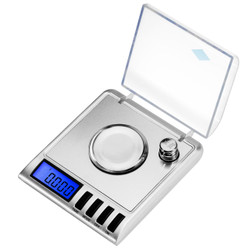
Buying a jewelry scale is easier when you focus on three fundamentals: accuracy, capacity, and calibration.
The scale needs enough capacity for the heaviest jewelry, tray, or batch you plan to place on it. It needs fine enough readability for the smallest weight difference that matters to your work. And it needs a dependable calibration process so you can check and maintain its performance.
For many general jewelry applications, 0.01g readability provides a practical balance between precision and usable capacity. Loose gemstones, tiny findings, and very small precious-metal components may call for 0.001g readability, while heavier jewelry or larger batches may be better served by greater capacity with 0.1g or 0.01g increments.
American Weigh Scales offers compact options through its pocket scales collection as well as finer-resolution models for applications requiring milligram-level measurements.
This jewelry scale buying guide explains what accuracy really means, how to choose capacity, how calibration works, and which additional features matter for jewelry makers, collectors, repair professionals, gemstone users, and precious-metal applications.
Jewelry Scale Buying Guide: Quick Recommendations
| Application | Practical capacity range | Suggested readability |
|---|---|---|
| Rings and earrings | 70–200g | 0.01g |
| Pendants and small chains | 100–250g | 0.01g |
| Bracelets | 200–500g | 0.01g |
| Watches | 250–500g+ | 0.01g or 0.1g |
| Loose gemstones | 20–100g | 0.001g or suitable carat resolution |
| Tiny findings | 20–100g | 0.001g |
| General jewelry making | 200–500g+ | 0.01g |
| Gold and silver pieces | 100–500g+ | 0.01g |
| Scrap precious metals | 500–2,000g+ | 0.01g or 0.1g |
These are starting points rather than universal requirements. The correct scale depends on your lightest meaningful load, heaviest complete load, required measurement detail, and the manufacturer's specifications.
1. Start With the Jewelry You Actually Weigh
Before comparing scale models, list the items you expect to measure.
These may include:
-
Rings
-
Earrings
-
Chains
-
Pendants
-
Bracelets
-
Watches
-
Loose gemstones
-
Diamonds
-
Findings
-
Beads
-
Gold components
-
Silver components
-
Wax models
-
Watch parts
-
Scrap precious metals
-
Finished inventory
Then identify two numbers:
-
The lightest item or weight difference that matters.
-
The heaviest item plus any tray or container.
Those two values immediately narrow the field.
A scale for loose gemstones has different priorities from a scale for grouped silver bracelets. Likewise, a scale used for finished jewelry inventory may need more capacity than a scale used for tiny findings.
2. What Does Accuracy Mean on a Jewelry Scale?
Accuracy is one of the most misunderstood scale terms.
A display with more decimal places does not automatically prove that the scale is more accurate.
Several characteristics contribute to useful weighing performance:
-
Readability
-
Accuracy or tolerance specification
-
Repeatability
-
Calibration
-
Minimum usable load
-
Linearity
-
Stability
-
Operating environment
NIST's Weighing and Scales FAQ advises scale users to consider suitability, accuracy, capacity, minimum load, and usability when selecting a scale for an application.
For jewelry buyers, that means a specification such as 500g x 0.01g should be treated as capacity and display readability—not as a blanket promise that every reading is accurate to exactly ±0.01g under every possible condition.
AWS explains this distinction further in What Does 500g x 0.01g Mean on a Digital Scale?.
3. Readability: 0.1g vs 0.01g vs 0.001g
Readability is the smallest increment displayed.
0.1g Readability
A 0.1g scale displays tenths of a gram.
It may work well for:
-
Heavier jewelry
-
Large silver pieces
-
Bulk beads
-
Larger batches of findings
-
Scrap-metal lots
-
Jewelry-making materials
It is less useful when differences of hundredths of a gram matter.
0.01g Readability
A 0.01g scale displays hundredths of a gram.
For general jewelry work, this is often an excellent starting point.
It is useful for:
-
Rings
-
Earrings
-
Pendants
-
Chains
-
Bracelets
-
Gold jewelry
-
Silver jewelry
-
Findings
-
Beads
-
Small scrap lots
-
Repair documentation
AWS's guide to pocket scales for jewelry, coins, coffee and crafts highlights 0.01g as a useful precision level for jewelry-related weighing.
0.001g Readability
A 0.001g scale displays thousandths of a gram, equal to one milligram.
Choose this level when measuring:
-
Tiny gemstones
-
Very small findings
-
Small precious-metal fragments
-
Lightweight components
-
Samples where 0.01g is too coarse
Finer readability also increases sensitivity to drafts, vibration, static, and temperature. AWS's 0.001g milligram scale comparison explains why capacity, calibration, draft protection, and operating conditions become especially important at this level.
4. How Much Capacity Do You Need?
Capacity is the maximum load the scale is designed to support.
Everything on the weighing platform counts:
-
Jewelry
-
Trays
-
Cups
-
Containers
-
Gemstone dishes
-
Multiple items
If you use a 500g scale with a 100g tray, approximately 400g remains for the jewelry.
Pressing tare changes the displayed net weight, but it does not remove the tray's physical load from the scale.
70g to 100g Capacity
This range can work for:
-
Rings
-
Earrings
-
Loose gemstones
-
Small pendants
-
Findings
-
Lightweight chains
It offers portability but less flexibility for heavier jewelry.
200g to 250g Capacity
This is a versatile range for many jewelry users.
It can accommodate:
-
Most rings
-
Earrings
-
Pendants
-
Many chains
-
Many bracelets
-
Findings
-
Precious-metal samples
-
Small containers
500g Capacity
A 500g scale gives more room for:
-
Watches
-
Heavy chains
-
Bracelets
-
Multiple pieces
-
Larger trays
-
Grouped findings
-
Small scrap-metal lots
Above 500g
Consider higher capacity when weighing:
-
Larger grouped jewelry
-
Heavy silver
-
Production materials
-
Large scrap lots
-
Containers that consume significant capacity
Do not buy maximum capacity merely because it sounds better. Choose enough capacity to provide useful headroom while preserving the readability your application requires.
5. Leave Capacity Headroom
Operating at or near the maximum load during every weighing session is not ideal.
Suppose your heaviest expected jewelry-plus-tray combination is 190g.
A 200g scale technically covers it, but it leaves only 10g of headroom.
A 250g or 500g model may be more practical.
Headroom helps accommodate:
-
Heavier-than-expected items
-
Different trays
-
Multiple pieces
-
Future applications
At the same time, excessive capacity can be unnecessary if all your work involves small rings and gemstones.
6. Minimum Load Matters
Maximum capacity receives more attention, but minimum usable load matters for jewelry too.
A scale displaying 0.01g increments should not automatically be assumed to reliably measure an object whose total mass is only 0.01g.
At very low loads, the relationship between the sample mass and the scale's measurement capability becomes important.
This is especially relevant for:
-
Tiny stones
-
Small findings
-
Solder
-
Metal fragments
-
Micro-components
When the smallest objects matter, review the manufacturer's operating specifications rather than relying only on the number of decimal places.
7. Repeatability Is Critical
Repeatability describes how consistently the scale returns similar results when the same object is weighed repeatedly under similar conditions.
A simple check is useful:
-
Put the scale on a stable surface.
-
Turn it on and let it stabilize.
-
Confirm zero.
-
Place an appropriate reference weight in the center.
-
Record the result.
-
Remove the weight.
-
Let the display return to zero.
-
Repeat several times.
If the readings vary beyond the scale's expected performance, investigate before using it for important jewelry measurements.
Potential causes include:
-
Drafts
-
Vibration
-
Weak batteries
-
Temperature changes
-
Static
-
Dirt
-
Off-center loading
-
Calibration issues
8. Calibration: What Jewelry Buyers Need to Know
Calibration compares a scale's response with a known reference mass and adjusts it according to the manufacturer's procedure. The international framework for SI measurement units is documented in the BIPM SI Brochure.
Calibration is not the same as pressing tare.
It is also not the same as simply turning the scale off and back on.
Before purchasing, determine:
-
Whether the scale supports user calibration
-
Which calibration mass is required
-
Whether a calibration weight is included
-
How calibration mode is entered
-
Whether one-point or multiple-point calibration is used
AWS provides a detailed overview in How to Calibrate a Digital Scale for Accurate Results.
9. Do You Need a Calibration Weight?
If the scale requires external calibration, you need the correct reference weight specified by the manufacturer.
Do not substitute:
-
Coins
-
Jewelry
-
Batteries
-
Packaged products
-
Random metal objects
These items are not calibration standards and may vary from the mass you assume.
A proper calibration weight gives you a known reference appropriate for the scale's procedure.
10. When Should a Jewelry Scale Be Calibrated?
Follow the scale manufacturer's instructions.
It is also sensible to check scale performance after:
-
Transportation
-
A drop or impact
-
Overloading
-
Significant temperature changes
-
Long-term storage
-
Unexplained changes in readings
-
Poor repeatability
A scale that travels to craft shows, estate appointments, workshops, or buying events may require more frequent performance checks than one that stays on a stable jewelry bench.
11. Tare Is Essential for Jewelry
Tare subtracts the displayed weight of a container so you can measure the jewelry's net weight.
Example:
-
Put a gemstone tray on the platform.
-
Wait for stabilization.
-
Press tare.
-
Confirm zero.
-
Add the stone.
-
Record the result.
Tare is useful for:
-
Gemstones
-
Findings
-
Beads
-
Chains
-
Scrap metal
-
Multiple components
Remember that the container still consumes physical capacity.
12. Jewelry Weighing Units
Look for units that match your workflow.
Common options include:
-
Grams (g)
-
Carats (ct)
-
Pennyweight (dwt)
-
Troy ounces (ozt)
-
Ounces (oz)
-
Grains (gn)
Grams
Grams are useful for general jewelry making, repair, inventory, components, and precious-metal pieces. NIST's reference on SI units of mass explains the relationship among kilograms, grams, and milligrams.
Carats
Carats are used for gemstones.
The Gemological Institute of America defines one metric carat as 200 milligrams, or 0.2 gram, divided into 100 points.
Carat is a unit of weight, not physical size.
Pennyweight
Pennyweight is still used in portions of the jewelry and precious-metals trade.
Troy Ounces
Troy ounces are commonly associated with precious metals and are different from standard avoirdupois ounces.
If you work in several units, direct scale conversion can reduce manual calculations.
13. Platform Size and Shape
The entire item must be supported by the scale.
A chain hanging from the platform and touching the counter is partially supported by the counter. The reading can therefore be incorrect.
Choose a platform suitable for the objects you weigh.
For loose gemstones and tiny findings, a small pan can work well.
For chains, bracelets, watches, and grouped jewelry, a larger platform or compatible lightweight tray can make weighing easier.
Make sure the tray:
-
Fits completely on the platform
-
Does not touch the scale housing
-
Does not block controls
-
Does not exceed capacity when loaded
14. Draft Protection
Air movement matters more as readability becomes finer.
A 0.001g scale may react to:
-
Air-conditioning
-
Fans
-
Open windows
-
Doors
-
Breathing near the pan
-
People moving around the bench
A draft shield helps reduce these effects.
For routine 0.01g jewelry weighing, a full shield may not be necessary. For milligram-level work, it can be a valuable feature.
15. Stable Zero
After removing an item, the scale should return reliably to zero under stable conditions.
If the empty display continually changes, investigate:
-
Air movement
-
Vibration
-
Temperature
-
Static
-
Weak batteries
-
Dirt around the platform
-
Damage
-
Calibration
AWS discusses common causes in Why Does My Digital Scale Give Different Readings?.
16. Display Quality
A jewelry scale may be used repeatedly throughout the day, so display quality matters.
Look for:
-
Large digits
-
Backlighting
-
Clear contrast
-
Visible unit indicators
-
A display not easily blocked by trays
The controls should remain accessible while weighing.
17. Portability and Protective Covers
Pocket scales are useful for:
-
Craft shows
-
Estate appointments
-
Auctions
-
Workshops
-
Mobile repair
-
Travel
-
Collecting
A protective cover helps prevent pressure, scratches, and debris from reaching the weighing platform during transport.
Some covers may double as weighing trays when designed for that purpose.
Precision scales should still be transported carefully. Compact does not mean impact-proof.
18. Power and Auto-Off
Pocket jewelry scales commonly use replaceable batteries.
Bench models may offer rechargeable power, USB, or an adapter.
Weak batteries can contribute to unstable operation, so replace or recharge them promptly.
Auto-off is useful for conserving battery power, but very short timeouts can interrupt repetitive weighing. Check whether the setting can be adjusted if you expect long jewelry sessions.
19. Best Scale for Rings and Earrings
For general rings and earrings, a strong starting specification is:
-
70g to 200g capacity
-
0.01g readability
-
Tare
-
Grams
-
Calibration capability
-
Protective cover
If you regularly weigh multiple pieces together, choose more capacity.
20. Best Scale for Chains and Bracelets
Chains and bracelets require attention to both weight and physical size.
Consider:
-
200g to 500g capacity
-
0.01g readability
-
Tare
-
Larger platform or tray
-
Clear display
Make sure no part of the jewelry touches the surrounding work surface.
21. Best Scale for Gold Jewelry
For many finished gold pieces, 0.01g readability is practical.
For tiny gold findings or fragments, 0.001g may be useful.
For grouped scrap gold, capacity becomes increasingly important.
If the scale reading determines the amount paid in a commercial transaction, additional legal requirements can apply.
22. Best Scale for Silver Jewelry
Silver pieces can be relatively large or heavy.
For individual silver jewelry, 0.01g readability with 200g to 500g+ capacity can provide useful flexibility.
For larger grouped silver items, consider higher capacity.
Again, choose the scale based on the heaviest realistic complete load.
23. Best Scale for Gemstones and Diamonds
Gemstone weighing often requires finer resolution.
Prioritize:
-
Fine readability
-
Carat mode
-
Low usable load
-
Calibration
-
Repeatability
-
Stable pan
-
Draft protection
For demanding gemological applications, a specialized balance may be more appropriate than a general-purpose pocket scale.
24. Best Scale for Jewelry Making
Jewelry makers often need versatility.
A general bench setup may involve:
-
Wire
-
Findings
-
Beads
-
Stones
-
Metal
-
Wax
-
Finished pieces
A 500g x 0.01g scale is a practical general-purpose specification for many workflows because it combines moderate capacity with hundredth-gram readability.
If tiny components require finer measurements, add a 0.001g scale rather than expecting one instrument to optimize both high capacity and milligram resolution.
25. Best Scale for Jewelry Repair
Repair work can involve complete jewelry and very small replacement parts.
A 0.01g pocket scale can cover many routine jobs.
A second 0.001g scale may be useful for:
-
Tiny findings
-
Loose stones
-
Small metal fragments
-
Fine component work
This two-scale approach can be more flexible than one compromise instrument.
26. Pocket Scale vs. Milligram Scale
A pocket scale generally prioritizes:
-
Portability
-
Moderate capacity
-
0.01g or 0.1g readability
-
Protective cover
-
Everyday convenience
A milligram scale prioritizes:
-
0.001g readability
-
Smaller loads
-
Fine measurement
-
Greater environmental control
-
Draft protection on some models
For many jewelry users, a 0.01g pocket scale should be the first purchase and a 0.001g milligram scale the specialized second tool.
27. Accuracy vs. Precision vs. Resolution
These terms should not be treated as synonyms.
Resolution/readability describes the smallest displayed increment.
Accuracy describes closeness to a reference value within specified conditions and tolerances.
Precision is often used informally to describe fine measurement, but technically it relates to the closeness of repeated measurements.
Repeatability describes consistency when the same item is measured repeatedly under similar conditions.
When buying a jewelry scale, examine the complete performance specification rather than one marketing number.
28. Why Jewelry Scales Give Different Readings
Small variations can come from the environment rather than the jewelry.
Common causes include:
-
Drafts
-
Vibration
-
Static
-
Temperature changes
-
Weak batteries
-
Uneven surfaces
-
Off-center loading
-
Contamination
-
Jewelry touching another surface
-
Overloading
-
Calibration issues
At 0.001g readability, environmental control becomes especially important.
29. Commercial Jewelry Scales and Legal-for-Trade Use
A scale used for internal jewelry making is not automatically appropriate for commercial transactions.
The current NIST Handbook 44 contains specifications, tolerances, and technical requirements intended to support accurate and repeatable commercial measurements. The current edition is the 2026 edition and is adopted by many state, local, and some federal weights-and-measures authorities.
NIST also explains that scales used for commercial applications must comply with the laws of the state where they are used.
Jewelry businesses should also review the FTC's Jewelry Guides, which address truthful representations involving characteristics such as quantity, metallic content, size, and weight. If you buy or sell gold, silver, gemstones, or other jewelry based directly on weight, verify:
-
State requirements
-
Local weights-and-measures requirements
-
Device approval
-
Inspection requirements
-
Accuracy class
-
Minimum load requirements
-
Legal-for-trade status
Do not assume that a consumer jewelry scale qualifies merely because it displays the desired unit or decimal places.
30. Jewelry Scale Buying Checklist
Before buying, ask:
-
What is the lightest item I will weigh?
-
What is the smallest weight difference I need to see?
-
What is my heaviest item?
-
Will I use a tray?
-
What is my heaviest item plus tray?
-
Do I need 0.1g, 0.01g, or 0.001g readability?
-
What accuracy or tolerance does the manufacturer specify?
-
Is the minimum usable load suitable?
-
Does the scale repeat consistently?
-
Can it be calibrated?
-
What calibration weight does it require?
-
Is the calibration weight included?
-
Do I need grams?
-
Do I need carats?
-
Do I need pennyweight?
-
Do I need troy ounces?
-
Is the platform large enough?
-
Does it have tare?
-
Do I need a draft shield?
-
Will I travel with it?
-
Does it have a protective cover?
-
Is the display easy to read?
-
What power source does it use?
-
Is it for internal use or a commercial transaction?
-
If commercial, is it approved for the intended application?
Common Jewelry Scale Buying Mistakes
Mistake 1: Choosing Only by Decimal Places
More displayed decimals do not independently guarantee greater accuracy.
Mistake 2: Ignoring Capacity
Your jewelry, tray, and container all count toward the maximum load.
Mistake 3: Ignoring Minimum Load
Fine readability does not guarantee reliable measurement of arbitrarily tiny samples.
Mistake 4: Confusing Tare With Capacity
Tare changes the display. It does not create more physical capacity.
Mistake 5: Using Random Calibration Objects
Use the calibration mass specified by the manufacturer.
Mistake 6: Ignoring Repeatability
A useful jewelry scale should provide consistent results under stable conditions.
Mistake 7: Ignoring the Environment
A 0.001g scale on a vibrating table near an air vent may perform poorly regardless of its specifications.
Mistake 8: Buying Too Little Capacity
Leave headroom above your normal maximum load.
Mistake 9: Buying Too Much Capacity
Do not sacrifice needed fine readability merely to obtain capacity you will never use.
Mistake 10: Assuming Every Jewelry Scale Is Legal for Trade
Commercial weighing can require approved and inspected equipment.
Frequently Asked Questions
What is the best accuracy for a jewelry scale?
There is no single specification for every jewelry task. For many general applications, 0.01g readability combined with suitable manufacturer accuracy specifications is a practical starting point. Tiny gemstones and components may require 0.001g.
Is 0.01g accurate enough for jewelry?
A 0.01g scale is useful for many rings, earrings, chains, pendants, bracelets, findings, and precious-metal pieces. Check the specific model's accuracy or tolerance specification rather than relying only on readability.
Is 0.001g better than 0.01g?
It provides finer readability, but it may have lower capacity and greater sensitivity to environmental conditions. Choose it when milligram-level measurement is actually needed.
What capacity should a jewelry scale have?
For lightweight individual jewelry, 100g to 250g may be enough. A 500g scale provides greater flexibility for watches, bracelets, heavy chains, multiple pieces, and trays.
What does 500g x 0.01g mean?
It means the scale supports up to 500 grams and displays measurements in 0.01-gram increments.
How do I calibrate a jewelry scale?
Follow the manufacturer's instructions, place the scale on a stable surface, enter calibration mode, and use the specified reference weight.
Can I calibrate a jewelry scale with a coin?
A coin is not a substitute for a proper calibration weight. Use the reference mass specified by the scale manufacturer.
How often should a jewelry scale be calibrated?
Follow the manufacturer's schedule and check performance after transport, impact, overload, major temperature changes, long storage, or unexplained reading changes.
What scale is best for gold?
For many finished gold jewelry pieces, 0.01g readability is a useful starting point. Tiny fragments may require 0.001g, while larger scrap lots may require greater capacity.
What scale is best for diamonds?
Loose diamonds generally require fine resolution and carat measurement. A specialized gemstone or milligram-level scale may be more suitable than a general pocket scale.
How many grams are in one carat?
One metric carat equals 0.2 gram, or 200 milligrams.
What is tare?
Tare subtracts the displayed weight of a container so the scale shows the net weight of the jewelry.
Does tare increase capacity?
No. The container continues to physically load the scale.
Why does my jewelry scale fluctuate?
Drafts, vibration, static, temperature changes, weak batteries, an unstable surface, contamination, calibration issues, or objects touching the surrounding counter can all contribute.
Can I use any jewelry scale to buy or sell gold?
No. When price is determined by weight, commercial weights-and-measures rules may apply. Confirm legal-for-trade requirements in your jurisdiction.
Final Verdict: Accuracy, Capacity and Calibration Matter Together
A good jewelry scale is not defined by one specification.
Accuracy determines whether the instrument's performance is suitable for the job.
Capacity determines whether it can safely support your heaviest complete load.
Readability determines how finely the result is displayed.
Calibration provides a way to compare and adjust the scale against a known reference according to the manufacturer's procedure.
For many jewelry users, a 0.01g pocket scale with 200g to 500g capacity is a strong general-purpose starting point.
For tiny gemstones and components, consider 0.001g readability.
For heavier jewelry and grouped materials, prioritize enough capacity while maintaining the resolution your work actually requires.
Beyond those core specifications, look for:
-
Good repeatability
-
Appropriate minimum load
-
Tare
-
Useful jewelry units
-
Suitable platform size
-
Draft protection when necessary
-
Clear display
-
Protective cover
-
Reliable power
-
Straightforward calibration
-
Appropriate commercial approval when required
American Weigh Scales offers precision weighing options for different jewelry applications. Match the scale to the objects you actually weigh rather than simply buying the model with the most decimals or highest capacity.
When accuracy, capacity, calibration, and operating conditions are considered together, you can choose a jewelry scale that is far more useful at the bench—and far easier to trust.