
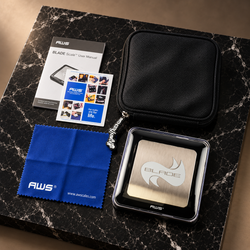
Choosing a scale for beads starts with three questions:
What type of beads are you weighing?
How small are your typical batches?
How heavy is the complete load including the container?
For many jewelry makers and bead sellers, a practical starting point is:
500 g capacity × 0.01 g readability.
That combination provides enough detail for small bead packages while still offering useful capacity for:
-
Seed beads
-
Glass beads
-
Crystal beads
-
Gemstone beads
-
Findings
-
Small trays
-
Containers
-
Finished jewelry
For larger bead batches:
0.1 g readability
may be perfectly adequate.
For extremely lightweight individual components:
0.001 g
may occasionally be useful, but most ordinary bead workflows do not require milligram resolution.
American Weigh Scales offers multiple digital pocket scales covering different combinations of capacity and readability.
The key is not choosing the scale with the most decimal places.
It is choosing the scale whose:
resolution + capacity + platform + tare functionality
match your actual bead workflow.
Quick Answer: How Do You Choose a Scale for Beads?
Follow this sequence:
-
Identify the type of beads you weigh.
-
Determine your smallest typical package.
-
Determine your largest typical batch.
-
Decide whether 0.1 g or 0.01 g readability is appropriate.
-
Consider 0.001 g only if genuinely necessary.
-
Weigh your usual container or tray.
-
Add container weight to maximum bead weight.
-
Choose enough capacity above that total.
-
Check platform dimensions.
-
Confirm tare functionality.
-
Check calibration requirements.
-
Consider repeatability and stable zero.
-
Decide whether portability matters.
-
Consider whether you also weigh finished jewelry.
For most mixed bead applications:
500 g × 0.01 g
is an excellent starting point.
Step 1: Identify the Type of Beads You Weigh
Different bead materials can have very different weights.
Common materials include:
-
Seed beads
-
Glass beads
-
Crystal beads
-
Acrylic beads
-
Plastic beads
-
Ceramic beads
-
Gemstone beads
-
Metal beads
-
Pearl beads
-
Wooden beads
A small batch of acrylic beads may weigh very little.
A similar-sized batch of:
-
Hematite
-
Steel
-
Glass
-
Gemstone
may weigh considerably more.
This means scale selection should begin with the actual material rather than simply the physical size of the beads.
Step 2: Consider Bead Size
Beads range from extremely tiny seed beads to large decorative focal beads.
Fire Mountain Gems publishes a useful seed bead sizing reference showing common bead sizes and shapes.
Small seed beads create a different weighing problem from large gemstone beads.
With tiny beads:
resolution becomes more important.
With large or heavy beads:
capacity becomes more important.
Step 3: Decide What You Are Actually Measuring
Do you need the scale for:
-
One bead?
-
Small retail packages?
-
Complete strands?
-
Bulk inventory?
-
Finished jewelry?
-
Approximate piece counts?
-
Jewelry-making materials?
Your answer determines the specification you should prioritize.
Small Retail Packages
If you frequently prepare:
5 g
10 g
15 g
25 g
packages, fine readability can be useful.
Bulk Inventory
If you routinely weigh:
250 g
500 g
1,000 g
of beads at once, capacity becomes more important.
Finished Jewelry
If the same scale will also weigh:
-
Bracelets
-
Necklaces
-
Earrings
-
Pendants
you need enough capacity for complete pieces.
Step 4: Understand Readability
Readability is the smallest increment shown on the scale display.
Typical options include:
1 g
0.1 g
0.01 g
0.001 g
For bead work, the most practical choices are usually:
0.1 g or 0.01 g.
Step 5: Decide Whether 0.1 g Is Enough
A:
0.1 g
scale displays tenths of a gram.
Examples:
9.8 g
9.9 g
10.0 g
10.1 g
This may be sufficient for:
-
Larger glass-bead batches
-
Gemstone beads
-
Metal beads
-
Finished jewelry
-
Wholesale quantities
-
Bulk craft materials
If your goal is simply:
100.0 g of beads
rather than:
100.01 g
then 0.1 g can be entirely appropriate.
Step 6: Choose 0.01 g for Smaller Packages
A:
0.01 g
scale displays hundredths of a gram.
Examples:
9.97 g
9.98 g
9.99 g
10.00 g
This gives ten times finer displayed detail than 0.1 g.
It is especially useful for:
-
Seed beads
-
Small retail packages
-
Findings
-
Crystal beads
-
Small gemstone-bead batches
-
Jewelry components
For many bead sellers:
0.01 g is the sweet spot.
AWS's guide to choosing a scale for jewelry explains the same basic principle: match the scale's readability to the smallest meaningful difference in the items you actually weigh.
Step 7: Decide Whether You Really Need 0.001 g
A:
0.001 g
scale reads in thousandths of a gram.
That level of detail can be useful for:
-
Extremely tiny findings
-
Individual lightweight components
-
Specialized precision work
But most ordinary bead businesses do not need it.
Milligram scales usually come with tradeoffs:
-
Lower capacity
-
Smaller platforms
-
Greater airflow sensitivity
-
Greater vibration sensitivity
-
Greater static sensitivity
Unless differences smaller than:
0.01 g
actually matter to your workflow, 0.001 g is usually unnecessary.
Step 8: Do Not Confuse Readability With Accuracy
A scale that displays:
0.01 g
does not automatically guarantee every measurement is accurate to:
±0.01 g.
These are different concepts.
Readability
The smallest displayed increment.
Accuracy
How close the measurement is to the relevant true or reference value.
Repeatability
How consistently the same object produces similar measurements under similar conditions.
Choose a scale based on the complete measurement task, not just the number of decimal places.
Step 9: Determine Your Capacity Requirement
Capacity is the maximum total physical load the scale can support.
Common capacities include:
-
100 g
-
200 g
-
500 g
-
1,000 g
-
2,000 g
-
5,000 g
The important calculation is:
beads + tray + container = total load.
Step 10: Include the Container
Suppose:
Beads = 350 g
Container = 120 g
Total physical load:
470 g.
A 500 g scale could accommodate that load.
Now suppose:
Beads = 400 g
Container = 120 g
Total:
520 g.
A 500 g scale is no longer sufficient.
Always calculate the complete load.
Step 11: Understand Why 500 g Is So Versatile
For many jewelry businesses:
500 g capacity
provides a useful middle ground.
It can accommodate:
-
Small bead packages
-
Seed-bead containers
-
Gemstone strands
-
Findings
-
Jewelry components
-
Small bowls
-
Finished bracelets
-
Necklaces
without requiring a large bench scale.
Step 12: Consider a 500 g × 0.01 g Scale
The SC501g Precision Digital Pocket Scale provides:
-
500 g capacity
-
0.01 g readability
-
Tare
-
Multiple units
-
Stainless-steel platform
-
Expansion trays
This type of configuration works especially well for:
small-to-medium bead batches plus general jewelry work.
Step 13: Consider a Compact Portable Alternative
The SM-501-BLK ScaleMate also provides:
500 g × 0.01 g
in a compact format.
This can be useful for:
-
Craft shows
-
Jewelry markets
-
Shared workspaces
-
Small studios
-
Mobile sellers
A compact scale can be easier to transport without giving up the capacity needed for typical bead work.
Step 14: Consider a Larger Platform for Bulk Work
Sometimes platform size matters more than hundredth-of-a-gram readability.
The AMW-500I Compact Digital Bench Scale provides:
500 g × 0.1 g
with a larger 6 × 6-inch platform.
This type of scale can be preferable when:
-
Containers are wider
-
Trays are larger
-
Batches are heavier
-
0.1 g readability is sufficient
Do not choose a tiny pocket scale simply because it has finer resolution if your normal bead bowl does not fit properly.
Step 15: Choose Enough Capacity Headroom
Avoid selecting a scale that operates near maximum capacity every day.
Suppose your normal complete load is:
480 g.
A 500 g scale technically provides enough capacity.
But it leaves very little flexibility for:
-
Heavier batches
-
Different containers
-
Larger trays
A higher-capacity scale may be more practical.
Step 16: Understand Tare
Tare removes the displayed weight of the container.
Example:
Empty bowl = 62.38 g
Place it on the scale.
Press:
TARE.
Display:
0.00 g.
Add beads.
The display now shows the net bead weight.
For bead work, tare is one of the most important scale functions.
Step 17: Remember That Tare Does Not Restore Capacity
Suppose:
Scale capacity = 500 g
Container = 100 g
After pressing tare, the display says:
0.00 g.
But the scale is still physically supporting:
100 g.
You have approximately:
400 g
of remaining load capacity.
Tare changes the displayed reference point.
It does not increase physical capacity.
Step 18: Choose the Right Platform Size
Check the actual dimensions of your usual:
-
Bowl
-
Cup
-
Tray
-
Bead container
The container should sit securely on the platform.
It should not:
-
Touch the table
-
Rest against the scale housing
-
Cover the controls
-
Become unstable
Platform fit is especially important for large bead batches.
Step 19: Use a Lightweight Tray for Small Batches
For smaller precision scales, lightweight trays preserve more usable capacity.
Example:
Scale capacity = 200 g
Heavy bowl = 120 g
Remaining capacity:
80 g.
A lightweight tray weighing:
20 g
would leave:
180 g.
available for beads.
Step 20: Choose a Scale With Easy Tare Access
If you prepare dozens of packages daily, tare should be:
-
Easy to locate
-
Easy to press
-
Quick to reset
Repeated packaging can become inefficient if the basic controls are cumbersome.
Step 21: Check Calibration Requirements
Precision scales should be calibrated according to the manufacturer's instructions.
Different models may require different calibration masses.
The National Institute of Standards and Technology discusses reference standards, uncertainty and proper measurement procedures in its balance and scale calibration guidance.
For bead work:
use the calibration reference specified for the exact model.
Step 22: Do Not Calibrate With Beads
A package labeled:
100 g beads
is not a substitute for the proper calibration weight.
Its actual total mass may differ because of:
-
Packaging
-
Manufacturing tolerances
-
Product variation
Use the correct calibration reference.
Step 23: Do Not Use Coins as Calibration Weights
Coins are also unsuitable as assumed precision standards.
Individual mass may vary because of:
-
Manufacturing tolerances
-
Wear
-
Damage
-
Dirt
-
Corrosion
Use the calibration weight recommended for your scale.
Step 24: Check Repeatability
Place the same bead container on the scale several times.
Suppose the readings are:
25.16 g
25.16 g
25.17 g
25.16 g
That suggests fairly consistent behavior.
If they are:
24.83 g
25.31 g
24.96 g
investigate possible causes.
These might include:
-
Airflow
-
Vibration
-
Static
-
Calibration
-
Uneven surface
-
Weak battery
Step 25: Check for a Stable Zero
Before adding beads:
the scale should settle at zero.
If an empty scale repeatedly changes between:
0.00 g
0.03 g
-0.01 g
0.02 g
something may be affecting the measurement.
Resolve that issue before packaging products.
Step 26: Use a Stable Surface
Place the scale on a:
-
Hard
-
Flat
-
Level
-
Stable
surface.
Avoid:
-
Flexible tables
-
Wobbly desks
-
Moving shelves
-
Workbenches attached to vibrating equipment
Stability matters more as readability becomes finer.
Step 27: Avoid Strong Airflow
Fine scales can respond to air movement.
Avoid placing a 0.01 g or 0.001 g scale directly beneath:
-
HVAC vents
-
Ceiling fans
-
Desk fans
-
Open windows
This is especially important when weighing very lightweight materials.
Step 28: Watch for Static
Bead businesses often use:
-
Plastic trays
-
Poly bags
-
Acrylic beads
-
Synthetic materials
These can accumulate static.
If fine readings fluctuate after checking:
-
Calibration
-
Surface stability
-
Airflow
static may be worth investigating.
Step 29: Use a Tray for Loose Beads
Loose beads can:
-
Roll off the platform
-
Fall into gaps
-
Mix with other inventory
-
Become difficult to retrieve
A lightweight tray makes weighing much easier.
The standard process is:
-
Place tray on scale.
-
Press tare.
-
Add beads.
-
Record net weight.
Step 30: Decide Whether You Will Estimate Bead Counts by Weight
A scale can help estimate piece quantity.
Suppose:
100 beads weigh 5.00 g.
Average weight per bead:
5.00 ÷ 100 = 0.05 g.
A batch weighing:
50 g
would contain approximately:
1,000 beads.
Weight-Based Counting Is an Estimate
The number may not be exact.
Beads can vary in:
-
Size
-
Hole diameter
-
Shape
-
Finish
-
Material
-
Manufacturing tolerance
Use a representative sample of the exact bead SKU.
Step 31: Use a Larger Reference Sample
Do not calculate average bead weight from just one bead if you can avoid it.
Instead:
-
Count 50 or 100 beads.
-
Weigh them together.
-
Divide total weight by quantity.
-
Record the average.
-
Weigh the larger batch.
-
Divide batch weight by average piece weight.
This helps reduce the impact of individual variation.
Step 32: Consider Seed Bead Packaging
Seed beads are frequently handled in relatively small gram quantities.
Fire Mountain Gems' seed bead package reference demonstrates that bead quantities can vary according to:
-
Size
-
Style
-
Manufacturer
-
Package weight
For seed beads:
0.01 g readability
is often a practical choice.
Step 33: Consider Gemstone Beads
Natural gemstone beads may vary in weight even when they appear similar in size.
Why?
Different materials have different densities.
The GIA Gem Encyclopedia covers the wide range of gem materials used in jewelry.
Gemstone bead weight can also vary because of:
-
Diameter
-
Shape
-
Hole size
-
Cutting
-
Natural variation
For many gemstone-bead workflows:
500 g × 0.01 g
is a useful starting point.
Step 34: Consider Glass Beads
Glass beads can work well with:
0.01 g readability
for small packages.
For large wholesale quantities:
0.1 g
may be sufficient.
Choose based on your smallest normal package.
Step 35: Consider Metal Beads
Metal beads can become heavy quickly.
For:
-
Steel beads
-
Brass beads
-
Sterling silver beads
-
Metal findings
capacity may become the limiting factor.
If your regular batches exceed several hundred grams:
choose a higher-capacity scale rather than forcing everything onto a 500 g precision model.
Step 36: Consider Plastic and Acrylic Beads
Plastic beads are usually lightweight.
For them:
resolution may matter more than capacity
when preparing small packages.
A 0.01 g scale can provide useful portion control.
Step 37: Consider Finished Jewelry
If your bead business also produces finished:
-
Bracelets
-
Necklaces
-
Earrings
-
Pendants
make sure the scale can accommodate complete pieces.
AWS's Best Digital Scale for Jewelry guide explains why general jewelry workflows often benefit from balancing fine readability with enough capacity for completed items.
Step 38: Decide Between a Pocket Scale and Bench Scale
Choose a Pocket Scale When:
-
Space is limited
-
Portability matters
-
Small batches dominate
-
0.01 g readability is important
-
Containers are compact
Choose a Bench Scale When:
-
Containers are larger
-
Bulk batches dominate
-
More platform space matters
-
0.1 g is sufficient
-
The scale stays at one workstation
Neither is automatically better.
Step 39: Decide Whether One Scale Is Enough
Some bead businesses have two very different workflows:
Small Retail Packaging
Examples:
5 g
10 g
25 g
Bulk Inventory
Examples:
500 g
1 kg
2 kg
One scale may not handle both optimally.
A two-scale setup can make more sense.
Example Two-Scale Setup
Precision Scale
500 g × 0.01 g
Use for:
-
Seed beads
-
Retail packages
-
Findings
-
Small gemstone batches
Bulk Scale
1,000–2,000 g+ × 0.1 g
Use for:
-
Wholesale inventory
-
Heavy bead batches
-
Large containers
This lets each scale operate within its natural use case.
How to Choose a Scale for Seed Beads
Prioritize:
-
0.01 g readability
-
200–500 g capacity
-
Tare
-
Lightweight tray
-
Repeatability
-
Stable zero
How to Choose a Scale for Gemstone Beads
Prioritize:
-
Around 500 g capacity or higher
-
0.01 g readability
-
Tare
-
Container fit
-
Calibration
-
Repeatability
How to Choose a Scale for Metal Beads
Prioritize:
-
Sufficient capacity
-
Larger platform
-
0.1–0.01 g readability depending on batch size
-
Strong tare functionality
How to Choose a Scale for Bulk Beads
Prioritize:
-
Higher capacity
-
Larger platform
-
Container compatibility
-
0.1 g readability if sufficient
-
Stable bench setup
How to Choose a Scale for Jewelry Makers
Jewelry makers often weigh:
-
Beads
-
Findings
-
Gemstones
-
Chains
-
Components
-
Finished jewelry
For this mixed workflow:
500 g × 0.01 g
is one of the most versatile configurations.
Commercial Weight Claims
If beads are sold according to:
-
Weight
-
Quantity
-
Material
-
Size
the representation should accurately describe the product.
The FTC's Jewelry Guides address truthful representations of jewelry-related characteristics including quantity, size and weight.
For sellers:
measurement practices should be appropriate for how the product is represented.
Common Mistakes When Choosing a Scale for Beads
Choosing by Decimal Places Alone
More decimal places are not automatically better.
Choosing 0.001 g for Ordinary Bead Work
It may add sensitivity without adding practical value.
Using a Whole-Gram Scale for Tiny Packages
A 1 g display increment can be too coarse.
Buying Too Little Capacity
Include the container.
Forgetting Tray Weight
The complete physical load matters.
Assuming Tare Restores Capacity
It does not.
Ignoring Platform Size
A large bowl may not work on a tiny pocket scale.
Letting the Container Touch the Table
The container must sit freely on the platform.
Ignoring Repeatability
Consistent readings are important.
Ignoring Calibration
Fine resolution does not eliminate the need for proper calibration.
Calibrating With Coins
Use the specified reference weight.
Assuming Weight Equals Exact Piece Count
Bead weights vary.
Using the Same Average Weight for Different Beads
Each SKU should be evaluated separately.
Ignoring Material Density
Glass, gemstone, plastic and metal beads can weigh very differently.
Weighing Near a Fan
Airflow can affect sensitive measurements.
Using an Unstable Table
Vibration can affect readings.
Bead Scale Selection Checklist
Before buying, answer these questions:
-
What type of beads do I weigh?
-
What material are they made from?
-
What is my smallest package?
-
What is my largest batch?
-
Do I need 0.1 g readability?
-
Would 0.01 g be better?
-
Do I genuinely need 0.001 g?
-
What is my heaviest bead load?
-
What container will I use?
-
How much does the container weigh?
-
What is the complete load?
-
Is 200 g enough capacity?
-
Would 500 g be better?
-
Do I need more than 500 g?
-
Does the scale have tare?
-
Is the platform large enough?
-
Does my normal tray fit correctly?
-
What calibration weight is required?
-
Is calibration straightforward?
-
Are repeated readings stable?
-
Is zero stable?
-
Will airflow affect the scale?
-
Is the workstation stable?
-
Could static affect the measurement?
-
Do I need portability?
-
Do I need battery operation?
-
Will I weigh finished jewelry?
-
Will I estimate bead counts by weight?
-
Will I weigh wholesale quantities?
-
Would two scales fit my workflow better?
Frequently Asked Questions
What type of scale is best for beads?
For most bead sellers and jewelry makers:
500 g × 0.01 g
is an excellent starting point.
What resolution should I use for beads?
For small packages:
0.01 g
is usually very practical.
For larger batches:
0.1 g
may be sufficient.
Do I need 0.001 g for beads?
Usually not.
Use it only when differences smaller than 0.01 g genuinely matter.
Is a kitchen scale good for beads?
A kitchen scale reading only to 1 g may be too coarse for small bead packages.
Is 0.1 g enough for seed beads?
It can work for larger quantities, but 0.01 g offers finer control for small packages.
Is 0.01 g enough for seed beads?
For most normal seed-bead packaging:
yes.
Is 500 g capacity enough?
For many bead businesses:
yes.
It can accommodate numerous:
-
Small packages
-
Trays
-
Gemstone strands
-
Finished jewelry pieces
When do I need more than 500 g?
When regularly weighing:
-
Bulk inventory
-
Heavy gemstone beads
-
Metal beads
-
Large containers
Does tare increase scale capacity?
No.
The container still contributes to the physical load.
Should I use a tray?
Yes.
A tray helps prevent small beads from rolling away.
Can I count beads with a scale?
You can estimate the count using average piece weight.
How do I estimate bead quantity?
Calculate:
sample weight ÷ sample quantity = average bead weight.
Then:
batch weight ÷ average bead weight = estimated quantity.
Is weight-based counting exact?
Not necessarily.
Individual beads can vary.
Should I use one bead to calculate average weight?
A sample of 50 or 100 pieces generally gives a more useful average.
Does 0.01 g readability mean ±0.01 g accuracy?
No.
Readability and accuracy are different.
Why does my scale fluctuate?
Possible causes include:
-
Airflow
-
Vibration
-
Static
-
Calibration
-
Temperature
-
Weak battery
Can I calibrate the scale with a coin?
Use the manufacturer's specified calibration reference instead.
What scale should I use for gemstone beads?
For many gemstone-bead applications:
500 g × 0.01 g
provides a useful balance.
What scale should I use for bulk beads?
Consider:
1,000–2,000 g+ × 0.1 g
if that readability is sufficient.
Can I use the same scale for finished jewelry?
Yes, provided:
-
Capacity is sufficient
-
The platform fits the piece
-
The selected readability meets your needs
Should a bead business have two scales?
It can be useful if you handle both:
small precision packages and large bulk batches.
Final Verdict: How to Choose a Scale for Beads
Choosing a scale for beads is easiest when you make the decisions in the correct order.
Start with:
the beads.
Determine:
-
Material
-
Typical batch size
-
Smallest package
-
Largest package
Then choose:
resolution.
For larger batches:
0.1 g
may be sufficient.
For small retail packages and general jewelry-making work:
0.01 g
is usually the strongest all-around choice.
Choose:
0.001 g
only when the task genuinely requires milligram-level readability.
Next calculate:
beads + tray + container.
That determines the real capacity requirement.
For many bead businesses:
500 g
offers excellent flexibility.
Then check:
-
Tare
-
Platform size
-
Calibration
-
Repeatability
-
Stable zero
-
Portability
-
Work-surface stability
Remember:
readability is not automatically accuracy.
The container counts toward capacity.
Tare does not restore physical capacity.
Weight-based bead counting is usually an estimate.
For most jewelry makers and bead sellers, the strongest general-purpose starting configuration remains:
500 g × 0.01 g.
The best selection sequence is:
identify bead type → determine smallest package → choose readability → calculate complete load → choose capacity → check platform size → confirm tare → verify calibration → evaluate repeatability.
That produces a scale chosen around the actual bead workflow rather than simply the largest capacity or the greatest number of decimal places.