
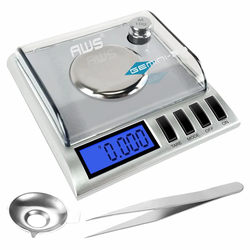
Choosing a scale for jewelry starts with two questions: what are you weighing, and how small a weight difference do you need to see?
A scale for finished rings and chains does not need exactly the same specifications as a scale for loose gemstones or tiny jewelry findings. Likewise, a compact scale that is excellent for milligram-level measurements may not have enough capacity for a heavy bracelet, a large silver piece, or a container full of scrap jewelry.
For many everyday jewelry applications, 0.01g readability offers a practical balance of precision and capacity. Very small gemstones, findings, and components may benefit from 0.001g readability, while larger jewelry pieces and bulk materials may be adequately served by 0.1g.
American Weigh Scales offers multiple formats in its pocket scales collection and milligram scale formats, making it possible to match the scale to the actual jewelry task.
This guide explains how to choose a scale for jewelry by comparing readability, capacity, minimum usable load, weighing units, tare, calibration, platform size, repeatability, draft protection, portability, and commercial-use requirements.
Step 1: Decide What You Will Weigh
Do not begin by shopping for the scale with the most decimal places.
Begin with the jewelry.
Your scale may be used for:
-
Rings
-
Earrings
-
Necklaces
-
Chains
-
Pendants
-
Bracelets
-
Loose diamonds
-
Colored gemstones
-
Gold components
-
Silver components
-
Findings
-
Beads
-
Watch parts
-
Wax models
-
Scrap jewelry
-
Small production batches
-
Finished jewelry inventory
Write down the lightest and heaviest items you expect to weigh.
This immediately gives you a better idea of the capacity and readability you need.
A jewelry maker weighing complete necklaces has different requirements from a gem collector weighing loose stones. A repair shop may need enough versatility for both finished jewelry and small replacement components.
Step 2: Understand Scale Readability
Readability is the smallest increment displayed by a digital scale.
Common jewelry-scale readability levels include:
-
1g — whole grams
-
0.1g — tenths of a gram
-
0.01g — hundredths of a gram
-
0.001g — thousandths of a gram
The smaller the increment, the more detail the display provides.
However, finer readability generally comes with tradeoffs such as lower maximum capacity and greater sensitivity to drafts, vibration, static, and temperature.
When Is 0.1g Enough?
A 0.1g scale may be appropriate for:
-
Larger jewelry
-
Bulk beads
-
Larger quantities of findings
-
Heavier silver pieces
-
Craft materials
-
Larger scrap-metal batches
If the difference between 20.1g and 20.2g matters to your work, 0.1g provides that level of display detail.
If differences of hundredths of a gram matter, move to 0.01g.
When Should You Choose 0.01g?
For general jewelry weighing, 0.01g is one of the most useful readability levels.
It can work well for:
-
Rings
-
Earrings
-
Chains
-
Pendants
-
Bracelets
-
Gold pieces
-
Silver pieces
-
Findings
-
Beads
-
Small scrap lots
-
Jewelry repair
-
Inventory measurements
AWS notes in its guide to pocket scales for jewelry, coins, coffee and crafts that jewelry and coins may benefit from 0.01g readability.
When Should You Choose 0.001g?
A 0.001g scale displays thousandths of a gram, or one milligram.
This can be useful for:
-
Loose gemstones
-
Tiny findings
-
Small precious-metal fragments
-
Lightweight components
-
Detailed jewelry development
-
Measurements where 0.01g is too coarse
AWS's comparison of 0.001g milligram scales explains that capacity, calibration, draft protection, platform size, units, and the operating environment all matter when choosing this finer class of scale.
Step 3: Choose the Right Capacity
Capacity is the maximum total load the scale is designed to support.
Everything placed on the platform counts toward capacity, including:
-
Jewelry
-
Trays
-
Cups
-
Gemstone dishes
-
Weighing boats
-
Containers
-
Multiple pieces weighed together
Suppose you choose a 500g scale and regularly use a 120g tray. The scale is physically supporting both the tray and the jewelry, even after you press tare.
That means you have approximately 380g of remaining capacity.
Leave Capacity Headroom
Avoid selecting a scale that will regularly operate right at its maximum.
If your heaviest normal load is around 400g, a 500g scale leaves relatively little room for containers or unexpectedly heavy pieces.
Choose enough capacity for the heaviest realistic combination of item and container.
Do Not Automatically Buy the Highest-Capacity Scale
More capacity is not always better.
A very high-capacity scale may sacrifice the fine readability you need for small jewelry.
The goal is not maximum capacity. The goal is appropriate capacity combined with appropriate readability.
Quick Jewelry Scale Selection Table
| Jewelry task | Suggested capacity | Suggested readability |
|---|---|---|
| Rings and earrings | 100–500g | 0.01g |
| Chains and pendants | 200–1,000g | 0.01g |
| Bracelets | 500–1,000g | 0.01g or 0.1g |
| Loose gemstones | 20–100g | 0.001g or suitable carat resolution |
| Tiny findings | 20–100g | 0.001g |
| Jewelry-making materials | 500–2,000g | 0.01g or 0.1g |
| Scrap precious metals | 500–2,000g+ | 0.01g or 0.1g |
| Larger finished jewelry | 1,000g+ | 0.1g may be suitable |
These ranges are general starting points. Always compare them with the specifications and tolerances of the individual scale.
Step 4: Understand What 500g x 0.01g Means
Scale specifications often use a format such as:
500g x 0.01g
The first number is maximum capacity.
The second number is readability.
Therefore:
-
500g = maximum capacity
-
0.01g = display increment
The scale can display weight changes in hundredths of a gram while supporting loads up to its stated 500g maximum.
This notation does not mean the scale is guaranteed accurate to ±0.01g across every condition and every point in its range.
For more detail, see the AWS explanation of what 500g x 0.01g means on a digital scale.
Step 5: Consider Minimum Usable Load
Maximum capacity gets most of the attention, but the lower end of the scale's range matters too.
The smallest displayed increment is not necessarily the smallest amount the scale can reliably measure.
A scale displaying 0.01g should not automatically be assumed to provide a dependable measurement when the entire sample weighs only 0.01g.
This becomes especially important for:
-
Tiny gemstones
-
Solder
-
Very small findings
-
Metal fragments
-
Lightweight watch components
If extremely small loads are part of your work, compare the manufacturer's specifications for the lower end of the weighing range.
NIST also identifies minimum load as one of the factors that should be considered when selecting a scale for a particular application.
Step 6: Choose the Weighing Units You Need
Different jewelry workflows use different mass units.
Common options include:
-
Grams (g)
-
Carats (ct)
-
Pennyweight (dwt)
-
Troy ounces (ozt)
-
Ounces (oz)
-
Grains (gn)
You may not need all of them.
Grams
Grams are convenient for:
-
Finished jewelry
-
Gold and silver components
-
Jewelry manufacturing
-
Repairs
-
Findings
-
Inventory
-
Scrap materials
For many users, grams are the primary unit. NIST provides an official reference for SI units of mass, including grams, milligrams, and kilograms.
Carats
Carats are used for diamonds and many other gemstones.
The Gemological Institute of America states that one metric carat equals 0.2 gram, or 200 milligrams, and each carat is divided into 100 points.
Carat measures weight, not physical size. Two gemstones with the same carat weight can have different visible dimensions.
If you routinely weigh loose stones, direct carat mode can simplify your workflow.
Pennyweight
Pennyweight, abbreviated dwt, is still used in parts of the jewelry and precious-metals industry.
If you regularly buy, sort, or document precious metal in pennyweight, direct dwt support can be useful.
Troy Ounces
Precious metals may also be expressed in troy ounces.
Do not confuse a troy ounce with the standard avoirdupois ounce used for many ordinary goods.
Always verify the unit indicator on the scale before recording a result.
Step 7: Look for a Tare Function
Tare is essential for many jewelry tasks.
It allows you to place a container on the scale and subtract its displayed weight before adding the jewelry.
For example:
-
Put a gemstone tray on the platform.
-
Wait for the reading to stabilize.
-
Press tare.
-
Confirm the display returns to zero.
-
Add the gemstone.
-
Record the net weight.
Tare is useful when weighing:
-
Loose stones
-
Findings
-
Beads
-
Chains
-
Scrap metal
-
Multiple components
Remember that tare does not increase the physical capacity of the scale.
Step 8: Check Platform Size
A scale can have enough capacity but still be inconvenient if the platform is too small.
The item must be fully supported.
If a chain hangs over the platform and touches the counter, part of its weight is supported by the counter rather than the scale.
The displayed result can therefore be incorrect.
For longer jewelry, use a compatible tray that:
-
Fits completely on the platform
-
Does not touch surrounding surfaces
-
Keeps the jewelry contained
-
Does not block controls
-
Does not exceed capacity when loaded
Small platforms are often ideal for gemstones and tiny components.
Larger platforms are more convenient for bracelets, chains, watches, and finished jewelry.
Step 9: Check Calibration Requirements
Precision scales need a reliable calibration process.
Calibration compares the scale's response with a known reference mass according to the manufacturer's procedure. The BIPM SI Brochure provides the international framework for SI measurement units.
Before choosing a scale, find out:
-
Whether it supports user calibration
-
Which calibration weight it requires
-
Whether the weight is included
-
Whether one or multiple calibration points are used
-
How calibration mode is activated
AWS provides a general walkthrough in its guide on how to calibrate a digital scale.
Do Not Calibrate With Random Household Objects
Coins, jewelry, batteries, and packaged products are not substitutes for the reference weight specified by the manufacturer.
Their actual mass can vary from the value you assume.
Use the correct calibration mass and procedure.
Step 10: Consider Repeatability
Repeatability describes how consistently a scale measures the same stable object under the same conditions.
This is one of the most important practical characteristics of a jewelry scale.
You can perform a basic repeatability check:
-
Place the scale on a stable surface.
-
Confirm zero.
-
Place an appropriate reference weight in the center.
-
Record the reading.
-
Remove the weight.
-
Let the display return to zero.
-
Repeat several times.
The results should remain within the scale's stated performance specifications.
If readings change unexpectedly, investigate before relying on the scale for valuable materials.
Step 11: Think About the Weighing Environment
The finer the readability, the more important the environment becomes.
A scale reading to 0.001g can react to conditions that barely affect a lower-resolution scale.
Drafts
Avoid:
-
Fans
-
Open windows
-
Air-conditioning vents
-
Doors
-
Breathing directly over the platform
Vibration
Avoid tables that shake because of:
-
Foot traffic
-
Machinery
-
Speakers
-
Nearby tools
-
Unstable flooring
Temperature
Allow a scale to acclimate after moving it from a cold vehicle, hot storage area, or other significantly different environment.
Static
Static electricity can affect lightweight objects and containers, especially at very fine resolutions.
Surface
Use a hard, flat, rigid, stable surface.
Do not weigh on:
-
Beds
-
Sofas
-
Carpet
-
Flexible mats
-
Unstable trays
Step 12: Decide Whether You Need a Draft Shield
For general 0.01g jewelry weighing, a draft shield may not always be necessary.
For 0.001g measurements, it becomes much more valuable.
A draft shield reduces the effect of moving air around the weighing pan.
Consider one when weighing:
-
Loose gemstones
-
Tiny findings
-
Lightweight metal fragments
-
Very small components
A draft shield does not eliminate every source of variation, but it makes the environment easier to control.
Step 13: Consider Portability
Will the scale stay on one jewelry bench, or travel with you?
Portable scales are useful for:
-
Craft shows
-
Estate work
-
Auctions
-
Workshops
-
Mobile repair
-
Collecting
-
Buying appointments
-
Travel
A portable jewelry scale should ideally include:
-
Protective cover
-
Compact dimensions
-
Battery power
-
Stable platform
-
Easy calibration
-
Useful units
Do not confuse portability with durability. Precision load cells still require careful handling.
Step 14: Look at Display and Controls
A jewelry scale is easier to use when you can see the display without moving the item.
Look for:
-
Clear digits
-
Backlighting
-
Good contrast
-
Accessible tare button
-
Easy unit switching
-
Controls not blocked by a tray
For repetitive bench work, these details can make a significant difference in usability.
Step 15: Check Power Options
Portable scales commonly use batteries.
Bench scales may offer:
-
Batteries
-
Rechargeable power
-
USB
-
AC adapters
Weak batteries can contribute to unstable behavior.
Choose a power system that matches where and how you work, and use only manufacturer-approved power sources.
Step 16: Understand Why Readings Can Change
Even a good precision scale can fluctuate when operating conditions change.
Common causes include:
-
Drafts
-
Vibration
-
Weak batteries
-
Temperature changes
-
Static
-
Uneven surfaces
-
Dirt around the platform
-
Off-center loading
-
Overloading
-
Very small loads
-
Incorrect calibration
-
Jewelry touching another surface
AWS explains these issues in more detail in Why Does My Digital Scale Give Different Readings?.
If a scale suddenly becomes inconsistent, troubleshoot the environment before assuming the instrument has failed.
How to Choose a Scale for Rings
For most finished rings, a 0.01g scale is a strong general choice.
Look for:
-
100g to 500g+ capacity
-
0.01g readability
-
Tare
-
Grams
-
Protective cover
-
Calibration capability
-
Stable platform
A 0.001g model may be useful for very small ring components or detailed manufacturing work.
How to Choose a Scale for Gold Jewelry
Gold jewelry can range from tiny findings to heavy chains and bracelets.
For general finished pieces, 0.01g provides useful detail.
For very small gold fragments, consider 0.001g.
For large scrap lots, consider more capacity.
If the weight will determine the amount paid in a commercial transaction, additional legal requirements may apply.
How to Choose a Scale for Silver Jewelry
Silver pieces can be larger and heavier than many small gold items.
A 0.01g scale with moderate or high capacity can be useful for individual pieces.
For bulk silver or larger decorative items, capacity may be more important than milligram readability.
Estimate the heaviest piece before selecting the scale.
How to Choose a Scale for Diamonds
Diamonds require a different approach because gemstone weights are commonly expressed in carats.
GIA defines a metric carat as 200 milligrams and notes that precision is important because even a fraction of a carat can affect cost.
For diamond weighing, prioritize:
-
Appropriate carat readability
-
Low minimum usable load
-
Repeatability
-
Calibration
-
Stable weighing pan
-
Draft protection
-
Carat unit
-
Controlled environment
Professional gemological applications may require specialized equipment beyond an ordinary consumer pocket scale.
How to Choose a Scale for Gemstones
For loose gemstones, look for fine resolution and direct carat support.
A useful gemstone scale may include:
-
0.001g readability or appropriate carat readability
-
Small weighing pan
-
Tare
-
Draft shield
-
Calibration capability
-
Stable zero
-
Protective case
The right resolution depends on the stones and the purpose of the measurement.
How to Choose a Scale for Jewelry Making
Jewelry makers often need to weigh both materials and finished pieces.
A versatile starting point is:
-
500g or greater capacity
-
0.01g readability
-
Tare
-
Grams
-
Multiple useful units
-
Protective cover
-
Straightforward calibration
Add a 0.001g milligram scale when tiny components require finer measurement.
This two-scale approach is often more practical than trying to find one scale with extremely fine readability and very high capacity.
How to Choose a Scale for Jewelry Repair
Repair shops may weigh:
-
Complete pieces
-
Replacement components
-
Stones
-
Findings
-
Precious metal before work
-
Precious metal after work
A 0.01g scale can handle many routine jobs.
For tiny replacement parts and loose stones, a separate 0.001g scale may be useful.
How to Choose a Scale for Scrap Gold
Scrap gold weighing can involve both small fragments and large batches.
For small pieces, 0.01g readability may be useful.
For very small fragments, consider 0.001g.
For larger lots, prioritize capacity.
If you buy or sell scrap gold based on the scale reading, make sure the device and its use comply with applicable commercial weights-and-measures rules.
Personal Use vs Commercial Jewelry Weighing
This distinction matters.
A scale used for:
-
Personal collecting
-
Jewelry making
-
Internal inventory
-
Hobby work
-
Non-transactional reference
does not necessarily need the same approval as a scale used to establish the amount a customer pays or receives.
The NIST Weighing and Scales FAQ states that scales used in commercial applications must comply with the laws of the state in which they are used. NIST's weighing and scales FAQ also notes that commercial devices generally need an active NTEP Certificate of Conformance and must be inspected and approved by an authorized state body before commercial use.
The current NIST Handbook 44 contains specifications, tolerances, and other technical requirements for weighing and measuring devices.
If weight determines the price of gold, silver, gemstones, or another product, verify the requirements in your jurisdiction before selecting equipment. Jewelry businesses should also be familiar with the FTC’s Jewelry Guides, which address representations involving jewelry products and their characteristics.
Jewelry Scale Buying Checklist
Before purchasing, answer these questions:
-
What is the lightest item I will weigh?
-
What is the heaviest item plus container?
-
Do I need 0.1g, 0.01g, or 0.001g readability?
-
Do I need carat mode?
-
Do I use pennyweight?
-
Do I use troy ounces?
-
Is the platform large enough?
-
Do I need a tray?
-
Does the scale have tare?
-
How is it calibrated?
-
What calibration weight is required?
-
Do I need a draft shield?
-
Will the scale travel?
-
Does it have a protective cover?
-
What is its minimum usable load?
-
What tolerance does the manufacturer specify?
-
Is the display easy to see?
-
Does it run on the power source I prefer?
-
Is the scale for internal use or commercial transactions?
-
If commercial, does it meet the applicable legal requirements?
Common Mistakes When Choosing a Jewelry Scale
Buying Based Only on Price
A low price is not useful if the scale has the wrong capacity or readability.
Buying Based Only on Decimal Places
More decimals do not automatically mean better accuracy.
Ignoring Minimum Load
Fine display increments do not guarantee reliable performance at arbitrarily tiny loads.
Ignoring Container Weight
Trays and cups count toward capacity even after tare.
Buying Too Little Capacity
Operating near maximum capacity leaves little working headroom.
Buying Too Much Capacity
A high-capacity scale may not provide the fine readability required for small jewelry.
Ignoring Platform Size
Chains and bracelets can touch the counter and produce incorrect readings.
Forgetting About Drafts
This is especially important for 0.001g scales.
Using the Wrong Unit
Carats, grams, pennyweights, troy ounces, and ordinary ounces are not interchangeable labels.
Assuming Every Jewelry Scale Is Legal for Trade
A scale marketed for jewelry is not automatically approved for commercial transactions based on weight.
Frequently Asked Questions
What type of scale is best for jewelry?
For many general jewelry applications, a digital precision scale with 0.01g readability and enough capacity for the heaviest piece is a practical choice.
Is 0.01g enough for jewelry?
Yes, 0.01g is useful for many rings, earrings, chains, pendants, findings, gold pieces, silver pieces, and repair tasks.
Do I need a 0.001g jewelry scale?
Choose 0.001g when you need milligram-level readings for tiny components, loose gemstones, or other very light materials.
Is 0.001g more accurate than 0.01g?
It provides finer readability, but readability alone does not determine overall accuracy. Calibration, tolerance, environment, repeatability, and load range also matter.
What capacity should a jewelry scale have?
It depends on your heaviest item plus any container. Around 200g to 500g can cover many small jewelry tasks, while chains, bracelets, scrap lots, or larger pieces may require 1,000g or more.
What does 500g x 0.01g mean?
The scale has a maximum capacity of 500g and displays weight in increments of 0.01g.
What units should a jewelry scale have?
Grams are useful for general jewelry. Carats are useful for gemstones. Pennyweight and troy ounces can be useful for precious-metal workflows.
How many grams are in one carat?
One metric carat equals 0.2 gram or 200 milligrams.
Is carat the same as karat?
No. Carat measures gemstone weight. Karat describes gold purity.
Can I use a kitchen scale for jewelry?
A kitchen scale may handle heavier jewelry, but many models do not provide sufficiently fine readability for small pieces or gemstones.
Can I use a pocket scale for jewelry?
Yes. A suitable 0.01g pocket scale can be a practical option for many general jewelry applications.
Can I weigh diamonds on a pocket scale?
It depends on the scale's readability and intended range. Loose diamond work often benefits from finer carat or milligram resolution than a general-purpose pocket scale provides.
Why does platform size matter?
The entire item must be supported by the scale. If a chain or bracelet touches the counter, the result can be inaccurate.
Does tare increase scale capacity?
No. Tare changes the displayed net weight but does not remove the physical container weight from the load cell.
How often should I calibrate a jewelry scale?
Follow the manufacturer's instructions and check performance after transport, impact, overload, significant temperature changes, long storage, or unexplained reading changes.
Can I buy gold from customers using any jewelry scale?
No. If weight determines the commercial transaction, legal-for-trade and weights-and-measures requirements may apply. Verify local requirements before using the scale commercially.
Final Verdict: How to Choose the Right Jewelry Scale
The best way to choose a scale for jewelry is to match the equipment to the actual weighing task.
For most general jewelry work, 0.01g readability offers an excellent starting point. It provides fine enough display increments for many rings, earrings, chains, pendants, findings, and precious-metal pieces while remaining available in useful capacities.
Choose 0.001g readability when weighing very small gemstones, tiny findings, or components where hundredths of a gram are not detailed enough.
Choose 0.1g readability with higher capacity when the items are heavier and finer increments do not materially improve the measurement.
Before buying, compare:
-
Readability
-
Capacity
-
Minimum usable load
-
Accuracy specifications
-
Repeatability
-
Tare
-
Platform size
-
Weighing units
-
Calibration
-
Draft protection
-
Display
-
Portability
-
Power
-
Protective features
-
Commercial approval when applicable
American Weigh Scales offers pocket and milligram formats for different jewelry applications. Choosing the correct scale is less about finding the model with the most decimals and more about finding the combination of capacity, readability, features, and operating range that fits the jewelry you actually weigh.
When those specifications are properly matched, weighing becomes easier to repeat, document, and use with confidence.