
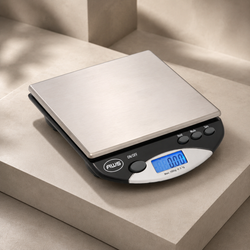
Choosing the right scale for supplements starts with a simple question:
What is the smallest quantity you actually need to measure?
Then ask:
What is the largest complete load the scale must support?
Those two numbers determine most of the important specifications.
For many small supplement-formulation tasks:
100–500g × 0.01g
is a useful starting range.
For larger powder blends:
1–5kg × 0.1g
may be more appropriate.
And if your application genuinely requires milligram-level measurement:
0.001g
or appropriately specified professional equipment may be necessary.
The key is to choose a scale based on your real measurement range—not simply the number of decimal places on the display.
Quick Answer: What Scale Should You Choose for Supplements?
| Application | Suggested Capacity | Suggested Readability |
|---|---|---|
| Small powder tests | 100–500g | 0.01g |
| Herbal powder blends | 100–500g | 0.01g |
| Capsule-batch preparation | 100–500g | 0.01g |
| Flavoring/formulation tests | 100–500g | 0.01g |
| Medium powder mixtures | 500g–2kg | 0.01–0.1g |
| Protein powder blends | 1–5kg | 0.1g |
| Larger bulk formulations | 2–5kg+ | 0.1g |
| Genuine milligram-level measurement | Low-capacity precision scale | 0.001g when required |
| Very small/high-potency ingredients | Application-specific equipment | Follow documented professional requirements |
For many users working with small powders:
500g × 0.01g
offers one of the most practical combinations of capacity and fine readability.
Step 1: Identify Your Smallest Normal Measurement
Start with the smallest quantity you commonly weigh.
For example:
Ingredient A = 25g
Ingredient B = 10g
Ingredient C = 2.5g
Ingredient D = 0.75g
A whole-gram scale might be fine for Ingredient A.
It is much less useful for Ingredient D.
Your smallest ingredient often determines how fine the readability needs to be.
Step 2: Understand Readability
Readability is the smallest increment shown on the display.
1g Readability
Displays:
10g
11g
12g
This may be sufficient for large bulk ingredients.
0.1g Readability
Displays:
10.0g
10.1g
10.2g
This can work well for medium and large powder quantities.
0.01g Readability
Displays:
10.00g
10.01g
10.02g
This offers much finer detail for small formulation ingredients.
AWS explains this specification in What Does 500g × 0.01g Mean on a Digital Scale?.
0.001g Readability
Displays:
10.000g
10.001g
10.002g
This is milligram readability.
It should be selected when your application genuinely requires milligram-level measurement.
AWS compares these precision levels in 0.001g vs. 0.01g Scales: Which Precision Do You Need?.
Step 3: Decide Whether 0.1g Is Enough
A 0.1g scale may be appropriate when your ingredients are normally measured in:
-
Tens of grams
-
Hundreds of grams
-
Larger powder quantities
For example:
Protein powder = 250.0g
Fiber = 30.0g
Flavor = 15.0g
Another ingredient = 5.0g
A 0.1g scale provides useful displayed detail without sacrificing as much capacity as an ultra-fine precision scale.
Step 4: Decide Whether You Need 0.01g
0.01g becomes more useful when your ingredients are smaller.
Examples:
Ingredient A = 2.50g
Ingredient B = 1.25g
Ingredient C = 0.75g
Ingredient D = 0.40g
For these types of quantities, a:
100–500g × 0.01g
scale may be a strong choice.
For general versatility:
500g × 0.01g
is especially useful because it provides fine displayed increments without restricting maximum capacity to only 100g or 200g.
Step 5: Decide Whether You Truly Need 0.001g
A 0.001g scale displays in one-milligram increments.
That may be necessary for certain specialized applications.
But it is not automatically better.
Fine-resolution instruments can be more sensitive to:
-
Airflow
-
Vibration
-
Static
-
Temperature changes
-
Surface instability
And 0.001g readability does not automatically mean the scale is accurate to ±0.001g.
Choose milligram readability only when the actual measurement requirement calls for it.
Step 6: Do Not Confuse Readability With Accuracy
This is one of the most important concepts when choosing a scale.
Suppose a scale displays:
1.25g
That means it has at least hundredth-of-a-gram readability.
It does not automatically prove that the true mass is exactly 1.25g.
When comparing scales, also consider:
-
Accuracy specifications
-
Repeatability
-
Minimum usable load
-
Calibration
-
Environmental requirements
NIST's Calibration of Mass Standards provides broader context for reference mass standards and measurement traceability.
Step 7: Pay Attention to Minimum Usable Load
Minimum usable load matters greatly for small supplement quantities.
A:
500g × 0.01g
scale can display 0.01g increments.
That does not automatically mean:
0.01g
is an appropriate working quantity.
Your actual minimum reliable measurement may be higher.
When very small masses matter, evaluate manufacturer information concerning:
-
Minimum load
-
Accuracy
-
Repeatability
-
Tolerance
-
Calibration
This becomes increasingly important as measurements approach the lower end of the scale's range.
Step 8: Determine Your Largest Complete Load
Next, calculate the largest amount the scale must physically support.
Include:
container + all ingredients
For example:
Container = 120g
Powder = 250g
Other ingredients = 50g
Total physical load:
420g
A 500g scale can support this.
If your container instead weighs 250g:
250g + 250g + 50g =
550g
Now a 500g scale is too small.
Step 9: Remember That the Container Counts
A scale's capacity includes everything resting on the weighing platform.
Suppose:
Scale capacity = 500g
Container = 150g
You place the container on the scale.
Display:
150.00g
Then press tare.
Display:
0.00g
The scale is still physically supporting 150g.
You have approximately:
350g
of nominal physical capacity remaining.
Step 10: Tare Does Not Restore Capacity
This deserves repeating.
Tare changes the displayed value.
It does not remove physical mass.
If:
Scale maximum = 500g
and:
Container = 200g
then after taring, only approximately:
300g
of nominal physical capacity remains.
Do not continue adding ingredients until the displayed value itself reaches 500g.
Step 11: Leave Capacity Headroom
Avoid choosing a scale that regularly operates close to maximum load.
If your typical complete load is:
480g
on a 500g scale, you have only:
20g
of headroom.
A 1kg scale may be more practical.
Capacity headroom becomes especially useful when:
-
Containers change
-
Recipes grow
-
More ingredients are added
-
Different batch sizes are tested
Step 12: Choose the Right Capacity Range
100g Scale
Useful for:
-
Tiny formulation tests
-
Very small powder samples
-
Lightweight containers
Limitation:
Containers can consume much of the capacity.
200g Scale
Useful for:
-
Small powder recipes
-
Low-volume formulation
-
Lightweight trays
Still limited for larger bowls.
500g Scale
Useful for:
-
Small powder blends
-
Capsule-batch formulation
-
Herbal mixtures
-
Flavor tests
-
Small formulation development
For many supplement applications, this is one of the most versatile compact capacities.
1–5kg Scale
Useful for:
-
Protein powder
-
Large powder blends
-
Bulk formulations
-
Heavy containers
-
Larger production trials
At these loads, 0.1g readability may be more practical.
Step 13: Consider the 500g × 0.01g Combination
A:
500g × 0.01g
scale provides:
500g maximum capacity
with:
0.01g displayed increments
That combination is useful for many small supplement applications because it offers:
-
Fine displayed detail
-
Moderate capacity
-
Room for trays
-
Tare
-
Practical versatility
It can be useful for:
-
Herbal powders
-
Flavoring
-
Small blends
-
Formulation tests
-
Capsule-batch preparation
Step 14: Consider Repeatability
Repeatability describes how consistently the scale reproduces the same reading with the same stable load.
Suppose the same reference is measured five times.
You might see:
10.25g
10.25g
10.24g
10.25g
10.25g
That is much more useful than:
10.25g
10.48g
10.11g
10.37g
10.18g
For formulation work, repeatability is important because recipes are intended to be reproduced.
AWS discusses common causes of instability in Why Does My Digital Scale Give Different Readings?.
Step 15: Choose a Platform That Fits Your Containers
A scale can have excellent specifications and still be inconvenient if the platform is too small.
Your:
-
Powder cup
-
Weighing paper
-
Bowl
-
Tray
-
Container
should sit securely.
The container should not:
-
Touch the countertop
-
Rest against another object
-
Tip easily
-
Completely block the display
Step 16: Look for Tare
Tare is essential for powder weighing.
Example:
Cup = 35.00g
Place it on the platform.
Press tare.
Display:
0.00g
Add ingredient:
10.25g
Now the display shows the ingredient mass directly.
Step 17: Decide Whether Sequential Tare Helps Your Workflow
Suppose your formula contains:
Ingredient A = 25.00g
Ingredient B = 10.00g
Ingredient C = 5.50g
Ingredient D = 2.25g
You can:
-
Place the container on the scale.
-
Tare.
-
Add Ingredient A.
-
Record the amount.
-
Tare.
-
Add Ingredient B.
-
Continue.
This can simplify multi-ingredient formulations.
Just remember that all ingredients continue adding to the total physical load.
Step 18: Look for a Clear Display
Small measurements require clear decimal placement.
There is a large difference between:
0.25g
and:
2.50g
Look for:
-
Clear digits
-
Backlighting
-
Strong contrast
-
Good viewing angle
-
Display visibility with the normal container installed
Step 19: Check Calibration Requirements
A precision scale should have a model-specific calibration procedure.
Do not assume:
500g maximum capacity = 500g calibration weight
That may be true for one model and false for another.
Another 500g scale might require:
200g
or another reference.
AWS explains the general process in How to Calibrate a Digital Scale for Accurate Results.
Always follow the instructions for the exact model.
Step 20: Use an Appropriate Calibration Weight
Do not calibrate a precision supplement scale with random household objects.
Avoid:
-
Coins
-
Bottles
-
Supplement containers
-
Phones
-
Batteries
-
Food packages
Use the appropriate calibration reference specified for the scale.
NIST's Calibration Procedures for Weights and Measures Laboratories provides additional technical background on calibration procedures and mass standards.
Step 21: Use a Stable Surface
Precision scales should be placed on a:
-
Hard
-
Flat
-
Rigid
-
Stable
work surface.
Avoid:
-
Soft mats
-
Upholstered surfaces
-
Flexible tables
-
Unstable countertops
-
Vibrating workstations
Step 22: Control Airflow
Fine powders and high-resolution scales can both respond to airflow.
Keep the scale away from:
-
Fans
-
HVAC vents
-
Open windows
-
Air purifiers
-
Strong air-conditioning flow
Environmental stability becomes increasingly important as resolution becomes finer.
Step 23: Control Vibration
Avoid performing precision weighing beside operating:
-
Blenders
-
Grinders
-
Mixers
-
Capsule machines
-
Packaging equipment
-
Motors
Vibration can destabilize the reading.
Step 24: Consider Static
Fine powders and plastic containers can generate static.
Static may cause powders to:
-
Cling to trays
-
Stick to scoops
-
Remain on containers
and can complicate fine weighing.
This becomes more relevant as quantities decrease.
Step 25: Consider Temperature Stability
Avoid making fine measurements immediately after moving the scale between very different temperatures.
Examples:
cold delivery vehicle → warm formulation room
or:
hot warehouse → air-conditioned workspace
Allow the scale to acclimate according to manufacturer instructions.
Step 26: Look for a Suitable Weighing Surface
A stainless-steel weighing platform can be useful for powder applications because it is smooth and relatively easy to maintain.
However, stainless steel does not mean the entire scale is waterproof.
Avoid allowing powders or liquids into:
-
Buttons
-
Platform gaps
-
Display seams
-
Battery compartments
Step 27: Consider Weighing Trays
A weighing tray helps contain powders.
Typical workflow:
-
Place tray on scale.
-
Wait for stability.
-
Press tare.
-
Confirm zero.
-
Add powder.
-
Record measurement.
Remember that the tray still counts toward physical capacity.
Step 28: Use Gram Mode for Formulation
Grams make supplement formulas easier to document.
Example:
| Ingredient | Mass |
|---|---|
| Powder A | 50.00g |
| Powder B | 20.00g |
| Powder C | 5.00g |
| Flavor | 2.25g |
| Ingredient E | 0.75g |
Total:
78.00g
Mass-based formulas can then be scaled proportionally.
Step 29: Decide Whether Battery or AC Power Is Better
Battery Operation
Useful for:
-
Portable work
-
Small formulation spaces
-
Occasional use
AC Operation
Useful for:
-
Permanent workstations
-
Frequent weighing
-
Long production sessions
Choose power source after deciding on the correct weighing specifications.
Step 30: Decide Whether One Scale Is Enough
If your entire measurement range falls between:
0.5g and 300g
a single:
500g × 0.01g
scale may cover much of your workflow.
But if you work with:
fractions of a gram
and:
several kilograms
one scale is unlikely to be ideal.
Step 31: Consider a Two-Scale Setup
For a broad formulation range:
Fine Precision Scale
100–500g × 0.01g
for:
-
Small powders
-
Herbal ingredients
-
Flavoring
-
Formula testing
-
Capsule-batch preparation
Higher-Capacity Scale
1–5kg × 0.1g
for:
-
Protein powder
-
Bulk ingredients
-
Large containers
-
Bigger batches
This lets each scale operate in a more appropriate range.
Best Scale for Supplement Powders
For many small powder quantities:
100–500g × 0.01g
is a useful range.
For large blends:
1–5kg × 0.1g
may be better.
Best Scale for Capsule Making
For small batch formulation where ingredients remain within the scale's appropriate operating range:
100–500g × 0.01g
may be useful.
If the application requires genuine milligram-level measurement, choose equipment specifically designed for that requirement.
Best Scale for Protein Powder
Protein powder batches are often much larger.
For:
-
Protein base
-
Fiber
-
Flavor blends
-
Bulk powders
a:
1–5kg × 0.1g
scale may be more practical.
Use a separate fine scale for small ingredients.
Best Scale for Herbal Supplement Powders
Herbal powders can be relatively lightweight.
For small formulations:
100–500g × 0.01g
is a strong starting range.
Keep fine powders away from drafts.
Best Scale for Amino Acid Blends
Choose based on your smallest ingredient.
If ingredients are generally:
10–100g
0.1g may be sufficient.
If they fall below a few grams:
0.01g may provide more useful detail.
For genuine milligram-level requirements, use appropriately specified equipment.
A Practical AWS Option for Small Supplement Formulation
For many small formulation tasks, the AWS SC501g Precision Digital Pocket Scale provides:
500g × 0.01g
Its features include:
-
Stainless-steel weighing surface
-
Backlit LCD
-
Tare
-
Multiple weighing units
-
Expansion trays
-
Battery operation
You can review the SC501g Precision Digital Pocket Scale for current specifications.
The 500g capacity provides room for many small containers while 0.01g readability gives substantially more measurement detail than a whole-gram scale.
When a 500g × 0.01g Scale Is Not Enough
Choose another scale if:
-
Total physical load exceeds 500g.
-
The container does not fit.
-
Your formulation requires genuine milligram-level measurement beyond the useful range of the instrument.
-
Your professional quality system requires different equipment.
-
You routinely work with kilogram-sized batches.
One compact scale cannot cover every supplement formulation.
Supplement Manufacturing Requires More Than Accurate Weighing
A precision scale can support repeatable mass measurement.
It does not replace:
-
Ingredient controls
-
Supplier qualification
-
Sanitation
-
Manufacturing procedures
-
Batch documentation
-
Quality control
-
Testing
-
Packaging
-
Labeling
FDA's Current Good Manufacturing Practices for Dietary Supplements provides broader information for dietary-supplement manufacturing operations.
Measurement Precision Does Not Determine Safe Dosage
A digital scale can display:
1.00g
That does not tell you whether 1.00g is an appropriate amount to consume.
A scale does not determine:
-
Safe dosage
-
Medical suitability
-
Ingredient interactions
-
Toxicological limits
-
Appropriate formulation
FDA's Dietary Supplements resources provide broader information on how dietary supplements are regulated.
Commercial Requirements Can Differ From Personal Formulation
Professional dietary-supplement operations may require documented systems involving:
-
Equipment qualification
-
Calibration programs
-
Specifications
-
Master manufacturing records
-
Batch production records
-
Quality procedures
FDA's Dietary Supplement Guidance Documents and Regulatory Information provides additional regulatory resources.
A consumer precision scale is not automatically appropriate for every professional manufacturing environment.
Common Mistakes When Choosing a Scale for Supplements
Buying Based Only on Decimal Places
More decimals do not automatically equal better measurement.
Confusing Readability With Accuracy
They are not the same specification.
Ignoring Minimum Usable Load
This is especially important with very small quantities.
Choosing Too Little Capacity
Your container contributes to maximum physical load.
Assuming Tare Restores Capacity
It does not.
Ignoring Repeatability
Repeatable formulations require consistent measurement.
Choosing Too Small a Platform
Make sure your container fits securely.
Ignoring Calibration Requirements
Follow the procedure for the exact model.
Using Random Objects for Calibration
Use the correct reference.
Ignoring Airflow
Fine powders and precision scales can be affected by drafts.
Ignoring Vibration
Nearby equipment can destabilize readings.
Ignoring Static
Fine powders can cling to containers and trays.
Assuming 0.001g Readability Means 1mg Accuracy
It does not automatically.
Using Scale Readings to Determine Safe Dosage
A scale measures mass, not medical appropriateness.
Supplement Scale Buying Checklist
Before choosing a scale, ask:
-
What ingredients will I weigh?
-
What is my smallest normal measurement?
-
What is my largest ingredient quantity?
-
What is my largest complete batch?
-
How much does my container weigh?
-
What is the complete physical load?
-
Do I need 0.1g readability?
-
Do I need 0.01g?
-
Do I genuinely need 0.001g?
-
What accuracy specifications are provided?
-
What repeatability information is available?
-
What is the minimum usable load?
-
Does the scale provide tare?
-
Does it measure grams?
-
Is the platform large enough?
-
Will the container block the display?
-
Is the display easy to read?
-
Does the scale stabilize properly at zero?
-
What calibration procedure does it use?
-
What calibration weight is required?
-
Is that calibration weight included?
-
Are weighing trays included?
-
Is the surface easy to maintain?
-
Can airflow be controlled?
-
Can vibration be minimized?
-
Is static a concern?
-
Is the temperature environment stable?
-
Is there enough capacity headroom?
-
Would two scales be more practical?
-
Does the scale meet the requirements of your actual formulation process?
Frequently Asked Questions
What type of scale is best for supplements?
For many small formulation tasks:
100–500g × 0.01g
is a useful starting range.
For larger powder batches:
1–5kg × 0.1g
may be more practical.
Is 0.01g precision good for supplements?
It can be very useful for small powder quantities and formulation work.
Suitability still depends on minimum load, accuracy, repeatability and your actual measurement requirement.
Do I need a 0.001g scale for supplements?
Only when your application genuinely requires milligram readability.
Do not choose 0.001g simply because it has more decimal places.
Is a 500g scale enough for supplements?
For many small formulations, yes.
Always include the container and all ingredients when calculating total physical load.
Is 500g × 0.01g a good supplement scale?
Yes, for many small powder and formulation applications.
It offers a useful balance of capacity and fine readability.
Can a 0.01g scale measure 1 milligram?
No.
0.01g equals:
10mg
A 0.01g scale therefore cannot display individual 1mg increments.
Does 0.001g mean the scale is accurate to 1mg?
Not automatically.
0.001g describes readability.
Accuracy, minimum usable load and repeatability must be evaluated separately.
Does the container count toward capacity?
Yes.
Everything physically resting on the scale contributes to maximum load.
Does tare restore maximum capacity?
No.
Tare changes the displayed value, not the physical load.
What scale should I use for capsule making?
For many small batch preparations:
100–500g × 0.01g
can be useful.
For genuine milligram-level quantities, appropriately specified equipment may be necessary.
What scale should I use for protein powder?
For larger powder batches:
1–5kg × 0.1g
may be more practical.
Use a smaller precision scale for small ingredients.
Should a supplement scale be calibrated?
Follow the calibration procedure for the exact scale model and any applicable quality requirements.
Why does my supplement scale fluctuate?
Possible causes include:
-
Drafts
-
Vibration
-
Static
-
Temperature changes
-
Weak batteries
-
Unstable surfaces
-
Platform interference
-
Calibration issues
Can a digital scale tell me how much supplement to take?
No.
A digital scale measures mass.
It does not determine safe dosage, appropriate intake or medical suitability.
Should I use one scale or two?
If your weighing range spans small fractions of a gram through kilogram-sized powder batches, two scales can be more practical:
500g × 0.01g precision scale
plus:
1–5kg × 0.1g higher-capacity scale.
Final Verdict: How to Choose a Scale for Supplements
To choose the right scale for supplements, begin with:
your smallest normal measurement
and:
your largest complete physical load.
For many small supplement-formulation applications:
100–500g × 0.01g
is a strong starting range.
For many users:
500g × 0.01g
offers the best balance of fine readability and useful capacity.
For larger powder blends:
1–5kg × 0.1g
may be more appropriate.
And if an application genuinely requires milligram-level measurement:
0.001g
or other appropriately specified equipment may be necessary.
Do not select a scale based only on the number of decimal places.
Compare:
capacity, readability, accuracy requirements, minimum usable load, repeatability, tare, calibration, platform size, display visibility, environmental stability and your actual formulation workflow.
For users working across both small and large powder quantities, the most practical setup may be:
one 500g × 0.01g precision scale for smaller formulation ingredients
plus:
one 1–5kg × 0.1g scale for bulk powders and larger batches.
Most importantly:
a scale measures mass—it does not determine supplement safety, appropriate dosage or regulatory compliance.