
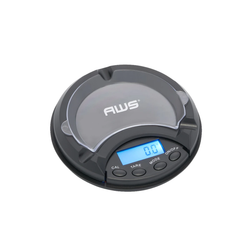
A pocket scale for 3D printing materials can be extremely useful when you need to measure small resin samples, pigments, additives, filament sections or lightweight printed components.
But pocket scales have an important tradeoff:
fine resolution usually comes with limited capacity.
That makes choosing the right combination of capacity and readability essential.
For many small 3D-printing applications:
100–500g × 0.01g
is a useful range.
For broader versatility:
500g × 0.01g
is especially practical.
It provides enough capacity for many:
-
Resin sample cups
-
Pigments
-
Colorants
-
Small additives
-
Filament samples
-
Miniatures
-
Lightweight printed parts
-
Small prototypes
while still offering hundredth-of-a-gram readability.
However, a pocket scale is generally not the right tool for:
-
Complete filament spools
-
Large resin bottles
-
Heavy printed prototypes
-
Multi-kilogram assemblies
For those applications, a:
2–5kg × 0.1g
higher-capacity scale may make considerably more sense.
The key is to match the scale to both:
your smallest normal measurement
and:
your largest complete physical load.
Quick Answer: What Pocket Scale Do You Need for 3D Printing Materials?
| Application | Suggested Capacity | Suggested Readability |
|---|---|---|
| Tiny resin pigment tests | 100–200g | 0.01g |
| Resin colorants | 100–500g | 0.01g |
| Small resin additives | 100–500g | 0.01g |
| Small resin samples | 200–500g | 0.01–0.1g |
| Filament samples | 100–500g | 0.01g |
| Small printed parts | 100–500g | 0.01g |
| Miniatures | 100–500g | 0.01g |
| Small prototype components | 200–500g | 0.01g |
| Medium printed parts | 500g–2kg | 0.1g |
| Full filament spools | 1–2kg+ | 0.1–1g |
| Large resin containers | 2–5kg+ | 0.1–1g |
| Large printed assemblies | 2–5kg+ | 0.1–1g |
| Genuine milligram-level work | Low-capacity precision scale | 0.001g when genuinely required |
For small precision tasks:
500g × 0.01g
is one of the strongest all-around pocket-scale configurations.
What Does Pocket Scale Capacity Mean?
Capacity is the maximum nominal physical load the scale is designed to support.
Everything resting on the scale counts.
For 3D printing, that can include:
-
Resin cup
-
Resin
-
Pigment
-
Weighing tray
-
Printed part
-
Filament sample
-
Support material
-
Small hardware
Suppose:
Resin cup = 50g
Resin = 125g
Pigment = 0.75g
Total physical load:
175.75g
A 200g scale technically has enough capacity.
But it leaves very little room for a larger batch.
A 500g scale provides considerably more flexibility.
What Does Resolution Mean?
Resolution, often called readability, describes the smallest change shown on the display.
A:
1g Scale
might display:
10g → 11g → 12g
A:
0.1g Scale
might display:
10.0g → 10.1g → 10.2g
A:
0.01g Scale
might display:
10.00g → 10.01g → 10.02g
A:
0.001g Scale
might display:
10.000g → 10.001g → 10.002g
AWS explains how capacity and readability work together in What Does 500g × 0.01g Mean on a Digital Scale?.
0.1g vs. 0.01g vs. 0.001g for 3D Printing
The correct readability depends on the scale of the material you need to measure.
0.1g Readability
Useful for:
-
Larger resin quantities
-
Medium printed parts
-
Support material
-
Prototype assemblies
-
Filament consumption
Example:
25.0g
82.4g
175.2g
For these quantities, 0.1g may provide plenty of practical detail.
When Is 0.01g Better?
A 0.01g scale becomes useful when the quantities are much smaller.
Examples:
Pigment = 0.45g
Additive = 0.25g
Filament sample = 4.75g
Miniature = 6.35g
Small printed component = 12.45g
For these measurements:
0.01g readability
provides much more useful comparative detail.
Do You Need 0.001g?
A 0.001g scale displays changes of one milligram.
Because:
0.001g = 1mg
it provides extremely fine displayed resolution.
Most normal 3D-printing applications do not require it.
AWS compares fine-resolution scale types in 0.001g vs. 0.01g Scales: Which Precision Do You Need?.
A milligram-resolution scale may also be more sensitive to:
-
Airflow
-
Vibration
-
Static
-
Temperature
-
Surface instability
Choose 0.001g only if your actual work genuinely requires measurement at that level.
Resolution Is Not the Same as Accuracy
A scale displaying:
8.45g
has 0.01g readability.
That does not automatically guarantee:
±0.01g accuracy.
Readability describes display increments.
Accuracy is a separate characteristic.
Also consider:
-
Repeatability
-
Minimum usable load
-
Calibration
-
Linearity
-
Environmental stability
NIST's Calibration of Mass Standards provides broader technical context for precision mass measurement.
The practical rule is:
more decimal places do not automatically equal more accuracy.
Minimum Usable Load Matters
Suppose your pocket scale is:
500g × 0.01g
The display changes by 0.01g.
That does not necessarily mean:
0.01g
is an appropriate working quantity.
The smallest reliably useful load can be higher depending on the scale and measurement requirements.
This is particularly important for:
-
Tiny resin pigments
-
Fine additives
-
Very small printed components
-
Lightweight filament samples
Check the instrument's actual performance specifications when extremely small measurements matter.
Why 500g × 0.01g Works Well for 3D Printing
A 500g × 0.01g pocket scale occupies a useful middle ground.
It combines:
-
Fine readability
-
Moderate capacity
-
Compact size
-
Portability
-
Room for small containers
-
Enough capacity for many printed parts
This can make it useful for:
-
Resin samples
-
Pigments
-
Colorants
-
Additives
-
Filament samples
-
Small printed parts
-
Miniatures
-
Small prototypes
Is a 100g Pocket Scale Enough?
A 100g scale can work for very small tasks.
Examples include:
-
Pigment testing
-
Resin-color development
-
Short filament samples
-
Miniatures
-
Tiny printed parts
Suppose:
Tray = 15g
Printed part = 35g
Total:
50g
A 100g scale is sufficient.
But a heavier tray or larger part can quickly consume the remaining capacity.
Is a 200g Pocket Scale Enough?
A 200g scale provides more flexibility.
It may work well for:
-
Small resin samples
-
Pigments
-
Additives
-
Filament samples
-
Small printed parts
Example:
Container = 40g
Resin sample = 100g
Pigment = 1g
Total:
141g
A 200g scale has adequate capacity.
But heavier containers or larger prototypes may still push it near the limit.
Is 500g Better for General 3D-Printing Work?
For many compact precision tasks, yes.
A 500g pocket scale gives you more room for:
-
Resin cups
-
Weighing trays
-
Small prototypes
-
Material samples
-
Multiple lightweight components
while still remaining compact.
This is why:
500g × 0.01g
is often more versatile than a lower-capacity scale with the same resolution.
When Is 500g Not Enough?
A 500g scale is not suitable when you need to weigh:
-
Full filament spools
-
Heavy partial spools
-
Large printed prototypes
-
Large resin bottles
-
Multi-part assemblies
Suppose:
Printed prototype = 650g
A 500g scale cannot measure it.
A:
1kg or higher-capacity scale
is necessary.
Your Container Counts Toward Capacity
This is especially important for resin work.
Suppose:
Scale capacity = 500g
Empty cup = 125g
Resin = 300g
Pigment = 2g
Total:
427g
You only have approximately:
73g
of nominal capacity remaining.
Tare Does Not Give Capacity Back
Place the 125g cup on the scale.
Press tare.
Display:
0.00g
The scale is still physically supporting:
125g
Approximate remaining capacity:
375g
not 500g.
Tare changes the displayed zero.
It does not reset physical capacity.
Leave Capacity Headroom
Suppose:
Normal physical load = 485g
Scale capacity = 500g
Remaining margin:
15g
That leaves very little flexibility.
If your normal loads regularly approach 500g, consider moving to a higher-capacity model.
Best Pocket Scale for 3D Printer Resin
Pocket scales can be useful for small photopolymer resin measurements.
For example:
Resin sample = 50.00g
Pigment = 0.45g
Colorant = 0.20g
For small formulations:
100–500g × 0.01g
provides useful measurement detail.
AWS covers broader resin-scale selection in Best Digital Scale for Resin.
Follow Resin Manufacturer Instructions
A scale measures mass.
It does not determine:
-
Whether materials are compatible
-
Safe pigment concentration
-
Proper handling procedures
-
Curing requirements
Formlabs' resin and printer safety guidance discusses handling considerations for liquid photopolymer resin.
Always follow the exact instructions for the resin and additive products being used.
Best Pocket Scale for Resin Pigments
Pigments and colorants are one of the clearest reasons to choose 0.01g readability.
Suppose:
Black pigment = 0.45g
Blue pigment = 0.20g
Silver pigment = 0.15g
A:
100–500g × 0.01g
scale provides useful resolution for documenting those small quantities.
Best Pocket Scale for Filament Samples
Short filament samples can also benefit from fine readability.
Example:
Sample A = 5.25g
Sample B = 5.48g
Sample C = 5.10g
A 0.01g pocket scale makes the differences easy to see.
This can be useful for:
-
Material comparison
-
Experimental samples
-
Small extrusion tests
-
Cut filament sections
Can a Pocket Scale Weigh a Full Filament Spool?
Often, no.
A complete spool can easily exceed a 500g pocket scale's capacity.
Suppose:
Spool + remaining filament = 825g
A 500g scale cannot measure it.
For normal filament spools:
1–2kg or greater capacity
is usually more practical.
Estimating Remaining Filament
A larger scale can help estimate remaining filament using:
loaded spool mass − empty spool mass = approximate filament mass
Example:
Loaded spool = 725g
Known empty spool = 225g
Approximate filament remaining:
500g
Do not assume all empty spools weigh the same.
Use the appropriate empty-spool mass for the specific spool design.
Filament Storage Can Affect Comparisons
Some filament materials can absorb moisture from the surrounding environment.
UltiMaker's 3D printer filament storage guide discusses moisture and filament-storage considerations.
A scale measures:
total mass.
It does not determine:
-
Filament moisture condition
-
Printability
-
Material quality
Keep storage conditions consistent when making precise comparisons.
Best Pocket Scale for Small Printed Parts
Pocket scales are particularly useful for lightweight printed components.
Suppose:
Part A = 8.45g
Part B = 8.20g
Part C = 7.95g
A 1g scale might obscure much of that difference.
A:
0.01g
scale makes the comparison much clearer.
Best Pocket Scale for Miniatures
Miniatures may weigh only a few grams.
For example:
Miniature A = 6.35g
Miniature B = 6.48g
Miniature C = 6.15g
A 100–500g × 0.01g scale can provide useful comparative measurements without requiring milligram-level equipment.
Best Pocket Scale for Prototype Components
Suppose successive versions of a small prototype weigh:
Version 1 = 32.45g
Version 2 = 29.80g
Version 3 = 27.35g
A pocket scale can help document how design changes affect physical mass.
This data can complement:
-
CAD measurements
-
Slicer estimates
-
Material estimates
-
Print-time data
Weight Does Not Explain Why a Print Changed
Suppose one print weighs:
24.50g
and another weighs:
22.80g
Possible causes include:
-
Geometry
-
Infill
-
Wall count
-
Material changes
-
Supports
-
Residual resin
-
Moisture
-
Post-processing
The scale tells you that mass changed.
It does not automatically identify the cause.
Platform Size Matters
Pocket scales are compact.
Your object should still:
-
Fit securely
-
Sit centrally
-
Avoid touching the workbench
-
Avoid leaning on another object
-
Leave the display visible
A printed component may be below 500g yet still be physically too large for the platform.
Do Not Let the Object Touch Another Surface
If a print rests partly on the scale and partly on the workbench, the reading will not represent its complete mass correctly.
The scale or weighing setup should fully support the object.
If necessary, use a larger platform scale.
Tare Is Essential for Resin and Loose Components
Example:
Empty container = 40.00g
Place it on the scale.
Press tare.
Display:
0.00g
Add resin:
50.00g
The scale now displays the material mass directly.
Sequential Tare Can Simplify Material Experiments
Suppose:
Base resin = 50.00g
Pigment = 0.45g
Additive = 0.20g
A workflow might be:
-
Tare empty cup.
-
Add base material.
-
Record mass.
-
Tare.
-
Add pigment.
-
Record mass.
-
Tare.
-
Add additive.
Remember:
all of those materials remain part of the physical load.
Calibration Matters
Calibration becomes especially useful when you want repeatable measurements across:
-
Material experiments
-
Prototype comparisons
-
Resin formulations
-
Filament tests
Different scales may require different calibration masses.
AWS explains the general process in How to Calibrate a Digital Scale for Accurate Results.
Follow the instructions for the exact model.
Use the Correct Calibration Weight
Do not use:
-
Printed calibration cubes
-
Coins
-
Batteries
-
Printer components
-
Filament samples
-
Resin bottles
as substitutes for an appropriate calibration reference.
NIST's Calibration Procedures for Weights and Measures Laboratories provides broader technical context on mass calibration.
For everyday hobby equipment, use the calibration weight specified by the manufacturer.
Calibration Weight Quality Matters
Controlled reference masses are preferable when reliable calibration matters.
NIST's Standards for Laboratory Weights provides additional technical background on reference weights.
For a pocket scale, the practical rule is:
use the correct calibration mass specified for that scale.
Stable Surface
Place a precision scale on a:
-
Hard
-
Flat
-
Stable
-
Rigid
surface.
Avoid:
-
Carpet
-
Fabric
-
Flexible mats
-
Upholstered furniture
-
Wobbly tables
Keep It Away From Printer Vibration
3D printers themselves can produce vibration.
Other sources include:
-
Resin mixers
-
Wash stations
-
Air compressors
-
CNC equipment
-
Rotary tools
A fine-resolution scale should ideally be used on a stable surface away from running machinery.
AWS discusses environmental causes of inconsistent measurements in Why Does My Digital Scale Give Different Readings?.
Airflow Can Affect Fine Measurements
3D-printing workspaces often have:
-
Ventilation
-
Exhaust systems
-
Filters
-
Fans
-
Printer enclosures
A 0.01g scale can respond to moving air.
Avoid direct drafts when taking precision measurements.
Static Can Affect Fine Materials
Plastic and fine powders can develop static.
This may affect:
-
Pigments
-
Filament
-
Plastic trays
-
Lightweight printed components
Static becomes increasingly relevant as measurements become smaller.
Temperature Stability Matters
Moving a scale between:
cold storage → warm print room
or:
hot garage → air-conditioned workspace
may affect immediate stability.
Allow the instrument to acclimate according to manufacturer instructions before fine measurement.
Choose a Clear Display
When measuring small quantities, decimal position needs to be obvious.
Compare:
0.25g
with:
2.50g
Look for:
-
Clear digits
-
Backlighting
-
High contrast
-
Easy decimal visibility
Your container should not completely block the display.
Weighing Trays Are Useful
Trays can be used for:
-
Filament samples
-
Printed components
-
Support material
-
Pigments
-
Small hardware
Basic workflow:
-
Place tray on scale.
-
Wait for stability.
-
Press tare.
-
Add object or material.
-
Record mass.
Remember that the tray contributes to physical capacity.
Protect the Scale From Liquid Resin
Liquid resin should not enter:
-
Buttons
-
Display seams
-
Platform gaps
-
Electronics
-
Battery compartment
Use appropriate cups and trays.
Any protective material placed over the platform should not interfere with the platform's movement.
Pocket Scale vs. Larger Scale for 3D Printing
A pocket scale generally prioritizes:
-
Compact dimensions
-
Portability
-
Fine readability
A larger scale generally provides:
-
Greater capacity
-
Larger platform
-
Better spool support
-
Better support for large printed objects
If you work across a wide material range, both may be useful.
Recommended Two-Scale Setup
Pocket Precision Scale
500g × 0.01g
Use for:
-
Resin pigments
-
Small resin samples
-
Additives
-
Filament samples
-
Miniatures
-
Lightweight printed parts
Higher-Capacity Scale
2–5kg × 0.1g
Use for:
-
Full filament spools
-
Large resin containers
-
Heavy prototypes
-
Large printed parts
-
Assemblies
This setup covers a much wider working range than trying to force one scale to handle everything.
A Practical AWS Pocket Scale for 3D Printing Materials
For many small 3D-printing materials and components, the AWS SC501g Precision Digital Pocket Scale provides:
500g capacity × 0.01g readability
Useful features include:
-
Stainless-steel weighing platform
-
Backlit LCD
-
Tare
-
Multiple weighing units
-
Two expansion trays
-
Compact design
-
Battery operation
You can review the AWS SC501g Precision Digital Pocket Scale for current specifications.
The 500g × 0.01g configuration is particularly useful for:
-
Resin samples
-
Pigments
-
Additives
-
Filament samples
-
Lightweight prints
-
Prototype components
When a Pocket Scale Is the Wrong Tool
Do not use a low-capacity pocket scale when:
-
Your spool exceeds capacity.
-
Your resin bottle exceeds capacity.
-
Your printed assembly is too large.
-
The object does not fit securely on the platform.
-
Your normal loads are constantly near the limit.
A larger scale will provide a safer and more practical working range.
Example 1: Resin Color Test
Suppose:
Resin = 50.00g
Black pigment = 0.45g
Blue pigment = 0.20g
Secondary pigment = 0.15g
A 0.01g pocket scale gives you enough displayed detail to document each small addition.
Example 2: Miniature Comparison
Suppose:
Miniature A = 6.35g
Miniature B = 6.52g
Miniature C = 6.18g
A 0.01g scale clearly shows the differences.
Example 3: Small Printed Part
Suppose:
Prototype 1 = 14.25g
Prototype 2 = 13.80g
Prototype 3 = 12.95g
This can help document changes made during design iteration.
Example 4: Partial Filament Spool
Suppose:
Partial spool + filament = 675g
Empty spool = 225g
Approximate filament:
450g
A 500g pocket scale still cannot perform this measurement because the complete physical load is:
675g.
A higher-capacity scale is required.
Example 5: Large Printed Prototype
Suppose:
Prototype = 1,850g
A pocket scale is inappropriate.
Choose:
2kg or greater capacity
with enough headroom for your expected largest print.
Common Pocket Scale Buying Mistakes
Choosing Based Only on Resolution
More decimals do not automatically mean better measurements.
Confusing Readability With Accuracy
They are separate characteristics.
Ignoring Minimum Usable Load
0.01g readability does not automatically make 0.01g an appropriate working quantity.
Choosing Too Little Capacity
This is especially common with filament spools.
Forgetting Container Weight
Resin cups and trays count.
Assuming Tare Restores Capacity
It does not.
Ignoring Platform Size
Printed objects need complete physical support.
Ignoring Repeatability
Comparative measurements need consistency.
Ignoring Calibration
Choose a model with a clear calibration procedure.
Using a Printed Cube for Calibration
Use an appropriate calibration reference.
Weighing Beside a Running Printer
Printer vibration can affect fine readings.
Ignoring Airflow
Ventilation may influence precision scales.
Ignoring Static
Plastic materials and pigments can generate static.
Treating Filament Weight as a Moisture Test
A scale cannot determine material condition by itself.
Spilling Resin Into the Scale
Protect the electronics.
Pocket Scale for 3D Printing Materials Buying Checklist
Before purchasing, ask:
-
What 3D-printing materials will I weigh?
-
Will I weigh resin?
-
Will I weigh pigments?
-
Will I weigh filament samples?
-
Will I weigh full spools?
-
Will I weigh finished parts?
-
What is my smallest normal measurement?
-
What is my largest normal measurement?
-
What is my heaviest complete physical load?
-
Do I need 1g readability?
-
Do I need 0.1g?
-
Do I need 0.01g?
-
Do I genuinely need 0.001g?
-
What accuracy specifications are provided?
-
What repeatability information is available?
-
What minimum usable load applies?
-
Is there enough capacity headroom?
-
Does the scale have tare?
-
Is sequential tare useful?
-
Is the platform large enough?
-
Can my normal object sit securely?
-
Can I see the display?
-
Can the scale be calibrated?
-
What calibration weight does it require?
-
Is that weight included?
-
Are trays included?
-
Can I protect the scale from resin?
-
Is my work surface stable?
-
Are nearby printers creating vibration?
-
Would a second higher-capacity scale be useful?
Frequently Asked Questions
What is the best pocket scale for 3D printing materials?
For many small materials and parts:
100–500g × 0.01g
is a useful range.
For broader pocket-scale versatility:
500g × 0.01g
is especially practical.
Is 500g × 0.01g good for 3D printing?
Yes.
It is particularly useful for:
-
Resin samples
-
Pigments
-
Additives
-
Filament samples
-
Lightweight printed parts
-
Miniatures
Is 0.01g enough for 3D printing?
For many small-material and component applications, yes.
Whether a particular scale is suitable also depends on its actual accuracy, repeatability and minimum usable load.
Do I need 0.001g?
Usually not.
Choose milligram-level resolution only when your actual measurement requirement calls for it.
Is a 100g pocket scale enough?
It can work well for very small pigments, samples and printed parts.
Its main limitation is low capacity.
Is a 200g scale enough?
For many small resin samples, filament pieces and printed components, yes.
But larger containers can consume capacity quickly.
Is 500g better?
For general precision 3D-printing work, 500g usually provides more flexibility while remaining compact.
What pocket scale should I use for resin?
For many small resin samples and pigments:
100–500g × 0.01g
is useful.
Larger resin quantities require higher capacity.
Can a pocket scale weigh a filament spool?
Only if the complete spool is below the scale's maximum capacity.
Many normal filament spools require a:
1–2kg+
scale instead.
What pocket scale should I use for small printed parts?
A:
0.01g
scale can provide useful comparative detail for lightweight parts.
Does tare restore capacity?
No.
Tare resets the displayed value but does not remove the physical load.
Does the tray count toward capacity?
Yes.
Everything physically supported by the scale counts toward maximum capacity.
Can I estimate remaining filament by weight?
Yes.
If the empty spool mass is known:
current loaded-spool mass − empty-spool mass
provides an approximate remaining filament mass.
Why does my scale fluctuate near my 3D printer?
Possible causes include:
-
Printer vibration
-
Fans
-
Ventilation
-
Static
-
Temperature changes
-
Unstable surfaces
-
Weak batteries
-
Calibration issues
Can I use a printed calibration cube as a calibration weight?
A printed cube should not substitute for the reference mass specified by the scale manufacturer when proper calibration matters.
Should I buy one scale or two?
If you work with everything from tiny pigments to kilogram-scale spools and prints, a two-scale setup is often more practical:
500g × 0.01g
for precision work,
plus:
2–5kg × 0.1g
for heavier materials.
Final Verdict: What Capacity and Resolution Do You Need?
The right pocket scale for 3D printing materials depends primarily on:
your smallest normal measurement
and:
your largest complete physical load.
For:
-
Resin pigments
-
Small additives
-
Resin samples
-
Filament samples
-
Miniatures
-
Lightweight printed components
100–500g × 0.01g
is a strong range.
For a single versatile precision pocket scale:
500g × 0.01g
is particularly useful because it combines:
-
Fine readability
-
Moderate capacity
-
Room for small trays and cups
-
Tare functionality
-
Compact dimensions
-
Useful resolution for small parts
For:
-
Full filament spools
-
Large resin bottles
-
Heavy prototypes
-
Large printed assemblies
a pocket scale is generally the wrong tool.
Instead:
2–5kg × 0.1g
or another appropriately sized higher-capacity scale may be more practical.
Do not choose based on decimal places alone.
Compare:
capacity, readability, minimum usable load, accuracy specifications, repeatability, tare, calibration, platform size and environmental stability.
For 3D-printing workflows spanning tiny material samples through kilogram-scale spools, one of the most useful combinations is:
a 500g × 0.01g pocket scale for precision materials and lightweight parts
paired with:
a 2–5kg × 0.1g higher-capacity scale for spools, resin containers and larger prints.
That gives you fine measurement where it matters without sacrificing the capacity required for larger 3D-printing materials.