
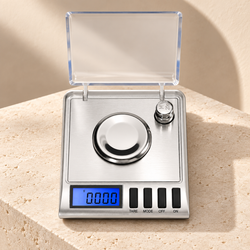
A pocket scale for beads should provide enough resolution for small packages without sacrificing the capacity needed for trays, containers, strands and finished jewelry.
For many bead sellers and jewelry makers, a strong all-around starting point is:
500 g capacity × 0.01 g readability.
That combination is useful for:
-
Seed beads
-
Glass beads
-
Crystal beads
-
Gemstone beads
-
Findings
-
Small retail packages
-
Bead strands
-
Finished jewelry
For larger bead quantities where hundredths of a gram are not important:
0.1 g readability
may be sufficient.
For exceptionally lightweight components:
0.001 g
may occasionally be useful, although most ordinary bead workflows do not require milligram resolution.
American Weigh Scales offers a range of digital pocket scales with different combinations of capacity and readability.
The best choice depends on balancing:
smallest package + heaviest complete load + required resolution + portability.
Quick Answer: What Capacity and Resolution Do You Need?
Use this table as a practical starting point:
| Bead Application | Suggested Capacity | Suggested Readability |
|---|---|---|
| Seed beads | 200–500 g | 0.01 g |
| Small glass beads | 200–500 g | 0.01 g |
| Crystal beads | 200–500 g | 0.01 g |
| Gemstone beads | Around 500 g | 0.01 g |
| Metal beads | 500 g+ | 0.01–0.1 g |
| Findings | 100–500 g | 0.01 g |
| Small retail packages | 200–500 g | 0.01 g |
| Finished jewelry | Around 500 g | 0.01 g |
| Bulk bead batches | 500 g+ | 0.1 g |
| Very tiny components | 20–100 g | 0.001 g if genuinely needed |
The simplest rule is:
Small bead packages → prioritize resolution.
Larger batches → prioritize capacity.
What Does Capacity Mean on a Bead Pocket Scale?
Capacity is the maximum total physical load the scale can support.
A specification such as:
500 g × 0.01 g
means:
-
500 g maximum capacity
-
0.01 g displayed readability
Those two numbers describe different characteristics.
Capacity tells you:
how much the scale can hold.
Readability tells you:
the smallest displayed increment.
What Does Resolution Mean?
Resolution, also commonly called readability, is the smallest weight increment shown on the display.
For bead work, the most relevant options are usually:
0.1 g
and:
0.01 g.
0.1 g Readability
A 0.1 g scale might display:
9.8 g
9.9 g
10.0 g
10.1 g
0.01 g Readability
A 0.01 g scale might display:
9.97 g
9.98 g
9.99 g
10.00 g
The second scale provides ten times finer displayed increments.
For small retail bead packages, this can be useful.
Is 0.1 g Enough for Beads?
Often, yes.
A:
0.1 g
pocket scale can work well for:
-
Larger gemstone bead batches
-
Metal beads
-
Finished jewelry
-
Larger containers
-
Bulk craft materials
If your target batch is:
250.0 g
rather than:
250.01 g,
there may be little practical value in hundredth-of-a-gram readability.
When Is 0.01 g Better?
Choose:
0.01 g
when you regularly weigh:
-
Seed beads
-
Small retail packages
-
Findings
-
Crystal beads
-
Lightweight gemstone beads
-
Small jewelry components
For example, if you package beads in:
5 g
10 g
20 g
25 g
quantities, hundredth-of-a-gram readability gives you finer control.
AWS explains this type of specification in its guide to what 500 g × 0.01 g means on a digital scale.
Do You Need 0.001 g for Beads?
Usually not.
A:
0.001 g
scale displays thousandths of a gram.
That may be useful for:
-
Extremely tiny findings
-
Individual lightweight components
-
Specialized precision work
However, it also usually means:
-
Lower capacity
-
Smaller platform
-
Greater draft sensitivity
-
Greater vibration sensitivity
-
Greater static sensitivity
For ordinary bead packaging:
0.01 g is usually the more practical choice.
0.1 g vs. 0.01 g vs. 0.001 g
| Readability | Best For | Advantage | Tradeoff |
|---|---|---|---|
| 0.1 g | Bulk beads | Higher capacity | Less fine detail |
| 0.01 g | General bead work | Excellent balance | Moderate capacity |
| 0.001 g | Tiny components | Very fine detail | Lower capacity, more sensitive |
The goal is not to buy the scale with the most decimal places.
The goal is to match resolution to:
the smallest difference that matters in your workflow.
Readability Is Not Accuracy
A scale displaying:
0.01 g
does not automatically guarantee:
±0.01 g accuracy.
These are different concepts.
Readability
The smallest displayed increment.
Accuracy
How close a result is to the relevant true or reference value.
Repeatability
How consistently the same object gives similar readings under similar conditions.
Fine decimal places are useful only when the scale also performs consistently.
How Much Capacity Do You Really Need?
Many bead sellers underestimate how quickly:
-
Trays
-
Cups
-
Bowls
-
Jars
consume capacity.
The correct calculation is:
container + beads = total physical load.
Is 100 g Capacity Enough?
A 100 g pocket scale may be enough for:
-
Small seed-bead packages
-
Findings
-
Lightweight components
But it can become restrictive once a container is added.
Example:
Container = 35 g
Beads = 75 g
Total load:
110 g.
A 100 g scale would not be sufficient.
Is 200 g Capacity Enough?
A 200 g scale provides more room for:
-
Small jars
-
Trays
-
Retail bead packages
-
Jewelry components
It can be suitable for hobbyists and small-volume sellers.
However, it still becomes limiting for heavier:
-
Gemstone strands
-
Metal beads
-
Larger containers
Why 500 g Is So Practical
For most bead and jewelry-making applications:
500 g
is a highly versatile pocket-scale capacity.
It can handle many:
-
Seed-bead batches
-
Glass beads
-
Gemstone strands
-
Crystal beads
-
Findings
-
Small containers
-
Bracelets
-
Necklaces
without requiring a large bench scale.
Best General Pocket-Scale Format for Beads
The SC501g Precision Digital Pocket Scale provides:
500 g × 0.01 g
with features useful for bead work, including:
-
Tare
-
Multiple weighing units
-
Stainless-steel platform
-
Expansion trays
-
Compact size
For many bead businesses, this is an excellent balance between:
precision and capacity.
Another Compact 500 g Option
The SM-501-BLK ScaleMate also offers:
500 g × 0.01 g
in a compact format.
This can be useful for:
-
Craft fairs
-
Jewelry markets
-
Classes
-
Mobile sellers
-
Small workspaces
when portability matters.
What If You Need More Than 500 g?
If you routinely weigh:
-
Bulk seed-bead inventory
-
Multiple heavy gemstone strands
-
Large metal-bead batches
-
Large bowls
a pocket scale may no longer be the best tool.
Consider a higher-capacity bench scale.
At larger quantities:
0.1 g readability
may also be perfectly adequate.
When Platform Size Becomes More Important Than Portability
Pocket scales are compact.
That is an advantage until your container becomes too large.
Suppose you use a:
6-inch bead bowl
on a very small pocket platform.
Even if the weight is below capacity, the bowl may:
-
Cover the display
-
Become unstable
-
Touch the scale housing
-
Touch the table
At that point, a bench scale may be more practical.
Pocket Scale vs. Bench Scale
Pocket Scale Advantages
-
Compact
-
Portable
-
Easy to store
-
Often available with 0.01 g readability
-
Useful for craft shows
-
Good for small packages
Bench Scale Advantages
-
Larger platform
-
Better for bowls
-
Better for bulk batches
-
Often higher capacity
-
Better for permanent workstations
Choose based on the physical workflow rather than portability alone.
Capacity Includes the Tray
This rule is essential.
Suppose:
Scale capacity = 500 g
Tray = 120 g
Beads = 350 g
Total load:
470 g.
That is within capacity.
Now increase the bead batch to:
400 g.
Total load becomes:
520 g.
The scale is now overloaded even if the display was previously tared.
Tare Does Not Increase Capacity
Tare changes the displayed zero.
It does not remove the physical weight of the tray.
Example:
500 g scale
100 g bowl
Press tare.
Display:
0.00 g.
The scale is still supporting:
100 g.
You have approximately:
400 g
of physical capacity remaining.
Build in Capacity Headroom
Avoid buying a scale whose maximum capacity barely exceeds your normal load.
If your regular complete load reaches:
480 g,
a 500 g scale leaves very little room for:
-
Larger batches
-
Heavier containers
-
Different trays
A higher-capacity model may be the better choice.
Choose Capacity Around the Complete Workflow
Calculate:
heaviest bead batch + heaviest usual container = required load.
Then select a scale with some additional capacity above that value.
Do not calculate using:
beads alone.
Platform Size Matters
A small pocket scale can be excellent for:
-
Small trays
-
Seed beads
-
Findings
-
Jewelry components
But larger containers need more platform area.
The container should:
-
Sit securely
-
Remain centered
-
Avoid touching the housing
-
Avoid touching the table
Use a Lightweight Tray for Small Packages
A lightweight tray preserves more usable capacity.
Example:
200 g scale
120 g bowl
Remaining physical capacity:
80 g.
If the tray weighs:
20 g,
remaining capacity becomes:
180 g.
That is a substantial difference.
Tare Is Essential
For bead packaging, tare is one of the most useful features.
Example:
Tray = 28.64 g
Place it on the scale.
Press:
TARE.
Display:
0.00 g.
Add beads until:
25.00 g.
Now you have approximately:
25 g net bead weight.
Can You Count Beads With a Pocket Scale?
You can use weight to estimate quantity.
Suppose:
100 beads weigh 4.00 g.
Average weight per bead:
4.00 ÷ 100 = 0.04 g.
A batch weighing:
20.00 g
would contain approximately:
500 beads.
This can save significant time compared with manual counting.
Why Bead Counts by Weight Are Estimates
Individual beads can vary in:
-
Diameter
-
Hole size
-
Shape
-
Finish
-
Material
-
Manufacturing tolerance
Therefore:
weight-based quantity is usually an estimate.
Use a representative sample from the exact bead SKU.
Use 50 or 100 Beads as a Reference Sample
Do not calculate average mass from one bead unless there is no alternative.
A better method is:
-
Count 50 or 100 beads.
-
Weigh the sample.
-
Divide total weight by quantity.
-
Calculate average mass per bead.
-
Weigh the larger batch.
-
Divide batch mass by average bead mass.
This reduces the impact of individual variation.
Example: Seed Beads
Suppose:
100 seed beads = 1.20 g.
Average weight:
1.20 ÷ 100 = 0.012 g.
A larger batch weighs:
60 g.
Estimated count:
60 ÷ 0.012 =
5,000 beads.
The result remains an estimate because individual beads may vary slightly.
Seed-Bead Sizes Vary
Fire Mountain Gems publishes a seed bead sizing reference showing the range of common bead sizes and shapes.
This matters because:
the number of beads per gram changes with size and design.
Do not use one average-weight value for every seed-bead SKU.
Seed Beads Are Often Packaged by Weight
Fire Mountain Gems also provides a seed bead package reference illustrating how quantities can vary by package weight, manufacturer and bead size.
For this kind of work:
0.01 g readability
provides useful control over small packages.
Best Pocket Scale for Seed Beads
Prioritize:
-
0.01 g readability
-
200–500 g capacity
-
Tare
-
Lightweight tray
-
Stable zero
-
Repeatability
For many users:
500 g × 0.01 g
provides more flexibility than a very low-capacity precision scale.
Best Pocket Scale for Glass Beads
Glass beads can be weighed effectively with:
0.01 g readability
for smaller packages.
For larger batches:
0.1 g
may be enough.
Best Pocket Scale for Gemstone Beads
Natural gemstone beads may be heavier and may vary in density.
The GIA Gem Encyclopedia illustrates the range of materials used as gemstones.
For gemstone bead work:
500 g × 0.01 g
is a useful general starting point.
If you frequently weigh large groups of heavy strands:
higher capacity may become more important.
Best Pocket Scale for Metal Beads
Metal beads can quickly create heavier loads.
For:
-
Sterling silver beads
-
Brass beads
-
Steel beads
-
Metal findings
consider:
500 g or more capacity.
For large bulk quantities:
a pocket scale may no longer be ideal.
Best Pocket Scale for Plastic Beads
Plastic and acrylic beads are lightweight.
This makes:
resolution
more important than very high capacity for small retail packages.
A 0.01 g model is usually more than sufficient.
Best Pocket Scale for Findings
Findings such as:
-
Jump rings
-
Clasps
-
Crimps
-
Bead caps
-
Small charms
can be lightweight.
A:
200–500 g × 0.01 g
pocket scale provides useful flexibility.
Best Pocket Scale for Finished Jewelry
If the same scale will also weigh:
-
Bracelets
-
Necklaces
-
Earrings
-
Pendants
500 g capacity becomes especially useful.
AWS's digital scale for jewelry guide explains why general jewelry work often requires balancing fine readability with sufficient capacity.
Best Pocket Scale for Jewelry Makers
Jewelry makers typically handle a wide mix of:
-
Beads
-
Findings
-
Gemstones
-
Chains
-
Components
-
Finished products
That makes:
500 g × 0.01 g
one of the strongest general-purpose pocket-scale formats.
Best Pocket Scale for Bead Sellers
A bead seller preparing retail packages should prioritize:
-
0.01 g readability
-
500 g capacity
-
Tare
-
Stable repeatability
-
Easy calibration
-
Appropriate platform size
If your business focuses on bulk quantities:
consider a higher-capacity scale.
Best Pocket Scale for Craft Shows
Portability matters at:
-
Craft fairs
-
Jewelry markets
-
Trade shows
Look for:
-
Battery operation
-
Protective cover
-
Compact size
-
Easy tare
-
Clear display
However, portable environments introduce challenges.
Outdoor wind, folding tables and foot traffic can affect fine measurements.
Calibration Matters
A precision pocket scale should be calibrated according to:
the manufacturer's instructions.
The National Institute of Standards and Technology discusses calibration, measurement uncertainty and reference standards in its balance and scale calibration guidance.
Use the calibration mass specified for your exact model.
Calibration Weight Is Model-Specific
Different scales may require:
-
100 g
-
200 g
-
500 g
or another calibration reference.
Do not assume every 500 g scale uses a 500 g calibration weight.
Check the model instructions.
Avoid Using Coins as Calibration Standards
Coins are not substitutes for an appropriate calibration reference.
Their actual weight can vary because of:
-
Manufacturing tolerances
-
Wear
-
Dirt
-
Damage
-
Corrosion
Use the correct reference mass.
Repeatability Matters
Suppose you weigh the same bead tray several times.
Readings:
25.03 g
25.03 g
25.03 g
suggest stable performance under those conditions.
Readings:
24.82 g
25.21 g
24.94 g
suggest something may be affecting the measurement.
Possible causes include:
-
Airflow
-
Vibration
-
Static
-
Calibration
-
Temperature
-
Battery condition
Use a Stable Surface
Place the scale on a:
-
Hard
-
Flat
-
Stable
-
Level
surface.
Avoid:
-
Wobbly craft tables
-
Flexible shelves
-
Unstable folding tables
The finer the resolution, the more important surface stability becomes.
Avoid Strong Airflow
At 0.01 g—and especially 0.001 g—strong air currents can affect readings.
Avoid placing the scale directly below:
-
Air-conditioning vents
-
Fans
-
Open windows
This is especially important for very lightweight bead portions.
Watch for Static
Plastic trays, packaging and synthetic materials can generate static.
This becomes more relevant as scale readability becomes finer.
If measurements remain unstable after checking:
-
Calibration
-
Airflow
-
Work surface
static may be another factor.
Keep the Platform Clean
Tiny:
-
Beads
-
Threads
-
Wire fragments
-
Dust
can remain on the weighing area.
Clear the platform between batches and use a tray to reduce the chance of pieces entering gaps around the scale.
Commercial Weight Claims
If bead products are marketed or sold according to:
-
Weight
-
Quantity
-
Size
-
Material
the representation should accurately describe the product.
The FTC's Jewelry Guides address truthful representation of characteristics including quantity, size and weight.
Businesses should use weighing methods appropriate to the claim being made.
Pocket Scale vs. Bulk Scale
A pocket scale is ideal when your workflow emphasizes:
-
Portability
-
Small retail packages
-
Fine readability
-
Small containers
-
Finished jewelry
A larger bench scale becomes more useful when you prioritize:
-
1 kg+ batches
-
Large bowls
-
Bulk inventory
-
Wide platforms
Do not force a pocket scale into a bulk-weighing role it was not designed to fill.
Should You Own Two Scales?
Some bead businesses will benefit from two scales.
Precision Pocket Scale
500 g × 0.01 g
Use for:
-
Seed beads
-
Retail packages
-
Findings
-
Gemstone beads
-
Finished jewelry
Higher-Capacity Scale
1,000–2,000 g+ × 0.1 g
Use for:
-
Bulk bead inventory
-
Large containers
-
Heavy gemstone strands
-
Metal bead batches
This gives each scale a clear role.
Capacity and Resolution Comparison
| Configuration | Best Use | Main Strength | Main Limitation |
|---|---|---|---|
| 100 g × 0.01 g | Tiny batches | Fine resolution | Limited capacity |
| 200 g × 0.01 g | Small packages | Compact | Moderate capacity |
| 500 g × 0.01 g | General bead work | Excellent balance | Not ideal for bulk |
| 500 g × 0.1 g | Larger batches | More forgiving | Less fine detail |
| 1,000 g+ × 0.1 g | Bulk beads | High capacity | Less portable |
| 20–100 g × 0.001 g | Tiny components | Very fine resolution | Sensitive, low capacity |
Common Pocket-Scale Buying Mistakes
Choosing the Most Decimal Places
More resolution is not automatically better.
Buying 0.001 g When 0.01 g Is Enough
You may sacrifice useful capacity without improving the workflow.
Using 1 g Resolution for Tiny Packages
Whole-gram resolution may be too coarse.
Choosing Too Little Capacity
Include the container.
Forgetting Tray Weight
Everything on the platform counts.
Assuming Tare Restores Capacity
It does not.
Ignoring Platform Size
A bowl may weigh less than capacity but still be too large physically.
Letting the Container Touch the Table
The container must sit freely on the platform.
Ignoring Repeatability
Stable measurements matter.
Ignoring Calibration
Fine resolution still requires proper setup.
Using Coins for Calibration
Use the manufacturer's specified reference.
Assuming Weight Gives an Exact Bead Count
Individual bead masses can vary.
Using One Average for Every Bead Type
Calculate averages separately for each SKU.
Ignoring Airflow
Drafts can affect precision scales.
Using an Unstable Craft Table
Vibration can destabilize readings.
Pocket Scale for Beads Buying Checklist
Before buying, ask:
-
What bead types will I weigh?
-
What is my smallest package?
-
What is my largest package?
-
Do I need 0.1 g readability?
-
Would 0.01 g be more useful?
-
Do I genuinely need 0.001 g?
-
Is 100 g capacity enough?
-
Is 200 g enough?
-
Would 500 g be better?
-
Do I need more than 500 g?
-
What tray will I use?
-
How much does the tray weigh?
-
What is the heaviest complete load?
-
Have I allowed capacity headroom?
-
Does the scale have tare?
-
Does tare operate quickly?
-
Is the platform large enough?
-
Can my normal container sit freely?
-
Is the scale portable?
-
Is battery operation available?
-
Does it have a protective cover?
-
What calibration weight is required?
-
Are repeated readings stable?
-
Is zero stable?
-
Is my work surface stable?
-
Could airflow affect measurements?
-
Could static be a problem?
-
Will I estimate bead quantities by weight?
-
Will I also weigh finished jewelry?
-
Would a second bulk scale be useful?
Frequently Asked Questions
What is the best pocket scale for beads?
For many bead sellers and jewelry makers:
500 g × 0.01 g
is an excellent general-purpose configuration.
What resolution do I need for beads?
For small retail packages:
0.01 g
is very useful.
For larger batches:
0.1 g
may be enough.
Is 0.01 g enough for seed beads?
For most seed-bead packaging:
yes.
Do I need 0.001 g?
Usually not.
Use milligram readability only when differences below 0.01 g actually matter.
Is 200 g capacity enough?
It can be sufficient for:
-
Small retail batches
-
Seed beads
-
Findings
provided the container also fits within capacity.
Is 500 g better?
For mixed bead and jewelry use:
often yes.
It provides much more room for:
-
Containers
-
Gemstone strands
-
Finished jewelry
Is 500 g enough for gemstone beads?
For many small-to-medium gemstone bead batches:
yes.
For bulk quantities or several heavy strands:
you may need more.
Can I use a pocket scale for finished jewelry?
Yes, provided capacity and platform size are sufficient.
Does tare increase capacity?
No.
The tray remains part of the physical load.
Can I count beads with a pocket scale?
You can estimate quantity using average bead weight from a representative sample.
Is weight-based bead counting exact?
Not necessarily.
Piece weights may vary.
Should I use one bead to calculate average mass?
A larger reference sample such as:
50 or 100 beads
usually provides a better average.
Is a whole-gram scale enough?
For bulk quantities, perhaps.
For small bead packages:
it may be too coarse.
Why does my pocket scale fluctuate?
Possible causes include:
-
Airflow
-
Vibration
-
Static
-
Calibration
-
Temperature
-
Weak battery
Can I calibrate with coins?
Use the manufacturer's specified calibration reference instead.
Is a pocket scale better than a bench scale?
For:
-
Portability
-
Small packages
-
Compact workspaces
yes.
For:
-
Large bowls
-
Bulk inventory
-
High-capacity work
a bench scale may be better.
Should a bead business own two scales?
It can make sense.
Use:
500 g × 0.01 g
for precise retail work
and:
1,000–2,000 g+ × 0.1 g
for larger batches.
Final Verdict: What Capacity and Resolution Do You Need?
The best pocket scale for beads should match the actual size of your packages and the heaviest complete load you expect to weigh.
For most bead sellers and jewelry makers:
500 g × 0.01 g
offers the strongest overall balance.
It gives you:
-
Fine control over small bead packages
-
Enough capacity for trays and containers
-
Room for gemstone strands
-
Flexibility for finished jewelry
-
Compact portability
Choose:
200 g × 0.01 g
when your work is limited primarily to:
-
Small seed-bead packages
-
Findings
-
Lightweight components
Choose:
500 g × 0.01 g
when you need one portable scale for:
-
Seed beads
-
Glass beads
-
Gemstone beads
-
Findings
-
Jewelry
Choose:
500 g+ × 0.1 g
when:
-
Batches are larger
-
Hundredths of a gram do not matter
-
Capacity is more important than fine resolution
Move beyond a pocket scale when your normal loads reach:
1 kg or more
or when your containers require a significantly larger platform.
Remember:
capacity includes the tray.
Tare does not restore physical capacity.
Readability is not automatically accuracy.
Weight-based piece counts are estimates unless bead mass is sufficiently uniform.
The best selection process is:
identify your smallest package → choose the needed resolution → calculate beads + container → select enough capacity → verify platform fit → confirm tare → check calibration → evaluate repeatability.
For most bead and jewelry businesses, that leads directly to:
500 g × 0.01 g
as the most versatile pocket-scale starting point.