
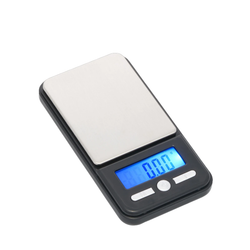
Yeast is one of the lightest ingredients in many bread formulas, so
choosing a scale for it requires a different approach from choosing a
general kitchen scale. A scale that is excellent for 1,000g of flour may
be relatively coarse when the target is 1.5g or 2.5g of yeast.
For most home and small-batch bakers, 0.1g readability with
approximately 200--500g capacity is the strongest starting point.
Bakers who routinely measure below 1g, scale professional formulas down
dramatically, or experiment with very low yeast percentages may benefit
from 0.01g readability.
King Arthur Baking's digital kitchen scale
guide
explains that ordinary 1g kitchen scales are sufficient for most baking
while advanced yeast bakers using baker's math or scaling bakery
formulas down can benefit from a high-precision scale.
American Weigh Scales' pocket
scales are useful as dedicated
precision tools for yeast, salt, spices and other low-mass baking
ingredients.
Quick Buying Guide
Use Capacity Readability
Yeast only 100--200g 0.1g
Yeast, salt and spices 200--500g 0.1g
General precision baking 500g 0.1g
Sub-gram formulas 100--200g 0.01g
Flour, water and bowls 2--5kg+ 1g or 0.1g
Complete dough batches 5kg+ 1g
For most bakers, 200--500g x 0.1g provides the best combination of
useful precision, capacity and convenience.
Accuracy: What Actually Matters?
Three terms deserve to be separated.
Readability is the smallest increment displayed by the scale.
Accuracy concerns how closely a measurement agrees with an
appropriate reference within the scale's stated performance.
Repeatability concerns whether the same stable load produces
consistent measurements under similar conditions.
A scale showing 0.01g is not automatically more accurate than every
scale showing 0.1g.
Why 0.1g Works So Well for Yeast
A 0.1g scale can display 2.3g, 2.4g, 2.5g and 2.6g. That is useful when
the complete ingredient quantity is only a few grams.
Consider a formula containing 500g flour, 350g water, 10g salt and 2.5g
yeast. A one-gram difference is tiny relative to the flour but
proportionally very large relative to the yeast.
AWS explains how maximum capacity and displayed increments work together
in What Does 500g x 0.01g Mean on a Digital
Scale?.
Is 1g Enough?
A 1g kitchen scale is excellent for many bulk baking ingredients. It
becomes relatively coarse around small yeast quantities. If a formula
calls for 2.5g, a whole-gram scale cannot display the target directly.
When 0.01g Makes Sense
Choose 0.01g when you frequently measure below 1g, dramatically scale
down bakery formulas, use very low yeast percentages, or run controlled
fermentation experiments.
AWS's 0.001g vs. 0.01g
Scales
guide provides additional context on fine-resolution selection.
Do You Need 0.001g?
Usually not. Milligram readability is far finer than ordinary bread
baking requires and may increase sensitivity to drafts, static,
vibration and temperature.
For normal yeast measurement, 0.1g is practical. For specialized
sub-gram work, 0.01g is usually the more relevant step up.
Repeatability and Stable Zero
Repeatability is critical because the purpose of weighing ingredients is
to reproduce formulas.
A simple check is to zero the scale, place the same stable dish on it,
record the result, remove it, allow the display to return to zero, and
repeat several times.
Unexpected variation can come from the environment rather than the
ingredient. AWS discusses common causes in Why Does My Digital Scale
Give Different
Readings?.
If zero drifts, check the surface, batteries, airflow, flour or crumbs
around the platform, calibration and whether the weighing dish touches
another object.
For a 500g flour measurement, a small fluctuation may represent a tiny
fraction of the ingredient. Around a 1g yeast target, small differences
are proportionally more important.
Capacity: How Much Do You Need?
Capacity is the maximum total physical load supported by the scale. The
weighing container counts toward this limit.
100g Capacity
A 100g scale can handle yeast, salt, spices, baking powder and other
small ingredients. It works best with lightweight dishes.
200g Capacity
A 200g scale provides more headroom while remaining compact. For bakers
who already own a large kitchen scale, it can be an excellent dedicated
small-ingredient format.
500g Capacity
A 500g precision scale is more versatile. It can handle yeast, salt,
spices, heavier dishes, small portions of flour or sugar, coffee and
other precision kitchen tasks.
For many bakers, 500g x 0.1g is the strongest all-around compact
format.
More Than 500g
A 2--3kg scale with 0.1g readability can be useful if one scale needs to
cover yeast and larger ingredients. A 5kg+ kitchen scale is better
suited to full mixing bowls and complete dough batches.
Leave Headroom
If a 200g scale is supporting a 190g dish plus 5g of yeast, the load
technically fits, but the margin is small. A lighter dish or 500g scale
is more practical.
Tare and Capacity
Tare resets the displayed value to zero after a container is placed on
the scale.
A typical workflow is:
-
Place the dish on the platform.
-
Press tare.
-
Confirm zero.
-
Add yeast.
-
Stop at the target mass.
Tare does not restore physical capacity. If a 150g dish sits on a
200g scale and is tared, the scale is still supporting 150g.
Some scales also permit negative tare: place the ingredient container on
the scale, tare it, remove yeast and read the amount removed. This can
be convenient for dry ingredients, although behavior varies by model.
Calibration: What Bakers Need to Know
A precision scale should provide clear calibration instructions,
including the required reference mass and how calibration mode is
activated.
AWS provides a practical walkthrough in How to Calibrate a Digital
Scale for Accurate
Results.
NIST's Calibration of Mass
Standards
explains the broader metrology principle that calibrating a weight
establishes a mass value and an appropriate uncertainty using suitable
reference standards.
For a consumer baking scale, follow the manufacturer's procedure and use
the specified calibration mass.
Do Not Calibrate With Food
Do not use yeast packets, flour, sugar, coffee beans, measuring spoons
or random household objects as calibration standards.
NIST's Standards for Laboratory
Weights
provides additional context on defined mass-standard classes used in
analytical measurement.
When to Check Performance
Follow the manufacturer's guidance. It can be sensible to check the
scale after travel, long storage, accidental overload or unusual
readings.
Before recalibrating, check the surface, battery, cleanliness, airflow
and container contact.
Why Grams Are Ideal for Baking
NIST's SI Units -- Mass
explains the SI mass framework and the gram-based decimal structure used
for smaller mass quantities.
Grams are especially convenient for baker's percentages.
Suppose flour is 500g and yeast is 2.5g:
2.5 ÷ 500 × 100 = 0.5% yeast
At the same percentage:
-
1,000g flour → 5g yeast
-
750g flour → 3.75g yeast
-
500g flour → 2.5g yeast
-
250g flour → 1.25g yeast
-
100g flour → 0.5g yeast
As the recipe shrinks, finer scale readability becomes more useful.
King Arthur Baking's Ingredient Weight
Chart
is also a useful weight-based reference for common baking ingredients.
Choosing a Scale by Yeast Type
Instant Yeast
Instant yeast is often used in small quantities. A 200--500g x 0.1g
scale is a practical choice for normal home formulas. For extremely
small long-fermentation formulas, 0.01g can be useful.
Active Dry Yeast
The same 0.1g precision range works well for active dry yeast. Weighing
by mass makes formula scaling easier than converting fractional spoon
measurements.
Fresh Yeast
Fresh yeast is typically used in larger quantities than dried yeast, so
extremely fine readability is less important. A 0.1g scale is more than
sufficient for many formulas.
Choosing a Scale by Baking Style
Bread
Precision weighing helps with recipe scaling, fermentation comparisons
and reproducibility. For everyday bread, 0.1g is usually enough.
Pizza Dough
Pizza dough is one of the strongest applications for a precision yeast
scale. Long fermentation can involve small yeast percentages,
particularly when a commercial formula is reduced to one or two dough
balls.
Enriched Dough
For brioche, cinnamon rolls, milk bread and similar formulas, use the
precision scale for yeast, salt and spices. Use a larger kitchen scale
for flour, butter, milk, eggs and sugar.
Sourdough
Even bakers who primarily use starter or levain can use a precision
scale for salt, hybrid commercial-yeast formulas, small starter
experiments and test doughs.
Physical Features That Matter
Platform Size
The weighing dish should sit completely on the platform without touching
the counter.
Display
Look for a clear decimal point, backlighting, large digits and easy gram
selection. The difference between 1.5g and 15g is significant.
Protective Cover
A cover helps protect a compact scale from flour dust, scratches and
pressure in a kitchen drawer.
Cleaning
Use a removable dish and keep flour, salt and crumbs away from the
platform mechanism.
Stable Surface
Use a hard, level countertop. Avoid towels, soft mats, flexible boards
and wobbly tables.
Airflow
Fine-resolution scales, especially 0.01g models, can respond to strong
airflow. Avoid fans, HVAC vents and open windows.
Power
Battery and rechargeable scales can both work well. If readings become
unusual, battery condition is one of the first things to check.
Auto-Off
Make sure the timeout is long enough for your normal
ingredient-preparation workflow.
Pocket Scale vs. Kitchen Scale
A precision pocket scale is best for yeast, salt, spices and other small
ingredients.
A larger kitchen scale is best for flour, water, mixing bowls, butter,
sugar and complete dough.
AWS's Pocket Scale vs. Kitchen
Scale
guide explains why these formats solve different measurement problems.
A Practical Two-Scale Setup
Precision scale: 200--500g x 0.1g for yeast, salt, spices and
leaveners.
Main kitchen scale: 5kg+ x 1g for flour, water, bowls and complete
dough.
If you prefer one scale, a 2--3kg+ model with 0.1g readability can cover
a wider range, although it may not replace a 0.01g micro scale for
specialized sub-gram work.
100g vs. 200g vs. 500g
Choose 100g if the scale is dedicated to yeast and you use a very
light dish.
Choose 200g if you want more headroom while keeping the scale highly
compact.
Choose 500g if you want heavier containers, broader kitchen utility
and more comfortable capacity headroom.
The yeast itself does not require 500g capacity. The flexibility does.
0.1g vs. 0.01g
Choose 0.1g when most yeast quantities are at least 1g, you bake
normal home batches and you want straightforward everyday use.
Choose 0.01g when you routinely work below 1g, dramatically scale
formulas down or conduct controlled low-dose fermentation experiments.
For most bakers, 0.1g remains the better starting point.
How to Weigh Yeast Correctly
-
Put the scale on a hard, level surface.
-
Turn it on and select grams.
-
Place a clean, dry dish on the platform.
-
Press tare.
-
Confirm zero.
-
Add yeast slowly.
-
Stop at the target mass.
-
Record the quantity if developing a formula.
-
Add the yeast according to the recipe.
Troubleshooting Unexpected Readings
Before assuming the scale is defective:
-
Confirm the scale is on a stable surface.
-
Remove strong airflow.
-
Check battery condition.
-
Clean the platform.
-
Confirm the dish touches nothing else.
-
Let the display return to zero.
-
Repeat the measurement.
-
Follow the manufacturer's calibration instructions if necessary.
Baking Yeast Scale Buying Checklist
Before buying, ask:
-
What is the smallest yeast quantity I normally use?
-
Do I routinely measure below 1g?
-
Is 0.1g readability sufficient?
-
Do I genuinely need 0.01g?
-
How much does my weighing dish weigh?
-
Is 100g capacity enough?
-
Would 200g provide better headroom?
-
Would 500g make the scale more versatile?
-
Do I need kilogram-level capacity?
-
Does it have tare?
-
Does it measure grams?
-
Are repeated readings stable?
-
Does it return reliably to zero?
-
Can it be calibrated?
-
What calibration mass is required?
-
Is the calibration reference included?
-
Is the platform large enough?
-
Is the display clear?
-
Is the decimal point obvious?
-
Does it have a protective cover?
-
Is it easy to clean?
-
Is the power source convenient?
-
Will auto-off interrupt my workflow?
-
Do I use baker's percentages?
-
Do I frequently scale recipes down?
-
Will I also weigh salt and spices?
-
Do I already own a high-capacity kitchen scale?
Common Buying Mistakes
Choosing by Decimal Places Alone
More digits do not automatically mean better measurements.
Confusing Readability With Accuracy
The smallest displayed increment is not the same thing as total
measurement accuracy.
Ignoring Repeatability
A useful scale should behave consistently under consistent conditions.
Using a 1g Scale for Tiny Quantities
Whole grams can be coarse when the entire yeast quantity is only a few
grams.
Buying 0.001g for Ordinary Bread
Milligram resolution is generally unnecessary.
Forgetting Container Weight
The dish counts toward capacity.
Assuming Tare Restores Capacity
It does not.
Ignoring Headroom
Avoid routinely operating at maximum capacity.
Calibrating With Food
Use the manufacturer's specified reference mass.
Using an Unstable Surface
Fine scales need a solid base.
Ignoring Drafts
Air movement can affect fine measurements.
Letting Flour Accumulate
Keep the weighing platform clean.
Expecting a Tiny Scale to Weigh Complete Dough
Use a larger kitchen scale for bulk ingredients.
Frequently Asked Questions
What accuracy do I need for baking yeast?
For most bakers, a scale designed around 0.1g readability with stable
repeatability and appropriate manufacturer-stated performance is
practical.
Is 0.1g enough?
Yes for most home bread, pizza, roll and enriched-dough formulas.
When do I need 0.01g?
Consider it when you frequently measure below 1g or dramatically scale
down formulas.
Do I need 0.001g?
Generally no for ordinary baking.
What capacity should I choose?
100--200g can be enough for dedicated yeast use. Around 500g gives more
flexibility for containers and other small ingredients.
Is 500g too much?
No. It makes the scale more versatile.
Does tare increase capacity?
No. The physical mass of the container remains on the scale.
Why does calibration matter?
Calibration establishes or checks the relationship between the scale's
indication and an appropriate reference according to the manufacturer's
procedure.
Can I calibrate with a yeast packet?
No.
What is repeatability?
Repeatability is the ability to obtain consistent results when the same
stable load is measured repeatedly under similar conditions.
Is a pocket scale good for yeast?
Yes. Pocket scales are particularly useful for yeast, salt, spices and
other small ingredients.
Do I need a separate kitchen scale?
If you weigh flour, water, bowls and complete dough, a larger kitchen
scale is useful.
What is the best setup?
For serious baking, a compact 0.1g precision scale paired with a
high-capacity kitchen scale provides excellent coverage.
Final Verdict: Accuracy, Capacity and Calibration
For most bakers, the best baking yeast scale begins with 0.1g
readability.
A practical capacity framework is:
-
100g x 0.1g: dedicated yeast use
-
200g x 0.1g: excellent compact small-ingredient scale
-
500g x 0.1g: best all-around precision range for yeast, salt,
spices and other small ingredients -
100--200g x 0.01g: specialized sub-gram formulas and
fermentation experiments -
2--3kg+ x 0.1g: broader baking versatility
-
5kg+ x 1g: separate bulk-ingredient kitchen scale
-
0.001g: generally unnecessary for baking yeast
Accuracy should never be judged by decimal places alone. Evaluate
readability, repeatability, stable zero, calibration, capacity, tare,
platform design and the weighing environment together.
Capacity includes the complete physical load, including the weighing
dish. Taring the dish makes the displayed value easier to use but does
not increase physical capacity.
Calibration should follow the manufacturer's procedure using the
specified reference mass. NIST's mass-calibration framework reinforces
the broader principle that meaningful calibration relies on known
standards and an understood measurement relationship.
For normal home bread and pizza dough, 200--500g x 0.1g is an
excellent target. For advanced bakers routinely working below 1g,
0.01g can provide useful additional resolution.
The right yeast scale is not the one with the largest capacity or the
most decimal places. It is the scale whose measurement range matches
your recipes, whose calibration procedure is clear, and whose
repeatability helps you reproduce the same formula consistently.
Practical Buying Scenarios
Scenario 1: The Everyday Bread Baker
You make sandwich loaves, dinner rolls and occasional artisan bread.
Most recipes use between 2g and 8g of dry yeast. You already have a
standard kitchen scale for flour and water.
A 200--500g x 0.1g pocket scale is the logical choice. It gives
enough detail for yeast while also handling salt and spices. There is
little reason to pay for 0.01g unless your recipes regularly fall below
1g.
Scenario 2: The Long-Fermentation Pizza Baker
You make one or two dough balls and frequently adjust yeast to
accommodate 24-, 48- or 72-hour fermentation schedules.
A 0.1g scale works for many formulas, but a 0.01g model becomes
more attractive when calculated yeast targets repeatedly fall below 1g.
Choose enough capacity for your dish rather than focusing on yeast mass
alone.
Scenario 3: The Recipe Developer
You compare multiple versions of the same formula and want changes to be
documented precisely.
Prioritize repeatability, stable zero and calibration in addition to
readability. A scale that consistently reproduces measurements is more
useful than one that simply displays an extra decimal place.
Scenario 4: The Small-Batch Baker
You routinely cut full recipes to one-quarter or one-eighth size.
This is exactly where fine resolution becomes valuable. A yeast quantity
that was 4g in the original formula may become 1g or 0.5g after scaling.
A 0.1g scale is a strong minimum; 0.01g may be justified for even
smaller formulas.
Scenario 5: The Minimalist Kitchen
You want one scale instead of two.
Look for kilogram-level capacity combined with 0.1g readability. This
sacrifices some ultra-fine resolution but can cover yeast, salt, flour,
water and many bowls on one platform.
Scenario 6: The Dedicated Precision Station
You already own a large kitchen scale and want the smallest practical
tool for yeast.
A 100--200g x 0.1g model with a light dish, tare, calibration and a
protective cover can be ideal. The smaller capacity is not a
disadvantage if you never intend to weigh bulk ingredients.
Why the Container Changes the Buying Decision
Two bakers may measure the same 2.5g yeast quantity but need different
scale capacities.
Baker A uses a 20g plastic cup. Gross load: 22.5g.
Baker B uses a 180g ceramic ramekin. Gross load: 182.5g.
A 100g scale works perfectly for Baker A and cannot support Baker B's
setup at all.
This is why capacity should be selected after weighing or estimating the
actual container.
Why More Capacity Is Not Always Better
Higher capacity can be convenient, but capacity should not be pursued at
the expense of the readability you need.
If your only choices were a 5kg x 1g scale and a 500g x 0.1g scale, the
smaller model would generally be more informative for a 2.5g yeast
target.
The best specification is a balance between the heaviest gross load and
the smallest meaningful ingredient change.
Why More Resolution Is Not Always Better
The same principle applies in the opposite direction.
A 100g x 0.001g laboratory-style scale may provide spectacular display
detail, but it can be unnecessarily sensitive and restrictive for an
ordinary kitchen.
If your recipe decisions happen in 0.1g steps, additional digits do not
necessarily improve the bread.
Building a Repeatable Yeast Workflow
Consistency comes from more than the scale.
Use the same yeast type, record the formula in grams, weigh on the same
stable surface, use a consistent container, keep the scale clean and
note fermentation temperature and time.
The scale controls one important variable. It does not control the
entire fermentation process.
Accuracy and Recipe Scaling
Suppose a recipe is based on 1,000g flour and 5g yeast. If you halve it,
the target becomes 2.5g.
A whole-gram scale forces a coarse decision around that target. A 0.1g
scale displays it directly.
If you reduce the original recipe to one-tenth, the target becomes 0.5g.
The advantage of fine readability becomes even clearer.
This is why the scale requirement should be based on the smallest
version of the recipe you realistically intend to make, not only the
original full-size formula.
Calibration and Long-Term Consistency
Calibration is particularly relevant when a scale is used over months or
years to compare recipes.
If you record a successful dough today and repeat it six months later,
you want the measurement system to remain dependable.
Store the scale carefully, avoid overload, keep the platform clean, use
fresh batteries or adequate charge, and follow the manufacturer's
calibration instructions.
Final Selection Formula
A simple way to choose is:
Step 1: Find your smallest normal yeast quantity.
Step 2: Choose readability fine enough to represent meaningful
changes in that quantity.
Step 3: Add the mass of your heaviest intended container to the
ingredient load.
Step 4: Choose capacity above that gross load with comfortable
headroom.
Step 5: Confirm tare, calibration, repeatability, gram mode and
platform fit.
Step 6: Decide whether the precision scale will complement or
replace your main kitchen scale.
For the majority of home bakers, this process leads to the same
practical answer: 200--500g capacity with 0.1g readability.