
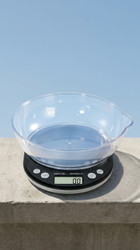
Yeast is one of the smallest ingredients in many baking formulas, but
small changes in the amount used can influence fermentation speed,
proofing schedules, and the way a dough fits into your baking routine.
That makes yeast a particularly good reason to add a precision scale to
a home or professional baking setup.
The best digital scale for baking yeast should provide enough
resolution to measure small quantities confidently without sacrificing
usability. For most bread, pizza, rolls, and enriched dough recipes,
0.1g readability is an excellent target. Bakers working with
extremely small batches, scaled-down formulas, preferments, or very low
yeast percentages may sometimes benefit from 0.01g readability.
This is different from weighing flour. A standard kitchen scale that
reads in 1g increments is often perfectly useful for hundreds of grams
of flour, water, sugar, or butter. Yeast can be used in quantities small
enough that a separate precision scale becomes valuable.
American Weigh Scales offers compact pocket
scales that can complement a
larger kitchen scale when a baker needs finer measurement of yeast and
other low-mass ingredients.
This guide explains how to choose the right digital scale for yeast
based on readability, capacity, repeatability, calibration, tare,
platform size, and the size of the recipes you actually bake. For a
broader comparison of scale formats, see AWS's Pocket Scale vs. Kitchen
Scale
guide.
Quick Answer: What Is the Best Scale for Baking Yeast?
For most bakers measuring yeast separately, look for:
-
0.1g readability
-
100--500g capacity
-
Tare
-
Stable repeatable readings
-
Calibration capability
-
A small tray or container
-
Clear backlit display
-
Compact platform
-
Protective cover
-
Easy gram measurement
For very small experimental formulas, 0.01g readability may be
useful.
For flour, water, and complete mixing bowls, use a larger kitchen scale
with kilogram-level capacity.
This creates an effective two-scale baking setup:
Precision scale: yeast, salt, spices, improvers, and other small
ingredients.
Kitchen scale: flour, water, butter, sugar, bowls, and complete
dough batches.
King Arthur Baking's digital kitchen scale
guide
recommends digital scales for consistent baking and specifically notes
that advanced yeast bakers working with baker's math may benefit from a
high-precision scale capable of measuring fractions of a gram.
Why Weigh Yeast?
Measuring yeast by mass offers several advantages.
It makes it easier to:
-
Repeat a successful dough
-
Scale a recipe up
-
Scale a recipe down
-
Work with baker's percentages
-
Compare fermentation schedules
-
Record recipe changes
-
Measure quantities smaller than convenient spoon measurements
When the ingredient quantity is small, mass measurement can be more
informative than relying on a scoop or spoon.
Why Yeast Needs More Precision Than Flour
Imagine a bread formula containing:
-
500g flour
-
350g water
-
10g salt
-
3g yeast
A 1g difference in flour is only 0.2% of the flour amount.
A 1g difference around a 3g yeast target is proportionally much larger.
That is why a scale suitable for flour is not automatically ideal for
yeast.
0.1g Readability: The Best General Choice
A scale with 0.1g readability displays:
-
1.0g
-
1.1g
-
1.2g
-
1.3g
For many bread formulas, this provides excellent practical control.
If a recipe calls for 2.5g of yeast, a 0.1g scale can display that
amount directly.
If you change the formula to 2.2g, that adjustment is also visible.
This makes 0.1g particularly useful for bakers experimenting with
fermentation time.
Is 1g Readability Enough for Yeast?
Sometimes, but it is not ideal for small quantities.
A standard kitchen scale reading in 1g increments is useful for:
-
Flour
-
Water
-
Sugar
-
Butter
-
Large batches
For yeast quantities of only a few grams, whole-gram resolution can be
relatively coarse.
King Arthur Baking's ingredient-weight
resources
recommend weighing baking ingredients for consistent results, while its
scale guidance notes that high-precision scales become useful for
advanced yeast bakers and scaled-down formulas.
That distinction is exactly why a small precision scale can complement
rather than replace a normal kitchen scale.
Do You Need 0.01g for Yeast?
Most home bakers do not need hundredth-of-a-gram readability for
everyday bread.
However, 0.01g can be useful when:
-
Scaling commercial formulas down dramatically
-
Working with extremely small dough batches
-
Testing low yeast percentages
-
Comparing controlled fermentation experiments
-
Measuring other very small baking ingredients
For normal home bread formulas, 0.1g is generally simpler and more
practical.
Do You Need 0.001g?
Usually not.
A milligram scale can measure extremely small quantities, but ordinary
baking rarely requires that level of resolution.
It may also be more sensitive to:
-
Drafts
-
Vibration
-
Static
-
Temperature
For yeast, a stable 0.1g or specialized 0.01g scale is usually a better
fit.
Readability vs. Accuracy
Readability is the smallest displayed increment.
Accuracy concerns how closely the indicated measurement agrees with an
appropriate reference within the scale's stated performance.
Repeatability concerns whether repeated measurements of the same stable
load produce consistent results.
Do not assume a scale is highly accurate simply because it shows many
decimal places.
Repeatability Matters
A baking scale is useful because it helps you reproduce recipes.
A simple repeatability test is:
-
Confirm zero.
-
Place the same small container on the scale.
-
Record the result.
-
Remove it.
-
Wait for zero.
-
Repeat.
The scale should behave consistently within its stated performance.
Capacity: How Much Do You Need for Yeast?
Yeast itself requires very little capacity.
If you weigh yeast in a lightweight cup, a 100g or 200g scale may be
more than sufficient.
If you use heavier bowls or want the precision scale to serve other
purposes, 500g provides more flexibility.
100g Capacity
A 100g scale can handle:
-
Yeast
-
Salt
-
Spices
-
Baking powder
-
Baking soda
-
Small additives
It is highly compact but leaves limited room for heavy containers.
200g Capacity
A 200g scale is a strong precision-baking format.
It gives plenty of room for:
-
Yeast
-
Small dishes
-
Small ingredient combinations
-
Salt
-
Spices
It can remain compact while providing more headroom than a 100g model.
500g Capacity
A 500g precision scale is extremely versatile.
It can handle:
-
Yeast
-
Salt
-
Spices
-
Small portions of flour
-
Small portions of sugar
-
Coffee
-
Other kitchen ingredients
For bakers who want one compact precision scale for multiple uses, 500g
is an attractive capacity.
AWS explains the relationship between capacity and displayed increments
in What Does 500g x 0.01g Mean on a Digital
Scale?.
Why You Usually Do Not Need 3kg Capacity for Yeast
A 3kg or 5kg kitchen scale is excellent for:
-
Mixing bowls
-
Flour
-
Water
-
Complete dough batches
But if its readability is only 1g, it may not provide the fine control
desired for a 1.5g or 2.5g yeast measurement.
This is why many serious bakers benefit from two scales.
The Two-Scale Baking Setup
Scale One: Precision Scale
Target:
100--500g x 0.1g
Use for:
-
Yeast
-
Salt
-
Spices
-
Baking powder
-
Small ingredients
Scale Two: Kitchen Scale
Target:
5kg+ x 1g
Use for:
-
Flour
-
Water
-
Mixing bowls
-
Complete dough
-
Large batches
Each scale handles the range it is best suited to measure.
Tare
Tare is essential for clean baking workflows.
Example:
-
Place a small yeast dish on the scale.
-
Press tare.
-
Confirm zero.
-
Add yeast.
-
Stop at the target.
You do not need to subtract the dish manually.
Tare Does Not Increase Capacity
Suppose a container weighs 80g and your scale has 100g capacity.
After taring, the display shows zero.
But the scale is still physically supporting 80g.
Only 20g of physical capacity remains.
Always choose capacity based on the gross load.
Calibration
A precision baking scale should have a clear calibration procedure.
Look for:
-
User-accessible calibration
-
Specified calibration mass
-
Clear instructions
-
Appropriate reference weight
AWS provides practical guidance in How to Calibrate a Digital Scale for
Accurate
Results.
Follow the manufacturer's instructions rather than improvising a
calibration reference.
Why Calibration Matters for Small Ingredients
If you are measuring 500g of flour, a tiny measurement discrepancy may
represent a very small percentage of the ingredient.
When measuring only a few grams of yeast, small differences are
proportionally larger.
That makes proper scale setup, calibration, and repeatability
particularly relevant.
Do Not Calibrate With Yeast
Yeast is not a calibration standard.
Neither are:
-
Flour
-
Coins
-
Measuring spoons
-
Packaged foods
-
Random household objects
Use the calibration mass specified by the scale manufacturer.
NIST's Calibration of Mass
Standards
explains the broader metrological principle that calibrated mass
standards are assigned mass values with stated uncertainty and
traceability.
Platform Size
For yeast, a huge platform is unnecessary.
A small stainless-steel platform works well with:
-
Ingredient dishes
-
Small cups
-
Weighing papers
-
Small trays
The container should rest completely on the weighing surface without
touching the counter.
Protective Cover
A cover is particularly useful for a small precision scale.
It can protect the platform from:
-
Flour dust
-
Pressure in a drawer
-
Scratches
-
Other kitchen tools
Some pocket-scale covers can also double as weighing trays, depending on
the model.
Display
Look for:
-
Clear digits
-
Backlighting
-
Easy-to-see decimal point
-
Gram mode
When weighing 1.8g rather than 18g, the decimal point matters.
A clear display reduces reading mistakes.
Grams Are Ideal for Yeast
For baking formulas, grams make scaling straightforward.
NIST's SI Units -- Mass
identifies the kilogram as the SI base unit of mass and explains the
gram-based decimal structure used for smaller mass quantities.
A formula written entirely in grams is easy to scale mathematically.
NIST's Writing with SI
Units also
provides conventions for correctly expressing gram and milligram
measurements.
Baker's Percentages
Baker's percentage expresses ingredients relative to flour weight.
Flour is:
100%
Suppose a formula contains:
-
Flour: 500g
-
Yeast: 2.5g
Yeast percentage:
2.5 ÷ 500 × 100 = 0.5%
If you double the flour to 1,000g and keep the same percentage:
1,000 × 0.005 = 5g yeast
A precision scale makes this type of formula scaling much easier.
Example: 0.5% Yeast
For 500g flour:
2.5g yeast
For 750g flour:
3.75g yeast
For 1,000g flour:
5g yeast
A 0.1g scale is suitable for all of these.
Example: 0.2% Yeast
For 500g flour:
1g yeast
For 250g flour:
0.5g yeast
For 100g flour:
0.2g yeast
As recipes get smaller or yeast percentages decrease, fine readability
becomes increasingly useful.
Why Precision Matters When Scaling Recipes Down
A bakery formula may be designed around several kilograms of flour.
When that formula is reduced to a small home batch, the yeast quantity
can become tiny.
A 1g kitchen scale may no longer provide enough resolution.
This is one of the situations where a 0.1g precision scale becomes
especially valuable.
Active Dry Yeast
Active dry yeast can be weighed directly by mass.
For repeatable recipes:
-
Place a small dish on the scale.
-
Tare.
-
Add the required yeast.
-
Record the mass.
The same scale can then be used for salt or other small ingredients.
Instant Yeast
Instant yeast is also convenient to weigh directly.
A precision scale is particularly useful when adapting recipes that
specify yeast as a percentage of flour weight.
Instead of converting back and forth between teaspoons and fractions of
teaspoons, you can work directly in grams.
Fresh Yeast
Fresh yeast is generally used in larger quantities than dried yeast, so
the resolution requirement may be less demanding.
However, weighing still provides a consistent way to scale formulas.
Choose capacity according to the recipe size and container.
Sourdough and Commercial Yeast
Sourdough formulas may use a starter or levain rather than commercial
yeast, but some hybrid formulas use both.
A precision scale can measure small commercial-yeast additions while the
larger kitchen scale handles the starter, flour, and water.
Pizza Dough
Pizza dough is a strong use case for precision yeast measurement.
Long fermentation schedules may use relatively small amounts of yeast.
When recipes are scaled for one or two dough balls, the required yeast
quantity can become especially small.
A 0.1g scale gives you much better control than a whole-gram kitchen
scale.
Bread Dough
For everyday sandwich bread or artisan loaves, a precision scale helps
when:
-
Adjusting fermentation speed
-
Scaling recipes
-
Comparing yeast percentages
-
Making smaller batches
-
Recording formulas
The goal is repeatability.
Enriched Dough
Brioche, rolls, cinnamon rolls, and other enriched doughs often involve
many ingredients.
A two-scale setup works well:
Precision scale: yeast, salt, spices.
Kitchen scale: flour, eggs, butter, milk, sugar.
Small-Batch Baking
Small batches amplify the value of precision.
If you cut a recipe to one-quarter size, a 4g yeast quantity becomes:
1g
Cut it in half again and it becomes:
0.5g
A 0.1g scale can measure that directly.
Large-Batch Baking
For large batches, the yeast quantity increases and 1g resolution
becomes more usable.
However, a precision scale still provides useful repeatability if the
formula is tightly controlled.
The best capacity depends on the largest ingredient quantity you intend
to measure on that particular scale.
Why Measuring Spoons Are Different
A measuring spoon measures volume.
A scale measures mass.
For many everyday recipes, spoons are perfectly practical.
A precision scale becomes particularly valuable when:
-
Scaling formulas mathematically
-
Using baker's percentages
-
Working with tiny quantities
-
Comparing controlled batches
-
Recording recipes professionally
Negative Tare
Some baking workflows use negative tare.
For example:
-
Put a container of yeast on the scale.
-
Tare it.
-
Remove yeast.
-
Read how much mass was removed.
This can be useful for ingredients that are easier to remove from a
storage container than pour into a tiny dish.
Not every scale handles negative weighing in the same way, so check the
instructions.
Response Speed
Yeast is a static ingredient, so ultra-fast response is less critical
than it is for espresso or pour-over coffee.
However, a scale should still settle quickly enough to make dosing
convenient.
A slow, drifting display can make it difficult to know when you have
reached the target.
Stable Zero
Before adding yeast, the scale should show a stable zero.
If the reading drifts, check:
-
Surface stability
-
Airflow
-
Battery condition
-
Flour or debris around the platform
-
Calibration
-
Container contact
AWS discusses common causes in Why Does My Digital Scale Give Different
Readings?.
Surface Stability
Place a precision scale on a hard, level counter.
Avoid:
-
Towels
-
Flexible cutting mats
-
Uneven surfaces
-
Wobbly tables
Fine-resolution scales benefit from a stable environment.
Airflow
Strong air movement can affect very sensitive scales.
Avoid placing a 0.01g scale directly beneath:
-
HVAC vents
-
Fans
-
Open windows
For 0.1g yeast measurement, normal kitchen conditions are usually much
easier to manage.
Flour Dust and Cleanliness
Baking environments produce flour dust.
Keep the weighing platform clean and prevent debris from accumulating
around moving parts or platform edges.
Use a removable dish when weighing yeast to simplify cleanup.
Battery or Rechargeable Power
Either can work well.
Battery-powered precision scales are convenient for:
-
Drawers
-
Travel
-
Occasional baking
Rechargeable scales can be convenient for frequent use.
Power type does not determine accuracy by itself.
Auto-Off
Auto-off preserves battery life but can interrupt a baking workflow.
If you frequently prepare several ingredients before weighing, choose a
scale with a reasonable timeout or learn how its auto-off function
behaves.
Best Scale for Yeast Only
If the scale's main job is yeast:
100--200g x 0.1g
is usually more than enough.
A compact platform and tare function are more important than high
capacity.
Best Scale for Yeast and Salt
For yeast plus salt:
200--500g x 0.1g
is highly versatile.
It can serve as the small-ingredient scale for an entire baking station.
Best Scale for Yeast and Spices
A 0.1g precision scale also works well for:
-
Cinnamon
-
Cardamom
-
Nutmeg
-
Small salt quantities
-
Baking powder
-
Baking soda
For extremely tiny experimental amounts, 0.01g may be useful.
Best Scale for Bread Baking
For complete bread baking, consider two scales:
Precision scale: 500g x 0.1g or similar.
Kitchen scale: 5kg+ x 1g.
This combination covers both small and large ingredients efficiently.
Best Scale for Pizza Dough
Pizza bakers working with long fermentation schedules can benefit from:
200--500g x 0.1g
for yeast and salt.
Use the larger kitchen scale for flour and water.
Best Scale for Sourdough
A sourdough baker may not use commercial yeast regularly, but a
precision scale is still useful for:
-
Salt
-
Small starter experiments
-
Hybrid yeast formulas
-
Small test doughs
Again, 0.1g is a practical general target.
Pocket Scale vs. Kitchen Scale for Yeast
Pocket Precision Scale
Best for:
-
Yeast
-
Salt
-
Spices
-
Small ingredients
-
Baker's percentage experiments
Kitchen Scale
Best for:
-
Flour
-
Water
-
Mixing bowls
-
Complete dough
-
Large batches
Neither replaces the other perfectly.
They solve different measurement problems.
0.1g vs. 0.01g for Yeast
Choose 0.1g if:
-
You bake normal home-size recipes
-
You make bread or pizza regularly
-
You want easy, stable measurements
-
You want a multi-purpose precision scale
Choose 0.01g if:
-
You routinely work below 1g
-
You dramatically scale down formulas
-
You perform controlled experiments
-
You need the scale for other fine-measurement tasks
For most bakers, 0.1g is the better starting point. AWS also explains
practical fine-resolution selection in its 0.001g vs. 0.01g scale
comparison.
200g vs. 500g for Yeast
Choose 200g if:
-
You use lightweight dishes
-
You only weigh small ingredients
-
Compactness matters most
Choose 500g if:
-
You want heavier containers
-
You want more headroom
-
You want the scale to handle additional kitchen tasks
The yeast itself does not require 500g capacity. The added flexibility
does.
How to Weigh Yeast Correctly
-
Put the scale on a hard, stable surface.
-
Turn it on.
-
Select grams.
-
Place a clean, dry dish on the platform.
-
Press tare.
-
Confirm zero.
-
Add yeast slowly.
-
Stop at the target mass.
-
Record the value if testing a formula.
-
Add the yeast according to your recipe.
How to Scale a Yeast Formula
Suppose your formula uses:
-
1,000g flour
-
5g yeast
That is:
0.5% yeast
If you want a 600g-flour batch:
600 × 0.005 = 3g yeast
If you want a 250g-flour batch:
250 × 0.005 = 1.25g yeast
A 0.1g scale lets you approximate that target much more closely than a
1g kitchen scale.
How to Troubleshoot Inconsistent Yeast Measurements
If readings seem inconsistent:
-
Confirm the scale is on a hard surface.
-
Remove strong airflow.
-
Check battery condition.
-
Clean the platform.
-
Make sure the dish touches nothing else.
-
Confirm zero.
-
Check calibration according to the manufacturer's instructions.
-
Repeat the measurement.
Do not immediately assume the yeast or recipe is the problem.
Baking Yeast Scale Buying Checklist
Before buying, ask:
-
What is the smallest yeast quantity I normally use?
-
Do I frequently measure below 1g?
-
Is 0.1g readability enough?
-
Do I genuinely need 0.01g?
-
Is 100--200g capacity sufficient?
-
Would 500g provide useful flexibility?
-
Does the scale have tare?
-
Does it measure grams?
-
Are repeated readings stable?
-
Can it be calibrated?
-
What calibration mass is required?
-
Is the platform large enough for my dish?
-
Is the display easy to read?
-
Does it have a protective cover?
-
Is it easy to clean?
-
Is the power source convenient?
-
Will auto-off interrupt my workflow?
-
Do I also need a larger kitchen scale?
-
Will I use baker's percentages?
-
Will I scale recipes down frequently?
Common Mistakes
Using a 1g Scale for Tiny Yeast Quantities
Whole grams can be too coarse when the target is only a few grams.
Buying 0.001g Because It Sounds Better
Milligram resolution is generally unnecessary for baking yeast.
Ignoring the Container
The weighing dish counts toward capacity.
Assuming Tare Restores Capacity
It does not.
Confusing Readability With Accuracy
The displayed increment is only one specification.
Ignoring Repeatability
Recipe consistency depends on consistent measurements.
Calibrating With Food
Yeast, flour, and packaged ingredients are not calibration standards.
Using an Unstable Surface
Fine-resolution scales need a solid base.
Ignoring Flour Dust
Keep precision weighing equipment clean.
Replacing a Kitchen Scale With a Tiny Precision Scale
A small scale is excellent for yeast but not for a 2kg bowl of dough.
Frequently Asked Questions
What is the best digital scale for baking yeast?
For most bakers, a compact scale with 0.1g readability, 100--500g
capacity, tare, stable repeatability, and calibration capability is an
excellent choice.
Is 0.1g accurate enough for yeast?
0.1g readability is practical for most home bread and pizza formulas.
Also consider the manufacturer's stated accuracy and repeatability.
Do I need 0.01g?
Usually not, but it can be useful for very small batches and low yeast
percentages.
Do I need 0.001g?
No for ordinary baking.
Is a normal kitchen scale good for yeast?
A 1g kitchen scale is useful for many baking ingredients, but a 0.1g
precision scale provides finer control for small yeast quantities.
What capacity do I need?
100--200g is enough for yeast and lightweight dishes. A 500g scale
provides more flexibility.
Is 500g too much?
No. It gives useful headroom while remaining compact.
Do I need a 5kg scale?
Not for yeast itself. A 5kg scale is useful as a separate main kitchen
scale for flour, water, bowls, and complete dough.
Does tare matter?
Yes. It lets you zero the weighing dish before adding yeast.
Does tare increase capacity?
No.
Should I calibrate my scale?
Follow the manufacturer's instructions and use the specified calibration
reference.
Can I calibrate with a packet of yeast?
No. Packaged food is not a precision calibration standard.
Why use grams?
Grams make recipe scaling and baker's percentages straightforward.
Is a pocket scale good for baking?
Yes. A pocket precision scale is particularly useful for yeast, salt,
spices, and other low-mass ingredients.
Is weighing better than measuring spoons?
Both can work, but weighing is particularly useful for recipe scaling,
baker's percentages, small quantities, and repeatable experiments.
What scale should a serious bread baker own?
A strong setup is a 0.1g precision scale for small ingredients plus a
high-capacity kitchen scale for flour, water, bowls, and dough.
Final Verdict: Best Digital Scale for Baking Yeast
For most bakers, the best digital scale for yeast starts with 0.1g
readability.
Then choose capacity based on the container and other ingredients you
want the scale to handle:
-
100g x 0.1g: yeast and very small ingredients
-
200g x 0.1g: excellent dedicated precision-baking format
-
500g x 0.1g: best all-around precision format for yeast, salt,
spices, and other small ingredients -
100--200g x 0.01g: specialized low-dose experiments
-
0.001g: generally unnecessary for baking
-
5kg+ x 1g: better as a separate main kitchen scale for flour,
water, bowls, and dough
For everyday bread, pizza, rolls, and enriched dough, 0.1g is usually
the sweet spot.
For advanced bakers who frequently scale formulas down until yeast
quantities fall below 1g, a 0.01g model can provide additional
measurement detail.
The best solution for serious baking is often not one scale but two: a
compact precision scale for yeast and other small ingredients, paired
with a larger kitchen scale for the bulk ingredients.
That combination gives you fine control where it matters without
sacrificing the capacity needed for complete baking recipes.