
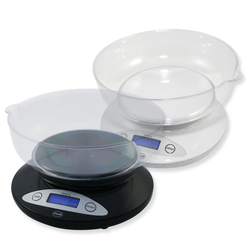
The best digital scale for candle making needs to do more than weigh
wax. Candle formulas can include several kilograms of wax, a pouring
pitcher, fragrance oil, dyes, and other additives that may require much
finer measurement.
That creates two very different weighing jobs.
For wax and complete batches, capacity matters most. For fragrance oil,
concentrated colorants, and small test batches, finer readability
becomes more important.
For many hobby and small-business candle makers, a 2,000--5,000g
digital scale with 0.1g or 1g readability is a practical primary
scale. Makers who formulate small samples or measure low-mass additives
can add a 100--500g precision scale with 0.01g or 0.1g readability.
CandleScience recommends weighing both wax and fragrance rather than
relying on volume because waxes and fragrance oils can differ in
density. Weight-based formulas also make it easier to reproduce a
successful candle from one batch to the next.
American Weigh Scales' guide to the best scale for candle making and
fragrance
oils
reaches a similar practical conclusion: higher capacity is important for
wax, while fragrance oils and small additives can benefit from finer
readability.
Quick Answer: What Is the Best Digital Scale for Candle Making?
For most candle makers, look for:
-
2--5kg capacity for wax and normal batches
-
0.1g or 1g readability depending on batch size
-
Reliable tare
-
Stable repeatability
-
Gram measurement
-
A platform large enough for your pouring pitcher
-
A display that remains visible behind the container
-
Easy-to-clean construction
-
Clear calibration instructions
-
Convenient power and sensible auto-off behavior
For fragrance oils, dyes, and small test batches, a separate 100--500g
x 0.01g or 0.1g precision scale can be useful.
Best Scale Specifications by Candle-Making Task
Candle-making task Suggested capacity Suggested readability
Tiny fragrance or dye tests 100--500g 0.01g
Fragrance oil 500--2,000g 0.1g
Sample candles 500--2,000g 0.1g
Small wax batches 2,000--3,000g 0.1g or 1g
Typical hobby batches 3,000--5,000g 0.1g or 1g
Larger wax batches 5kg+ 1g
Concentrated colorants 100--500g 0.01g or 0.1g
Pouring pitcher plus wax 3,000--5,000g+ 1g or 0.1g
Your actual formula, pitcher weight, batch size, and ingredient supplier
recommendations should determine the final specification.
Why Candle Makers Should Weigh Ingredients
Candle formulas are fundamentally easier to reproduce when wax and
fragrance are measured by mass.
CandleScience specifically advises candle makers to weigh wax and
fragrance because measuring by volume can be unreliable when materials
have different densities.
This matters because the same fluid volume of two fragrance oils does
not necessarily represent the same mass.
Weight-based measurement also makes percentage calculations
straightforward.
Wax and Fragrance Are Different Weighing Jobs
Consider a candle batch containing:
-
1,000g wax
-
80g fragrance oil
The wax quantity is large enough that whole-gram readability may be
perfectly practical.
The fragrance oil is much smaller.
If you make a small test batch:
-
100g wax
-
8g fragrance
finer readability becomes more useful.
This is why many serious candle makers benefit from either a
high-capacity scale with 0.1g readability or a two-scale setup.
Capacity: The First Specification to Check
Capacity is the maximum total load the scale can support.
If the scale is rated:
5,000g x 1g
then:
-
5,000g is maximum capacity.
-
1g is the displayed increment.
AWS explains this notation in What Does 500g x 0.01g Mean on a Digital
Scale?.
For candle making, the total load includes the pouring pitcher or other
container.
Container Weight Counts
Suppose:
-
Pouring pitcher = 700g
-
Wax = 2,000g
-
Fragrance = 160g
Gross load:
2,860g
A 3kg scale technically supports the batch, but there is very little
capacity headroom.
A 5kg scale is a more comfortable choice.
Tare Does Not Increase Capacity
Put a 700g pitcher on a 5kg scale and press tare.
The display returns to zero.
The scale is still physically supporting 700g.
You have not regained the full 5kg of physical capacity.
Tare changes the displayed net mass. It does not remove the container
from the load cell.
Is 500g Capacity Enough?
A 500g scale can be excellent for:
-
Fragrance oil
-
Liquid dye
-
Powdered dye
-
Small additives
-
Tiny test candles
-
Sample formulations
It is usually too small to serve as the only candle-making scale.
Is 2kg Enough?
A 2kg scale can work for smaller batches when the pitcher is
lightweight.
Always calculate:
pitcher + wax + fragrance + additives
before deciding.
Is 3kg Enough?
Three kilograms is a useful capacity for many hobby batches.
However, larger pitchers or multi-candle batches can approach the limit
quickly.
If your expected gross load regularly exceeds about 2.5kg, moving to 5kg
provides more flexibility.
Why 5kg Is a Strong General Choice
A 5kg scale can accommodate:
-
Pouring pitchers
-
Medium wax batches
-
Fragrance additions
-
Multiple-candle batches
-
Container weighing
-
Broader kitchen or craft use
For many candle makers choosing one primary scale, 5kg is an excellent
capacity target.
When to Choose More Than 5kg
Consider higher capacity if you:
-
Produce candles commercially
-
Melt large wax batches
-
Use heavy production pitchers
-
Make many candles per batch
-
Routinely approach a 5kg gross load
Choose capacity from your real workflow rather than simply buying the
largest specification available.
Readability: How Small an Increment Do You Need?
Common digital-scale readabilities include:
-
1g
-
0.1g
-
0.01g
-
0.001g
The correct choice depends on the ingredient.
When 1g Readability Is Enough
Whole-gram readability works well for larger wax quantities.
If you are weighing:
2,000g wax
a 1g increment provides useful control for ordinary candle production.
It is also practical for:
-
Large wax batches
-
Container filling
-
Finished candle checks
-
Large production formulas
When 0.1g Is Better
Tenth-gram readability is highly versatile for candle makers.
It works well for:
-
Fragrance oil
-
Small wax batches
-
Sample candles
-
Dyes
-
Additives
-
Formula development
For many small and medium candle businesses, 0.1g is the ideal
precision level when available at sufficient capacity.
When 0.01g Makes Sense
Hundredth-gram readability is useful for:
-
Tiny fragrance tests
-
Concentrated dyes
-
Very small sample candles
-
Experimental additives
-
Small-batch formulation
A 0.01g scale usually has lower capacity, so it works best as a
precision companion rather than the main wax scale.
AWS compares fine-resolution formats in 0.001g vs. 0.01g Scales: Which
Precision Do You
Need?.
Do Candle Makers Need 0.001g?
Usually not.
Milligram readability is excessive for normal wax and fragrance
measurements.
It can also make a scale more sensitive to:
-
Airflow
-
Vibration
-
Static
-
Temperature changes
-
Tiny disturbances
For candle making, a stable 0.1g or 0.01g scale is normally more
practical.
Readability Is Not the Same as Accuracy
A scale displaying two decimal places is not automatically more accurate
than a scale displaying one decimal place.
Readability tells you the smallest displayed increment.
Accuracy concerns agreement with an appropriate reference within the
scale's specified performance.
Repeatability describes how consistently the scale behaves when the same
stable load is measured repeatedly under similar conditions.
Repeatability Matters for Candle Formulas
If you develop a candle that performs well, you want the next batch to
follow the same formula.
A simple repeatability check is:
-
Place the scale on a hard surface.
-
Confirm zero.
-
Place the same stable object on the platform.
-
Record the reading.
-
Remove it.
-
Allow the scale to return to zero.
-
Repeat several times.
If results vary unexpectedly, investigate the setup.
AWS explains common causes in Why Does My Digital Scale Give Different
Readings?.
Why Fragrance Oil Should Be Weighed
CandleScience recommends weighing fragrance oil rather than measuring it
with a spoon or cup because different oils can vary in volume.
That makes mass a better basis for repeatable fragrance percentages.
A scale also makes formula scaling much easier.
Fragrance Oil Calculation Example
Suppose your tested formula calls for fragrance equal to 8% of wax mass.
Wax:
1,000g
Fragrance:
1,000 × 0.08 = 80g
For a 500g wax batch:
500 × 0.08 = 40g
For a 125g test batch:
125 × 0.08 = 10g
Always follow the fragrance-load guidance for the specific wax and
fragrance system you are using rather than assuming one percentage
applies to every material.
Why Supplier Limits Matter
Different waxes can have different recommended fragrance-load limits.
CandleScience notes that fragrance amount should be selected according
to the particular wax and its listed maximum rather than assuming every
wax accepts the same percentage.
The scale gives you measurement control; the material specification
tells you what formula is appropriate.
Best Scale for Fragrance Oil
For normal fragrance-oil quantities, a scale with:
-
500--2,000g capacity
-
0.1g readability
-
Tare
-
Gram mode
-
Stable platform
is highly practical.
For very small tests, consider:
-
100--500g capacity
-
0.01g readability
Best Scale for Candle Wax
Wax requires more capacity.
Look for:
-
3--5kg+ capacity
-
1g or 0.1g readability
-
Large platform
-
Visible display
-
Tare
-
Easy cleaning
The ideal capacity depends on the pitcher and batch size.
Best Scale for Soy Wax
The scale requirements for soy wax are primarily determined by:
-
Batch size
-
Pitcher mass
-
Fragrance amount
-
Desired precision
For a typical hobby workflow, 3--5kg capacity is a useful range.
Best Scale for Beeswax
The same capacity logic applies to beeswax.
Calculate the total load of:
container + wax + additives
Then select a scale with adequate headroom.
Best Scale for Paraffin Wax
For paraffin candle batches, choose capacity according to batch size
rather than wax type alone.
A high-capacity scale remains useful because the pouring vessel
contributes to gross load.
Best Scale for Coconut and Blended Waxes
Again, batch size and container weight are the key scale-selection
factors.
The wax manufacturer's formulation guidance should determine fragrance
limits and processing conditions; the scale's job is to measure the
chosen formula consistently.
Tare: Essential for Candle Making
Tare lets you remove the displayed mass of the container.
Example:
-
Put an empty pitcher on the scale.
-
Press tare.
-
Confirm zero.
-
Add wax.
-
Record the wax mass.
For fragrance oil:
-
Put a compatible small container on the scale.
-
Press tare.
-
Add fragrance.
-
Stop at the calculated target.
CandleScience specifically recommends taring the fragrance container
before adding oil.
Choosing a Weighing Container for Fragrance
CandleScience cautions that fragrance oils can react with some plastics.
Its current guidance recommends glass or wax-lined paper for fragrance
weighing and identifies HDPE, PET, and PP as compatible plastic
categories in this context.
Follow your fragrance supplier's material-handling guidance.
Calibration
A good candle-making scale should have a clear calibration procedure.
Look for:
-
Specified calibration mass
-
Straightforward calibration mode
-
Clear instructions
-
Information on whether the reference weight is included
AWS provides practical instructions in How to Calibrate a Digital Scale
for Accurate
Results.
NIST's Calibration of Mass
Standards
explains the broader metrology principle: calibration establishes a mass
value and an appropriate uncertainty using suitable standards.
A home or workshop candle scale does not require laboratory-level
procedures, but the underlying lesson is useful---follow the
manufacturer's instructions and use the specified reference.
Do Not Calibrate With Candle Ingredients
Do not use:
-
Wax
-
Fragrance bottles
-
Candle jars
-
Coins
-
Measuring cups
-
Random household objects
as improvised calibration standards.
Use the mass specified by the scale manufacturer.
Stable Zero
Before weighing, the scale should settle at zero.
If it does not:
-
Check the work surface
-
Check batteries
-
Clean the platform
-
Remove airflow
-
Confirm nothing touches the container
-
Review calibration
Platform Size
Platform size is especially important for wax.
A pouring pitcher must sit securely on the scale.
If the pitcher overhangs slightly but remains fully supported without
touching another surface, the setup may still function depending on
scale design. But the safest practical choice is a platform that
comfortably accommodates your normal vessel.
Display Position
A large pitcher can hide a small screen.
Look for a display that remains visible from your normal working
position.
Useful features include:
-
Large digits
-
Backlighting
-
Clear decimal point
-
Forward placement
-
Good viewing angle
Response Speed
The scale should respond quickly enough to help you stop near the
target.
This matters when pouring:
-
Melted wax
-
Fragrance oil
-
Liquid additives
A delayed display can make overshooting easier.
Easy Cleaning
Candle-making scales may encounter:
-
Wax drips
-
Fragrance oil
-
Dye
-
Dust
-
Additives
Choose a surface that is easy to wipe.
Avoid allowing hardened wax to interfere with platform movement.
Protect the Electronics
Do not assume a scale is waterproof.
Keep melted wax and liquid fragrance away from:
-
Buttons
-
Display openings
-
Battery compartments
-
Charging ports
If the manufacturer specifies splash resistance, follow the stated
limits.
Power Source
Battery power offers:
-
Portability
-
Easy storage
-
Flexible workbench placement
Rechargeable scales can be convenient for frequent production.
For larger production benches, external power may also be useful when
offered.
Choose based on workflow rather than assuming one power source is more
accurate.
Auto-Off
Auto-off conserves power but can interrupt candle formulation.
You may pause while:
-
Calculating fragrance
-
Melting wax
-
Preparing containers
-
Checking a formula
-
Opening fragrance bottles
A sensible auto-off interval is therefore worth considering.
Pocket Scale vs. Larger Scale
A precision pocket scale is best for:
-
Fragrance oil
-
Dyes
-
Small additives
-
Test candles
-
Formula development
A larger kitchen or bench scale is best for:
-
Wax
-
Pouring pitchers
-
Complete batches
-
Production quantities
For many makers, the two formats complement each other better than
either scale alone.
Best Two-Scale Setup for Candle Making
Scale 1: Wax Scale
Look for:
3--5kg+ capacity
1g or 0.1g readability
Use it for:
-
Wax
-
Pitchers
-
Full batches
-
Finished product checks
Scale 2: Precision Scale
Look for:
100--500g capacity
0.01g or 0.1g readability
Use it for:
-
Fragrance
-
Dye
-
Additives
-
Test formulas
This setup covers both high-capacity and fine-measurement tasks.
Can One Scale Do Everything?
Yes, especially for small and medium batches.
A scale offering:
-
3--5kg capacity
-
0.1g readability
-
Large platform
-
Reliable tare
-
Good display
can cover a broad range of candle-making jobs.
A separate precision scale becomes useful when your test ingredients
regularly fall below the main scale's practical resolution.
2kg vs. 5kg
Choose 2kg if:
-
You make small batches
-
Your pitcher is lightweight
-
Your total gross load stays comfortably below 2kg
Choose 5kg if:
-
You make medium batches
-
You use heavier pitchers
-
You want capacity headroom
-
You expect your production to grow
For a general-purpose primary candle scale, 5kg is more versatile.
5kg vs. 10kg
Choose 5kg for most hobby and small-batch workflows.
Consider 10kg if:
-
You make larger production batches
-
Your melting/pouring vessel is heavy
-
Your normal gross load approaches 5kg
Do not choose 10kg simply because it sounds better. Capacity should
match the actual job.
1g vs. 0.1g
Choose 1g when your main task is:
-
Wax
-
Large batches
-
Finished candle mass
Choose 0.1g when you want better control over:
-
Fragrance
-
Samples
-
Small batches
-
Additives
If sufficient capacity is available, 0.1g is a versatile choice.
0.1g vs. 0.01g
Choose 0.1g for most candle formulation.
Choose 0.01g for:
-
Tiny tests
-
Concentrated colorants
-
Very small fragrance samples
-
Specialized formulation
Most candle makers do not need 0.001g.
Candle Batch Example: Small Test Candle
Suppose:
-
Wax = 100g
-
Fragrance = 8g
A 500g x 0.1g scale can comfortably handle the ingredients with a
lightweight container.
For extremely small dye additions, a separate 0.01g scale may be useful.
Candle Batch Example: Medium Batch
Suppose:
-
Pitcher = 600g
-
Wax = 1,500g
-
Fragrance = 120g
Gross load:
2,220g
A 3kg scale works.
A 5kg scale provides greater headroom.
Candle Batch Example: Larger Batch
Suppose:
-
Pitcher = 900g
-
Wax = 3,500g
-
Fragrance = 280g
Gross load:
4,680g
A 5kg scale is very close to maximum capacity.
A higher-capacity scale would be the better choice for this routine
batch size.
Scaling a Candle Formula
Suppose your tested fragrance formula is 7%.
For 1,000g wax:
1,000 × 0.07 = 70g fragrance
For 750g wax:
750 × 0.07 = 52.5g fragrance
For 250g wax:
250 × 0.07 = 17.5g fragrance
For 100g wax:
100 × 0.07 = 7g fragrance
A 0.1g scale makes these calculations easy to execute.
Again, the percentage should come from your tested formula and the
material supplier's recommendations.
Why Grams Are Convenient
Grams provide a decimal mass system that works cleanly across both wax
and fragrance quantities.
NIST's Mass Metrology resources
describe the U.S. measurement framework for mass and traceability to the
SI.
For candle makers, grams simplify:
-
Percentage calculations
-
Batch scaling
-
Formula records
-
Test comparisons
-
Production consistency
How to Weigh Wax
-
Put the scale on a stable, level surface.
-
Turn it on.
-
Select grams.
-
Place the empty pitcher on the platform.
-
Press tare.
-
Confirm zero.
-
Add wax until you reach the target.
-
Confirm the gross load remains below capacity.
How to Weigh Fragrance Oil
-
Calculate the fragrance mass from your tested formula.
-
Put a compatible container on the scale.
-
Press tare.
-
Confirm zero.
-
Add fragrance slowly.
-
Stop at the target.
-
Transfer or add it according to your candle-making process.
CandleScience's fragrance-oil weighing
guidance
recommends weight rather than volume for fragrance measurement.
How to Check Repeatability
-
Place the scale on its normal workbench.
-
Confirm zero.
-
Add the same stable test object.
-
Record the result.
-
Remove it.
-
Wait for zero.
-
Repeat several times.
If readings vary unexpectedly, troubleshoot the environment before
changing your candle formula.
Troubleshooting Inconsistent Readings
Check:
-
Is the surface hard and level?
-
Is the scale overloaded?
-
Is the pitcher touching another object?
-
Is wax stuck around the platform?
-
Are the batteries weak?
-
Is there strong airflow?
-
Does the display return to zero?
-
Does the scale need calibration according to its instructions?
Candle-Making Scale Buying Checklist
Before buying, ask:
-
What is my largest normal wax batch?
-
How heavy is my pouring pitcher?
-
What is my maximum expected gross load?
-
Is 2kg enough?
-
Would 3kg provide enough headroom?
-
Is 5kg a better long-term choice?
-
Do I need more than 5kg?
-
Is 1g readability sufficient for wax?
-
Do I need 0.1g for fragrance?
-
Do I need 0.01g for tiny additives?
-
Is 0.001g unnecessary?
-
Does the scale measure grams?
-
Does it have reliable tare?
-
Is the platform large enough?
-
Can I see the display behind my pitcher?
-
Are repeated readings stable?
-
Does it return reliably to zero?
-
Can it be calibrated?
-
What calibration mass is required?
-
Is a calibration weight included?
-
Is the platform easy to clean?
-
Is the power source convenient?
-
Is auto-off appropriate?
-
Is the scale protected from normal workshop splashes?
-
Would two scales be more practical than one?
Common Candle Scale Buying Mistakes
Buying Too Little Capacity
Always include the pitcher.
Forgetting Capacity Headroom
Do not routinely operate right at the maximum load.
Assuming Tare Restores Capacity
It does not.
Buying by Decimal Places Alone
More digits do not automatically mean better performance.
Confusing Readability With Accuracy
Readability is only one characteristic.
Ignoring Repeatability
Consistent formulas require consistent measurement behavior.
Using Volume for Fragrance Formulas
Weight is generally more repeatable because oils can differ in density.
Ignoring Platform Size
The pitcher must sit securely.
Ignoring Display Visibility
A large vessel can hide the screen.
Buying 0.001g for Normal Candle Making
Milligram readability is generally unnecessary.
Calibrating With Wax or Coins
Use the manufacturer's specified reference.
Letting Wax Harden Around the Platform
Keep the weighing mechanism clean and unobstructed.
Frequently Asked Questions
What is the best digital scale for candle making?
For many candle makers, a 3--5kg scale with 0.1g or 1g readability is a
strong primary choice. A 100--500g precision scale can complement it for
fragrance and tiny additives.
What capacity do I need?
For typical hobby and small-business batches, 3--5kg is a useful
starting range. Calculate your actual pitcher plus ingredient mass.
Is 2kg enough?
It can be for small batches and lightweight pitchers.
Is 5kg better?
It provides more capacity headroom and flexibility for growing batch
sizes.
Do I need 0.1g readability?
It is useful for fragrance oil, samples, small batches, and formulation.
Do I need 0.01g?
Only if you regularly make tiny tests or measure very small additives.
Do I need 0.001g?
Generally no.
Should fragrance oil be weighed?
Yes. CandleScience recommends weighing fragrance rather than relying on
volume because different oils can vary in volume and density.
What scale should I use for fragrance oil?
A 500--2,000g x 0.1g scale is practical for many fragrance quantities.
Tiny tests may benefit from 0.01g.
What scale should I use for wax?
A 3--5kg+ scale with a platform large enough for your pitcher is a
strong general choice.
Does tare increase capacity?
No.
Should a candle scale be calibrated?
Follow the manufacturer's calibration and performance-check
instructions.
Can I calibrate a scale with wax?
No. Use the specified calibration reference.
Is one scale enough?
It can be. A 3--5kg scale with 0.1g readability can cover many tasks. A
two-scale setup provides greater flexibility.
Why use grams?
Grams simplify percentage formulas, batch scaling, and record keeping.
Final Verdict: Best Digital Scale for Candle Making
The best digital scale for candle making should match both your
largest batch and your smallest meaningful ingredient.
Start with capacity.
Calculate:
pouring pitcher + wax + fragrance + additives
For many hobby and small-business candle makers, 3--5kg capacity is
a strong target. Larger production batches may require more.
Next, choose readability.
For bulk wax, 1g may be sufficient.
For fragrance oil, small batches, and formula development, 0.1g
provides useful control.
For tiny tests and concentrated additives, 0.01g may be worthwhile.
Then evaluate the practical features that determine whether the scale is
pleasant to use every day: tare, repeatability, calibration, platform
size, display visibility, response speed, cleaning, power, and auto-off
behavior.
CandleScience recommends weighing wax and fragrance rather than relying
on volume because material density varies, while NIST's mass-calibration
framework reinforces the broader principle that useful measurements
depend on appropriate references and procedures.
For the most versatile candle-making setup, use:
Primary wax scale: 3--5kg+ x 0.1g or 1g
Precision ingredient scale: 100--500g x 0.01g or 0.1g
Use the primary scale for wax, pitchers, and complete batches. Use the
precision scale for fragrance oil, dyes, small additives, and
experimental candles.
A candle scale does not need the most decimal places or the highest
capacity on the market. It needs enough capacity for the real gross
load, enough readability for the formula quantities that matter, and
enough consistency to help you reproduce a successful candle batch again
and again.
Additional Candle-Making Scale Resources
For more guidance on choosing between compact precision scales and
higher-capacity formats, see AWS's Pocket Scale vs. Kitchen
Scale.
CandleScience's candle-making supplies for
beginners
guide identifies a scale as a core candle-making tool and recommends
weighing wax and fragrance rather than relying on volume. Its
fragrance-load
guidance
also emphasizes following the recommended maximum fragrance percentage
for the particular wax being used.