
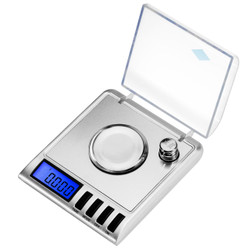
The best digital scale for gold and silver should combine the right readability, capacity, repeatability, calibration options, and weighing units for the precious metals you actually handle.
For many jewelry makers, collectors, hobbyists, repair professionals, and precious-metal enthusiasts, a 0.01g digital scale provides a useful balance between precision and practical capacity. Tiny gold fragments, findings, or very small components may benefit from 0.001g readability, while larger silver pieces and bulk scrap lots may require more capacity even if that means using 0.1g readability.
American Weigh Scales offers compact pocket scales designed for precision weighing across jewelry, coins, precious metals, crafts, and other small-object applications.
The right scale is not simply the model with the most decimal places. This guide explains how to choose a digital scale for gold and silver based on readability, capacity, calibration, tare, platform size, repeatability, minimum usable load, and units such as grams, pennyweight, and troy ounces.
Why Gold and Silver Need a Precision Scale
Precious metals can carry significant value in relatively small amounts.
A whole-gram household scale may be adequate for some large objects, but it can hide differences that matter when weighing:
-
Gold rings
-
Gold chains
-
Silver jewelry
-
Earrings
-
Pendants
-
Bracelets
-
Precious-metal findings
-
Small gold fragments
-
Silver scrap
-
Coins and rounds
-
Jewelry-making materials
-
Metal samples
-
Finished pieces
A precision scale provides more detailed measurements and makes it easier to document weights consistently.
Quick Guide: What Scale Do You Need?
| Gold or silver application | Suggested capacity | Suggested readability |
|---|---|---|
| Gold rings and earrings | 100–250g | 0.01g |
| Gold chains and pendants | 200–500g | 0.01g |
| Silver jewelry | 200–500g+ | 0.01g |
| Tiny gold findings | 20–100g | 0.001g |
| Small precious-metal fragments | 20–100g | 0.001g |
| Coins and small rounds | 200–500g | 0.01g |
| Multiple jewelry pieces | 500–1,000g | 0.01g |
| Scrap gold lots | 500–2,000g+ | 0.01g or 0.1g |
| Scrap silver lots | 1,000g+ | 0.1g or suitable higher-capacity scale |
These are general starting points. Always compare them with the specifications of the individual scale and your actual load range.
Is 0.01g Accurate Enough for Gold and Silver?
For many everyday precious-metal applications, 0.01g readability is a strong general-purpose choice.
A 0.01g scale displays hundredths of a gram:
-
3.24g
-
18.57g
-
42.09g
-
156.31g
This level of detail can be useful for individual pieces of gold and silver jewelry, coins, findings, and small scrap lots.
AWS explains this common specification in What Does 500g x 0.01g Mean on a Digital Scale?.
A specification of 500g x 0.01g means the scale supports a maximum load of 500 grams and displays changes in 0.01-gram increments.
Readability, however, is not identical to accuracy. Always evaluate the manufacturer's stated tolerance and intended operating range.
When Do You Need 0.001g?
A 0.001g scale displays weight to one milligram.
This finer readability may be useful for:
-
Tiny gold fragments
-
Small precious-metal findings
-
Lightweight components
-
Very small samples
-
Detailed jewelry-making tasks
The tradeoff is that milligram scales are generally more sensitive to:
-
Air movement
-
Vibration
-
Static
-
Temperature
-
Surface instability
They also tend to have lower capacity.
For more detail, see the AWS guide to 0.001g milligram scales.
When Is 0.1g Enough?
A 0.1g scale displays tenths of a gram.
It can be practical for:
-
Large silver pieces
-
Heavy jewelry
-
Bulk scrap silver
-
Larger scrap-gold lots
-
Jewelry-making materials
-
Applications where hundredths of a gram are not meaningful
The advantage is that coarser-resolution scales can often provide much greater capacity.
If you routinely weigh kilograms of silver, capacity may matter more than 0.01g readability.
Gold Scale Capacity: How Much Do You Need?
Capacity is the maximum total load the scale can support.
For individual gold jewelry, relatively modest capacities often work well.
100g Capacity
Useful for:
-
Rings
-
Earrings
-
Small pendants
-
Tiny chains
-
Findings
-
Small gold samples
200g to 250g Capacity
Provides more flexibility for:
-
Rings
-
Earrings
-
Pendants
-
Chains
-
Bracelets
-
Multiple small pieces
-
Coins
500g Capacity
Useful for:
-
Heavy chains
-
Watches
-
Multiple jewelry pieces
-
Larger trays
-
Small scrap lots
The AWS comparison of 200g vs. 500g pocket scales explains why the right choice depends on both the heaviest item and the container used during weighing.
Silver Scale Capacity: Why You May Need More
Silver jewelry and silver objects can be larger and heavier than many small gold pieces.
A silver-focused scale may need:
-
500g
-
1,000g
-
2,000g
-
Or greater capacity
depending on the application.
For individual silver rings, earrings, and small pendants, a 200g or 500g precision scale may be sufficient.
For grouped silver jewelry, flatware, large decorative pieces, or scrap lots, a higher-capacity scale may be more appropriate.
Do not sacrifice necessary capacity simply to gain another decimal place.
Always Include the Container in Capacity
Tare can make a container disappear from the display, but it does not remove the container's physical weight.
Suppose:
-
Tray = 80g
-
Silver jewelry = 390g
-
Total physical load = 470g
A 500g scale can support this example.
A 400g scale cannot, even after you press tare.
Always calculate capacity using:
container + precious metal = total load
Then leave additional headroom.
What Is Tare and Why Does It Matter?
Tare allows you to subtract the displayed weight of a container.
For gold and silver, tare is useful when weighing:
-
Scrap-metal cups
-
Jewelry trays
-
Findings
-
Chains
-
Multiple small pieces
-
Coins
-
Components
To use tare:
-
Put the empty container on the scale.
-
Wait for a stable reading.
-
Press tare.
-
Confirm zero.
-
Add the gold or silver.
-
Record the net weight.
Again, the container still counts toward maximum capacity.
Which Units Should a Gold and Silver Scale Have?
Useful units can include:
-
Grams (g)
-
Pennyweight (dwt)
-
Troy ounces (ozt)
-
Ounces (oz)
-
Grains (gn)
-
Carats (ct)
Not every user needs every unit.
Grams for Gold and Silver
Grams are broadly useful for:
-
Jewelry
-
Coins
-
Scrap
-
Findings
-
Components
-
Inventory
-
Jewelry making
-
Repairs
For many users, grams are the simplest default unit.
NIST provides an official reference for SI units of mass, including grams and milligrams.
Pennyweight for Precious Metals
Pennyweight is abbreviated dwt.
It remains common in parts of the jewelry and precious-metal trade.
A scale with direct dwt mode can be convenient if your workflow already uses pennyweight.
Direct display reduces the need to manually convert from grams.
Troy Ounces for Gold and Silver
Precious metals are commonly associated with the troy-ounce system.
A troy ounce is not the same as the ordinary avoirdupois ounce used for many household goods. NIST's SI units and measurement resources provide standardized measurement references.
If your workflow uses troy ounces, select a scale with ozt mode and verify the unit symbol before recording a measurement.
Never assume that “oz” and “ozt” mean the same thing.
Carats vs. Karats
These terms are easy to confuse.
Carat (ct) is a unit of mass used for diamonds and gemstones.
The Gemological Institute of America states that one metric carat equals 0.2 gram, or 200 milligrams.
Karat (K) refers to gold purity.
For example:
-
24K
-
18K
-
14K
-
10K
A scale measures mass. It does not determine gold purity merely by weighing the object.
Testing purity requires other appropriate methods.
Readability vs. Accuracy
This is one of the most important distinctions in scale shopping.
Readability
Readability is the smallest increment shown on the display.
Examples:
-
0.1g
-
0.01g
-
0.001g
Accuracy
Accuracy concerns how close the result is to the relevant reference value within the instrument's specified performance.
A display with three decimal places does not automatically guarantee ±0.001g accuracy.
Consider:
-
Manufacturer tolerance
-
Calibration
-
Repeatability
-
Minimum load
-
Environment
-
Load placement
-
Condition of the scale
before deciding whether a model is suitable.
Repeatability
Repeatability is the ability to produce similar results when the same object is measured repeatedly under similar conditions.
A simple repeatability test:
-
Put the scale on a hard, stable surface.
-
Confirm zero.
-
Place an appropriate reference mass in the center.
-
Record the reading.
-
Remove it.
-
Wait for zero.
-
Repeat several times.
If readings change significantly, investigate the environment and scale condition.
AWS covers common causes in Why Does My Digital Scale Give Different Readings?.
Minimum Usable Load
The smallest displayed increment does not automatically equal the smallest sample the scale can reliably measure.
A scale displaying 0.01g should not be assumed to measure a 0.01g fragment reliably simply because that value appears on the display.
For extremely light precious-metal fragments, compare:
-
Minimum usable load
-
Manufacturer tolerance
-
Repeatability
-
Intended operating range
A lower-capacity 0.001g scale may be better for very small samples.
Calibration
Calibration is essential for precision weighing. The BIPM SI Brochure provides the international framework for SI measurement units.
It compares the scale's response against a known reference mass according to the manufacturer's procedure.
Calibration is not the same as:
-
Pressing tare
-
Zeroing
-
Restarting the scale
Before buying, check:
-
Whether user calibration is supported
-
Required calibration mass
-
Whether the weight is included
-
Calibration procedure
-
Recommended calibration conditions
AWS provides a detailed walkthrough in How to Calibrate a Digital Scale for Accurate Results.
When Should You Check Calibration?
Check scale performance:
-
After transportation
-
After a drop
-
After accidental overload
-
After long storage
-
After a large temperature change
-
When a known reference reads unexpectedly
-
When repeatability deteriorates
-
When the scale is moved to a different work environment
Follow the manufacturer's specific instructions.
Platform Size
Platform size becomes important with chains, bracelets, watches, and grouped pieces.
The entire load must be supported by the scale.
If a gold chain hangs over the platform and touches the counter, part of its weight is supported by the counter.
The result can be incorrect.
Use a lightweight tray when necessary, but ensure:
-
The tray fits completely on the platform
-
It does not touch the scale housing
-
It remains below capacity when loaded
-
The display remains visible
Drafts and Air Movement
Fine-resolution scales can react to moving air.
Avoid weighing near:
-
Fans
-
HVAC vents
-
Open windows
-
Doors
-
Strong air currents
For 0.001g measurements, a draft shield can be particularly helpful.
Vibration
Vibration can cause unstable readings.
Avoid placing the scale on:
-
Wobbly tables
-
Shared workbenches with machinery
-
Surfaces affected by foot traffic
-
Flexible shelves
Use a rigid, stable surface.
Temperature
Allow a scale to acclimate when moving between significantly different temperatures.
A scale brought from a hot vehicle into an air-conditioned shop may need time to stabilize before precise measurements.
For critical measurements, calibrate and operate the scale under stable conditions.
Static Electricity
Static can influence very lightweight materials and fine-resolution scales.
It may become noticeable when using:
-
Plastic trays
-
Synthetic materials
-
Very small metal fragments
-
Milligram scales
If the final digits remain unstable despite eliminating drafts and vibration, static is another factor to investigate.
Pocket Scale vs. Bench Scale for Gold and Silver
Pocket Scale
Best when you need:
-
Portability
-
Compact storage
-
0.01g readability
-
Small to moderate capacity
-
Jewelry and coin weighing
-
Protective cover
Bench Scale
Better when you need:
-
Larger platform
-
Greater capacity
-
Larger scrap lots
-
Bigger silver pieces
-
Permanent workstation use
For many jewelry users, a pocket scale handles everyday pieces while a larger bench scale covers bulk material.
Pocket Scale vs. Milligram Scale
Choose a pocket scale for:
-
Finished gold jewelry
-
Finished silver jewelry
-
Coins
-
Rings
-
Chains
-
Bracelets
-
Portable work
Choose a milligram scale for:
-
Tiny gold fragments
-
Very small findings
-
Micro-components
-
Fine low-range measurements
A two-scale setup can be more practical than forcing one instrument to cover every load.
Best Digital Scale for Gold Rings
For gold rings, a scale with:
-
100–250g capacity
-
0.01g readability
-
Tare
-
Grams
-
Easy calibration
-
Protective cover
is a practical general setup.
If you work with tiny ring components, a separate 0.001g scale may be useful.
Best Digital Scale for Gold Chains
Chains vary significantly in weight.
For delicate chains, 100g or 200g capacity may be enough.
For heavy chains, consider 500g or more.
Platform size is important. Use a tray if the chain would otherwise touch the counter.
Best Digital Scale for Silver Jewelry
For individual silver jewelry pieces, consider:
-
200–500g+ capacity
-
0.01g readability
-
Tare
-
Grams
-
Optional dwt/ozt modes
For larger silver pieces or grouped lots, choose greater capacity.
Best Digital Scale for Scrap Gold
Scrap gold can range from tiny fragments to grouped lots.
A useful setup may include:
-
0.001g scale for tiny fragments
-
0.01g scale for general scrap pieces
-
Higher-capacity scale for larger lots
Choose based on the actual size of your batches.
Best Digital Scale for Scrap Silver
Silver scrap can become heavy quickly.
A 500g pocket scale may work for small lots, but larger quantities may require:
-
1,000g
-
2,000g
-
5,000g
-
Or greater capacity
For larger batches, prioritize sufficient capacity and a stable platform.
Best Scale for Gold Coins and Silver Coins
Coins are well suited to compact precision scales because they are generally small, rigid, and easy to center.
For individual coins and small groups, 0.01g readability with 200–500g capacity can be useful.
When verifying a coin, remember that weight is only one characteristic. Dimensions, composition, condition, and authenticity may require additional evaluation.
How to Weigh Gold or Silver Correctly
-
Put the scale on a hard, level surface.
-
Keep it away from drafts.
-
Turn it on with an empty platform.
-
Allow it to stabilize.
-
Confirm the correct unit.
-
Add a tray if necessary.
-
Press tare.
-
Confirm zero.
-
Place the gold or silver in the center.
-
Make sure nothing touches the counter.
-
Wait for a stable reading.
-
Record the result.
-
Remove the item.
-
Confirm the scale returns to zero.
-
Repeat when additional confidence is needed.
Can a Scale Tell You If Gold Is Real?
No.
Weight can be one piece of information, but a digital scale alone cannot determine whether an object is genuine gold or identify its exact purity.
Two objects can have similar weights while being made from different materials.
Gold authentication may involve:
-
Dimensions
-
Density
-
Hallmarks
-
Professional testing
-
XRF analysis
-
Other appropriate methods
Do not use scale weight alone as proof of authenticity.
Can a Scale Tell You If Silver Is Real?
Not by itself.
Weight may help compare an object with expected specifications, but it does not independently prove composition or purity.
Professional precious-metal evaluation may require additional testing.
Legal-for-Trade Requirements
This section is particularly important for gold and silver buyers.
A scale used for:
-
Personal collecting
-
Jewelry making
-
Internal inventory
-
Hobby measurements
is not automatically suitable for determining how much money a customer receives or pays.
The current NIST Handbook 44, 2026 edition contains specifications, tolerances, and technical requirements for commercial weighing and measuring devices and is adopted by many state, local, and some federal weights-and-measures authorities.
If you buy gold or silver from customers based on weight, verify:
-
State requirements
-
Local weights-and-measures rules
-
Device certification
-
Inspection requirements
-
Applicable scale class
-
Legal-for-trade status
Do not assume that a scale marketed for jewelry or precious metals is automatically approved for commercial transactions. The NIST Weighing and Scales FAQ provides additional guidance for commercial scale users.
Gold and Silver Scale Buying Checklist
Before purchasing, ask:
-
What is the lightest item I will weigh?
-
What is the heaviest item?
-
Will I weigh multiple pieces together?
-
Will I use a tray?
-
How much capacity does the tray consume?
-
Do I need 0.1g, 0.01g, or 0.001g?
-
What tolerance does the manufacturer specify?
-
What is the minimum usable load?
-
Does the scale have tare?
-
Does it support grams?
-
Does it support pennyweight?
-
Does it support troy ounces?
-
Is the platform large enough?
-
How is the scale calibrated?
-
What calibration weight is required?
-
Do I need a protective cover?
-
Will I travel with the scale?
-
Do I need a draft shield?
-
Is the display easy to read?
-
Is the scale for internal use or a commercial transaction?
Common Mistakes When Buying a Gold or Silver Scale
Mistake 1: Buying by Decimal Places Alone
More decimals do not automatically mean better accuracy.
Mistake 2: Ignoring Capacity
Silver and grouped jewelry can exceed small-scale capacities quickly.
Mistake 3: Forgetting the Tray
Tare does not eliminate physical load.
Mistake 4: Confusing Ounces With Troy Ounces
Check the unit symbol carefully.
Mistake 5: Confusing Carat With Karat
Carat measures gemstone mass. Karat refers to gold purity.
Mistake 6: Using Random Objects for Calibration
Use the manufacturer's specified calibration mass.
Mistake 7: Weighing on an Unstable Surface
Precision scales require rigid support.
Mistake 8: Letting Chains Touch the Counter
The scale must support the complete load.
Mistake 9: Assuming Weight Proves Authenticity
A scale does not identify metal composition.
Mistake 10: Assuming Every Gold Scale Is Legal for Trade
Commercial transactions based on weight may require approved equipment.
Frequently Asked Questions
What is the best digital scale for gold and silver?
For many general jewelry and precious-metal applications, a 0.01g scale with enough capacity for the heaviest complete load is a practical choice. Tiny fragments may require 0.001g, while larger silver lots may require a higher-capacity scale.
Is 0.01g accurate enough for weighing gold?
A quality 0.01g scale can be useful for many gold jewelry and general precious-metal applications. Whether it meets a specific accuracy requirement depends on the model's stated tolerance, calibration, load range, and operating conditions.
Do I need 0.001g for gold?
Not for most finished jewelry. It is more useful for tiny fragments, findings, and very small components.
What capacity is best for gold jewelry?
Around 100–500g can cover many individual gold jewelry pieces. Heavy chains, multiple items, or trays may require more.
What capacity is best for silver?
Silver pieces can be heavier, so 500g or more may be useful. Large scrap lots may require capacities of several kilograms.
What does 500g x 0.01g mean?
It means the scale supports a maximum load of 500 grams and displays readings in 0.01-gram increments.
Should a gold scale have pennyweight?
If your workflow uses dwt, direct pennyweight mode is convenient. It is not necessary for everyone.
Should a gold scale have troy ounces?
Troy-ounce mode is useful for precious-metal workflows that use ozt. Always verify the displayed unit.
How many grams are in one carat?
One metric carat equals 0.2 gram, or 200 milligrams. GIA notes that precision is important because fractions of a carat can affect gemstone value.
Is karat a unit of weight?
No. Karat describes gold purity. Carat is a unit of gemstone mass.
Can I weigh gold with a kitchen scale?
A kitchen scale may be too coarse for small gold jewelry because many display only whole grams or tenths of a gram.
Can I use a pocket scale for gold?
Yes. A suitable pocket scale with 0.01g readability can be practical for many rings, chains, coins, and small precious-metal pieces.
How do I calibrate a gold scale?
Follow the manufacturer's procedure using the specified calibration mass. Do not substitute coins or random household objects.
Why does my gold scale give different readings?
Possible causes include drafts, vibration, weak batteries, temperature changes, static, unstable surfaces, contamination, off-center loading, overload, or calibration problems.
Can a digital scale test gold purity?
No. A scale measures mass; it does not independently determine gold purity.
Can I use any digital scale to buy scrap gold?
No. If payment is based on weight, legal-for-trade requirements may apply. Check your state and local weights-and-measures rules.
Final Verdict: Choosing the Best Digital Scale for Gold and Silver
For most individual gold and silver jewelry, 0.01g readability is an excellent starting point.
Pair that readability with enough capacity for your actual workload:
-
100–250g: rings, earrings, pendants, small chains, individual coins
-
500g: heavier chains, bracelets, watches, multiple pieces, small scrap lots
-
1,000g and above: larger silver items, grouped jewelry, and heavier scrap batches
Choose 0.001g when tiny fragments or components genuinely require milligram-level readability.
Choose 0.1g or another suitable higher-capacity format when weighing larger precious-metal batches where capacity is more important than hundredth-of-a-gram detail.
Then evaluate the features that support reliable use:
-
Calibration
-
Repeatability
-
Tare
-
Minimum usable load
-
Platform size
-
Grams
-
Pennyweight
-
Troy ounces
-
Stable display
-
Protective cover
-
Appropriate power source
-
Legal-for-trade approval when required
American Weigh Scales offers compact precision scales for jewelry, coins, precious metals, and related applications. Match the scale to the smallest meaningful measurement and the heaviest complete load rather than choosing solely by price or decimal places.
The best gold and silver scale is the one whose capacity, readability, calibration, and operating range fit the work you actually perform.