
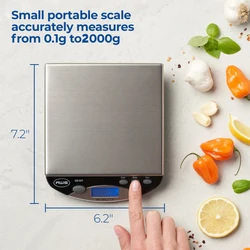
The best digital scale for sourdough is not necessarily the scale with
the most decimal places. Sourdough baking involves several very
different measurement jobs: feeding a starter, weighing flour and water,
measuring salt, building a levain, portioning dough, and sometimes
comparing small experimental formulas.
That means the ideal scale depends on what you want it to do.
For a baker who wants one scale for nearly everything, a high-capacity
digital kitchen scale with at least 5kg capacity and 1g readability
can handle starter, flour, water, bowls, and complete dough batches.
For bakers who want more control over small ingredients, a second
200--500g precision scale with 0.1g readability is an excellent
companion. It is particularly useful for salt, small starter
experiments, hybrid formulas using commercial yeast, spices, and other
low-mass ingredients.
King Arthur Baking specifically recommends weighing ingredients when
maintaining and baking with sourdough because starter volume changes
depending on its consistency and whether it has been stirred down. Its
sourdough starter instructions use gram-based feeding quantities such as
50g starter and 50g water. King Arthur Baking's sourdough starter
guide
therefore provides a useful real-world example of why a digital scale
belongs in a sourdough setup.
American Weigh Scales offers pocket
scales that can complement a
larger kitchen scale when finer measurements are needed.
Quick Answer: What Is the Best Digital Scale for Sourdough?
For most sourdough bakers, the best setup is:
Sourdough task Recommended capacity Recommended readability
Starter feeding 1--3kg+ 1g
Levain building 1--3kg+ 1g
Flour and water 5kg+ 1g
Complete dough 5kg+ 1g
Dough division 5kg+ 1g
Salt 200--500g 0.1g
Tiny test batches 200--500g 0.1g
Hybrid yeast formulas 200--500g 0.1g
Specialized sub-gram experiments 100--200g 0.01g
If you want one scale, prioritize capacity and platform size.
If you want the most versatile sourdough setup, use one larger
kitchen scale and one compact precision scale.
Why Sourdough Bakers Need a Scale
Sourdough is particularly well suited to weight-based baking.
Starter consistency changes. Flour packs differently depending on how it
is scooped. A cup of active starter can occupy a different volume from
the same mass of stirred-down starter.
King Arthur Baking says weighing ingredients is the most accurate and
consistent approach for sourdough starter and specifically notes that
starter volume varies with consistency and whether it has been stirred.
That makes mass measurement especially valuable for starter maintenance.
A scale also simplifies baker's percentages, hydration calculations,
levain builds, recipe scaling, and dough division.
The Five Main Jobs of a Sourdough Scale
A sourdough scale may need to handle:
-
Starter maintenance
-
Levain builds
-
Main dough ingredients
-
Small ingredients such as salt
-
Dough portioning
The ideal specifications differ for each job.
1. Starter Maintenance
A typical starter feeding may involve tens or hundreds of grams rather
than tiny fractions of a gram.
For example:
-
50g starter
-
50g water
-
50g flour
A 1g kitchen scale can handle this easily.
The bigger issue is container weight. A glass jar may weigh several
hundred grams before any starter is added.
That is why capacity matters.
2. Levain Builds
A levain may contain:
-
A small amount of mature starter
-
Flour
-
Water
Again, whole-gram readability is generally sufficient for ordinary
builds.
The container and total levain mass determine the required capacity.
3. Main Dough Ingredients
A typical loaf may contain hundreds of grams of flour and water.
A two-loaf batch can easily exceed 1kg before the bowl is included.
For this reason, a main sourdough scale should usually have several
kilograms of capacity.
4. Salt and Small Ingredients
Salt is where finer readability can become useful.
If a small experimental dough uses only a few grams of salt, 0.1g
readability allows more detailed adjustments.
A compact precision scale can also be useful for:
-
Spices
-
Malt
-
Dough conditioners
-
Commercial yeast in hybrid formulas
-
Tiny starter experiments
5. Dough Portioning
If you make multiple loaves, rolls, buns, or pizza dough balls, the
scale needs enough capacity for the total dough portion being weighed.
A large, stable platform is more important here than ultra-fine
resolution.
What Capacity Do You Need for Sourdough?
Capacity is the maximum total load the scale is designed to support.
The total includes:
-
Bowl
-
Jar
-
Container
-
Ingredients
If your mixing bowl weighs 1,200g and your dough weighs 1,800g, the
scale is supporting 3,000g.
A 2kg scale cannot handle that setup.
Is 500g Enough?
A 500g scale is excellent for precision work but usually too small to be
the only sourdough scale.
It can handle:
-
Salt
-
Small levain builds
-
Small starter feeds
-
Spices
-
Tiny test formulas
It generally cannot handle a large starter jar, mixing bowl, or full
dough batch.
AWS explains capacity and displayed increments in What Does 500g x
0.01g Mean on a Digital
Scale?.
Is 1kg Enough?
One kilogram can work for:
-
Starter maintenance
-
Small levain builds
-
Small dough ingredients
But it can become restrictive once a heavy bowl or jar is involved.
For an all-purpose sourdough scale, more headroom is usually preferable.
Is 3kg Enough?
A 3kg scale can cover many home sourdough workflows, especially with
lightweight bowls.
It can handle:
-
Starter
-
Levain
-
Flour
-
Water
-
Many single-loaf doughs
However, larger batches or heavy bowls can approach the limit.
Why 5kg Is a Strong General Target
For a main sourdough scale, 5kg capacity is a practical target.
It provides room for:
-
Heavy mixing bowls
-
Large flour quantities
-
Water
-
Complete dough
-
Multiple-loaf batches
If you regularly bake very large batches, consider even more capacity.
Leave Capacity Headroom
Do not plan to operate at maximum capacity every time.
Suppose:
-
Scale capacity: 3,000g
-
Bowl: 1,000g
-
Dough: 1,900g
-
Total: 2,900g
The load fits, but there is very little headroom.
A 5kg scale would provide a more comfortable working range.
Tare Does Not Increase Capacity
Tare is essential for sourdough, but it does not remove physical load.
Suppose your bowl weighs 1,000g.
You place it on a 5kg scale and press tare.
The display returns to zero, but the scale is still supporting 1,000g.
You have approximately 4kg of physical capacity remaining, not 5kg.
Why Tare Is Essential for Sourdough
Tare lets you add ingredients directly into a bowl.
Example:
-
Put the bowl on the scale.
-
Press tare.
-
Add flour.
-
Press tare.
-
Add water.
-
Press tare.
-
Add starter.
This reduces separate measuring containers and simplifies cleanup.
What Readability Do You Need?
Readability is the smallest increment displayed.
Common options include:
-
1g
-
0.1g
-
0.01g
-
0.001g
For most sourdough ingredients, 1g is enough.
For small ingredients and experiments, 0.1g is useful.
Is 1g Readability Enough for Sourdough?
For the main dough, usually yes.
Consider:
-
500g flour
-
350g water
-
100g starter
-
10g salt
A 1g scale represents these major ingredients well.
It also aligns naturally with many gram-based sourdough recipes.
When 0.1g Is Better
Choose 0.1g for:
-
Salt in small doughs
-
Tiny starter experiments
-
Hybrid commercial-yeast formulas
-
Small additions
-
Recipe-development work
AWS discusses practical precision selection in its Best Precision Scale
for Baking
Yeast
guide, which is relevant to hybrid sourdough formulas and other low-mass
ingredients.
Do You Need 0.01g for Sourdough?
Most sourdough bakers do not.
Hundredth-of-a-gram resolution may be useful for specialized
experiments, but normal starter, flour, water, and salt quantities do
not require it.
A 0.01g scale can also be more sensitive to airflow and vibration.
Do You Need 0.001g?
No for ordinary sourdough baking.
Milligram resolution adds complexity without providing a meaningful
advantage for normal bread formulas.
Readability vs. Accuracy
Readability is the smallest displayed increment.
Accuracy concerns how closely the scale's indication agrees with an
appropriate reference within its specified performance.
Repeatability concerns whether repeated measurements of the same stable
load produce consistent results.
More decimal places do not automatically mean greater real-world
accuracy.
Repeatability Matters
Repeatability is important when you want to reproduce the same loaf.
A simple check is:
-
Zero the scale.
-
Place the same stable object on it.
-
Record the reading.
-
Remove it.
-
Let the scale return to zero.
-
Repeat.
Unexpected variation can come from the setup rather than the scale
itself.
AWS discusses common causes in Why Does My Digital Scale Give Different
Readings?.
Stable Zero
Before weighing ingredients, the display should return predictably to
zero.
If it does not, check:
-
Surface stability
-
Battery condition
-
Debris
-
Bowl contact
-
Airflow
-
Calibration
Stable zero is especially useful when repeatedly taring during a dough
mix.
Calibration
A digital scale should have clear instructions for calibration or
performance checking.
AWS provides a practical overview in How to Calibrate a Digital Scale
for Accurate
Results.
NIST's Calibration of Mass
Standards
explains the broader metrology principle that calibrating a weight
establishes a mass value and an appropriate uncertainty using suitable
standards.
For a consumer kitchen scale, follow the manufacturer's procedure and
specified reference mass.
Do Not Calibrate With Food
Do not use:
-
Flour
-
Starter
-
Bread
-
Coins
-
Packaged foods
-
Measuring cups
as improvised calibration standards.
Use the reference specified by the manufacturer.
NIST's Standards for Laboratory
Weights
provides additional context on reference weights used in analytical
measurement.
Why Grams Are Ideal for Sourdough
Grams make sourdough formulas easy to calculate and scale.
NIST's SI Units -- Mass
explains the SI framework for mass and gram-based decimal quantities.
For baking, grams eliminate much of the complexity created by cups,
tablespoons, fractions, and ingredient-specific volume conversions.
Baker's Percentage
Baker's percentage expresses each ingredient relative to flour mass.
Flour is always:
100%
Suppose:
-
Flour: 500g
-
Water: 350g
-
Starter: 100g
-
Salt: 10g
If you are using a simple formula convention where water is compared
with the listed flour mass:
350 ÷ 500 × 100 = 70%
Baker's percentages make formulas easy to scale.
More advanced sourdough calculations may account for the flour and water
contained inside the starter when determining total dough hydration.
Why a Scale Helps With Starter Ratios
Starter feeding ratios are easy to manage by mass.
For a simple equal-mass feeding:
-
50g starter
-
50g water
-
50g flour
For a larger feeding, the same relationship can be scaled without
converting cups or spoon measurements.
King Arthur Baking recommends weighing sourdough starter ingredients
because starter volume can vary substantially depending on consistency
and aeration.
Starter Jar Capacity
When choosing a scale for starter maintenance, weigh the jar itself.
Example:
-
Glass jar: 450g
-
Starter: 50g
-
Water: 50g
-
Flour: 50g
-
Total: 600g
A 500g scale cannot support this complete setup.
A 1kg or larger scale is a better choice.
Heavy Jar Example
Suppose:
-
Jar: 800g
-
Starter and feed: 300g
-
Total: 1,100g
Now even a 1kg scale is insufficient.
This is why sourdough bakers should choose capacity based on the gross
load, not just ingredient quantities.
Mixing Bowl Capacity
The same logic applies to dough.
Example:
-
Bowl: 1,200g
-
Flour: 1,000g
-
Water: 700g
-
Starter: 200g
-
Salt: 20g
-
Total: 3,120g
A 5kg scale handles this comfortably.
Platform Size
Platform size matters more for sourdough than it does for
tiny-ingredient weighing.
The scale should support:
-
Starter jars
-
Mixing bowls
-
Dough containers
-
Bannetons or trays when appropriate
A bowl should sit securely without touching the countertop.
Display Visibility
Large bowls can hide a scale's display.
Look for:
-
Forward-positioned display
-
Bright backlight
-
Large digits
-
Good viewing angle
A technically excellent scale becomes frustrating if the bowl blocks the
numbers.
Response Speed
A sourdough scale should respond promptly as flour or water is added.
You do not need espresso-scale speed, but excessive lag can cause you to
overshoot ingredient targets.
Auto-Off
Very short auto-off times can be frustrating during sourdough
preparation.
You may pause to:
-
Mix starter
-
Open flour
-
Calculate a percentage
-
Prepare another ingredient
A scale that stays active long enough for the workflow is more
convenient.
Power Source
Battery-powered scales are easy to move and store.
Rechargeable models can be convenient for frequent bakers.
The best choice depends on your kitchen setup rather than measurement
quality alone.
Easy Cleaning
Sourdough can be messy.
Flour dust, wet dough, starter, and water can reach the scale.
Look for:
-
Easy-to-wipe surfaces
-
Minimal crevices
-
Removable protective mats when available
-
A platform that is easy to access
Avoid allowing dough or dried starter to interfere with platform
movement.
Splash Resistance
A degree of splash resistance can be valuable because water and wet
starter are frequently handled near the scale.
Do not assume a scale is waterproof unless the manufacturer specifically
says so.
Best Scale for Sourdough Starter
For starter maintenance alone, prioritize:
-
1kg+ capacity
-
1g readability
-
Tare
-
Stable zero
-
Jar-friendly platform
-
Clear display
If you use a heavy crock or jar, consider 2--3kg capacity.
Best Scale for Sourdough Bread
For complete bread making, prioritize:
-
5kg+ capacity
-
1g readability
-
Large platform
-
Tare
-
Clear display
-
Good response
-
Easy cleaning
This handles the ingredients that account for most of the dough mass.
Best Precision Scale for Sourdough
A precision companion scale should prioritize:
-
200--500g capacity
-
0.1g readability
-
Tare
-
Calibration
-
Stable zero
-
Compact design
-
Protective cover
Use it for salt, spices, hybrid yeast formulas, and experiments.
Best Scale for Sourdough Pizza
Sourdough pizza often involves:
-
Starter or levain
-
Flour
-
Water
-
Salt
-
Individual dough-ball portioning
A 5kg kitchen scale is ideal for the main formula and dough division.
A 0.1g precision scale is useful if you add tiny quantities of
commercial yeast or make small formula experiments.
Best Scale for Small-Batch Sourdough
For very small test loaves, a 1--3kg scale with 0.1g readability can be
particularly useful.
It provides enough capacity for the dough while giving finer information
for salt and other small ingredients.
Best Scale for Large-Batch Sourdough
For multiple loaves, prioritize capacity.
A 5kg scale may be sufficient for many home batches, but very large
dough mixes may require more.
Always include the bowl in the capacity calculation.
Kitchen Scale vs. Pocket Scale
A kitchen scale is best for:
-
Starter jars
-
Flour
-
Water
-
Mixing bowls
-
Dough
-
Dough division
A pocket precision scale is best for:
-
Salt
-
Spices
-
Tiny starter tests
-
Hybrid yeast formulas
-
Small additions
AWS's Pocket Scale vs. Kitchen
Scale
guide explains why these formats serve different measurement ranges.
The Best Two-Scale Sourdough Setup
For serious sourdough baking, a two-scale setup is extremely practical.
Main Scale
5kg+ x 1g
Use for:
-
Starter
-
Levain
-
Flour
-
Water
-
Bowls
-
Complete dough
-
Portioning
Precision Scale
200--500g x 0.1g
Use for:
-
Salt
-
Spices
-
Small additives
-
Hybrid yeast
-
Formula testing
Each scale does the job it is best suited to.
Can One Scale Do Everything?
Yes, especially if you choose:
-
3--5kg+ capacity
-
0.1g readability
-
Large enough platform
-
Good tare function
This can cover a wide range of sourdough measurements.
However, scales combining high capacity with very fine readability may
cost more, and a small precision scale can still be more convenient for
tiny ingredients.
1g vs. 0.1g for Sourdough
Choose 1g if:
-
You mainly weigh starter, flour, water, and dough
-
You want high capacity
-
You bake standard home-size loaves
-
You want one simple kitchen scale
Choose 0.1g if:
-
You make small test batches
-
You want finer salt measurements
-
You use hybrid formulas
-
You develop recipes
-
You want a precision companion scale
0.1g vs. 0.01g
Choose 0.1g for most precision sourdough tasks.
Choose 0.01g only when you routinely work with quantities below 1g
or conduct specialized experiments.
For ordinary sourdough, 0.01g is usually unnecessary.
3kg vs. 5kg
Choose 3kg if:
-
You make small single loaves
-
Your bowls are lightweight
-
Compact size matters
Choose 5kg if:
-
You use heavy bowls
-
You bake multiple loaves
-
You want more headroom
-
You portion larger dough batches
For a general sourdough scale, 5kg is the safer recommendation.
5kg vs. 10kg
Choose 5kg for most home sourdough baking.
Consider 10kg if you:
-
Make very large batches
-
Use heavy commercial-style containers
-
Regularly divide multiple loaves from one dough mass
Do not buy extra capacity solely for the specification. Match it to your
actual workflow.
How to Weigh a Sourdough Starter Feeding
-
Place the starter jar on the scale.
-
Tare.
-
Add or retain the target starter quantity.
-
Tare if your workflow calls for it.
-
Add water by mass.
-
Tare.
-
Add flour by mass.
-
Mix according to your starter-maintenance routine.
The exact feeding ratio depends on the method you follow.
How to Weigh a Sourdough Dough
-
Put the mixing bowl on the scale.
-
Press tare.
-
Add flour.
-
Tare.
-
Add water.
-
Tare.
-
Add starter or levain.
-
Tare.
-
Add salt.
-
Continue according to the recipe.
Some bakers prefer weighing each ingredient separately. Both approaches
can work.
How to Divide Dough Evenly
Suppose your finished dough weighs:
1,800g
You want two equal loaves.
1,800 ÷ 2 = 900g each
For three loaves:
1,800 ÷ 3 = 600g each
A digital scale makes portioning straightforward.
How to Scale a Sourdough Formula
Suppose your formula uses:
-
500g flour
-
350g water
-
100g starter
-
10g salt
To double it:
-
1,000g flour
-
700g water
-
200g starter
-
20g salt
Weight-based formulas scale cleanly without converting volume
measurements.
Why Weight Is Better for Starter Consistency
A bubbly starter contains gas pockets.
The same mass can occupy different volumes depending on fermentation
stage and how much it has been stirred.
That is one reason King Arthur Baking recommends a scale for maintaining
and baking with sourdough.
Its 2026 sourdough starter material calls a digital scale one of the
most important tools for sourdough success and emphasizes weight-based
measurement because starter volume varies with consistency and aeration.
King Arthur Baking's sourdough starter feeding
guide
likewise recommends weighing starter ingredients for consistent
measurement.
Sourdough Scale Buying Checklist
Before buying, ask:
-
Will this be my only scale?
-
How heavy is my mixing bowl?
-
How heavy is my starter jar?
-
What is my largest normal dough batch?
-
Is 3kg enough?
-
Would 5kg provide better headroom?
-
Do I ever need more than 5kg?
-
Is 1g readability sufficient?
-
Do I need 0.1g for small ingredients?
-
Do I genuinely need 0.01g?
-
Does the scale have tare?
-
Does it measure grams?
-
Is the platform large enough?
-
Will my bowl block the display?
-
Is the display backlit?
-
Does it respond quickly?
-
Is zero stable?
-
Are repeated readings consistent?
-
Can it be calibrated or checked according to manufacturer
instructions? -
Is it easy to clean?
-
Is splash resistance important?
-
Is the power source convenient?
-
Is auto-off too aggressive?
-
Do I portion dough on the scale?
-
Would a two-scale setup work better?
Common Mistakes When Buying a Sourdough Scale
Buying Too Little Capacity
A scale may handle the flour but not the flour plus the bowl.
Forgetting the Starter Jar
Heavy glass jars can consume much of a small scale's capacity.
Assuming Tare Restores Capacity
It does not.
Buying by Decimal Places Alone
Most sourdough ingredients do not need 0.01g or 0.001g resolution.
Ignoring Platform Size
A large bowl must sit securely.
Ignoring Display Position
A wide bowl can hide the numbers.
Ignoring Repeatability
Consistency matters more than impressive-looking specifications.
Calibrating With Household Objects
Follow the manufacturer's procedure.
Using an Unstable Surface
A scale needs a hard, level base.
Letting Dough Touch the Counter
If a bowl or dough container touches another surface, the reading can be
affected.
Choosing a Precision Pocket Scale as the Only Scale
A 500g model is useful for small ingredients but too restrictive for
most complete sourdough workflows.
Frequently Asked Questions
What is the best digital scale for sourdough?
For most home bakers, a 5kg+ digital kitchen scale with 1g readability
is an excellent main scale. A 200--500g x 0.1g precision scale is a
useful companion.
Is 1g accurate enough for sourdough?
For starter, flour, water, and complete dough, 1g readability is
generally sufficient for ordinary home baking.
Do I need 0.1g?
It is useful for salt, small batches, recipe development, hybrid yeast
formulas, and other small ingredients.
Do I need 0.01g?
Usually not. Consider it only for specialized sub-gram measurements.
What capacity is best?
Around 5kg is a strong general target for a main home sourdough scale.
Is 3kg enough?
It can be, especially for single loaves and lightweight bowls. Check
your actual gross loads.
Is 500g enough?
Not as an all-purpose sourdough scale. It is better as a precision
companion.
Does tare increase capacity?
No.
What is the best scale for starter feeding?
A 1kg+ scale can work well, but heavy jars may require 2--3kg or more.
Why should I weigh sourdough starter?
Starter volume changes with consistency and aeration. Weight provides a
more consistent basis for feeding ratios.
Can I weigh ingredients directly into the mixing bowl?
Yes, provided the bowl and ingredients remain within the scale's
capacity.
Should a sourdough scale be calibrated?
Follow the manufacturer's instructions for calibration and performance
checking.
Can I use coins or flour to calibrate it?
Use the reference specified by the manufacturer rather than improvised
household objects.
Is a pocket scale useful for sourdough?
Yes, as a companion scale for salt and other small ingredients.
What is the best two-scale setup?
A 5kg+ x 1g kitchen scale plus a 200--500g x 0.1g precision scale covers
most home sourdough needs.
Final Verdict: Best Digital Scale for Sourdough
The best digital scale for sourdough depends on whether you want one
scale or a complete weighing setup.
For one all-purpose scale, prioritize:
-
5kg or greater capacity
-
1g readability
-
Large platform
-
Reliable tare
-
Stable zero
-
Clear display
-
Good response
-
Easy cleaning
For a more complete setup, add:
-
200--500g capacity
-
0.1g readability
-
Calibration capability
-
Protective cover
Use the large scale for starter, levain, flour, water, bowls, complete
dough, and dough division. Use the precision scale for salt, spices,
hybrid yeast formulas, and small experiments.
King Arthur Baking explicitly recommends scale-based sourdough
measurement because starter volume can vary with consistency and
aeration, making weight a more reliable way to maintain and bake with
starter.
For most home sourdough bakers, 5kg x 1g for the main scale plus
200--500g x 0.1g for precision work is the most versatile combination.
Do not choose based on decimal places alone. Capacity, tare, platform
size, display visibility, repeatability, calibration, and real-world
workflow matter just as much.
The best sourdough scale is the one that comfortably supports your
heaviest bowl and dough while still giving you enough measurement detail
for the smallest ingredients you actually use.