
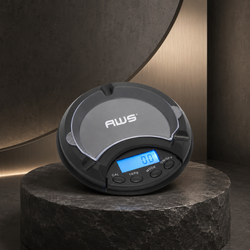
The best precision scale for herbs is not necessarily the scale with the most decimal places.
Dried herbs are lightweight, containers add to the total physical load, and very fine-resolution scales can become sensitive to environmental conditions such as airflow and vibration.
The goal is therefore to find the right combination of:
capacity + readability + repeatability + calibration + practical usability.
For many small dried-herb and seasoning applications, a useful starting range is:
100–500g capacity × 0.01g readability
For maximum versatility within that range:
500g × 0.01g
is particularly useful.
It provides enough capacity for many weighing trays and small bowls while displaying changes in hundredths of a gram.
For larger herb and seasoning batches, a:
1–5kg × 0.1g
scale may be more appropriate.
And 0.001g should generally be considered when your application genuinely requires milligram-level measurement—not simply because three decimal places appear more precise.
Quick Answer: What Features Matter Most in a Precision Herb Scale?
| Feature | What to Look For |
|---|---|
| Capacity | 100–500g for small herb work; higher for large batches |
| Readability | 0.01g for many small herb quantities |
| Accuracy | Evaluate separately from readability |
| Repeatability | Consistent readings from the same stable load |
| Minimum usable load | Important for very lightweight herbs |
| Tare | Essential for bowls and weighing trays |
| Calibration | Clear model-specific procedure |
| Platform | Large enough for your normal container |
| Display | Clear, backlit and visible with container installed |
| Stability | Stable zero under appropriate conditions |
| Environment | Protection from drafts and vibration |
| Units | Gram mode is particularly useful |
| Surface | Easy-to-maintain weighing platform |
| Power | Battery or AC depending on workflow |
If you want one compact precision scale for general dried-herb formulation, 500g × 0.01g is one of the strongest specifications to consider.
Why Herbs Benefit From a Precision Scale
Herbs are commonly measured using teaspoons, tablespoons, scoops and pinches.
That is convenient for casual cooking.
But consider a recipe containing:
Oregano = 2.40g
Basil = 1.75g
Thyme = 0.65g
Rosemary = 0.85g
Dill = 0.45g
A standard whole-gram kitchen scale cannot show much useful detail for several of these quantities.
A precision scale makes it easier to:
-
Develop recipes
-
Repeat formulations
-
Compare test batches
-
Scale recipes
-
Measure lightweight herbs
-
Standardize seasoning blends
-
Record formulations by mass
The right scale depends on how small and how large your actual measurements become.
Feature 1: Readability
Readability is one of the first specifications people notice.
A scale with:
1g readability
may display:
10g → 11g → 12g
A:
0.1g scale
may display:
10.1g → 10.2g → 10.3g
A:
0.01g scale
may display:
10.21g → 10.22g → 10.23g
And a:
0.001g scale
may display:
10.213g → 10.214g → 10.215g
AWS explains the relationship between capacity and readability in What Does 500g × 0.01g Mean on a Digital Scale?.
For many small herb quantities, 0.01g readability provides a useful balance between measurement detail and practical usability. AWS also notes that 0.01g readability does not mean every quantity from 0.01g upward is necessarily accurate or suitable to measure.
Feature 2: 0.01g vs. 0.1g
This is one of the most important decisions when choosing a precision scale for herbs.
Choose 0.1g When:
Your quantities are generally larger.
For example:
Oregano = 50.0g
Basil = 40.0g
Parsley = 35.0g
Thyme = 15.0g
Rosemary = 12.0g
At these quantities, 0.1g can provide plenty of displayed detail.
A 0.1g scale can also make it easier to obtain greater capacity.
Choose 0.01g When:
You routinely weigh ingredients below a few grams.
For example:
Thyme = 0.75g
Dill = 0.45g
Rosemary = 1.25g
Oregano = 2.35g
A 0.01g scale provides substantially more displayed detail.
This makes it useful for:
-
Small herb blends
-
Recipe development
-
Fine seasoning adjustments
-
Test batches
-
Lightweight dried herbs
For many herb-focused applications, 0.01g is the sweet spot.
Feature 3: Do You Actually Need 0.001g?
Probably not for ordinary herb recipes.
A 0.001g scale displays milligram increments.
That may sound automatically superior.
It isn't.
Fine-resolution instruments can be more sensitive to:
-
Drafts
-
Vibration
-
Static
-
Temperature changes
-
Surface movement
If your smallest meaningful quantity can comfortably be handled by a 0.01g scale, moving to 0.001g may add sensitivity without providing a useful advantage.
AWS provides a detailed comparison in 0.001g vs. 0.01g Scales: Which Precision Do You Need?.
Choose 0.001g because your measurement requirement calls for milligram readability—not because it has another decimal place.
Feature 4: Accuracy
Readability and accuracy are not interchangeable.
Suppose a digital scale displays:
5.27g
The hundredth-of-a-gram display tells you its readability.
It does not automatically guarantee that the actual mass is exactly 5.27g or that the scale is accurate to ±0.01g in every environment.
When comparing precision herb scales, evaluate available information regarding:
-
Accuracy
-
Tolerance
-
Repeatability
-
Minimum load
-
Calibration
-
Operating environment
NIST's Calibration of Mass Standards explains how reference mass standards fit into the broader U.S. measurement system. NIST currently calibrates qualifying mass standards across a wide range, from 1 mg through 50 kg in decimal subdivisions, with larger standards handled in suitable cases.
The takeaway for an herb-scale buyer is straightforward:
More digits do not automatically equal more accuracy.
Feature 5: Repeatability
Repeatability describes how consistently the same stable load produces the same result under similar conditions.
Suppose you place the same test load on a scale five times.
You might see:
10.25g
10.25g
10.25g
10.24g
10.25g
Compare that with:
10.25g
10.38g
10.11g
10.31g
10.17g
The second group would make precise recipe development much more difficult.
Repeatability matters because herb formulations are often created specifically so they can be reproduced.
If your digital scale gives different readings, see AWS's guide to Why Does My Digital Scale Give Different Readings?.
Feature 6: Minimum Usable Load
This is frequently overlooked.
Suppose a scale is labeled:
500g × 0.01g
The scale can display hundredth-of-a-gram increments.
That does not automatically establish that:
0.01g
is an appropriate minimum working quantity.
When your application involves very small herb samples, examine available manufacturer specifications regarding:
-
Minimum load
-
Accuracy
-
Repeatability
-
Tolerance
This becomes increasingly important as your ingredient quantities approach the lower end of the scale's usable measurement range.
Feature 7: Capacity
Herbs may be lightweight, but your container might not be.
Imagine:
Bowl = 150g
Herbs = 100g
Other seasonings = 100g
Total physical load:
350g
A 200g precision scale cannot support that complete load.
A 500g scale can.
Capacity should therefore be calculated using:
container + every ingredient + anything else supported by the platform
Do not choose capacity based only on the weight of the herbs.
Feature 8: Capacity Headroom
A scale should not constantly operate at its maximum capacity.
Suppose your typical total load is:
190g
A 200g scale technically accommodates it.
But you have only:
10g
of headroom.
If you switch to a slightly heavier bowl or increase your recipe, you may exceed capacity.
A 500g model would provide much greater flexibility.
For many small herb applications, this is another reason 500g capacity is so practical.
Feature 9: Tare
Tare is one of the most useful features for herb weighing.
Suppose your bowl weighs:
85.00g
Place it on the scale.
The display shows:
85.00g
Press tare.
The display becomes:
0.00g
You can now add your herbs and read their displayed mass directly.
A typical workflow is:
-
Place the empty bowl on the scale.
-
Wait for the reading to stabilize.
-
Press tare.
-
Confirm zero.
-
Add the first herb.
-
Record the measurement.
-
Tare again when appropriate.
-
Add the next ingredient.
Feature 10: Remember That Tare Does Not Restore Capacity
This is critical.
Suppose:
Scale capacity = 500g
Bowl = 150g
You press tare.
Display:
0.00g
The scale is still physically supporting 150g.
You have approximately:
350g
of nominal physical capacity remaining.
Tare changes the displayed value.
It does not magically remove the container's mass from the platform.
Feature 11: Platform Size
Precision specifications are not useful if your container barely fits on the scale.
Your bowl or tray should:
-
Sit securely
-
Be adequately supported
-
Avoid touching the countertop
-
Avoid touching another object
-
Leave the display visible
A very small pocket scale may work beautifully for tiny herb samples but become inconvenient when you begin creating complete seasoning blends.
Feature 12: Pocket Scale vs. Kitchen Scale
A precision pocket scale is particularly useful for:
-
Small herb quantities
-
Recipe development
-
Seasoning adjustments
-
Portable weighing
-
Fine ingredients
A larger kitchen or bench scale is often more appropriate for:
-
Heavy bowls
-
Large batches
-
Bulk herbs
-
Restaurant production
-
Kilogram-sized recipes
AWS compares these formats in Pocket Scale vs. Kitchen Scale: Which One Should You Buy?.
Do not focus on the marketing category alone.
Focus on the specifications.
Feature 13: Weighing Trays
A weighing tray can be especially useful with dried herbs.
Loose ingredients such as:
-
Thyme
-
Oregano
-
Dill
-
Basil
-
Parsley
-
Rosemary
can be difficult to keep contained on a small platform.
A tray provides a cleaner workflow.
Place the empty tray on the platform, tare it, and then add the herbs.
Again, remember:
the tray still counts toward maximum physical capacity.
Feature 14: Stainless-Steel Weighing Surface
Herbs and seasoning powders can leave residue.
A stainless-steel weighing surface can make routine maintenance easier.
However, the presence of stainless steel does not automatically mean the entire scale is waterproof.
Avoid allowing powders, moisture or cleaning products to enter:
-
Platform gaps
-
Buttons
-
Display seams
-
Battery compartments
Follow the manufacturer's maintenance instructions.
Feature 15: Display Quality
A precision scale should make small measurements easy to read.
Look for:
-
Backlighting
-
Large digits
-
Clear decimal placement
-
Good viewing angle
-
Display placement that remains visible with a bowl installed
When measuring small ingredients, confusing:
0.45g
with:
4.5g
is not a minor mistake.
A clear display is an important practical feature.
Feature 16: Stable Zero
Before adding herbs, the scale should settle at zero under appropriate operating conditions.
If the display continuously moves through:
0.00g
0.02g
-0.01g
0.03g
you should investigate why.
Possible causes include:
-
Airflow
-
Vibration
-
Static
-
Weak batteries
-
Temperature instability
-
Unstable surface
-
Platform interference
Do not automatically assume calibration is the answer.
Feature 17: Calibration
A precision scale should have a clear calibration or performance-check procedure appropriate to the model.
Calibration requirements vary.
One 500g scale might require a:
500g calibration weight
while another might use:
200g
or another specified reference.
Never determine the required calibration mass simply from maximum capacity.
AWS explains the general procedure in How to Calibrate a Digital Scale for Accurate Results.
Always follow the instructions for the exact model.
Feature 18: Proper Calibration Weights
Avoid using random household objects for precision calibration.
Do not substitute:
-
Coins
-
Spice containers
-
Measuring spoons
-
Phones
-
Batteries
-
Food packages
for an appropriate calibration reference.
NIST's information on Standards for Laboratory Weights discusses classifications and applications of reference mass standards used for analytical and calibration purposes.
For an everyday consumer precision scale, follow the scale manufacturer's calibration-weight requirements.
Feature 19: Resistance to Airflow Problems
This feature is especially relevant to herbs.
Dried herbs can be extremely light.
Air from:
-
HVAC vents
-
Fans
-
Open windows
-
Air purifiers
-
Strong air conditioning
can physically move the material and destabilize fine measurements.
A scale should be used in an environment appropriate to its resolution.
For very fine measurements, environmental control becomes increasingly important.
Feature 20: Vibration Control
Herb preparation frequently involves equipment such as:
-
Spice grinders
-
Blenders
-
Food processors
-
Coffee grinders
-
Mixers
These devices can create vibration.
Avoid running them on the same unstable surface while taking precision measurements.
Place the scale on a rigid, stable work surface and allow the reading to settle before recording it.
Feature 21: Temperature Stability
Electronic precision scales have specified operating conditions.
Avoid immediately performing fine measurements after moving the scale from:
a cold vehicle into a warm kitchen
or:
a hot storage area into an air-conditioned room.
Allow the instrument to acclimate according to manufacturer guidance.
Temperature stability becomes increasingly relevant as measurement requirements become finer.
Feature 22: Gram Mode
For herb formulation, grams are particularly convenient.
Instead of writing:
one teaspoon oregano
record:
Oregano = 2.35g
Instead of:
half a spoon of thyme
record:
Thyme = 0.72g
A formula might look like:
| Ingredient | Mass |
|---|---|
| Oregano | 3.50g |
| Basil | 2.75g |
| Parsley | 2.25g |
| Thyme | 0.75g |
| Rosemary | 0.65g |
| Dill | 0.40g |
Mass-based recipes can then be scaled proportionally.
Feature 23: Battery vs. AC Power
Both can work.
Battery Power
Useful for:
-
Portable weighing
-
Flexible countertop placement
-
Recipe development
-
Occasional use
AC Power
Useful for:
-
Permanent workstations
-
Frequent weighing
-
Longer production sessions
-
Fixed formulation areas
Power source should be treated as a convenience factor after you have selected the correct capacity and readability.
Best Precision Scale for Oregano
Oregano is lightweight and can be used in relatively small quantities.
For small recipes:
100–500g × 0.01g
is a useful range.
For larger commercial-style seasoning batches, greater capacity may be more important than hundredth-of-a-gram readability.
Best Precision Scale for Thyme
Thyme can weigh very little.
For small formulation quantities:
100–500g × 0.01g
provides useful displayed detail.
Because dried thyme can move easily, airflow control is particularly important.
Best Precision Scale for Rosemary
Rosemary can be measured as whole leaves, chopped material or ground seasoning.
For small recipe development:
200–500g × 0.01g
provides a useful balance.
For large recipes, move to a higher-capacity scale rather than operating a compact scale near its maximum.
Best Precision Scale for Basil
For dried basil and small seasoning formulations:
100–500g × 0.01g
is a strong starting range.
If basil is being incorporated into kilogram-sized batches, use a higher-capacity scale for the bulk mixture.
Best Precision Scale for Dill
Dried dill can be extremely lightweight.
A 0.01g precision scale can provide useful displayed detail for small quantities.
Keep the weighing environment free from drafts and allow the reading to stabilize before recording it.
Best Precision Scale for Herb Blends
Consider this herb blend:
Oregano = 5.00g
Basil = 4.00g
Parsley = 3.50g
Thyme = 1.25g
Rosemary = 0.85g
Dill = 0.40g
A 500g × 0.01g scale provides fine displayed increments for the smaller ingredients while offering substantial room for a weighing tray or bowl.
This is where the combination becomes particularly useful.
Best Precision Scale for Dry Herb Seasonings
Dry seasonings can combine lightweight herbs with heavier ingredients.
For example:
Salt = 25.00g
Garlic powder = 8.00g
Oregano = 4.50g
Basil = 3.50g
Thyme = 1.25g
Cayenne = 0.45g
A 500g × 0.01g precision scale can accommodate this type of development batch comfortably when the complete physical load remains within capacity.
For larger production batches, move to a higher-capacity instrument.
Should You Use One Herb Scale or Two?
If you only create small herb blends, one 500g × 0.01g scale may be enough.
If you work across a much wider measurement range, consider two scales.
Precision Scale
100–500g × 0.01g
for:
-
Lightweight herbs
-
Small ingredients
-
Recipe development
-
Fine seasoning adjustments
Higher-Capacity Scale
1–5kg × 0.1g
for:
-
Bulk herbs
-
Salt
-
Sugar
-
Large seasoning blends
-
Heavy bowls
This allows each scale to work in a measurement range better suited to its purpose.
AWS SC501g: Strong All-Around Precision Option for Herbs
For many small herb applications, the AWS SC501g Precision Digital Pocket Scale is a particularly practical option.
Its key specification is:
500g × 0.01g
The SC501g also provides:
-
3.9 × 3.7-inch platform
-
Stainless-steel weighing surface
-
Backlit LCD
-
Tare
-
Expansion trays
-
Battery operation
-
Multiple weighing units
AWS specifies calibration using a 500g weight, which is not included. The current AWS product information also describes the SC501g as a 500g × 0.01g model with a stainless-steel platform, tare and backlit display.
For herb weighing, this combination is particularly useful because it provides fine readability without limiting capacity to only 100g or 200g.
Review the SC501g Precision Digital Pocket Scale for current product specifications.
When a 500g × 0.01g Scale Is Not Enough
The SC501g—or any other 500g precision scale—is not appropriate for every herb application.
Suppose:
Large mixing bowl = 400g
Herb and seasoning mixture = 300g
Total physical load:
700g
That exceeds a 500g scale's capacity.
In this situation, choose a higher-capacity scale.
Do not divide a recipe artificially simply to force it onto an undersized instrument when a suitable higher-capacity scale is available.
Precision Weighing and Herb Safety Are Different
A precision scale can help you reproduce an herb blend.
It cannot determine whether dried plant material is microbiologically safe.
FDA's Risk Profile: Pathogens and Filth in Spices discusses microbial hazards, contamination and control considerations for spices. FDA notes that contamination risks can arise across complex production, processing, packing and storage chains.
Accurate weighing should therefore not be confused with food-safety control.
Commercial Herb and Seasoning Production Requires More Than a Scale
Businesses manufacturing herb and seasoning products may need controls covering:
-
Ingredient sourcing
-
Receiving
-
Sanitation
-
Storage
-
Processing
-
Allergen management
-
Packaging
-
Documentation
-
Traceability
FDA's Questions & Answers on Improving the Safety of Spices explains that preventive controls under FSMA are part of the broader effort to address risks associated with spices.
A precision scale can support formula consistency.
It does not independently make a commercial process safe or compliant.
FDA Research Reinforces Why Handling Matters
FDA's spice risk work has examined hazards such as Salmonella as well as contamination and filth concerns. The agency's research and risk-profile work is aimed at understanding where risks arise and which mitigation approaches may reduce them.
For someone simply choosing a digital scale, this leads to an important distinction:
Measurement precision controls quantity.
Food-safety systems control different risks.
You need to consider both separately when the herbs or seasonings are intended for food.
Common Mistakes When Buying a Precision Scale for Herbs
Choosing Based Only on Decimal Places
0.001g is not automatically better than 0.01g.
Confusing Readability With Accuracy
A 0.01g display does not automatically guarantee ±0.01g accuracy.
Ignoring Minimum Usable Load
Fine readability does not mean every extremely small quantity is appropriate to measure.
Buying Too Little Capacity
Your container contributes to the total physical load.
Assuming Tare Restores Capacity
It does not.
Ignoring Repeatability
Repeatable recipes need repeatable measurements.
Buying Too Small a Platform
Make sure your normal container fits securely.
Ignoring Airflow
Dried herbs are particularly susceptible to movement from drafts.
Ignoring Vibration
Nearby grinders and mixers can destabilize readings.
Ignoring Calibration Requirements
Check the model-specific procedure before purchasing.
Using Random Objects for Calibration
Use the appropriate calibration reference.
Buying One Scale for Every Possible Batch Size
A two-scale setup may be much more practical.
Precision Herb Scale Buying Checklist
Before buying, ask:
-
What herbs will I weigh?
-
What is my smallest normal ingredient quantity?
-
What is my largest ingredient quantity?
-
What is my normal batch size?
-
How much does my weighing container weigh?
-
What is my largest complete physical load?
-
Do I need 0.1g or 0.01g readability?
-
Do I genuinely require 0.001g?
-
What accuracy specifications are provided?
-
What repeatability information is available?
-
What minimum load applies?
-
Does the scale provide tare?
-
Does it measure in grams?
-
Is the platform large enough?
-
Will my container block the display?
-
Is the display backlit?
-
Does the scale settle reliably at zero?
-
What calibration procedure is required?
-
What calibration weight is required?
-
Is the calibration weight included?
-
Are weighing trays included?
-
Is the weighing surface easy to maintain?
-
Is battery operation sufficient?
-
Would AC power be more convenient?
-
Can I use the scale away from drafts?
-
Is my work surface rigid and stable?
-
Can I isolate it from grinders and mixers?
-
Does the scale provide adequate capacity headroom?
-
Will it accommodate future recipe growth?
-
Would a second higher-capacity scale be useful?
Frequently Asked Questions
What is the best precision scale for herbs?
For many small dried-herb applications, start around:
100–500g × 0.01g
For many users, 500g × 0.01g provides particularly useful versatility.
Is a 0.01g scale good for herbs?
Yes.
0.01g readability is useful for small herb quantities, seasoning development and recipes containing ingredients below a few grams.
Is 0.1g enough for herbs?
It can be.
For larger quantities measured in tens or hundreds of grams, 0.1g may provide sufficient displayed detail.
Do I need a 0.001g scale for herbs?
Usually not for ordinary culinary herb recipes.
Use 0.001g when your actual measurement requirement calls for milligram readability.
Is 500g × 0.01g good for herbs?
Yes.
It provides enough capacity for many small bowls and weighing trays while displaying hundredth-of-a-gram increments.
Does 0.01g mean ±0.01g accuracy?
No.
0.01g is readability.
Accuracy, repeatability, minimum load and other performance characteristics should be evaluated separately.
What is the best scale for dried herbs?
For small dried-herb recipes:
100–500g × 0.01g
is a useful range.
For larger batches, choose greater capacity.
What is the best precision scale for oregano?
For small recipe quantities:
200–500g × 0.01g
can provide a useful combination.
What is the best precision scale for thyme?
Because thyme can be extremely lightweight:
100–500g × 0.01g
is a practical starting range for small recipes.
Does the weighing bowl count toward scale capacity?
Yes.
Everything physically resting on the weighing platform contributes toward maximum capacity.
Does tare give me the full capacity back?
No.
Tare changes the displayed reading but does not remove the container's physical mass.
Why does my herb scale fluctuate?
Possible causes include:
-
Drafts
-
Vibration
-
Static
-
Temperature instability
-
Weak batteries
-
Unstable surface
-
Platform interference
-
Calibration problems
Does a precision herb scale need calibration?
Follow the manufacturer's calibration and performance-check recommendations for the exact scale model.
Can I calibrate a herb scale with coins?
Use the calibration reference specified by the manufacturer rather than relying on random household objects.
Is a pocket scale better than a kitchen scale for herbs?
Pocket scales are often better for small precision measurements.
Larger kitchen or bench scales are generally more practical for heavy containers and larger batches.
Should I use two scales for herbs?
If your workflow ranges from fractions of a gram to several kilograms, two scales can be more practical:
100–500g × 0.01g precision scale
plus:
1–5kg × 0.1g higher-capacity scale.
Final Verdict: Which Features Matter Most in a Precision Herb Scale?
The best precision scale for herbs should be selected according to the actual quantities you measure—not according to the number of decimal places in the product description.
For many small quantities of:
-
Oregano
-
Basil
-
Thyme
-
Rosemary
-
Dill
-
Parsley
-
Sage
-
Herb-based seasoning blends
a:
100–500g × 0.01g
scale is a strong starting range.
For maximum versatility:
500g × 0.01g
is particularly practical.
It provides enough capacity for many small containers while still displaying hundredth-of-a-gram increments.
For larger batches:
1–5kg × 0.1g
may be more appropriate.
And if your application genuinely requires milligram-level measurements:
0.001g
may be worth considering.
Most importantly, evaluate the complete scale.
Look at:
capacity, readability, accuracy specifications, repeatability, minimum usable load, tare, calibration, platform dimensions, display visibility, environmental stability and power source.
For users who weigh both tiny herb quantities and large seasoning batches, the strongest overall setup may be:
one 500g × 0.01g precision scale for small herbs and formulation
plus:
one higher-capacity 0.1g scale for bulk ingredients and larger batches.
That gives you fine measurement where it matters without forcing a low-capacity precision scale to handle jobs outside its intended range.