
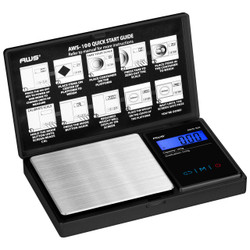
Buying a coin scale is easier when you focus on three fundamentals:
measurement performance, capacity, and calibration.
The scale needs enough capacity for the heaviest coin, holder, tray,
medal, bullion piece, or group you expect to place on it. It needs fine
enough readability for the differences that matter to your collecting
work. And it needs a dependable calibration process so you can maintain
and check its performance.
For many general coin-collecting applications, 0.01g readability
provides an excellent balance between useful detail and practical
capacity. Individual coins typically require little capacity, while
collectors who weigh groups, medals, trays, or multiple bullion pieces
may benefit from 250g, 500g, or higher-capacity models.
American Weigh Scales offers compact options through its pocket scales
collection, including scales
designed for small objects and collectible applications.
This buying guide explains how to evaluate accuracy, readability,
capacity, calibration, repeatability, tare, weighing units, platform
size, environmental stability, and commercial-use considerations before
choosing a coin scale.
Quick Coin Scale Buying Guide
Application Practical capacity Practical readability
Individual U.S. coins 100g+ 0.01g
Individual collectible coins 100--250g 0.01g
Gold coins 100--250g 0.01g
Silver coins 100--250g 0.01g
Coins in holders or capsules 100--250g 0.01g
Small groups 200--500g 0.01g
Tokens 250--500g 0.01g
Medals 250--500g+ 0.01g or 0.1g
Bullion groups 500g+ 0.01g
Specialized tiny pieces Application-dependent 0.001g
These are starting points. Always select the scale from the actual loads
and measurement requirements of your collection.
The Three Most Important Specifications
When comparing coin scales, start with:
-
Readability and measurement performance
-
Capacity
-
Calibration
Then evaluate:
-
Repeatability
-
Minimum usable load
-
Tare
-
Units
-
Platform dimensions
-
Display
-
Protective cover
-
Portability
-
Power
-
Environmental sensitivity
A scale is a complete measuring system. One impressive number on the
specification sheet does not guarantee that it is right for coins.
Accuracy vs. Readability
One of the most common scale-buying mistakes is treating readability and
accuracy as interchangeable.
They are not.
Readability
Readability is the smallest increment shown by the display.
Examples:
-
0.1g
-
0.01g
-
0.001g
Accuracy
Accuracy concerns how closely the measured result agrees with the
relevant reference value within the scale's specified performance.
Repeatability
Repeatability describes whether the same stable object produces
consistent measurements when weighed repeatedly under similar
conditions.
A scale that displays three decimal places is not automatically accurate
to the final displayed digit.
For that reason, do not buy a coin scale based only on the number of
decimals.
Why 0.01g Is a Strong Choice for Coins
For many collectors, 0.01g readability is the practical sweet spot.
A hundredth-of-a-gram scale can display values such as:
-
2.50g
-
5.00g
-
5.67g
-
11.34g
These correspond to nominal weights currently published by the U.S. Mint
for several U.S. denominations.
That makes 0.01g convenient when comparing a measured coin with a
published specification.
AWS also identifies coins as a common application for compact precision
scales in its Best Pocket Scales for Jewelry, Coins, Coffee and
Crafts
guide.
Is 0.1g Enough?
A 0.1g scale may be suitable for:
-
Large groups of coins
-
Heavy medals
-
Bulk sorting
-
Applications where hundredths are unnecessary
For individual collectible coins, 0.01g gives you another decimal place
of useful measurement detail.
A nominal 5.67g coin, for example, is more naturally compared on a
hundredth-of-a-gram scale than on one displaying only tenths.
Do You Need 0.001g?
Usually not for ordinary coin collecting.
A 0.001g scale can be useful for:
-
Very small ancient pieces
-
Specialized low-mass research
-
Extremely lightweight objects
However, milligram readability generally requires greater attention to:
-
Drafts
-
Vibration
-
Static
-
Temperature
-
Surface stability
It may also come with lower capacity and a smaller weighing pan.
Choose 0.001g because the application genuinely benefits from it---not
simply because more decimal places appear more precise.
Capacity: How Much Do You Need?
Capacity is the maximum total load the scale is designed to support.
For a single coin, 100g is often more than enough.
But collectors do not always weigh bare individual coins.
The complete load may include:
-
Coin
-
Holder
-
Capsule
-
Tray
-
Multiple coins
-
Token
-
Medal
-
Bullion pieces
Capacity should be selected for the heaviest realistic complete load.
AWS explains the relationship between capacity and readability in What
Does 500g x 0.01g Mean on a Digital
Scale?.
100g Capacity
A 100g x 0.01g scale is a strong option for individual coins.
It offers:
-
Compact dimensions
-
Fine readability
-
Easy portability
-
More than enough capacity for most individual circulating coins
Choose more capacity if groups, trays, or medals are part of your
workflow.
200g Capacity
A 200g x 0.01g scale adds flexibility for:
-
Individual coins
-
Holders
-
Capsules
-
Small groups
-
Tokens
-
Lightweight medals
This range can be a good compromise between portability and headroom.
250g Capacity
A 250g x 0.01g scale is one of the most versatile configurations for
collectors.
It accommodates:
-
Individual coins
-
Several coins together
-
Holders
-
Trays
-
Tokens
-
Small medals
For someone buying one general-purpose coin scale, this is an excellent
target.
500g Capacity
A 500g x 0.01g scale is useful when you expect to weigh:
-
Larger groups
-
Multiple bullion pieces
-
Medals
-
Containers
-
Mixed collectibles
Moving to 500g capacity does not automatically require giving up 0.01g
readability.
AWS discusses this choice in its 200g vs. 500g Pocket Scale
comparison.
Capacity Headroom
Avoid planning a normal workflow right at the scale's maximum capacity.
Suppose:
-
Coin group = 220g
-
Tray = 20g
-
Total load = 240g
A 250g scale technically accommodates the load, but leaves little
headroom.
A 500g model would be the more flexible option.
NIST's weighing guidance likewise emphasizes that the maximum expected
load should not exceed scale capacity.
Tare Does Not Increase Capacity
This is important.
Suppose you place a 40g tray on a 250g scale and press tare.
The display returns to:
0.00g
But the load cell is still physically supporting 40g.
Tare subtracts the container from the displayed net result. It does not
restore physical capacity.
Always calculate capacity from the gross load.
Minimum Usable Load
Maximum capacity receives most of the attention, but the lower end
matters too.
The smallest displayed increment is not necessarily the smallest amount
a scale can reliably measure.
If you work with very lightweight numismatic pieces, review the
manufacturer's:
-
Minimum load
-
Accuracy specification
-
Repeatability
-
Recommended operating range
This becomes especially important with 0.001g instruments.
Repeatability: A Critical Coin-Scale Feature
For collectors, repeatability is extremely useful.
Try a simple check:
-
Place the scale on a stable surface.
-
Confirm zero.
-
Put the same coin in the center.
-
Record the result.
-
Remove the coin.
-
Wait for zero.
-
Repeat several times.
The readings should behave consistently within the instrument's
specified performance.
If they do not, investigate environmental and setup factors.
AWS explains common causes in Why Does My Digital Scale Give Different
Readings?.
Calibration: What Coin Collectors Should Know
Calibration compares or adjusts the scale's response using an
appropriate known reference mass according to the manufacturer's
procedure.
Before buying, check:
-
Whether user calibration is supported
-
Which calibration mass is required
-
Whether the mass is included
-
How calibration mode is activated
-
Whether the manufacturer provides clear instructions
AWS's How to Calibrate a Digital Scale for Accurate
Results
provides a detailed calibration process.
Can You Calibrate a Scale With a Coin?
Do not use a coin as a substitute for the specified calibration weight.
Even when a coin has an official nominal mass, an individual piece may
differ because of:
-
Production tolerances
-
Wear
-
Damage
-
Contamination
-
Alteration
-
Historical composition differences
AWS specifically notes that coins should not be used for precise
calibration and recommends using the correct reference mass for the
scale.
When Should You Calibrate?
Follow the manufacturer's instructions.
Situations that may justify checking or recalibrating the scale include:
-
After transportation
-
After long storage
-
After significant temperature changes
-
After unusual readings
-
When a suitable reference check suggests a problem
Do not recalibrate impulsively every time one coin differs from a
catalog specification. First eliminate setup and environmental causes.
Calibration Weight Selection
Use the mass specified by the scale manufacturer.
Do not assume:
-
Any 100g object equals a calibration weight
-
A coin is sufficiently exact
-
A household object is a reference standard
The purpose of calibration is defeated if the reference itself is
uncertain.
Tare Function
Tare is one of the most useful convenience features for coin collectors.
Use it when weighing coins in:
-
Trays
-
Cups
-
Containers
-
Removable holders
Basic process:
-
Place the empty container on the platform.
-
Wait for stability.
-
Press tare.
-
Confirm zero.
-
Add the coin.
-
Record the net reading.
Again, the container still counts toward physical capacity.
Grams
A good coin scale should measure grams.
The U.S. Mint's current Coin
Specifications
list gram weights alongside other physical specifications.
Examples include:
Denomination Nominal weight
One-cent coin 2.50g
Nickel 5.00g
Dime 2.268g
Quarter 5.67g
Half dollar 11.34g
Native American / Innovation dollar 8.10g
Historical issues can have different compositions and specifications, so
always use a reference appropriate to the exact coin.
Troy Ounces
Troy ounces are useful if your collection includes:
-
Bullion coins
-
Gold
-
Silver
-
Precious-metal rounds
They are optional for ordinary circulating coins but increase a scale's
versatility.
Pennyweight
Pennyweight, or dwt, is used in parts of the precious-metal and jewelry
industries.
It may be useful if the same scale will be used for:
-
Gold
-
Silver
-
Jewelry
-
Scrap precious metal
For ordinary numismatics, grams remain the most straightforward unit.
Platform Size
Capacity is not enough.
The object must physically fit on the weighing surface.
Platform dimensions matter for:
-
Medals
-
Large tokens
-
Groups
-
Trays
-
Bullion pieces
If part of the load touches the surrounding table, another surface is
supporting some of the weight and the reading may be incorrect.
Platform Material
Stainless steel is commonly used on compact precision scales because it
is durable and easy to keep clean.
For valuable coins, direct contact may not always be desirable.
An appropriate tray or holder can be used when necessary, with tare
applied correctly.
Protective Cover
A protective cover is particularly useful for portable scales.
It can protect the platform from:
-
Dust
-
Scratches
-
Accidental pressure
-
Transport damage
This is valuable for collectors who bring scales to shows, auctions,
shops, or club meetings.
Display
Look for:
-
Clear digits
-
Obvious decimal placement
-
Unit indicator
-
Backlighting when useful
A scale can have excellent technical specifications but still be
frustrating if the display is difficult to read.
Stable Zero
After removing a coin, the scale should return predictably to zero
within normal instrument behavior.
If the zero drifts, investigate:
-
Air movement
-
Vibration
-
Temperature
-
Static
-
Battery condition
-
Calibration
-
Debris
Do not immediately assume the coin or scale is defective.
Drafts
Fine-resolution scales can respond to moving air.
Avoid placing the scale beside:
-
Fans
-
HVAC vents
-
Open windows
-
Frequently opened doors
This becomes increasingly important at 0.001g readability.
Vibration
Use a hard, stable table.
Avoid:
-
Wobbly furniture
-
Flexible shelves
-
Machinery benches
-
Soft surfaces
A precision scale needs a stable foundation.
Temperature
If a pocket scale has been transported through substantially different
temperatures, allow it to acclimate according to the manufacturer's
instructions before important measurements or calibration.
Temperature stability becomes more important as measurement requirements
become finer.
Static Electricity
Static can affect sensitive weighing.
Potential sources include:
-
Plastic trays
-
Dry indoor air
-
Synthetic materials
If a fine-resolution scale behaves inconsistently after drafts and
vibration have been controlled, static is another variable to
investigate.
Battery Condition
Weak batteries can contribute to unusual behavior.
If readings suddenly become unstable:
-
Check the surface.
-
Eliminate drafts.
-
Check battery condition.
-
Check calibration.
-
Inspect the platform.
-
Repeat the measurement.
Best Coin Scale for U.S. Coins
For individual modern U.S. coins:
100--250g x 0.01g
is a strong general-purpose range.
The capacity is generous for individual pieces, while
hundredth-of-a-gram readability provides useful comparison detail.
Best Coin Scale for Silver Coins
For individual silver coins:
100--250g x 0.01g
works well for many applications.
For groups:
250--500g+ x 0.01g
may be more appropriate.
Troy-ounce mode is a useful bonus for bullion-oriented collections.
Best Coin Scale for Gold Coins
For individual gold coins:
100--250g x 0.01g
is a versatile target.
Useful features include:
-
Calibration
-
Repeatability
-
Tare
-
Grams
-
Troy ounces
-
Protective cover
Weight cannot determine gold purity or authenticity by itself.
Best Coin Scale for Bullion
For bullion:
-
Prioritize 0.01g readability for individual pieces
-
Calculate total capacity for groups
-
Consider 500g+ if weighing several pieces
-
Look for grams and troy ounces
-
Use tare for containers
A higher-capacity scale can be more useful than an ultra-fine
low-capacity instrument.
Best Coin Scale for Ancient Coins
Ancient coins can be small and irregular.
A 0.01g scale is useful for many pieces.
Very small examples may justify 0.001g readability in specialized work.
However, ancient-coin evaluation should also consider:
-
Diameter
-
Metal
-
Style
-
Fabric
-
Provenance
-
Specialist evaluation
Weight is only one characteristic.
Best Coin Scale for Tokens
Tokens vary widely.
A 250--500g x 0.01g scale is a flexible choice for many collections.
Check platform size for oversized tokens.
Best Scale for Medals
Medals can be larger and heavier than ordinary coins.
A 500g scale may be preferable.
For large medals, a higher-capacity bench scale may be necessary.
Choose resolution according to the actual purpose of the measurement.
Pocket Scale vs. Kitchen Scale
Kitchen scales commonly prioritize:
-
Higher capacity
-
Larger platforms
-
Food measurement
Many offer only 1g or 0.1g readability.
A precision pocket scale with 0.01g readability is generally better
suited to detailed individual-coin measurements.
Pocket Scale vs. Milligram Scale
0.01g Pocket Scale
Best for:
-
Most collectible coins
-
Portability
-
Groups
-
Tokens
-
Coin shows
0.001g Milligram Scale
Best for:
-
Specialized tiny pieces
-
Very-low-mass applications
-
Situations where thousandth-of-a-gram readings are genuinely
required
For most collectors, the 0.01g pocket scale is the better first
purchase.
Pocket Scale vs. Bench Scale
A pocket scale is ideal when you value:
-
Portability
-
Compact storage
-
Individual coins
-
Small groups
A bench scale is useful when you need:
-
Larger platform
-
Higher capacity
-
Heavy medals
-
Bulk groups
Some collectors benefit from a two-scale setup.
Can Weight Authenticate a Coin?
No.
A measured weight can be compared with a published specification, but
matching weight does not prove authenticity.
A counterfeit can potentially approximate expected mass.
Coin authentication may also involve:
-
Diameter
-
Thickness
-
Composition
-
Edge details
-
Surface characteristics
-
Die diagnostics
-
Provenance
-
Professional evaluation
Use weight as one piece of evidence. The BIPM SI
Brochure provides the
international reference framework for SI measurement units.
Why a Genuine Coin Can Differ From Nominal Weight
Possible factors include:
-
Circulation wear
-
Damage
-
Corrosion
-
Deposits
-
Cleaning
-
Manufacturing tolerance
-
Scale setup
-
Environmental conditions
A difference from nominal mass should be investigated in context rather
than treated as automatic proof of a counterfeit. For issue-specific
U.S. coin research, PCGS CoinFacts can
provide additional collector reference information.
Commercial Coin and Precious-Metal Weighing
Personal collecting and commercial weighing are different applications.
NIST's Weighing and Scales
FAQs
emphasize:
-
Suitability
-
Accuracy class
-
Capacity
-
Minimum load
-
Usability
The current 2026 NIST Handbook
44
contains specifications, tolerances, and technical requirements for
weighing and measuring devices used in regulated contexts.
If a business buys or sells coins, bullion, gold, or silver based
directly on weight, applicable state and local weights-and-measures
requirements may govern the equipment.
Do not assume that every consumer pocket scale is approved for
legal-for-trade use.
Choosing Capacity for Commercial Applications
NIST advises that the maximum expected load should not exceed scale
capacity.
For regulated applications, minimum load and accuracy class also matter.
That means a business should not simply choose the smallest scale that
can display the desired number of decimal places.
The scale must be appropriate for the complete commercial application.
Coin Scale Buying Checklist
Before purchasing, ask:
-
What coins will I weigh?
-
Will I weigh individual coins or groups?
-
What is the lightest object?
-
What is the heaviest complete load?
-
Will I use a tray or holder?
-
Do I need 100g, 200g, 250g, or 500g+ capacity?
-
Is 0.01g readability sufficient?
-
Do I genuinely need 0.001g?
-
What accuracy or tolerance does the manufacturer specify?
-
What is the minimum usable load?
-
How repeatable is the scale?
-
Does it support calibration?
-
Which calibration mass is required?
-
Is the calibration mass included?
-
Does it have tare?
-
Does it measure grams?
-
Do I need troy ounces?
-
Do I need pennyweight?
-
Is the platform large enough?
-
Does it have a protective cover?
-
Is the display easy to read?
-
Is it portable?
-
What batteries does it use?
-
Will it be used commercially?
-
If commercial, is it appropriate and approved for that application?
Common Coin Scale Buying Mistakes
Choosing by Decimal Places Alone
More digits do not automatically mean better measurement quality.
Confusing Readability With Accuracy
They describe different properties.
Ignoring Repeatability
Consistent readings are important.
Buying Too Little Capacity
Remember groups, holders, trays, medals, and bullion.
Forgetting Capacity Headroom
Do not routinely operate at the maximum.
Assuming Tare Restores Capacity
It does not.
Ignoring Minimum Load
The lower end of the measuring range matters.
Skipping Calibration
Choose a scale with a clear calibration process.
Calibrating With a Coin
Use the specified reference mass.
Ignoring Platform Size
The complete load must fit.
Weighing Near Airflow
Drafts can influence fine readings.
Using Weight as Proof of Authenticity
Weight is only one characteristic.
Assuming Every Scale Is Legal for Trade
Commercial applications may be regulated.
How to Set Up a New Coin Scale
When your scale arrives:
-
Read the manufacturer's instructions.
-
Install fresh batteries or the specified power source.
-
Place the scale on a hard, level surface.
-
Inspect the platform.
-
Allow appropriate acclimation if temperature changed significantly.
-
Keep the scale away from drafts.
-
Follow the specified calibration procedure.
-
Confirm zero.
-
Check repeatability with a stable object.
-
Begin weighing coins.
Do not overload the scale during testing.
How to Weigh Coins Consistently
Use the same procedure whenever possible:
-
Confirm a stable surface.
-
Turn on the scale empty.
-
Select grams.
-
Confirm zero.
-
Tare a container if used.
-
Place the coin near the center.
-
Wait for a stable reading.
-
Record the result.
-
Remove the coin.
-
Confirm return to zero.
-
Repeat important measurements.
Consistency makes your records more meaningful.
When to Consider Two Scales
One scale does not have to do everything.
A useful two-scale setup might be:
Scale One
200--250g x 0.01g
For:
-
Individual coins
-
Portable work
-
Coin shows
-
Small groups
Scale Two
500g+
For:
-
Large groups
-
Heavy medals
-
Containers
-
Bulk lots
Alternatively, specialized collectors may pair a 0.01g pocket scale with
a 0.001g milligram scale.
Frequently Asked Questions
What is the best scale for coins?
For many collectors, a 200--250g x 0.01g pocket scale provides an
excellent combination of readability, capacity, and portability.
What accuracy do I need for coins?
Choose a scale whose stated performance is appropriate for the
comparisons you intend to make. Do not infer accuracy solely from
display resolution.
Is 0.01g good for coins?
Yes. It is a practical general-purpose readability for many
collectible-coin applications.
Is 0.001g better?
Not automatically. It offers finer readability but can be more
environmentally sensitive and may provide less capacity.
Is 100g capacity enough?
For most individual coins, yes.
Is 250g a good capacity?
Yes. It provides useful headroom for holders, small groups, and tokens.
Should I buy a 500g scale?
Choose 500g if you regularly weigh groups, medals, bullion, or
containers.
What does 500g x 0.01g mean?
It indicates a nominal 500g maximum capacity and 0.01g display
increments.
Does a coin scale need calibration?
A dependable calibration process is highly desirable for precision
weighing.
Can I calibrate with a nickel?
Use the calibration mass specified by the manufacturer instead.
How often should I calibrate?
Follow the manufacturer's instructions and consider checking calibration
after transport, storage, major temperature changes, or unusual
readings.
What is repeatability?
It is the ability to produce consistent measurements of the same stable
object under similar conditions.
Is tare important?
Yes, especially when using trays or containers.
Does tare give me more capacity?
No.
Should the scale measure grams?
Yes. Grams are commonly used in official coin specifications.
Do I need troy ounces?
They are useful for bullion, gold, and silver but optional for general
coin collecting.
Can a scale identify a counterfeit coin?
No. It provides one useful measurement but cannot prove authenticity.
Can wear change coin weight?
Yes. Wear can remove material, while damage, deposits, corrosion, and
alteration can also affect mass.
Can I use a kitchen scale?
For rough bulk measurements, perhaps. For detailed individual-coin work,
a 0.01g precision scale is generally more useful.
Do coin dealers need legal-for-trade scales?
If weight determines transaction value, applicable weights-and-measures
rules may apply. Verify requirements in the jurisdiction where the scale
is used.
Final Verdict: Accuracy, Capacity and Calibration
For most coin collectors, the ideal scale is not the model with the
highest capacity or the most decimal places.
It is the scale that balances:
-
Useful measurement performance
-
0.01g readability for many general coin applications
-
Enough capacity for the complete load
-
Good repeatability
-
Dependable calibration
-
Tare
-
Gram measurement
-
Appropriate platform size
-
Stable operating conditions
A practical buying framework is:
-
100g x 0.01g: individual coins and maximum portability
-
200--250g x 0.01g: broad general-purpose coin collecting
-
500g x 0.01g: groups, bullion, medals, and extra headroom
-
0.001g: specialized very-low-mass applications
-
Higher capacity: bulk lots and large collectibles
For most collectors buying one scale, 200--250g x 0.01g is a
particularly versatile starting point. If groups, bullion, or medals are
common, 500g x 0.01g offers greater flexibility.
Whatever capacity you choose, calibration and repeatability deserve as
much attention as resolution.
A precision coin scale is most useful when it produces consistent
measurements under controlled conditions and when those measurements are
interpreted appropriately. Use weight alongside authoritative
specifications and broader numismatic evaluation---not as a stand-alone
test of authenticity, grade, composition, rarity, or value.