
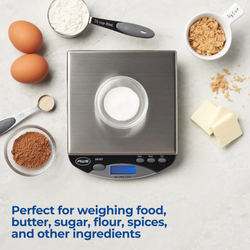
Choosing the right scale for epoxy pigments is about more than finding a model that displays two or three decimal places.
A good pigment scale needs the right balance of:
accuracy, capacity, readability, repeatability and calibration capability.
For many resin artists, a practical starting specification is:
100–500g capacity × 0.01g readability
A 500g × 0.01g scale can be especially versatile because it provides fine displayed increments while leaving enough capacity for pigment cups, small resin samples, trays and multiple additives.
But the best scale depends on what you actually measure.
If your pigment quantities are several grams, 0.1g may be enough.
If you regularly work below 1g, 0.01g becomes much more useful.
If your actual formulation involves milligram-level quantities, 0.001g may be necessary.
This buying guide explains how to evaluate the specifications that matter before choosing an epoxy pigment scale.
Quick Buying Guide
| Application | Suggested Capacity | Suggested Readability |
|---|---|---|
| General mica powder | 100–500g | 0.01g |
| Concentrated resin pigments | 100–500g | 0.01g |
| Small pigment formulas | 100–500g | 0.01g |
| Metallic powders | 100–500g | 0.01g |
| Glitter | 200–500g | 0.01–0.1g |
| Resin jewelry pigments | 200–500g | 0.01g |
| Small resin samples | 200–500g | 0.01g |
| Larger additives | 500g+ | 0.1g where appropriate |
| Milligram-level ingredients | Application-specific | 0.001g when required |
For many pigment-focused workflows, 500g × 0.01g offers one of the most useful combinations of capacity and fine readability.
AWS explains exactly what those two numbers mean in What Does 500g × 0.01g Mean on a Digital Scale?.
1. Accuracy Should Come Before Extra Decimal Places
When people shop for a precision pigment scale, they often focus immediately on:
0.1g
0.01g
or:
0.001g
But those numbers describe readability.
They do not tell you everything about measurement performance.
A scale displaying:
0.37g
has 0.01g readability.
That does not automatically mean every measurement is guaranteed accurate to exactly ±0.01g.
When evaluating a scale, consider:
-
Readability
-
Accuracy specification
-
Repeatability
-
Minimum usable load
-
Calibration procedure
-
Capacity
-
Environmental sensitivity
-
Proper loading
This distinction becomes especially important when weighing small quantities of concentrated pigment.
NIST describes calibration in terms of establishing a mass value together with an appropriate uncertainty, illustrating why dependable measurement requires more than simply displaying additional decimal places. Learn more from NIST's Calibration of Mass Standards program.
2. What Is Readability?
Readability is the smallest increment the scale displays.
A:
0.1g scale
might display:
1.2g
A:
0.01g scale
might display:
1.27g
A:
0.001g scale
might display:
1.274g
More readability gives you finer displayed detail.
It does not automatically mean the scale is better for your application.
The goal is to choose the level of readability appropriate for the smallest meaningful quantity you need to measure.
3. Is 0.1g Enough for Epoxy Pigments?
Sometimes.
A 0.1g scale can work well when your normal pigment quantities are relatively large.
For example:
4.5g
8.2g
12.7g
In those situations, hundredth-of-a-gram resolution may provide little practical benefit.
0.1g may also be preferable if you need considerably more capacity for resin, hardener and larger containers.
For dedicated small-pigment work, however, 0.01g is often more useful.
4. When Is 0.01g Better?
A 0.01g scale displays hundredths of a gram.
That can be especially useful when weighing quantities such as:
0.25g
0.48g
0.72g
1.35g
Common applications include:
-
Mica powder
-
Concentrated pigments
-
Small resin additives
-
Metallic powders
-
Jewelry color formulas
-
Small test batches
-
Multi-pigment blends
If you want to document a successful resin color and reproduce it later, 0.01g can provide significantly more useful detail than 0.1g.
AWS's 0.001g vs. 0.01g Scales guide explains how these finer readability ranges differ.
5. Do You Need 0.001g?
Usually not for ordinary epoxy pigment work.
A 0.001g scale displays:
one milligram
That means it can show readings such as:
0.125g
0.126g
0.127g
This can be valuable when your formulation genuinely requires quantities measured in thousandths of a gram.
However, finer-resolution scales are also more sensitive to environmental factors.
These may include:
-
Drafts
-
Vibration
-
Static
-
Temperature
-
Surface movement
-
Off-center loads
If your typical pigment quantity is:
0.65g
you probably do not need to buy a milligram scale simply because it displays another decimal place.
Choose 0.001g only when the actual application requires it.
6. Repeatability Is Critical for Pigment Formulation
Accuracy matters, but repeatability is also extremely important.
Suppose you create a color using:
Mixed resin: 75.00g
Blue mica: 0.46g
Pearl pigment: 0.24g
Silver pigment: 0.18g
A scale that provides stable, repeatable readings gives you a much stronger foundation for recreating that same formulation later.
Repeatability matters for:
-
Resin jewelry collections
-
Product batches
-
Custom colors
-
Prototype development
-
Customer orders
-
Formula documentation
If the same stable load produces noticeably different readings repeatedly, investigate your setup before assuming the pigment formula is the problem.
AWS covers common causes in Why Does My Digital Scale Give Different Readings?.
7. Minimum Usable Load Matters More Than Many Buyers Realize
This specification is especially relevant for epoxy pigments.
A scale may be labeled:
500g × 0.01g
but the smallest displayed increment is not necessarily the same as the smallest ideal working load.
If your ingredient quantity is extremely small, check any available manufacturer specifications for:
-
Minimum load
-
Accuracy
-
Repeatability
-
Tolerance
This becomes increasingly important as your samples approach the bottom of the scale's useful measurement range.
Do not assume a scale displaying 0.01g is automatically optimized for weighing exactly 0.01g.
8. Capacity Is the Other Half of the Decision
Pigments are light.
Your entire weighing setup may not be.
Capacity includes everything sitting on the platform.
That can include:
container + resin sample + pigment + additives
Suppose:
Container = 45g
Resin sample = 120g
Pigments = 2g
Other additives = 3g
Total physical load:
170g
A 100g scale would be unsuitable.
A 200g scale could technically support the example but would provide limited headroom.
A 500g scale would give you significantly more flexibility.
9. Why 500g Is a Practical Capacity for Pigment Work
For many resin makers, a 500g precision scale can accommodate:
-
Small pigment containers
-
Weighing trays
-
Resin samples
-
Jewelry-sized batches
-
Multiple pigment additions
-
Mica powder
-
Glitter
-
Metallic powders
Combined with 0.01g readability, it provides a useful working range without forcing you into a very low-capacity scale.
That is why 500g × 0.01g is such a common and practical specification for fine craft measurements.
10. Capacity Includes the Container
This is one of the easiest specifications to misunderstand.
Suppose you have:
500g maximum capacity
and your cup weighs:
60g
You put the cup on the platform and press tare.
The scale displays:
0.00g
However, the scale is still physically supporting 60g.
Approximately:
440g
of nominal capacity remains.
Tare does not restore physical capacity.
11. Leave Capacity Headroom
It is usually better to choose enough capacity so that your normal workflow does not constantly bring you close to the maximum load.
If your typical complete load is:
180g
a 200g scale may technically be enough.
But a 500g scale provides much more flexibility for:
-
Different cups
-
Larger samples
-
Additional additives
-
Future projects
Choose capacity based on realistic use rather than the smallest possible number.
12. Tare Is Essential
A pigment scale should include tare.
A typical workflow is:
-
Place the empty pigment cup on the scale.
-
Allow the reading to stabilize.
-
Press tare.
-
Confirm 0.00g.
-
Add Pigment A.
-
Record the mass.
-
Tare again if appropriate.
-
Add Pigment B.
-
Record the mass.
-
Continue until the formulation is complete.
This removes the need to manually subtract container weight during every measurement.
13. Calibration Capability Should Be Part of Your Buying Decision
A precision scale should provide a documented method for calibration or performance checking.
Different models can require different:
-
Calibration weights
-
Procedures
-
Button sequences
-
Setup conditions
Do not assume all 500g scales use the same calibration mass.
AWS explains the process in How to Calibrate a Digital Scale for Accurate Results.
For broader technical context, NIST also publishes calibration procedures used by weights-and-measures laboratories. See NIST Calibration Procedures for Weights and Measures Laboratories.
14. Use the Correct Calibration Weight
Do not calibrate your precision scale using:
-
Coins
-
Resin bottles
-
Pigment jars
-
Jewelry
-
Tools
-
Cured resin pieces
-
Random kitchen objects
Use the reference mass specified by the manufacturer for your exact model.
An object having an approximate advertised weight is not the same as using an appropriate calibration reference.
NIST's work on mass standards reinforces the broader measurement principle that reference masses need known values and uncertainties rather than assumptions based on ordinary household objects.
15. Calibration and Tare Are Not the Same Thing
This is another common misunderstanding.
Tare sets the displayed value to zero with a container or object on the scale.
Calibration adjusts or checks the scale's relationship to a known reference mass according to the manufacturer's procedure.
Pressing tare does not calibrate the scale.
Calibrating the scale does not eliminate the need to tare your container during normal weighing.
Both functions serve different purposes.
16. How Often Should You Calibrate a Pigment Scale?
There is no universal schedule that applies to every model and every workshop.
Follow the scale manufacturer's instructions.
It may be worth checking performance after situations such as:
-
Moving the scale
-
Long storage
-
Significant temperature changes
-
Accidental shock
-
Suspected measurement problems
Do not create an arbitrary calibration interval that contradicts the instructions supplied for your scale.
17. Calibration Requires a Stable Environment
Calibration should be performed under suitable conditions.
Use a:
hard, flat, stable surface
and avoid:
-
Airflow
-
Vibration
-
Temperature swings
-
Physical movement of the table
The same environmental factors that affect normal precision weighing can interfere with calibration.
18. Platform Size Matters
Capacity alone does not tell you whether your pigment cup will fit.
A suitable platform should allow your container to:
-
Sit securely
-
Remain centered
-
Be fully supported
-
Avoid touching the surrounding counter
-
Avoid touching other parts of the scale
-
Leave the display visible
Before buying, measure the containers you actually use.
A compact scale may have enough capacity but still have too little platform area for your workflow.
19. Stainless Steel Is Useful Around Pigments
Mica and resin work can be messy.
A stainless-steel weighing platform can be useful because it provides a smooth surface for routine cleaning.
However, do not allow uncured resin or pigment to enter:
-
Display seams
-
Buttons
-
Platform gaps
-
Battery compartments
-
Electronic components
Use weighing trays or disposable liners where appropriate and follow the manufacturer's cleaning instructions.
20. Trays and Protective Covers Add Practical Value
Precision pocket scales often include:
-
Protective covers
-
Expansion trays
-
Removable weighing trays
These can help contain:
-
Mica
-
Glitter
-
Metallic powders
-
Lightweight additives
If you use a tray, remember:
the tray counts toward scale capacity.
Place it on the platform and tare it before adding the material.
21. Display Quality Matters
When you are measuring 0.01g quantities, you need to see the decimal clearly.
Look for:
-
Backlighting
-
Clear digits
-
Visible decimal point
-
Useful viewing angle
-
Display placement that is not blocked by the cup
A scale with excellent specifications can still be inconvenient if the container constantly hides the display.
22. Stable Zero Is Important
Before adding pigment, the display should settle reliably.
If the empty scale fluctuates between:
0.00g
0.02g
-0.01g
0.03g
then weighing a 0.25g pigment quantity becomes difficult.
Possible causes include:
-
Drafts
-
Vibration
-
Weak batteries
-
Temperature changes
-
Static
-
Unstable work surfaces
-
Improper loading
-
Calibration issues
Evaluate the environment before assuming the scale itself is faulty.
23. Avoid Drafts
Fine-resolution scales react to forces that may seem insignificant.
Air movement can come from:
-
Fans
-
HVAC vents
-
Open windows
-
Air purifiers
-
Strong air conditioning
This is particularly relevant with mica powder because the material itself is also lightweight.
Perform precision weighing away from direct airflow.
24. Avoid Vibration
Precision measurement also requires a stable work surface.
Possible vibration sources include:
-
Sanders
-
Compressors
-
Rotary tools
-
Drills
-
Speakers
-
Machinery
-
Foot traffic
Turn nearby vibrating equipment off when performing fine pigment measurements whenever practical.
25. Temperature and Static Matter More as Readability Gets Finer
A scale that reads to 0.01g or 0.001g is more sensitive to environmental conditions than a typical whole-gram kitchen scale.
Allow the scale to acclimate if it has been moved from a significantly different temperature.
Static can also complicate handling very lightweight powders.
This is another reason not to buy 0.001g equipment unless your formulation actually requires that level of readability.
26. Battery or AC Power?
Both can work well.
Choose according to your workspace.
Battery Operation
Useful for:
-
Portable scales
-
Small studios
-
Flexible placement
-
Occasional use
AC Power
Useful for:
-
Permanent formulation stations
-
Frequent weighing
-
Long work sessions
Power source does not replace the need to evaluate accuracy, readability, capacity and calibration.
27. Should You Buy a Pocket Scale?
For pigment work, a precision pocket scale can be an excellent choice because these compact models frequently combine:
-
Low-to-medium capacity
-
0.01g readability
-
Tare
-
Compact storage
-
Protective covers
-
Small weighing trays
For larger resin batches, however, a higher-capacity scale may make more sense.
AWS compares these categories in Pocket Scale vs. Kitchen Scale: Which One Should You Buy?.
28. Do You Need One Scale or Two?
Many resin makers can benefit from separating pigment measurement from bulk resin measurement.
Precision Pigment Scale
A useful range is:
100–500g × 0.01g
Use it for:
-
Mica
-
Concentrated pigments
-
Metallic powders
-
Lightweight additives
-
Color formulation
Main Resin Scale
A useful general range is:
2–5kg × 0.1g
Use it for:
-
Resin
-
Hardener
-
Mixing containers
-
Larger batches
AWS's Best Digital Scale for Resin discusses why larger resin batches often benefit from higher capacity while pigments can benefit from finer readability.
29. Do Not Use Pigment Precision to Guess Your Epoxy Mixing Ratio
If your pigment scale is also used for resin and hardener, there is an important distinction.
Your scale tells you mass.
It does not tell you the correct resin-to-hardener ratio.
A resin system labeled:
2:1 by volume
does not automatically mean:
2:1 by weight.
Resin and hardener can have different densities.
TotalBoat's current guidance states that product-specific weight ratios should be used when mixing its epoxy systems by weight because weight and volume ratios can differ. See TotalBoat's guide to mixing epoxy by weight.
A current TotalBoat TableTop Epoxy technical sheet, for example, specifies 1:1 by volume but 1.2:1 by weight, demonstrating why the measurement basis must be checked for the exact product. See the TotalBoat TableTop Epoxy instructions.
Always follow the resin manufacturer's instructions for the exact epoxy system you are using.
30. Do Not Assume Every Pigment Uses the Same Loading Percentage
A scale can measure pigment accurately.
It cannot determine how much pigment should be added to a particular resin formulation.
Recommended loading can vary by:
-
Mica
-
Paste pigment
-
Liquid colorant
-
Dye
-
Metallic powder
-
Resin system
-
Manufacturer
Always follow the pigment and resin manufacturers' instructions.
If you record pigment as a percentage, define the basis consistently so that you can reproduce the formula later.
31. A Better Way to Record Pigment Formulas
Instead of recording:
“one scoop blue mica”
write:
Blue mica: 0.65g
Instead of:
“small amount of white”
write:
White pigment: 0.22g
For example:
| Component | Mass |
|---|---|
| Mixed resin | 100.00g |
| Blue mica | 0.65g |
| Pearl pigment | 0.28g |
| Metallic pigment | 0.16g |
| Glitter | 0.45g |
This gives you a measurable reference for future batches.
A precision scale is particularly valuable when it helps turn a successful experiment into a repeatable formulation.
32. Best Capacity for Mica Powder
For many mica applications:
100–500g
provides an appropriate range.
A 100g scale may be enough if:
-
The tray is lightweight
-
Pigment is weighed separately
-
Resin samples are tiny
A 500g scale provides more flexibility if you want to weigh pigment directly into:
-
Larger pigment cups
-
Resin samples
-
Jewelry batches
For general versatility, 500g often offers better headroom.
33. Best Readability for Mica Powder
For many mica formulations:
0.01g
is useful.
It allows you to distinguish:
0.32g
from:
0.38g
rather than forcing both measurements into coarser tenths-of-a-gram increments.
If you normally use several grams of mica and smaller differences are not important, 0.1g may be sufficient.
34. Best Scale Range for Concentrated Pigments
Concentrated pigments are often used in smaller amounts.
A range around:
100–500g × 0.01g
can therefore be a strong starting point.
The 500g capacity provides room for the container while 0.01g readability provides useful displayed detail for sub-gram colorant quantities.
If the actual ingredient quantity becomes genuinely milligram-sized, investigate whether a 0.001g model is appropriate.
35. Best Scale Range for Resin Jewelry Pigments
Jewelry-sized resin work often benefits from:
200–500g capacity
combined with:
0.01g readability
because both resin and pigment quantities are relatively small.
This range can be useful for:
-
Earrings
-
Pendants
-
Charms
-
Small molds
-
Colored inclusions
-
Small resin samples
A 500g model provides more capacity flexibility if you also weigh the resin mixture on the same scale.
36. Price Should Not Be Your Only Buying Criterion
The cheapest precision scale is not necessarily the best value.
The most expensive scale is not automatically the correct one either.
Compare the specifications that matter:
-
Capacity
-
Readability
-
Accuracy
-
Repeatability
-
Minimum load
-
Calibration
-
Platform size
-
Power source
-
Display
-
Included trays
-
Warranty
A scale is a better purchase when its measurement range matches the work you actually perform.
Common Epoxy Pigment Scale Buying Mistakes
Buying More Decimal Places Than You Need
0.001g is not automatically better than 0.01g.
Confusing Readability With Accuracy
They describe different characteristics.
Ignoring Minimum Load
This matters when weighing very small pigment quantities.
Buying Too Little Capacity
Always include the container.
Forgetting That Tare Does Not Restore Capacity
The container remains physically on the scale.
Ignoring Repeatability
Repeatability is crucial when recreating color formulas.
Ignoring Calibration Requirements
Check which calibration mass is required before purchasing.
Using Household Items for Calibration
Use the specified reference mass.
Choosing a Platform That Is Too Small
Your actual pigment cup needs to fit correctly.
Weighing Beside a Fan
Airflow can affect fine measurements.
Using a Flexible Work Surface
Use a hard, stable surface.
Ignoring Vibration
Precision measurement requires stability.
Assuming Volume Ratio Equals Weight Ratio
Use the exact epoxy manufacturer's instructions.
Epoxy Pigment Scale Buying Checklist
Before purchasing, check:
-
Smallest normal pigment quantity
-
Largest pigment quantity
-
Container weight
-
Maximum complete physical load
-
Scale capacity
-
Capacity headroom
-
0.1g vs. 0.01g readability
-
Whether 0.001g is actually necessary
-
Accuracy specification
-
Repeatability
-
Minimum usable load
-
Tare function
-
Gram measurement mode
-
Platform dimensions
-
Container fit
-
Display visibility
-
Backlit display
-
Calibration capability
-
Required calibration weight
-
Whether calibration weight is included
-
Stable zero
-
Protective tray
-
Protective cover
-
Surface material
-
Battery or AC operation
-
Storage requirements
-
Stable work surface
-
Protection from drafts
-
Protection from vibration
-
Whether a second high-capacity resin scale would be useful
Frequently Asked Questions
What is the best scale for epoxy pigments?
For many resin pigment applications, a scale around:
100–500g × 0.01g
provides a useful balance of fine readability and practical capacity.
Is 500g × 0.01g good for pigments?
Yes.
It offers hundredth-of-a-gram readability while leaving enough capacity for many pigment cups, trays and small resin samples.
Is 0.01g accurate enough for mica?
0.01g describes readability rather than guaranteed accuracy.
However, hundredth-of-a-gram readability is useful for many mica formulations, especially when quantities are below 1g.
Do I need 0.001g?
Usually not for ordinary epoxy pigment use.
Choose 0.001g when your actual ingredients require milligram-level measurement.
Is 0.1g enough?
It can be if your normal pigment quantities are several grams and hundredth-of-a-gram differences are not important.
What does minimum load mean?
It refers to the lower part of the scale's useful weighing range.
The smallest displayed increment is not necessarily the smallest ideal working quantity.
Why does repeatability matter?
Repeatable measurements help you recreate successful pigment formulations later.
Does tare increase capacity?
No.
Tare changes the display but the container continues to count toward physical capacity.
How much capacity should I leave?
Choose enough capacity that your normal complete load does not constantly approach the maximum limit.
Should my scale be calibratable?
A clearly documented calibration or checking procedure is valuable for precision weighing.
Can I use coins for calibration?
Use the calibration reference specified by the manufacturer rather than ordinary household objects.
Does platform size affect accuracy?
The entire load should sit properly and securely on the platform without touching surrounding surfaces.
Why does my pigment scale drift?
Potential causes include airflow, vibration, weak batteries, temperature changes, static, unstable surfaces and calibration issues.
Can I use one scale for resin and pigment?
Yes, if your entire measurement range fits within its specifications.
For makers handling both sub-gram pigments and multi-kilogram resin batches, two scales may be more practical.
What two-scale setup should I consider?
A useful starting combination is:
100–500g × 0.01g for pigments
and:
2–5kg × 0.1g for resin and hardener
Final Verdict: How to Buy the Right Epoxy Pigment Scale
When comparing scales for epoxy pigments, evaluate three areas first:
accuracy-related performance, capacity and calibration.
Start with your smallest normal pigment quantity.
If your ingredients are generally several grams:
0.1g readability may be sufficient.
If you regularly measure sub-gram pigments:
0.01g is often the better choice.
If your formulation genuinely requires milligram-level quantities:
consider 0.001g equipment.
Then calculate capacity using:
container + resin sample + pigment + additives
For many pigment workflows:
100–500g × 0.01g
provides an effective balance.
A:
500g × 0.01g
scale is especially versatile because it combines fine readability with enough capacity for many pigment containers and small resin samples.
But never purchase on capacity and decimal places alone.
Also compare:
accuracy specifications, repeatability, minimum usable load, tare, calibration, platform size, display visibility and environmental stability.
Use the correct calibration reference.
Place the scale on a hard, stable surface.
Keep it away from drafts and vibration.
And remember the three rules that prevent many scale-buying mistakes:
Readability is not automatically the same as accuracy.
Tare does not restore physical capacity.
More decimal places do not automatically make a scale better.
For makers handling both pigment formulas and larger epoxy pours, a two-scale system can provide the most practical measurement range:
100–500g × 0.01g precision scale for pigments
plus:
2–5kg × 0.1g scale for resin and hardener.
That gives you fine measurement where it matters while preserving the capacity required for larger mixing work.