
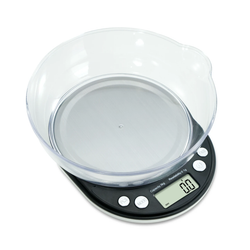
Choosing a scale for candle making starts with two numbers: the
smallest ingredient you need to measure and the heaviest complete
load you will put on the platform.
Candle making covers a wide measurement range. A pouring pitcher may
hold several kilograms of wax, while a test formula may use only a few
grams of fragrance oil, dye, or another additive. A high-capacity scale
can handle wax but may be too coarse for tiny ingredients. A fine
precision scale can handle small additions but may not support a full
pitcher.
American Weigh Scales' candle making and fragrance oil scale
guide
recommends matching capacity and readability to the material being
weighed. For many small and medium batches, 0.1g readability with useful
kilogram-level capacity is practical, while larger wax batches may
require 5kg or more and tiny tests may benefit from a separate 0.01g
scale.
For many serious candle makers, the most versatile setup is:
Main wax scale: 3--5kg+ x 0.1g--1g
Precision ingredient scale: 100--500g x 0.01g--0.1g
Quick Selection Guide
Task Suggested capacity Suggested readability
Tiny fragrance/dye tests 100--500g 0.01g
Fragrance oil 500--2,000g 0.1g
Sample candles 500--2,000g 0.1g
Small wax batches 2--3kg 0.1g--1g
Typical hobby batches 3--5kg 0.1g--1g
Larger wax batches 5kg+ 1g may be sufficient
Concentrated additives 100--500g 0.01g--0.1g
These are starting points. Your real batch, container weight, tested
formula, and supplier guidance should determine the final choice.
1. Start With Capacity
Capacity is the maximum total physical load a scale can support. Always
count the container.
Suppose your pouring pitcher weighs 650g, the wax weighs 1,500g, and
fragrance weighs 90g. The gross load is 2,240g. A 2kg scale is too
small. A 3kg scale can handle the load, while a 5kg model gives more
headroom.
A scale marked 5,000g x 1g has 5,000g maximum capacity and 1g
readability. A scale marked 500g x 0.01g has 500g capacity and 0.01g
readability. AWS explains this notation in What Does 500g x 0.01g Mean
on a Digital
Scale?.
Include the pitcher or cup
If a pitcher weighs 800g on a 3,000g scale, approximately 2,200g of
physical capacity remains. Pressing tare does not change this.
The same principle applies to a precision scale. A 180g glass cup on a
200g scale leaves very little capacity for fragrance.
Leave headroom
Avoid routinely working at the maximum. If your normal gross load is
2,850g, a 3kg model technically fits but leaves almost no margin. A 5kg
model is more flexible.
Is 2kg enough?
Yes for some small batches. A 400g pitcher plus 1,000g wax and 60g
fragrance equals 1,460g.
Is 3kg enough?
Three kilograms works for many hobby batches, especially with
lightweight vessels. It becomes restrictive as production grows.
Why 5kg is a strong general target
Five kilograms accommodates heavier pitchers, larger batches, and future
recipe scaling. For many home and small-business makers, it is a
practical main-scale capacity.
When to choose more than 5kg
Choose more when your real gross loads approach 5kg, you use heavy
production vessels, or you make large multi-candle batches.
2. Understand Tare
Tare resets the displayed value to zero after the empty container is
placed on the scale.
A normal workflow is:
-
Place the empty pitcher or cup on the scale.
-
Wait for a stable reading.
-
Press tare.
-
Confirm zero.
-
Add the ingredient.
-
Read the net ingredient mass.
Tare is essential, but it does not restore physical capacity. A 700g
pitcher still places a 700g load on the scale after the display returns
to zero.
3. Choose the Right Readability
Readability is the smallest increment shown by the display.
Common choices are 1g, 0.1g, 0.01g, and 0.001g.
1g readability
Whole-gram readability can be practical for large wax quantities. A
one-gram increment is small relative to several kilograms of wax, but it
can be too coarse for a 2.5g additive.
0.1g readability
For many candle makers, 0.1g is the most versatile choice. It works well
for fragrance oil, small wax tests, dyes, additives, and formula
development.
0.01g readability
Choose 0.01g when ingredients regularly fall below 1g, you make tiny
fragrance trials, or concentrated additives require finer control.
AWS's 0.001g vs. 0.01g scale
guide
explains why finer readability should solve a real measurement need
rather than simply add more digits.
Do you need 0.001g?
Usually not for ordinary candle making. Milligram scales are more
sensitive to drafts, vibration, static, and surface movement. For most
wax, fragrance, dye, and additive work, 0.1g or 0.01g is more practical.
4. Readability Is Not the Same as Accuracy
Readability is the smallest displayed increment. Accuracy concerns
agreement with an appropriate reference within the scale's stated
performance. Repeatability concerns how consistently the same stable
load is measured under similar conditions.
A display showing 0.01g does not automatically guarantee that every
measurement is accurate to ±0.01g.
Review the manufacturer's specifications, including any minimum-load or
tolerance information.
5. Prioritize Repeatability
Candle making depends on reproducing successful formulas. If the same
stable object is measured repeatedly under the same conditions, the
scale should behave consistently within its specification.
A simple check is to weigh the same object several times, removing it
and allowing the scale to return to zero between measurements.
AWS discusses common causes of unstable results in Why Does My Digital
Scale Give Different
Readings?.
If readings fluctuate, check the work surface, batteries, airflow,
vibration, cleanliness, and calibration before changing your formula.
6. Choose a Scale for Wax
Wax generally requires capacity more than extreme resolution.
For a main wax scale, prioritize:
-
3--5kg+ capacity
-
Large enough platform
-
Reliable tare
-
Clear display
-
Stable readings
-
Easy cleaning
-
Useful capacity headroom
A 1g scale may be sufficient for large wax batches. A 0.1g scale
provides more flexibility for smaller batches if adequate capacity is
available.
7. Choose a Scale for Fragrance Oil
Fragrance generally requires less capacity and finer readability.
A strong all-around target is 500g x 0.1g. It can support many
fragrance quantities plus a suitable weighing cup.
For tiny formulation trials, 100--500g x 0.01g may be useful.
CandleScience recommends weighing fragrance oil rather than measuring
it by
volume,
because different oils can vary in volume.
8. Calculate Fragrance by Weight
If your tested formula defines fragrance as a percentage of wax mass:
fragrance mass = wax mass x fragrance percentage
For 500g wax at 6%:
500 x 0.06 = 30g fragrance
For 1,000g wax:
1,000 x 0.06 = 60g fragrance
For 250g wax:
250 x 0.06 = 15g fragrance
CandleScience's fragrance calculation
guidance
uses the same wax-mass-times-percentage calculation. The appropriate
percentage depends on the wax and formulation, so always check current
supplier guidance.
9. Choose a Scale for Dyes and Additives
Concentrated dyes and additives may be much lighter than wax.
If typical targets are 5.0g, 3.0g, or 1.5g, 0.1g readability is useful.
If quantities regularly fall below 1g, 0.01g may be more appropriate.
This is one of the strongest arguments for a separate precision scale.
10. Check Platform Size
The platform must fit the actual container.
For wax, consider pouring pitchers and production vessels. For fragrance
and additives, consider small glass cups and weighing dishes.
A container should sit securely without touching the counter, scale
housing, or surrounding objects.
11. Check Display Visibility
Large pitchers can hide the screen. Look for a forward-positioned
display, clear digits, backlighting, and an obvious decimal point.
Display layout is a practical feature that is easy to overlook when
shopping by specifications alone.
12. Check Response and Settling
The display should respond as material is added and then settle
predictably.
Excessive lag makes it easier to overshoot fragrance or dye targets. Add
material more slowly as you approach the final value.
13. Look for Stable Zero
Before adding an ingredient, the scale should settle at zero.
If it drifts, check:
-
Battery condition
-
Surface stability
-
Airflow
-
Vibration
-
Platform cleanliness
-
Container contact
-
Calibration
Stable zero matters increasingly as readability becomes finer.
14. Understand Calibration
Calibration helps establish or check the relationship between a scale
indication and an appropriate reference according to the manufacturer's
procedure.
AWS provides practical instructions in How to Calibrate a Digital Scale
for Accurate
Results.
Look for clear instructions, a specified calibration mass, and
information about whether the reference weight is included.
NIST's Calibration of Mass
Standards
provides broader context for mass calibration and traceability.
Do not substitute wax chunks, fragrance bottles, coins, or packaged
products for the reference mass specified by the scale manufacturer.
NIST's Standards for Laboratory
Weights
provides additional context on appropriate mass standards.
15. Choose Gram Mode
Grams simplify percentage-based formulas and avoid confusion between
weight ounces and fluid ounces.
For example:
-
500g wax at 6% = 30g fragrance
-
1,000g wax at 8% = 80g fragrance
-
250g wax at 10% = 25g fragrance
Use one clearly defined calculation convention and record it
consistently.
16. Consider Power and Auto-Off
Battery power offers portability. Rechargeable or adapter-powered models
can be convenient for longer production sessions.
Look for a low-battery indicator and an auto-off behavior that does not
interrupt slow formulation work.
Candle making often includes pauses while you calculate percentages,
record notes, or prepare containers.
17. Think About Cleaning
Wax and fragrance residue can interfere with the platform and controls.
Choose a smooth, accessible weighing surface and use compatible cups,
trays, or vessels. Follow the manufacturer's cleaning instructions and
keep liquid away from electronics.
18. Protect the Scale From Heat
Do not place a hot pouring vessel directly on a scale unless the
manufacturer explicitly permits the temperature and load.
When possible, weigh wax before heating. Excess heat can damage plastic,
electronics, or weighing components.
19. Use a Hard, Level Surface
Avoid weighing on towels, soft silicone mats, flexible trays, or
unstable tables.
Precision scales need a rigid base. This becomes particularly important
with 0.01g readability.
20. Control Airflow and Vibration
Fans, open windows, HVAC vents, foot traffic, melting equipment, and
flexible tables can make fine readings unstable.
A 0.01g precision scale should be located in a calmer area than a 1g
bulk-wax scale.
21. Decide Between One Scale and Two
One scale can work for a limited range. A 2--3kg x 0.1g model can cover
many hobby wax and fragrance tasks.
However, a two-scale setup avoids the fundamental tradeoff between high
capacity and fine readability.
Main wax scale
3--5kg+ x 0.1g--1g
Use for wax, pitchers, and larger batches.
Precision scale
100--500g x 0.01g--0.1g
Use for fragrance oil, dyes, additives, and product-development tests.
AWS's Pocket Scale vs. Kitchen
Scale
guide explains why compact and high-capacity formats serve different
measurement ranges.
22. Compare Common Scale Specifications
2kg vs. 5kg
Choose 2kg for small batches with lightweight pitchers and gross loads
comfortably below 2kg.
Choose 5kg for larger batches, heavier vessels, future growth, and
greater headroom.
5kg vs. 10kg
Five kilograms is enough for many hobby and small-business workflows.
Consider 10kg only when your actual production load requires it.
1g vs. 0.1g
Choose 1g mainly for larger wax quantities.
Choose 0.1g for fragrance, smaller batches, dyes, additives, and formula
development.
0.1g vs. 0.01g
Choose 0.1g when most meaningful quantities exceed 1g.
Choose 0.01g when ingredients regularly fall below 1g or your
experimental design genuinely requires finer increments.
200g vs. 500g precision capacity
A 200g scale can work for tiny ingredients in lightweight containers. A
500g scale provides more room for fragrance cups and larger tests.
For many candle makers, 500g is the stronger all-around precision
capacity.
23. How to Weigh Wax
-
Place the scale on a hard, stable surface.
-
Select grams.
-
Place the empty pitcher on the platform.
-
Wait for a stable reading.
-
Press tare.
-
Confirm zero.
-
Add wax gradually.
-
Stop at the target mass.
-
Confirm gross load remains within capacity.
-
Record the amount.
24. How to Weigh Fragrance Oil
-
Calculate the target fragrance mass.
-
Place a suitable container on the precision scale.
-
Wait for the reading to stabilize.
-
Press tare.
-
Confirm zero.
-
Add fragrance slowly.
-
Slow down near the target.
-
Allow the display to settle.
-
Record the final mass.
CandleScience's current fragrance-weighing instructions also use a tared
container and weight-based measurement.
25. Scale a Successful Formula
Suppose a test uses:
-
200g wax
-
12g fragrance
The fragrance is 6% of wax mass.
To make five times the formula:
-
1,000g wax
-
60g fragrance
A digital scale makes this kind of scaling straightforward and
repeatable.
26. Keep a Batch Record
The scale is most useful when measurements are documented.
For each test, consider recording:
-
Wax type
-
Wax mass
-
Fragrance
-
Fragrance mass
-
Dye
-
Additive mass
-
Wick
-
Vessel
-
Relevant process temperatures
-
Cure time
-
Burn-test observations
If a candle performs well, you can reproduce the measured formula rather
than relying on approximate quantities.
27. Best Setup for Beginners
A beginner should prioritize:
-
3--5kg capacity
-
Tare
-
Gram mode
-
Clear display
-
Large enough platform
-
Stable readings
-
Straightforward controls
A precision scale can be added later if tiny additives become part of
the process.
28. Best Setup for Hobby Candle Makers
A frequent hobby maker may benefit from a 3--5kg scale with 0.1g
readability when a suitable model is available.
This gives useful capacity while retaining fine enough increments for
many fragrance quantities.
29. Best Setup for a Small Candle Business
A growing candle business should consider separate production and
precision scales.
Standardize containers, formula conventions, calibration checks, work
surfaces, and batch records. This makes measurements easier to reproduce
across sessions and team members.
30. Best Setup for Product Development
For experimental work, 500g x 0.1g is a strong default precision
specification.
Add 0.01g capability only when your actual test quantities require it.
The goal is controlled comparison, not the maximum number of decimal
places.
Common Scale-Buying Mistakes
Ignoring container weight
Always calculate gross load.
Assuming tare increases capacity
It does not.
Buying too little headroom
Choose capacity above the normal maximum.
Buying by decimal places alone
More digits do not automatically mean better measurements.
Confusing readability with accuracy
Review the manufacturer's performance specifications.
Ignoring repeatability
A successful formula should be measurable consistently.
Buying 0.001g for normal wax
Milligram readability is generally unnecessary.
Ignoring platform size
Your normal pitcher or cup must sit securely.
Blocking the display
Check screen visibility with the real container.
Using a soft surface
Use a rigid, level base.
Working under strong airflow
Drafts can disturb fine measurements.
Calibrating with household objects
Use the specified reference mass.
Placing hot vessels on the scale
Follow manufacturer temperature limits.
Assuming every wax uses the same fragrance percentage
Check current supplier guidance for the specific wax and formulation.
Candle-Making Scale Buying Checklist
Before purchasing, ask:
-
What is my largest wax batch?
-
How heavy is my pouring pitcher?
-
What is my maximum gross load?
-
Is 2kg enough?
-
Would 3kg work?
-
Would 5kg provide better headroom?
-
Do I need more than 5kg?
-
What is my smallest ingredient?
-
Is 1g readability enough?
-
Would 0.1g be better?
-
Do I genuinely need 0.01g?
-
Is 0.001g unnecessary?
-
Does the scale have tare?
-
Does it measure grams?
-
Is the platform large enough?
-
Can I see the display behind the container?
-
Does it settle promptly?
-
Does it return reliably to zero?
-
Are repeated readings consistent?
-
Can it be calibrated?
-
What calibration mass is required?
-
Is the calibration weight included?
-
Is it easy to clean?
-
Is the power source convenient?
-
Will auto-off interrupt the process?
-
Do I need a second precision scale?
-
Does the setup fit my actual workflow?
Frequently Asked Questions
What scale should I buy for candle making?
For many makers, a 3--5kg main scale with 0.1g or 1g readability is
practical for wax. Add a 100--500g precision scale if you need finer
control for small ingredients.
What capacity is best?
Calculate the heaviest vessel plus the largest batch. For many hobby
makers, 3--5kg is a useful range.
Is 2kg enough?
It can be for small batches with lightweight pitchers.
Is 5kg enough?
For many home and small-batch candle makers, yes.
Is 500g enough?
It is excellent for fragrance and additives but generally too limited as
the only wax scale.
Is 1g readability enough?
It can be sufficient for bulk wax.
Is 0.1g better?
It provides more useful detail for fragrance, smaller batches, dyes, and
additives.
Do I need 0.01g?
Only if you regularly measure very small quantities, especially below
1g.
Do I need 0.001g?
Usually not for ordinary candle making.
What scale should I use for fragrance oil?
A 500g x 0.1g precision scale works well for many fragrance
measurements. Tiny tests may benefit from 0.01g.
Should fragrance oil be weighed?
Yes when following a weight-based formulation. Weight also makes
percentage formulas easier to reproduce.
Does tare increase capacity?
No. The container remains part of the physical load.
Should the scale be calibrated?
Follow the manufacturer's calibration and performance-check
instructions.
Can I calibrate with coins?
Use the manufacturer's specified reference mass instead of improvised
household objects.
Why do readings fluctuate?
Possible causes include airflow, vibration, weak batteries, unstable
surfaces, temperature changes, debris, static, or calibration issues.
Should I own two scales?
If you regularly weigh both multi-kilogram wax batches and small
fragrance or additive quantities, two scales are often the most
practical solution.
Why Weight-Based Candle Formulas Are Easier to Reproduce
Weight-based formulation creates a common measurement system for wax,
fragrance, and other ingredients. CandleScience's candle-making
guidance
notes that candle formulas use weight measurements and recommends
weighing both wax and fragrance oil rather than relying on volume tools.
This becomes especially useful when a formula is scaled. If a 200g wax
test performs well, doubling every ingredient by mass creates a clearly
documented 400g version. The scale does not determine whether the candle
will perform correctly---that still requires appropriate formulation and
burn testing---but it helps ensure that the quantities being compared
are controlled.
Why this matters during testing
Suppose two test candles use the same wax, wick, vessel, and process,
but different fragrance quantities. Precise weight records let you
identify exactly what changed between the tests.
The same principle applies when comparing wax blends, dyes, or
additives. Instead of describing a test as having "slightly more" of one
component, you can record the actual mass and reproduce it later.
Why consistency matters as production grows
A hobby maker may remember a small number of formulas. A growing candle
business eventually needs repeatable written procedures. Recording
ingredients by weight makes those procedures easier to communicate and
audit.
Standardize the unit, container, scale, tare procedure, and formula
convention. When possible, use the same scale for the same stage of
production. If you change equipment, verify the new scale's performance
before assuming results are interchangeable.
Do not confuse measurement precision with candle performance
A scale can help you measure 30.0g of fragrance consistently. It cannot
tell you whether 30.0g is the correct amount for a particular wax,
fragrance, vessel, or wick.
Supplier recommendations, safety documentation, and finished-candle
testing remain essential. Precision measurement supports that process by
making the formulation itself repeatable.
Choose specifications that support the workflow
A scale is most valuable when it reduces friction. If the platform is
too small, the display is blocked, or capacity is constantly near its
limit, impressive resolution will not compensate for an awkward
workflow.
Likewise, a scale with much finer readability than the formula needs may
add sensitivity without adding meaningful control. Choose enough
resolution to distinguish the smallest changes you actually intend to
test.
For many candle makers, that means a high-capacity scale for wax and a
compact 0.1g precision scale for fragrance and additives. A 0.01g model
becomes useful when genuine sub-gram work enters the process.
Final Verdict: How to Choose a Scale for Candle Making
Start with the heaviest gross load.
Add your pouring vessel to the largest quantity of material that will be
on the platform at one time. For many hobby and small-batch candle
makers, 3--5kg capacity is a strong target for the main scale.
Then identify the smallest ingredient that matters.
For bulk wax, 1g readability may be sufficient.
For fragrance oil, smaller batches, dyes, additives, and formula
development, 0.1g readability is highly versatile.
For tiny quantities below 1g, 0.01g readability may be worthwhile.
Next, evaluate tare, repeatability, stable zero, calibration, platform
size, display visibility, response speed, cleaning, power, and auto-off
behavior.
CandleScience recommends weighing fragrance oil and using weight-based
percentage calculations, while the appropriate fragrance amount should
be matched to the specific wax and formulation. NIST's calibration
guidance provides the broader measurement framework behind appropriate
mass references and traceability.
For the broadest capability, use:
Main wax scale: 3--5kg+ x 0.1g--1g
Precision ingredient scale: 100--500g x 0.01g--0.1g
That combination gives you capacity for wax and pouring vessels while
preserving finer measurement for fragrance oils, dyes, additives, and
controlled product-development tests.