
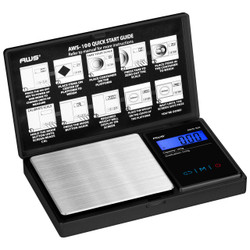
Choosing a scale for coins is mostly about matching the instrument to
what you actually collect and how you plan to use the measurements. A
collector weighing individual U.S. coins has different requirements from
someone weighing groups of silver coins, bullion, large medals, tokens,
or coins in holders.
For many collectors, a digital scale with 0.01g readability and
roughly 100g to 500g of capacity provides a practical combination of
detail and flexibility. The exact capacity should be based on the
heaviest complete load you expect to place on the scale, including any
tray, capsule, or container.
American Weigh Scales offers multiple formats in its pocket scales
collection, including compact
precision scales suitable for coins and other small collectibles.
This guide explains how to choose the right scale by evaluating
readability, capacity, accuracy, repeatability, calibration, tare,
weighing units, platform size, environmental stability, portability, and
commercial-use requirements.
Quick Guide: What Scale Do You Need for Coins?
Application Suggested capacity Suggested readability
Individual U.S. coins 100g+ 0.01g
Individual world coins 100--250g 0.01g
Gold coins 100--250g 0.01g
Silver coins 100--250g 0.01g
Coins in lightweight holders 100--250g 0.01g
Small groups of coins 250--500g 0.01g
Tokens 250--500g 0.01g
Small medals 250--500g 0.01g
Larger groups 500g+ 0.01g or 0.1g
Specialized tiny pieces Application-dependent 0.001g if needed
These are practical starting points rather than universal
specifications.
Step 1: Decide What You Will Weigh
Before comparing scale specifications, list the objects you actually
expect to measure.
Your list might include:
-
Pennies
-
Nickels
-
Dimes
-
Quarters
-
Half dollars
-
Dollar coins
-
Historical U.S. coins
-
World coins
-
Gold coins
-
Silver coins
-
Bullion coins
-
Tokens
-
Medals
-
Coin capsules
-
Small groups of coins
Then identify the lightest and heaviest examples.
This immediately narrows the scale choices.
A collector who only weighs individual coins may be completely satisfied
with a 100g scale. Someone who weighs groups or medals may need 250g,
500g, or more.
Step 2: Understand Readability
Readability is the smallest increment shown on the display.
Common options include:
-
0.1g --- tenths of a gram
-
0.01g --- hundredths of a gram
-
0.001g --- thousandths of a gram
AWS explains these distinctions in its guide to the best pocket scales
for jewelry, coins, coffee and
crafts.
For most coin collectors, 0.01g is the most useful place to start.
Step 3: Why 0.01g Works Well for Coins
A 0.01g scale can display readings such as:
-
2.50g
-
5.00g
-
5.67g
-
11.34g
Those examples align with nominal weights the U.S. Mint currently
publishes for several circulating denominations.
A whole-gram scale would show dramatically less information.
A 0.1g scale provides more detail than a whole-gram scale but still
rounds to tenths.
For general collecting, 0.01g usually provides a useful balance between
measurement detail, capacity, portability, and ease of setup.
Step 4: Decide Whether You Need 0.001g
A 0.001g scale displays thousandths of a gram.
That can be useful for specialized very-low-mass objects, but it is
usually unnecessary for ordinary coin collecting.
Finer-resolution scales can also be more sensitive to:
-
Air movement
-
Vibration
-
Static electricity
-
Temperature changes
-
Surface instability
They frequently offer lower capacity and smaller pans.
Choose 0.001g because your application requires it, not simply because
three decimal places sound better.
Step 5: Do Not Confuse Readability With Accuracy
Readability and accuracy are different concepts.
A display that changes in 0.001g increments does not automatically mean
every reading is accurate to ±0.001g.
When choosing a coin scale, review:
-
Readability
-
Manufacturer accuracy or tolerance specifications
-
Repeatability
-
Minimum usable load
-
Calibration procedure
-
Operating environment
The complete performance specification matters more than the number of
digits on the screen.
Step 6: Calculate the Capacity You Need
Capacity is the maximum total load the scale is designed to support.
For individual coins, capacity requirements are modest.
But the complete load may include:
-
Coin
-
Capsule
-
Holder
-
Tray
-
Multiple coins
-
Token
-
Medal
If you use a container, its physical weight counts toward capacity even
after you press tare.
AWS explains capacity/readability notation in What Does 500g x 0.01g
Mean on a Digital
Scale?.
Step 7: Is 100g Capacity Enough?
For individual coins, 100g is usually substantial capacity.
A 100g x 0.01g pocket scale is a compact choice for collectors who
primarily measure:
-
Individual circulating coins
-
Small historical coins
-
Individual gold or silver coins
-
Lightweight tokens
The limitation appears when you start weighing multiple coins, large
holders, or medals.
Step 8: When to Choose 200g
A 200g x 0.01g scale provides more flexibility while remaining compact.
It can accommodate:
-
Individual coins
-
Capsules
-
Holders
-
Small groups
-
Tokens
-
Lightweight medals
This is a strong option if you want more headroom than 100g without
needing 500g.
Step 9: When to Choose 250g
Around 250g is an excellent all-purpose capacity for collectors.
It provides room for:
-
Individual coins
-
Several coins together
-
Coin capsules
-
Holders
-
Tokens
-
Small medals
while remaining available with 0.01g readability.
For many collectors, 250g x 0.01g is a particularly versatile target.
Step 10: When to Choose 500g
Choose approximately 500g when you regularly weigh:
-
Groups of coins
-
Heavy medals
-
Multiple bullion pieces
-
Trays
-
Mixed collectibles
A 500g x 0.01g scale can provide substantially more headroom without
necessarily sacrificing hundredth-of-a-gram readability.
AWS's 200g vs. 500g Pocket Scale
guide
explains why capacity and readability should be evaluated separately.
Step 11: Leave Capacity Headroom
Do not intentionally choose a scale that will operate near its maximum
capacity during normal use.
Suppose:
-
Coin group = 225g
-
Tray = 20g
-
Complete load = 245g
A 250g scale technically covers the load but leaves only 5g of nominal
headroom.
A 500g scale is more flexible.
NIST's scale-selection guidance says the maximum expected load should
not exceed scale capacity.
Step 12: Consider Minimum Load
The upper limit is only half of the measuring range.
The lower end matters too.
The smallest display increment is not automatically the smallest amount
that can be measured reliably.
For extremely lightweight numismatic pieces, review the scale
manufacturer's minimum-load and performance information.
This is particularly important when considering a very fine-resolution
instrument.
Step 13: Check Repeatability
Repeatability describes whether repeated measurements of the same stable
object produce similar results under similar conditions.
A basic collector test:
-
Put the scale on a hard surface.
-
Confirm zero.
-
Place the same coin in the center.
-
Record the reading.
-
Remove it.
-
Wait for zero.
-
Repeat several times.
If the result changes unexpectedly, investigate the setup before drawing
conclusions about the coin.
Step 14: Look for Calibration
Calibration is an important feature on a precision coin scale.
Before purchasing, check:
-
Whether user calibration is supported
-
Which calibration mass is required
-
Whether the weight is included
-
How calibration mode is entered
-
Whether stabilization time is recommended
AWS provides a detailed walkthrough in How to Calibrate a Digital Scale
for Accurate
Results.
Step 15: Do Not Calibrate With a Coin
Even if a mint publishes a nominal weight for a coin, that coin should
not automatically be treated as a calibration standard.
Individual coins can differ because of:
-
Wear
-
Damage
-
Deposits
-
Manufacturing tolerance
-
Alteration
Use the reference mass specified by the scale manufacturer.
Step 16: Look for Tare
Tare is especially useful when weighing coins in:
-
Trays
-
Cups
-
Holders
-
Lightweight containers
To use it:
-
Place the empty container on the scale.
-
Wait for stability.
-
Press tare.
-
Confirm zero.
-
Add the coin or coins.
-
Record the net result.
Remember that the container still physically counts toward maximum
capacity.
Step 17: Make Sure It Measures Grams
Grams are the most important general-purpose unit for coin collecting.
The U.S. Mint publishes current coin specifications in grams, making
comparison straightforward.
Current nominal examples include:
U.S. denomination Published weight
One-cent coin 2.50g
Nickel 5.00g
Dime 2.268g
Quarter 5.67g
Half dollar 11.34g
Native American / Innovation dollar 8.10g
The U.S. Mint Coin
Specifications
page is an authoritative source for current U.S. issues.
Historical coins may have different specifications.
Step 18: Decide Whether You Need Troy Ounces
Troy ounces, abbreviated ozt, are useful for precious metals and
bullion.
This feature can be valuable if your collection includes:
-
Gold bullion coins
-
Silver bullion coins
-
Rounds
-
Other precious-metal objects
For ordinary circulating-coin collecting, grams remain the more useful
primary unit.
Step 19: Consider Pennyweight
Pennyweight, abbreviated dwt, is used in parts of the
precious-metals and jewelry trade.
It is not essential for most numismatists, but it can make a scale more
versatile if you also work with:
-
Gold
-
Silver
-
Jewelry
-
Scrap precious metals
Step 20: Check Platform Size
Most coins fit easily on a pocket-scale platform.
Platform size becomes more important for:
-
Large medals
-
Groups of coins
-
Trays
-
Holders
-
Bullion pieces
The complete object must be supported by the scale.
If part of a tray or medal touches the table, the measurement can be
incorrect because another surface is supporting part of the load.
Step 21: Choose a Stable Platform
A rigid, easy-to-clean weighing platform helps produce repeatable
measurements.
Stainless steel is common on precision pocket scales because it is
durable and straightforward to maintain.
For valuable coins, use an appropriate tray or holder when direct
contact with the platform is undesirable.
Step 22: Consider a Protective Cover
A protective cover is particularly useful for a portable coin scale.
It can help protect the weighing platform from:
-
Dust
-
Scratches
-
Pressure
-
Accidental loading
-
Transport damage
This matters if you bring your scale to shows, auctions, shops, club
meetings, or estate evaluations.
Step 23: Choose a Clear Display
A good display should have:
-
Large digits
-
Clear decimal placement
-
Visible unit indicator
-
Backlighting when useful
Coin measurements often involve small differences, so the display should
be easy to read correctly.
Step 24: Check Stable Zero Behavior
When the coin is removed, the scale should return consistently to zero
within its normal performance.
If it does not, investigate:
-
Drafts
-
Vibration
-
Temperature
-
Static
-
Battery condition
-
Calibration
-
Platform contamination
AWS covers common causes in Why Does My Digital Scale Give Different
Readings?.
Step 25: Think About Air Movement
Fine-resolution scales can react to drafts.
Avoid weighing directly beside:
-
Fans
-
HVAC vents
-
Open windows
-
Doors
For 0.001g measurements, draft control becomes even more important.
Step 26: Control Vibration
Use a hard, rigid, stable table.
Avoid:
-
Wobbly furniture
-
Flexible shelves
-
Machinery benches
-
Soft surfaces
If the support surface moves, the scale may struggle to produce a stable
final reading.
Step 27: Allow for Temperature Stability
A precision scale moved from a hot car into an air-conditioned coin show
may need time to acclimate.
Follow the manufacturer's operating instructions and allow the
instrument to stabilize before important measurements or calibration.
Step 28: Consider Static
Static electricity can influence very lightweight objects and
fine-resolution instruments.
Potential contributors include:
-
Plastic trays
-
Dry environments
-
Synthetic materials
If readings remain unstable after drafts and vibration are controlled,
static is another factor to investigate.
Step 29: Think About Power
Battery-powered scales are convenient for:
-
Coin shows
-
Travel
-
Auctions
-
Club meetings
-
Estate visits
For a permanent workstation, AC power can also be useful if the chosen
model supports it.
Weak batteries can contribute to unusual electronic-scale behavior, so
keep replacements available.
Step 30: Decide How Portable the Scale Must Be
If the scale stays on one desk, size may not matter much.
If you travel with it, prioritize:
-
Compact dimensions
-
Protective cover
-
Battery power
-
Durable housing
-
Easy controls
Pocket scales are particularly convenient for collectors who need
precision away from home.
How to Choose a Scale for U.S. Coins
For ordinary individual U.S. coins:
100--250g x 0.01g
is a strong general-purpose range.
Choose more capacity if you weigh groups or large holders.
Use official specifications for the exact denomination and issue.
How to Choose a Scale for Silver Coins
For individual silver coins:
100--250g+ x 0.01g
is a useful starting point.
For groups:
250--500g+ x 0.01g
may be more appropriate.
Troy-ounce mode is a useful bonus for collectors who also work with
bullion.
How to Choose a Scale for Gold Coins
Individual gold coins generally do not require high capacity.
A 100--250g x 0.01g scale can provide substantial headroom.
Prioritize:
-
Repeatability
-
Calibration
-
Grams
-
Stable platform
-
Tare
-
Troy ounces if useful
Remember that weight alone cannot determine gold purity or coin
authenticity.
How to Choose a Scale for Bullion Coins
Bullion collectors should consider:
-
0.01g readability
-
250--500g+ capacity
-
Grams
-
Troy ounces
-
Calibration
-
Tare
-
Platform size
If you weigh multiple bullion pieces together, calculate the combined
load before selecting capacity.
How to Choose a Scale for Ancient Coins
Ancient coins can vary dramatically in:
-
Size
-
Weight
-
Metal
-
Shape
-
Condition
A 0.01g scale is useful for many pieces.
Very small ancient coins may justify 0.001g in specialized work, but
identification should never rely on weight alone.
How to Choose a Scale for Tokens
Tokens can be heavier than ordinary coins.
A 250--500g x 0.01g scale is a flexible choice for many token
collections.
Check platform dimensions if the tokens are unusually large.
How to Choose a Scale for Medals
Medals may require more capacity and a larger platform.
Consider:
-
500g or more capacity
-
0.01g or 0.1g readability depending on the purpose
-
Large enough platform
-
Stable support
For large medals, a bench scale may be more practical than a pocket
scale.
Pocket Scale vs. Kitchen Scale for Coins
Kitchen scales commonly prioritize:
-
High capacity
-
Large platform
-
Food weighing
Many read only to 1g or 0.1g.
A precision pocket scale commonly provides finer 0.01g readability,
which is more useful for individual coins.
For most collectors, the pocket scale is the better first choice.
Pocket Scale vs. Milligram Scale
Choose a 0.01g pocket scale for:
-
General coins
-
Portability
-
Holders
-
Groups
-
Tokens
-
Most medals
Choose a 0.001g milligram scale for:
-
Specialized tiny pieces
-
Very-low-mass samples
-
Applications where hundredths are too coarse
Do not buy 0.001g merely because it sounds more precise.
Pocket Scale vs. Bench Scale
Choose a pocket scale when you prioritize:
-
Portability
-
Individual coins
-
Coin shows
-
Small groups
-
Compact storage
Choose a bench scale when you need:
-
Large platform
-
Higher capacity
-
Heavy medals
-
Large groups
-
Permanent workstation
Some serious collectors may benefit from both.
Can a Scale Tell Whether a Coin Is Genuine?
No.
Weight is one characteristic.
A coin can match an expected nominal weight and still require further
authentication.
Other factors can include:
-
Diameter
-
Thickness
-
Composition
-
Edge details
-
Surface characteristics
-
Die diagnostics
-
Provenance
-
Professional authentication
A scale is a measurement tool, not a complete authentication system.
Why a Genuine Coin May Differ From Nominal Weight
Measured mass can differ because of:
-
Circulation wear
-
Damage
-
Corrosion
-
Deposits
-
Cleaning
-
Manufacturing tolerances
-
Scale/environmental effects
Do not automatically interpret a small difference as evidence of a
counterfeit.
Use issue-specific numismatic references and appropriate professional
evaluation when authenticity matters.
How to Weigh a Coin Correctly
Use a consistent procedure:
-
Place the scale on a hard, level surface.
-
Keep it away from airflow.
-
Turn it on with the platform empty.
-
Allow it to stabilize.
-
Select grams.
-
Confirm zero.
-
Add and tare a tray if needed.
-
Place the coin near the center.
-
Wait for a stable reading.
-
Record the result.
-
Remove the coin.
-
Confirm return to zero.
-
Repeat important measurements when appropriate.
Consistency improves the usefulness of comparisons.
Should You Remove a Coin From a Capsule?
Not necessarily.
Do not remove a valuable professionally encapsulated coin merely to
obtain a weight.
For ordinary removable holders, you may be able to account for the
holder using tare or by weighing an identical empty holder, depending on
the purpose.
Protecting the coin is more important than obtaining a bare-coin
measurement when removal could cause damage.
Commercial Coin and Bullion Weighing
A scale used for collecting or cataloging is different from a scale used
to determine the amount charged or paid in a commercial transaction.
NIST's scale FAQ says commercial scales must comply with the laws of the
state where they are used. NIST also advises selecting equipment based
on suitability, accuracy class, capacity, minimum load, and usability.
The current 2026 NIST Handbook
44
provides specifications, tolerances, and technical requirements used by
many weights-and-measures authorities.
If coins, bullion, gold, or silver are bought or sold by weight, verify:
-
State requirements
-
Local requirements
-
Device approval
-
Inspection requirements
-
Accuracy class
-
Minimum-load requirements
-
Legal-for-trade status
Do not assume a consumer pocket scale is automatically approved for
commercial transactions.
Understanding Minimum Load for Commercial Applications
For regulated commercial applications, minimum load is more technical
than simply asking whether the display turns on at a tiny weight.
NIST's Considerations for Class II Scale
Applications
explains how verification scale division, scale division, minimum
capacity, and recommended minimum load interact in commercial scale
selection.
Collectors using a scale only for hobby measurements generally do not
need to apply commercial metrology rules to every measurement, but
businesses should understand the distinction.
International Measurement Framework
The BIPM SI Brochure
provides the international framework for the International System of
Units.
For collectors, the practical takeaway is simple: grams provide a
convenient standardized unit for comparing measured coin mass with
authoritative specifications.
Coin Scale Buying Checklist
Before purchasing, answer these questions:
-
Which coins will I weigh?
-
Will I weigh individual pieces or groups?
-
What is the lightest object?
-
What is the heaviest complete load?
-
Will I use a holder, tray, or capsule?
-
Is 100g capacity enough?
-
Would 200--250g be more flexible?
-
Do I need 500g or more?
-
Is 0.01g readability sufficient?
-
Do I genuinely need 0.001g?
-
What accuracy does the manufacturer specify?
-
What is the minimum usable load?
-
How repeatable is the scale?
-
Can it be calibrated?
-
Which calibration mass is required?
-
Is the calibration weight included?
-
Does it have tare?
-
Does it measure grams?
-
Do I need troy ounces?
-
Is the platform large enough?
-
Does it have a protective cover?
-
Is the display easy to read?
-
Is it battery powered?
-
Will I travel with it?
-
Will it be used in a commercial transaction?
Common Mistakes
Choosing by Decimal Places Alone
Three decimal places do not automatically make a scale better for
ordinary coins.
Buying Too Little Capacity
Remember trays, groups, medals, and holders.
Buying Too Much Capacity Without Checking Readability
A large-capacity scale can be too coarse for detailed coin work.
Confusing Readability and Accuracy
They describe different characteristics.
Ignoring Repeatability
Consistent measurements matter.
Skipping Calibration
Choose a scale with a clear calibration procedure.
Using a Coin as a Calibration Weight
Use the reference mass specified by the manufacturer.
Forgetting Tare
A container still contributes to the physical load.
Ignoring Platform Size
Large medals and groups need full support.
Weighing on an Unstable Surface
Vibration can make the display fluctuate.
Weighing Near Airflow
Drafts matter more as resolution becomes finer.
Treating Weight as Proof of Authenticity
It is only one data point.
Assuming Every Scale Is Legal for Trade
Commercial requirements may apply.
Frequently Asked Questions
What scale should I buy for coins?
For many collectors, a 0.01g pocket scale with approximately 200--500g
capacity is a versatile choice.
Is 0.01g good for coins?
Yes. Hundredth-of-a-gram readability provides useful detail for many
collectible-coin applications.
Do I need 0.001g?
Usually not for general collecting. Choose it only for specialized
low-mass work.
Is 100g enough?
It is enough for most individual coins. Higher capacity is useful for
groups, trays, tokens, and medals.
Is 250g a good capacity?
Yes. It provides useful headroom while remaining compact.
Should I choose 500g?
Choose 500g if you regularly weigh groups, medals, bullion, or
containers.
What is the difference between capacity and readability?
Capacity is the maximum supported load. Readability is the smallest
displayed increment.
Is readability the same as accuracy?
No.
Does a coin scale need calibration?
A clear calibration process is highly desirable for a precision scale.
Can I calibrate with a nickel?
Use the reference mass specified by the scale manufacturer rather than a
coin.
Is tare important?
Yes, especially if you use trays or containers.
Should the scale measure grams?
Yes. Grams are widely used in official coin specifications.
Do I need troy ounces?
They are useful for bullion and precious metals but optional for
ordinary coin collecting.
Can weight identify a fake coin?
No. Weight can support an evaluation but cannot authenticate a coin by
itself.
Why does my coin weigh differently from the official specification?
Wear, damage, deposits, manufacturing tolerances, incorrect
identification, environmental conditions, and scale performance can all
contribute.
Is a kitchen scale good enough?
It may be adequate for rough measurements, but many kitchen scales do
not provide the 0.01g readability useful for detailed coin work.
What is the best scale for a coin show?
A compact battery-powered 0.01g pocket scale with a protective cover and
roughly 200--500g capacity is a flexible choice.
Final Verdict: How to Choose a Scale for Coins
For most collectors, start with 0.01g readability and then choose
capacity based on the heaviest complete load.
A practical framework is:
-
100g x 0.01g: individual coins and maximum portability
-
200--250g x 0.01g: individual coins, holders, small groups,
tokens, and broad collector use -
500g x 0.01g: groups, medals, bullion, trays, and extra headroom
-
0.001g: specialized very-low-mass applications
-
Higher-capacity scale: large medals, bulk groups, and heavier
containers
Then compare accuracy specifications, repeatability, minimum load,
calibration, tare, units, platform size, display, protective design,
power source, and operating environment.
The best scale for coins is not the one with the highest capacity or the
most decimal places. It is the scale whose complete measuring range
and features match the coins you actually collect.
Use the scale to obtain useful mass measurements, compare those
measurements with authoritative specifications, and document your
collection---but remember that weight alone cannot establish
authenticity, grade, composition, rarity, or value.