
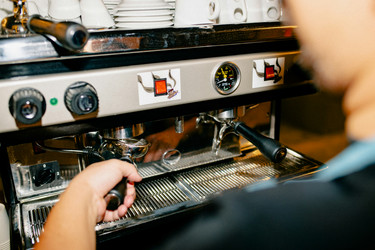
Choosing a scale for espresso is different from choosing an ordinary
kitchen scale. Espresso uses relatively small coffee doses, the beverage
flows quickly, and the scale often has to fit into the limited space
between an espresso machine's drip tray and group head.
That means the best espresso scale is not necessarily the one with the
highest capacity or the most decimal places.
For most espresso preparation, start with 0.1g readability, then
evaluate response speed, tare, timer functionality, capacity, physical
dimensions, platform size, calibration, repeatability, display
visibility, and splash resistance.
American Weigh Scales currently recommends 0.1g readability for coffee
and espresso preparation. Its BARISTA-3KG combines 3,000g capacity with
0.1g readability, a built-in timer, splash-resistant construction, and
coffee-focused features. citeturn0search5
If you only weigh beans or grounds before brewing, a smaller model from
the AWS pocket scales collection
may be enough.
This guide walks through each decision so you can choose a scale that
fits both your espresso recipe and your machine.
Quick Answer: How to Choose an Espresso Scale
For most espresso users, look for:
-
0.1g readability
-
Fast response
-
Tare
-
Built-in timer
-
500g--1kg+ capacity for espresso-focused use
-
2--3kg capacity if you also make pour-over
-
Compact footprint
-
Low-profile body
-
Platform large enough for your cup
-
Visible display
-
Splash resistance
-
Stable repeatability
-
Clear calibration procedure
AWS's current Best Scale for Coffee Beans and Espresso
Dosing
guide likewise emphasizes 0.1g readability, fast tare, adequate
capacity, and platform size. citeturn0search5
Step 1: Decide What You Will Weigh
Before comparing scale specifications, decide exactly what will sit on
the platform.
You may weigh:
-
Whole coffee beans
-
Ground coffee
-
Dosing cup
-
Portafilter
-
Espresso cup
-
Espresso beverage
-
Pour-over brewer
-
Carafe
These uses require very different capacities and platform dimensions.
A scale used only beside the grinder can be tiny.
A scale used beneath the espresso machine must fit the drip tray.
A scale used for pour-over needs substantially more capacity.
Step 2: Choose 0.1g Readability for Most Espresso
Readability is the smallest increment shown by the display.
A 0.1g scale displays values such as:
-
17.8g
-
17.9g
-
18.0g
-
18.1g
-
18.2g
This level of detail is well suited to espresso dosing and
beverage-yield measurement.
The Specialty Coffee Association has reported contemporary espresso
practices involving 18--20g doses and approximately 36.5g beverage
output, illustrating why tenths of a gram are useful.
citeturn0search6
Step 3: Understand Why 1g Can Be Too Coarse
A whole-gram kitchen scale can weigh coffee, but it provides relatively
little information around a small espresso dose.
Suppose your target is:
18.0g
A 0.1g scale lets you see small changes as you approach the target.
That makes it easier to keep the dose consistent while adjusting other
variables such as grind size.
For espresso, 0.1g is generally more useful than 1g.
Step 4: Decide Whether You Need 0.01g
Most espresso users do not.
A 0.01g scale can be useful for:
-
Specialized experiments
-
Individual-bean comparisons
-
Very small samples
-
Other precision hobbies
But the extra decimal place often comes with tradeoffs:
-
Lower capacity
-
Smaller platform
-
Greater environmental sensitivity
For everyday espresso, 0.1g is usually the better balance.
Step 5: Skip 0.001g for Normal Espresso
A 0.001g milligram scale is generally unnecessary for espresso.
Such scales are designed for much smaller quantities and can be more
sensitive to:
-
Drafts
-
Vibration
-
Static
-
Temperature
Espresso benefits more from a fast, stable 0.1g measurement than from
laboratory-style resolution.
Step 6: Do Not Confuse Readability With Accuracy
Readability, accuracy, and repeatability are different concepts.
Readability is the smallest displayed increment.
Accuracy concerns agreement with an appropriate reference within the
scale's stated performance.
Repeatability concerns whether the same stable load produces
consistent readings under similar conditions.
NIST notes that real-world measurement uncertainty can include
contributions from the instrument, method, operator, and physical
environment. citeturn0search4
Do not choose a scale based on decimal places alone.
Step 7: Prioritize Response Speed
Response speed is critical when measuring espresso output.
During extraction, beverage mass changes continuously.
A slow display may lag behind the actual amount in the cup.
If your target is 36g, you need to see the measurement quickly enough to
stop the extraction close to that target.
For beans alone, response speed is less critical.
For an active espresso shot, it becomes one of the most important
features.
Step 8: Look for Tare
Tare should be considered essential.
For bean dosing:
-
Place the dosing cup on the scale.
-
Press tare.
-
Confirm zero.
-
Add beans.
-
Stop at your target.
For espresso output:
-
Place the cup on the scale.
-
Press tare.
-
Start extraction.
-
Monitor beverage mass.
Tare removes the container from the displayed net measurement.
Step 9: Remember That Tare Does Not Increase Capacity
Suppose your portafilter weighs 450g.
You place it on a 500g scale and tare it.
The display returns to zero, but the scale is still supporting 450g.
If you then add a funnel and coffee, you may exceed the scale's
capacity.
AWS explains how capacity and displayed increments work in What Does
500g x 0.01g Mean on a Digital
Scale?.
Step 10: Choose Capacity Based on the Gross Load
Capacity must include everything resting on the scale.
For espresso, that could include:
-
Dosing cup + coffee
-
Portafilter + basket + coffee
-
Cup + espresso
Do not calculate capacity from the coffee dose alone.
Step 11: Consider 200--500g for Beans and Grounds
If you only weigh beans or grounds, you need relatively little capacity.
A 200--500g scale can easily handle:
-
18g espresso doses
-
20g espresso doses
-
Small dosing cups
-
Travel coffee portions
This is where compact pocket scales work particularly well.
Step 12: Consider 500--750g for More Flexibility
A 500--750g scale gives you more headroom for:
-
Heavier dosing cups
-
Espresso cups
-
Small bowls
-
Some portafilters
AWS's Best Pocket Scales for Jewelry, Coins, Coffee and
Crafts
discusses compact 0.1g scales for coffee beans and grounds.
Step 13: Consider 1kg for Heavy Portafilters
If you want to place the complete portafilter on the scale, check its
actual weight.
Example:
-
Portafilter: 450g
-
Funnel: 30g
-
Coffee: 20g
Total:
500g
A 500g scale has no useful headroom.
A 750g or 1kg scale is more appropriate.
Step 14: Consider 3kg for Espresso Plus Pour-Over
If you want one scale for multiple coffee methods, 3kg is highly
versatile.
AWS currently lists the BARISTA-3KG Coffee/Kitchen
Scale at 3,000g
x 0.1g. Its current product information also lists a built-in timer, a
3.94 x 4.72-inch platform, and a body measuring approximately 5.77 x
5.04 x 0.9 inches. citeturn0search14
This type of capacity can handle:
-
Espresso
-
Pour-over
-
AeroPress
-
Mugs
-
Carafes
-
General coffee preparation
Step 15: Leave Capacity Headroom
Avoid choosing a scale that routinely operates at its maximum.
Headroom helps accommodate:
-
Different cups
-
Larger dosing containers
-
Accessories
-
Accidental extra load
If your normal setup weighs 480g, a 500g scale is not an ideal choice.
Step 16: Measure Your Drip Tray
Do not buy an espresso scale before checking physical fit.
Measure:
-
Drip-tray width
-
Drip-tray depth
-
Available vertical clearance
Then compare those measurements with the scale.
A high-quality scale is useless beneath your espresso machine if it does
not physically fit.
Step 17: Check Scale Height
Low-profile construction matters because the scale sits beneath the cup.
The total stack becomes:
drip tray + scale + cup
If the scale is too tall, your cup may no longer fit comfortably beneath
the portafilter or group head.
For espresso output, a thin scale is highly desirable.
Step 18: Check Platform Size
The cup should sit securely on the weighing platform.
If part of the cup touches the machine or another surface, the scale may
not support the complete load.
For portafilter dosing, the platform must also support the portafilter
securely.
Capacity alone is not enough.
Step 19: Check Display Placement
The display should remain visible while the cup is on the platform.
Look for:
-
Large digits
-
Backlighting
-
Clear decimal point
-
Visible timer
-
Good viewing angle
If your espresso cup blocks the display, real-time measurement becomes
difficult.
Step 20: Choose a Built-In Timer if You Measure Shots
A timer is highly useful for espresso.
It lets you monitor:
-
Pre-infusion
-
Extraction duration
-
Dose-to-yield timing
-
Recipe consistency
You can use a separate timer, but an integrated timer keeps mass and
time in one place.
Step 21: Understand Dose, Yield and Time
Three measurements make espresso easier to reproduce:
Dose: dry coffee used.
Yield: beverage mass in the cup.
Time: extraction duration.
Example:
-
Dose: 18.0g
-
Yield: 36.0g
-
Time: 28 seconds
Those numbers give you a repeatable recipe.
Step 22: Understand Brew Ratio
Brew ratio compares dry coffee input with espresso output.
Example:
18g coffee → 36g espresso
36 ÷ 18 = 2
That is a 1:2 ratio.
The SCA's discussion of contemporary espresso reports an average barista
practice around a 1:2 ratio, while also making clear that espresso
practices evolve. citeturn0search6
Your preferred ratio may differ.
The important point is that a scale lets you measure it.
Step 23: Look for Splash Resistance
Espresso scales operate around liquid.
They may encounter:
-
Water
-
Espresso
-
Wet cups
-
Steam condensation
-
Drips
Splash-resistant construction is useful.
Do not assume splash resistance means the scale can be immersed.
Step 24: Consider a Silicone Mat
A removable silicone mat can:
-
Improve cup grip
-
Protect the weighing platform
-
Catch minor drips
-
Simplify cleaning
AWS's current BARISTA-3KG design includes a removable silicone mat as
part of its coffee-focused setup. citeturn0search5turn0search14
Step 25: Evaluate Repeatability
A scale should behave consistently when the same stable object is
weighed repeatedly.
Test it:
-
Confirm zero.
-
Place the same dosing cup on the platform.
-
Record the result.
-
Remove it.
-
Wait for zero.
-
Repeat.
If results vary unexpectedly, investigate the setup.
Step 26: Look for a Stable Zero
After removing the load, the scale should return predictably to zero.
If it does not, check:
-
Coffee grounds around the platform
-
Water or residue
-
Battery condition
-
Surface stability
-
Air movement
-
Calibration
AWS discusses these issues in Why Does My Digital Scale Give Different
Readings?.
Step 27: Check Calibration
A precision espresso scale should have a clear calibration process.
Find out:
-
Whether user calibration is supported
-
Which calibration mass is required
-
Whether the weight is included
-
How calibration mode works
AWS provides a step-by-step overview in How to Calibrate a Digital
Scale for Accurate
Results.
Step 28: Use the Correct Calibration Reference
Do not calibrate a precision scale with:
-
Coffee beans
-
Coins
-
Random kitchen objects
-
A bag labeled with a nominal net weight
NIST explains that calibrating a mass standard involves establishing its
mass value and an appropriate uncertainty through controlled reference
procedures. citeturn0search0
For a consumer espresso scale, follow the manufacturer's specified
calibration procedure and reference mass.
Step 29: Use Grams
Grams are the most convenient unit for espresso recipes.
NIST explains that the kilogram is the SI base unit of mass and that
decimal multiples and submultiples are formed using the gram.
citeturn0search1
Using grams lets you express both coffee input and beverage output in
the same system:
18g in → 36g out
That makes ratio calculations simple.
Step 30: Consider Battery vs. Rechargeable Power
Battery-Powered Scale
Useful for:
-
Travel
-
Moving between coffee stations
-
Simple battery replacement
Rechargeable Scale
Useful for:
-
Permanent espresso stations
-
Frequent use
-
Convenient routine charging
Neither option is inherently more precise.
Choose according to your workflow.
Step 31: Check Auto-Off Behavior
Auto-off saves battery power.
But a scale that shuts down too quickly can interrupt your workflow
while you:
-
Grind
-
Distribute
-
Tamp
-
Flush the machine
-
Prepare the cup
Look for a timeout that works with your preparation routine.
Step 32: Consider Cleaning
Espresso stations accumulate:
-
Coffee grounds
-
Espresso drips
-
Water
-
Coffee oils
Choose a scale that is easy to wipe down.
Keep grounds away from gaps around the weighing platform.
Best Scale for Espresso Beans
If you only weigh beans:
200--600g x 0.1g
is a strong range.
Prioritize:
-
Tare
-
Compact size
-
Fast response
-
Stable readings
-
Protective cover
A pocket scale is often ideal.
Best Scale for Espresso Grounds
For grounds in a dosing cup:
200--600g x 0.1g
is usually enough.
If the dosing cup is heavy, move toward 500--750g.
Best Scale for Portafilter Dosing
For a complete portafilter, calculate:
portafilter + basket + funnel + coffee
Then add headroom.
A 750g or 1kg scale may be more suitable than a 500g pocket model.
Best Scale for Espresso Output
For measuring the beverage beneath the machine, prioritize:
-
0.1g readability
-
Fast response
-
Tare
-
Timer
-
Low-profile design
-
Compact footprint
-
Splash resistance
-
Visible display
Physical fit is often more important than very high capacity.
Best Scale for Espresso and Pour-Over
For one scale that handles both methods:
3,000g x 0.1g
is a highly versatile format.
The larger capacity supports many pour-over setups while the 0.1g
readability remains useful for espresso.
Best Scale for Travel Espresso
If portability matters:
200--600g x 0.1g
is easier to carry.
Use it primarily for:
-
Beans
-
Grounds
-
Dosing
A separate timer can handle extraction timing.
Pocket Scale vs. Espresso Scale
Choose a Pocket Scale If You:
-
Weigh beans
-
Weigh grounds
-
Travel frequently
-
Need compact storage
-
Keep the scale beside the grinder
Choose a Dedicated Espresso Scale If You:
-
Measure beverage output
-
Time shots
-
Keep the scale on the drip tray
-
Need splash resistance
-
Want a low-profile design
Espresso Scale vs. Kitchen Scale
A kitchen scale can work for espresso if it provides:
-
0.1g readability
-
Fast response
-
Tare
-
Suitable dimensions
However, many kitchen scales are:
-
Too large
-
Too tall
-
Limited to 1g readability
The physical constraints of an espresso machine make a coffee-specific
scale more convenient.
Should You Use Two Scales?
Some espresso enthusiasts benefit from two.
Grinder/Dosing Scale
500--600g x 0.1g
Use for:
-
Beans
-
Grounds
-
Dosing
Brewing Scale
500g--3kg x 0.1g
Use for:
-
Espresso cup
-
Beverage yield
-
Timing
-
Pour-over if desired
This keeps one scale beside the grinder and one beneath the machine.
Example 1: Bean Dosing
Dosing cup:
70g
Coffee:
18g
Gross load:
88g
Even a 200g scale provides plenty of capacity.
Example 2: Heavy Dosing Cup
Dosing cup:
180g
Coffee:
20g
Gross load:
200g
A 200g scale leaves no headroom.
A 500g scale is a better choice.
Example 3: Portafilter
Portafilter:
450g
Funnel:
30g
Coffee:
20g
Gross load:
500g
Choose more than 500g capacity.
Example 4: Espresso Output
Cup:
180g
Espresso:
40g
Gross load:
220g
A 500g scale has ample capacity.
The more important questions are response speed, timer, platform size,
and machine fit.
How to Use a Scale for Espresso Dosing
-
Put the scale on a stable surface.
-
Turn it on.
-
Select grams.
-
Place the dosing cup on the platform.
-
Press tare.
-
Add beans.
-
Stop at your target dose.
-
Grind.
-
Prepare the puck.
Holding dose constant makes grinder adjustments easier to compare.
How to Use a Scale for Espresso Output
-
Place the scale on the drip tray.
-
Put the cup on the platform.
-
Confirm nothing touches the cup or scale.
-
Press tare.
-
Start the timer.
-
Begin extraction.
-
Watch beverage mass.
-
Stop near your target.
-
Record final yield and time.
-
Taste and adjust.
This gives you measurable data for dialing in.
Why a Scale Helps With Grinder Adjustments
Suppose Shot A is:
-
18.0g dose
-
36.0g yield
-
20 seconds
Shot B is:
-
18.0g dose
-
36.0g yield
-
28 seconds
If dose and yield remain constant, the change in time gives you useful
information about how the grind adjustment affected flow.
Without a scale, several variables can change at once.
Espresso Scale Buying Checklist
Before buying, ask:
-
Will I weigh beans only?
-
Will I weigh grounds?
-
Will I weigh a portafilter?
-
Will I measure espresso output?
-
Does the scale read to 0.1g?
-
Do I actually need 0.01g?
-
Is response speed suitable for espresso?
-
Does it have tare?
-
Does it have a timer?
-
What is the maximum capacity?
-
Have I included container weight?
-
Is there enough headroom?
-
Does it fit the drip tray?
-
Is it low enough for the cup?
-
Is the platform large enough?
-
Is the display visible?
-
Is it splash resistant?
-
Does it have a removable mat?
-
Is repeatability good?
-
Does it return reliably to zero?
-
Can it be calibrated?
-
What calibration mass is required?
-
Is the power system convenient?
-
Will auto-off interrupt preparation?
-
Is it easy to clean?
-
Will I also use it for pour-over?
-
Will I travel with it?
Common Mistakes When Choosing an Espresso Scale
Buying by Decimal Places Alone
More decimals do not automatically mean better espresso measurements.
Choosing 1g Readability
Whole grams are relatively coarse for espresso.
Buying 0.001g for Everyday Espresso
Milligram readability is generally unnecessary.
Ignoring Response Speed
A slow display can lag behind an active shot.
Forgetting the Timer
Time is useful when dialing in espresso.
Buying Too Little Capacity
Remember the portafilter and containers.
Assuming Tare Restores Capacity
It does not.
Ignoring Drip-Tray Dimensions
The scale must physically fit.
Ignoring Height
A tall scale can reduce cup clearance.
Ignoring Platform Size
The cup needs stable support.
Ignoring Display Position
The cup should not hide the measurement.
Calibrating With Coffee Beans
Use the manufacturer's specified reference.
Ignoring Splash Exposure
Espresso preparation happens around liquid.
Frequently Asked Questions
What scale should I choose for espresso?
For most users, choose a 0.1g scale with fast response, tare, a timer,
sufficient capacity, compact dimensions, and splash-resistant
construction.
Is 0.1g good enough?
Yes. It provides useful detail for normal espresso dosing and
beverage-yield measurement.
Do I need 0.01g?
Usually not. It is more useful for specialized experiments.
Do I need 0.001g?
No for ordinary espresso preparation.
Is 500g enough?
For beans, grounds, cups, and many dosing containers, yes. It may not be
enough for a heavy portafilter.
Should I choose 750g or 1kg?
Choose more capacity if you weigh a complete portafilter or heavier
accessories.
Is 3kg too much?
No if you want one scale for espresso, pour-over, AeroPress, and general
coffee preparation.
Does response speed matter?
Yes. Espresso output changes quickly.
Do I need a timer?
It is highly useful for tracking extraction duration.
Does tare increase capacity?
No.
Does platform size matter?
Yes. The cup or portafilter must fit securely.
Does scale height matter?
Yes. Low-profile scales preserve cup clearance.
Should the scale be waterproof?
Splash resistance is useful. Do not assume a scale is waterproof or
submersible unless explicitly specified.
Should I calibrate it?
Follow the manufacturer's instructions. Check calibration or scale
performance when readings become unusual or after conditions such as
transport when appropriate.
Can I calibrate it with coffee beans?
No. Use the specified calibration reference.
What espresso ratio should I use?
A roughly 1:2 dose-to-output ratio is a common contemporary starting
point, but the right ratio depends on the coffee, equipment, and flavor
target. citeturn0search6
Can I use a pocket scale?
Yes for beans and grounds. For espresso output, confirm that it fits the
machine and is suitable for use around liquid.
Can I use a kitchen scale?
Yes if it has suitable readability, response speed, dimensions, tare,
and capacity.
Final Verdict: How to Choose a Scale for Espresso
For most espresso users, start with 0.1g readability.
Then choose the scale around the actual job:
-
200--500g x 0.1g: beans, grounds, and compact dosing
-
500--750g x 0.1g: heavier dosing cups and portable espresso use
-
750g--1kg+ x 0.1g: portafilters and heavier accessories
-
2--3kg x 0.1g: espresso plus pour-over and broader coffee
preparation -
0.01g: specialized experiments
-
0.001g: generally unnecessary for espresso
For measuring an active espresso shot, prioritize fast response, tare,
a built-in timer, low-profile dimensions, platform fit, display
visibility, and splash resistance.
For beans alone, a compact pocket scale may be the better choice.
For one scale that can handle both espresso and broader coffee
preparation, a 3,000g x 0.1g format provides substantially more
flexibility. AWS's current BARISTA-3KG is specified at 3kg/0.1g with a
timer and a compact 0.9-inch-high body. citeturn0search14
The best espresso scale is not the one with the highest capacity or
smallest displayed increment. It is the one that fits your machine,
responds quickly enough for a flowing shot, measures the loads you
actually use, and helps you repeat dose, yield, and time consistently.