
Start With What You Actually Weigh
Choosing a scale for gold and silver starts with the objects you handle. A scale for individual rings has different requirements from one used for heavy silver jewelry or grouped scrap metal. List your lightest meaningful sample, your heaviest item or batch, and every tray or container you normally use.
For many individual jewelry pieces, coins, findings, and small precious-metal samples, 0.01g readability is a practical starting point. Tiny gold fragments may benefit from 0.001g, while large silver lots may need higher capacity even if 0.1g readability is sufficient.
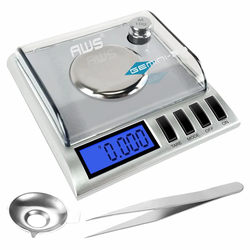
American Weigh Scales offers compact options in its pocket scales collection for jewelry, coins, precious metals, crafts, and other small-object applications.
Choose the Right Readability
Readability is the smallest increment shown on the display. A 0.1g scale reads in tenths of a gram, a 0.01g scale in hundredths, and a 0.001g scale in thousandths.
For general gold and silver jewelry, 0.01g is often the most versatile choice. It provides useful detail for rings, earrings, pendants, chains, bracelets, coins, findings, repairs, and small scrap lots. A 0.001g scale is better suited to tiny fragments, lightweight components, and samples for which hundredths of a gram are too coarse. A 0.1g scale can be appropriate for larger silver pieces or bulk material where higher capacity matters more than very fine resolution.
More decimal places do not automatically mean greater accuracy. Readability describes the display increment; accuracy and repeatability are separate performance characteristics.
Choose Enough Capacity
Capacity is the maximum total load the scale is designed to support. A specification such as 500g x 0.01g means 500 grams of maximum capacity with readings displayed in 0.01-gram increments. AWS explains this notation in What Does 500g x 0.01g Mean on a Digital Scale?.
Everything on the platform counts toward capacity, including trays and containers. If a tray weighs 80g and the silver weighs 390g, the physical load is 470g even after you press tare.
A useful starting guide is 100–250g for rings, earrings, pendants and small coins; 200–500g for chains, bracelets and many silver jewelry pieces; 500–1,000g for grouped jewelry and small scrap lots; and higher capacities for bulk silver or larger precious-metal batches.
Leave Capacity Headroom
Do not choose a scale that will routinely operate at its maximum capacity. If your normal complete load is 470g, a 500g scale leaves very little flexibility. A higher-capacity model may be more practical.
Headroom accommodates heavier-than-expected pieces, containers, multiple items, and future uses. At the same time, do not buy maximum capacity without checking readability. The best choice balances both specifications.
AWS's comparison of 200g vs. 500g pocket scales illustrates why both capacities can work for jewelry depending on the load.
Understand Accuracy and Repeatability
Accuracy describes how close a measurement is to the relevant reference value within the instrument's stated performance. Repeatability describes how consistently the same stable object is measured under the same conditions.
When comparing scales, review the manufacturer's tolerance, intended operating range, calibration instructions, minimum usable load, and repeatability rather than relying only on the number of displayed decimals.
To perform a basic repeatability check, place the scale on a stable surface, confirm zero, weigh an appropriate reference mass, remove it, allow the display to return to zero, and repeat several times. Unexpected variation can come from drafts, vibration, temperature, weak batteries, static, off-center loading, or calibration issues. AWS discusses these factors in Why Does My Digital Scale Give Different Readings?.
Consider Minimum Usable Load
Maximum capacity is only one end of the weighing range. The smallest display increment is not automatically the smallest sample the scale can reliably measure.
A 0.01g display should not be interpreted to mean that every 0.01g object is an appropriate load. This matters when weighing tiny gold fragments, solder, findings, or lightweight components.
NIST's Weighing and Scales FAQ emphasizes selecting equipment that is suitable for the application and has an appropriate accuracy class. For extremely small samples, a lower-capacity milligram scale may be a better match.
Make Calibration a Priority
Calibration compares the scale's response with a known reference mass according to the manufacturer's procedure. Before purchasing, check whether the scale supports user calibration, which calibration mass it requires, whether the weight is included, and how the calibration procedure works.
Do not substitute coins, jewelry, batteries, or random household objects for the specified reference mass. Use the value and procedure recommended by the manufacturer.
AWS provides a practical guide in How to Calibrate a Digital Scale for Accurate Results. The BIPM SI Brochure provides the international framework for SI measurement units.
Check performance after transportation, impact, overload, long storage, major temperature changes, or unexplained changes in repeatability.
Look for Tare
Tare lets you subtract a container from the displayed result. It is useful for scrap cups, jewelry trays, chains, findings, coins, and multiple small pieces.
Place the empty container on the platform, wait for stability, press tare, confirm zero, and then add the metal. Remember that tare does not increase physical capacity: the container still contributes to the load supported by the scale.
Choose the Units You Need
Grams are broadly useful for jewelry, coins, repairs, production, inventory, and scrap. NIST's SI mass guidance provides the official framework for mass units.
Pennyweight, abbreviated dwt, remains useful in parts of the jewelry and precious-metals trade. Troy ounces, shown as ozt, are also commonly associated with precious metals. Do not confuse ozt with the ordinary avoirdupois ounce.
Carats are used for gemstone mass, while karats describe gold purity. The Gemological Institute of America states that one metric carat equals 0.2 gram, or 200 milligrams. A scale measures mass; it does not determine gold purity simply by weighing an item.
Check Platform Size
A scale can have enough capacity but still be inconvenient if the platform is too small. Chains, bracelets, watches, grouped jewelry, and scrap containers need complete support.
If part of a chain touches the counter, some of the load is supported by the counter rather than the scale. Use a lightweight tray when necessary, tare it correctly, and make sure the combined load remains below capacity.
Control Drafts, Vibration, Temperature and Static
Precision measurements depend on the environment. Keep the scale away from fans, HVAC vents, open windows, doors, machinery, and unstable tables.
Allow a scale to acclimate after a major temperature change. Fine-resolution 0.001g scales are especially sensitive to moving air and may benefit from a draft shield. Static can also influence very lightweight samples, particularly when plastic trays or dry conditions are involved.
Use a hard, flat, rigid surface and center the load whenever possible.
Pocket Scale vs. Milligram Scale
Choose a pocket scale when portability, moderate capacity, finished jewelry, coins, and 0.01g readability are the priorities. Choose a milligram scale when 0.001g readability, tiny fragments, and low-range measurement matter more.
For users who handle both finished jewelry and very small components, two scales can be more practical than trying to make one instrument cover every application. AWS's guide to 0.001g milligram scales explains the tradeoffs in this finer-resolution category.
Best Scale for Gold Rings and Earrings
For most individual gold rings and earrings, 100–250g capacity with 0.01g readability is a strong general-purpose combination. It provides substantial capacity headroom while showing hundredths of a gram.
If your work involves tiny findings or fragments, supplement the general jewelry scale with a 0.001g model rather than sacrificing useful capacity on every measurement.
Best Scale for Gold Chains and Bracelets
Chains and bracelets vary dramatically in weight. Lightweight pieces may fit comfortably within 100–200g, while heavy chains can require 250–500g or more.
Platform size is particularly important. A long chain should be placed in a suitable lightweight tray so the complete item is supported without touching the counter.
Best Scale for Silver Jewelry
Silver jewelry can be larger and heavier than many small gold items. A 200–500g scale with 0.01g readability can cover many individual pieces. Larger objects, grouped jewelry, or scrap silver may require 1,000g, 2,000g, or greater capacity.
For large batches, sufficient capacity may be more useful than milligram-level readability.
Best Scale for Gold and Silver Coins
Coins are convenient to weigh because they are compact, rigid, and easy to center. A 200–500g scale with 0.01g readability can be useful for individual coins and small groups.
Weight is only one characteristic used when evaluating a coin. A matching weight does not independently prove authenticity or composition.
Best Scale for Scrap Gold
Scrap gold can include broken chains, rings, findings, and tiny fragments. A two-scale setup can be useful: 0.001g for very small fragments and 0.01g with greater capacity for ordinary scrap lots.
Always calculate capacity using the metal plus the sorting container and leave reasonable headroom.
Best Scale for Scrap Silver
Silver scrap can become heavy quickly. Small lots may fit a 500g scale, while larger batches may require 1,000g, 2,000g, 5,000g, or more.
When batch weights increase, choose capacity first and then determine whether 0.01g or 0.1g readability is appropriate for the purpose.
Can a Scale Determine Gold or Silver Purity?
No. A digital scale measures mass. It cannot independently determine whether an object is solid gold, plated, gold filled, sterling silver, or another alloy.
Weight can be one piece of information alongside dimensions, density, hallmarks, and appropriate professional testing, but it should not be treated as proof of composition or purity.
How to Weigh Gold and Silver Correctly
Use a consistent process. Place the scale on a hard, level surface away from drafts. Turn it on with the platform empty and allow it to stabilize. Select the correct unit. Add a tray if needed, press tare, and confirm zero.
Place the item near the center and make sure nothing touches the counter. Wait for a stable reading and record it. Remove the item and confirm that the scale returns to zero. Repeat important measurements when appropriate.
Consistency in setup is one of the simplest ways to improve repeatability.
Personal Use vs. Commercial Weighing
A scale used for collecting, jewelry making, internal inventory, or hobby measurements is not automatically suitable for a transaction in which weight determines how much a buyer or seller pays.
The current 2026 NIST Handbook 44 contains specifications, tolerances, and technical requirements for weighing and measuring devices. NIST says the requirements are intended to support accurate, repeatable measurements and transparent transactions, and the handbook is adopted by many weights-and-measures authorities.
If gold or silver is bought or sold by weight, verify state and local requirements, device certification, inspection requirements, applicable accuracy class, and legal-for-trade status. Jewelry sellers should also review the FTC's Jewelry Guides for federal guidance on jewelry representations.
Buying Checklist
Before purchasing, answer these questions:
-
What is the lightest item or weight difference that matters?
-
What is the heaviest complete load?
-
Will you use a tray or container?
-
Do you need 0.1g, 0.01g, or 0.001g readability?
-
What accuracy or tolerance does the manufacturer specify?
-
What is the minimum usable load?
-
How repeatable is the scale?
-
Can it be calibrated?
-
Which calibration weight is required?
-
Does it have tare?
-
Does it support grams?
-
Do you need pennyweight?
-
Do you need troy ounces?
-
Is the platform large enough?
-
Do you need a draft shield?
-
Will the scale travel?
-
Does it have a protective cover?
-
Is the display easy to read?
-
What power source does it use?
-
Will it be used for internal purposes or commercial transactions?
Common Mistakes to Avoid
Do not choose a scale only because it displays more decimal places. Do not ignore container weight, minimum load, platform size, or capacity headroom. Do not confuse readability with accuracy. Do not use random household objects for calibration.
Avoid weighing on soft or unstable surfaces, near fans, or with part of a chain touching the counter. Do not confuse ordinary ounces with troy ounces, or carat gemstone weight with karat gold purity. Finally, do not assume that a scale marketed for jewelry or precious metals is automatically legal for commercial transactions.
Practical Capacity Examples
A ring that weighs 8g does not require a 500g scale by itself, but a 500g model may still make sense if the same instrument will also be used for watches, heavy chains, grouped jewelry, or trays. Conversely, a user who only handles lightweight individual pieces may prefer a smaller-capacity scale that is easier to store and transport.
For silver, capacity becomes especially important because larger pieces and grouped batches can quickly exceed the limits of compact pocket scales. Estimate your real working load rather than choosing based on a single representative item.
Why a Two-Scale Setup Can Be Better
Trying to cover tiny fragments and kilogram-scale batches with one instrument often creates unnecessary compromises. A compact 0.01g scale can handle most jewelry and coin work, while a 0.001g milligram scale can cover very small samples. A separate higher-capacity scale can handle bulk silver or larger scrap lots.
This approach lets each scale operate in the range for which it is best suited and can make day-to-day weighing easier.
Protecting a Precision Scale
Do not overload the platform, store heavy objects on top of the scale, or transport it with loose objects pressing against the weighing surface. Keep the platform clean and dry and follow the manufacturer's storage instructions.
A protective cover is especially useful for a portable scale. Battery condition should also be monitored because weak power can contribute to erratic behavior on some electronic scales.
Documentation for Jewelry and Precious Metals
For repeatable internal workflows, record the unit, date, item identification, scale used, and measurement. If measurements are important to inventory or production, consider recording calibration or verification checks as well.
Good documentation does not replace appropriate calibration or commercial compliance, but it makes measurements easier to compare over time.
Frequently Asked Questions
What is the best scale for gold and silver?
For many individual jewelry and precious-metal applications, a quality 0.01g scale with enough capacity for the heaviest complete load is a practical choice.
Is 0.01g enough for gold?
For many rings, chains, coins, findings, and small scrap pieces, yes. Tiny fragments may require 0.001g.
What capacity is best for gold?
Around 100–500g can cover many individual gold jewelry items. Heavy chains, grouped jewelry, and scrap lots may require more.
What capacity is best for silver?
Silver pieces can be heavier, so 500g or more may be useful. Large scrap lots may require several kilograms of capacity.
What does 500g x 0.01g mean?
It means a maximum capacity of 500 grams with readings displayed in 0.01-gram increments.
Should a gold scale measure pennyweight?
If your workflow uses dwt, direct pennyweight mode is convenient.
Should a precious-metal scale measure troy ounces?
If you work in troy weight, choose a scale with ozt mode.
Can a pocket scale weigh gold and silver?
Yes, provided its capacity, readability, and stated performance fit the application.
How do I calibrate a precious-metal scale?
Follow the manufacturer's procedure using the specified reference mass.
Can I calibrate it with a coin?
Use the manufacturer's specified calibration weight instead of a random coin.
Why does my scale fluctuate?
Drafts, vibration, temperature, static, weak batteries, unstable surfaces, contamination, overloading, and calibration issues can contribute.
Can a scale test gold purity?
No. A scale measures mass, not composition.
Can a scale test silver purity?
No. Appropriate additional testing is required to determine composition.
Can I use any scale to buy gold from customers?
No. Commercial transactions based on weight may require approved legal-for-trade equipment under applicable state and local rules.
Final Verdict
For most individual gold and silver jewelry, begin with 0.01g readability and then select capacity around the heaviest complete load.
As a general starting point, 100–250g works for many rings, earrings, pendants, small chains, and individual coins. Around 500g provides more flexibility for heavier chains, bracelets, watches, multiple pieces, and small scrap lots. Capacities of 1,000g and above may be more appropriate for larger silver pieces and heavier batches.
Choose 0.001g when tiny fragments or components genuinely require milligram-level readability. Choose 0.1g or another suitable higher-capacity format when large batches matter more than hundredth-of-a-gram detail.
Compare accuracy specifications, repeatability, minimum usable load, calibration, tare, platform size, grams, pennyweight, troy ounces, environmental stability, and commercial approval when applicable.
The best scale is not simply the one with the most decimal places. It is the scale whose capacity, readability, calibration requirements, units, and operating range match the gold and silver you actually weigh.