
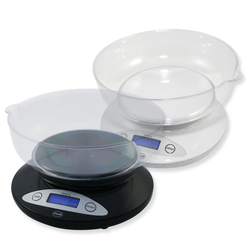
Choosing a scale for sourdough is different from choosing a scale for a
single-purpose kitchen task. A sourdough baker may weigh a small amount
of salt one minute, a starter feeding the next, and then place a heavy
mixing bowl containing more than a kilogram of dough on the same scale.
The best scale therefore depends on the smallest ingredient you want
to measure and the heaviest complete load you expect the platform to
support.
For most home sourdough bakers, a 5kg or greater kitchen scale with 1g
readability is the best primary scale. It provides enough capacity for
starter jars, flour, water, mixing bowls, complete dough and dough
division.
Bakers who want finer control over salt, small starter experiments,
spices or hybrid formulas can add a 200--500g precision scale with
0.1g readability.
King Arthur Baking's sourdough starter
recipe
recommends weighing sourdough starter ingredients because starter volume
varies with consistency and whether it has been stirred down. Its
starter instructions use gram-based quantities, making a digital scale
one of the most useful tools in a sourdough workflow.
American Weigh Scales offers pocket
scales that can serve as the
precision side of a two-scale baking setup.
Quick Answer: What Scale Should You Choose for Sourdough?
Use Recommended capacity Recommended readability
Starter feeding 1--3kg+ 1g
Levain 1--3kg+ 1g
Flour and water 5kg+ 1g
Complete dough 5kg+ 1g
Dough division 5kg+ 1g
Salt and spices 200--500g 0.1g
Small starter experiments 200--500g 0.1g
Hybrid commercial-yeast formulas 200--500g 0.1g
Specialized sub-gram work 100--200g 0.01g
If you want one scale, prioritize capacity, tare and platform size.
If you want the most versatile setup, combine a 5kg+ kitchen scale
with a 200--500g x 0.1g precision scale.
Step 1: Decide What You Will Weigh
Before comparing specifications, list the jobs the scale must perform.
A sourdough scale may be used for:
-
Starter maintenance
-
Levain builds
-
Flour
-
Water
-
Salt
-
Mixing bowls
-
Complete dough
-
Dough division
-
Small test batches
-
Hybrid formulas
-
Spices and add-ins
A scale intended only for salt can be very different from one expected
to support a heavy ceramic bowl full of dough.
Step 2: Choose the Right Capacity
Capacity is the maximum total physical load the scale is designed to
support.
The key word is total.
The scale supports both the ingredient and the container.
If your bowl weighs 1,000g and your dough weighs 1,800g, the gross load
is 2,800g.
That number---not merely the dough mass---determines the capacity you
need.
Is 500g Enough for Sourdough?
A 500g scale is useful, but generally not as your only sourdough scale.
It can handle:
-
Salt
-
Spices
-
Small starter portions
-
Small levain builds
-
Tiny test doughs
-
Commercial yeast in hybrid recipes
It may not support:
-
Heavy starter jars
-
Mixing bowls
-
Full dough batches
AWS explains the relationship between maximum capacity and displayed
increments in What Does 500g x 0.01g Mean on a Digital
Scale?.
Is 1kg Enough?
One kilogram can work for starter maintenance when lightweight
containers are used.
It becomes restrictive with:
-
Heavy glass jars
-
Ceramic crocks
-
Mixing bowls
-
Full dough
For an all-purpose sourdough scale, more capacity is preferable.
Is 3kg Enough?
A 3kg scale can handle many single-loaf workflows.
Example:
-
Bowl: 700g
-
Flour: 500g
-
Water: 350g
-
Starter: 100g
-
Salt: 10g
Gross load: 1,660g
That fits comfortably.
However, a heavy bowl or double batch can push the load much higher.
Why 5kg Is a Strong General Choice
For most home sourdough bakers, 5kg provides useful headroom.
It can accommodate:
-
Starter jars
-
Large levain builds
-
Mixing bowls
-
Flour
-
Water
-
Complete dough
-
Multiple loaf portions
If you routinely make very large batches, consider capacity above 5kg.
Capacity Headroom Matters
Avoid selecting a scale that will routinely operate close to its
maximum.
Suppose:
-
Scale capacity: 3,000g
-
Bowl: 1,000g
-
Dough: 1,900g
Gross load: 2,900g
The load fits, but there is very little margin.
A 5kg scale is a more comfortable choice.
Tare Does Not Restore Capacity
This is one of the most important concepts when choosing a baking scale.
Suppose a bowl weighs 1,000g.
You put it on a 5kg scale and press tare.
The display becomes zero.
The scale is still physically supporting 1,000g.
Tare changes the displayed net value; it does not remove the physical
load.
Step 3: Choose the Right Readability
Readability is the smallest increment displayed by the scale.
Common options include:
-
1g
-
0.1g
-
0.01g
-
0.001g
Sourdough does not require the same readability for every ingredient.
When 1g Is Enough
One-gram readability is suitable for most major sourdough ingredients:
-
Flour
-
Water
-
Starter
-
Levain
-
Complete dough
For example:
-
500g flour
-
350g water
-
100g starter
A 1g scale represents these quantities well.
This is why a 5kg x 1g kitchen scale is such a practical primary tool.
When 0.1g Is Better
Tenth-gram readability becomes useful for:
-
Salt
-
Small test doughs
-
Tiny starter builds
-
Recipe development
-
Spices
-
Malt
-
Hybrid formulas using commercial yeast
A precision scale lets you distinguish 4.8g from 5.0g or 5.2g.
AWS discusses these precision considerations in Best Precision Scale
for Baking Yeast: Features That
Matter.
Do You Need 0.01g?
Usually not.
Choose 0.01g if you routinely:
-
Measure below 1g
-
Conduct very small fermentation experiments
-
Scale formulas down dramatically
-
Use extremely small commercial-yeast quantities in hybrid doughs
For normal sourdough starter, salt and dough, 0.1g is generally
sufficient for precision work.
Do You Need 0.001g?
No for ordinary sourdough baking.
Milligram readability is much finer than normal bread formulas require
and can increase sensitivity to drafts, vibration, static and
environmental changes.
Step 4: Understand Accuracy, Readability and Repeatability
These terms should not be treated as synonyms.
Readability is the smallest displayed increment.
Accuracy concerns agreement with an appropriate reference within the
scale's specified performance.
Repeatability concerns whether repeated measurements of the same
stable load behave consistently under similar conditions.
A scale displaying 0.01g is not automatically more useful than a stable
0.1g scale.
Why Repeatability Matters
Sourdough baking is built around repetition.
If a formula works well, you want to reproduce it.
A simple repeatability check is:
-
Zero the scale.
-
Place the same stable object on it.
-
Record the result.
-
Remove the object.
-
Allow the display to return to zero.
-
Repeat several times.
If readings vary unexpectedly, investigate the setup.
AWS covers common causes in Why Does My Digital Scale Give Different
Readings?.
Step 5: Look for Reliable Tare
Tare is essential for sourdough.
It lets you weigh multiple ingredients directly into one container.
A common workflow is:
-
Place the mixing bowl on the scale.
-
Press tare.
-
Add flour.
-
Press tare.
-
Add water.
-
Press tare.
-
Add starter.
-
Press tare.
-
Add the next ingredient.
This simplifies cleanup and eliminates manual subtraction.
Step 6: Consider Calibration
A good scale should provide clear instructions for calibration or
performance checking.
AWS provides a practical guide in How to Calibrate a Digital Scale for
Accurate
Results.
Calibration should follow the manufacturer's instructions using the
specified reference mass.
Do not improvise with food, coins or random household objects.
NIST's Calibration of Mass
Standards
explains the broader measurement principle: calibration establishes a
mass value and associated uncertainty using appropriate standards.
For a home baking scale, the process is much simpler, but the principle
remains useful---use the correct reference and follow the manufacturer's
procedure.
Step 7: Choose a Platform That Fits Your Containers
Platform size is particularly important for sourdough.
Your scale may need to support:
-
Starter jars
-
Mixing bowls
-
Dough containers
-
Small ingredient dishes
The container should sit securely without touching the countertop or
another object.
If part of the bowl rests elsewhere, the displayed mass can be affected.
Step 8: Check Display Visibility
Large bowls can hide a small display.
Look for:
-
Forward-positioned display
-
Large digits
-
Backlighting
-
Clear decimal point
-
Good viewing angle
A scale can have excellent technical specifications and still be
frustrating if you cannot read it with your normal mixing bowl in place.
Step 9: Consider Response Speed
A useful baking scale should respond promptly as ingredients are added.
Excessive lag can make it easy to overshoot a target, particularly when
pouring water.
The scale does not need specialized espresso-style timing performance.
It simply needs to settle reliably and quickly enough for normal
ingredient addition.
Step 10: Check Auto-Off Behavior
Sourdough preparation includes pauses.
You may stop to:
-
Check a recipe
-
Calculate hydration
-
Open a flour container
-
Mix starter
-
Prepare salt
-
Answer a timer
An extremely short auto-off period can interrupt the workflow.
Choose power-management behavior that matches the way you bake.
Step 11: Think About Cleaning
Sourdough can be messy.
A scale may encounter:
-
Flour dust
-
Water
-
Wet starter
-
Dough
-
Salt
-
Crumbs
Look for a platform and body that are easy to wipe.
A removable silicone mat can be useful when offered by the manufacturer.
Do not assume splash resistance or waterproofing unless the scale is
specifically rated for it.
Step 12: Choose a Convenient Power Source
Battery-powered scales are:
-
Portable
-
Easy to store
-
Convenient in kitchens without nearby outlets
Rechargeable scales can reduce battery replacement.
Neither power system is inherently more accurate. Choose according to
your workflow.
Why a Scale Is Particularly Important for Starter
King Arthur Baking recommends weighing starter ingredients because
starter volume can vary depending on consistency and whether the starter
has been stirred down.
That means a cup measurement can change even when the underlying mass
relationship you want to maintain has not.
A scale makes feeding ratios easier to reproduce.
Starter Feeding Example
Suppose your feeding is:
-
50g starter
-
50g water
-
50g flour
The total ingredient mass is 150g.
But the scale must also support the jar.
If the jar weighs 500g, the gross load is 650g.
A 500g precision scale is therefore too small for this setup even though
the starter ingredients themselves total only 150g.
Small Starter Example
Suppose you maintain:
-
20g starter
-
20g water
-
20g flour
A lightweight dish and 200g precision scale can handle this easily.
This is one reason compact scales are useful for small starter
experiments even when a larger kitchen scale is used for normal
maintenance.
Choosing a Scale for Levain
Levain builds often involve quantities that are easily handled by a 1g
kitchen scale.
The main questions are:
-
How heavy is the container?
-
What is the total levain mass?
-
Is the platform large enough?
-
Is tare easy to use?
A 1--3kg scale can handle many levain workflows, but a 5kg primary scale
gives more versatility.
Choosing a Scale for Flour
Flour is a bulk ingredient.
Prioritize:
-
Capacity
-
Platform size
-
Display visibility
-
Tare
Ultra-fine readability is not necessary for normal flour quantities.
Choosing a Scale for Water
Water may represent hundreds of grams in a bread formula.
A 1g scale is practical.
Response speed becomes useful because water can be poured quickly.
Choosing a Scale for Salt
Salt is one of the strongest reasons to add a precision scale.
Suppose:
-
Flour = 500g
-
Salt = 10g
A 1g scale works.
But if you make a quarter batch:
-
Flour = 125g
-
Salt = 2.5g
Now 0.1g readability is much more useful.
Choosing a Scale for Complete Dough
For complete dough, capacity matters far more than hundredth-gram
resolution.
Suppose:
-
Bowl = 900g
-
Flour = 1,000g
-
Water = 700g
-
Starter = 200g
-
Salt = 20g
Gross load = 2,820g
A 3kg scale technically handles it, but a 5kg scale provides better
headroom.
Choosing a Scale for Dough Division
A scale makes loaf division easy.
If total dough is 1,800g:
For two loaves:
1,800 ÷ 2 = 900g each
For three loaves:
1,800 ÷ 3 = 600g each
One-gram readability is sufficient for normal loaf division.
Choosing a Scale for Sourdough Pizza
Sourdough pizza benefits from the same basic setup.
Use the main scale for:
-
Flour
-
Water
-
Starter
-
Dough-ball division
Use a precision scale for:
-
Salt
-
Tiny additions
-
Hybrid commercial yeast
-
Formula development
Choosing a Scale for Small-Batch Sourdough
Small batches increase the usefulness of fine readability.
A formula that contains 10g salt at full size may contain:
-
5g at half size
-
2.5g at quarter size
-
1.25g at one-eighth size
At these quantities, 0.1g readability is valuable.
Choosing a Scale for Large-Batch Sourdough
Large batches shift the priority toward capacity.
If you regularly make multiple loaves in one bowl, calculate the
heaviest likely gross load.
Include:
-
Bowl
-
Flour
-
Water
-
Starter
-
Salt
-
Add-ins
Then choose capacity with headroom.
Baker's Percentages
A scale makes baker's percentages easy to use.
Flour is conventionally treated as 100%.
Example:
-
Flour = 500g
-
Salt = 10g
Salt percentage:
10 ÷ 500 × 100 = 2%
If you increase flour to 750g:
750 × 0.02 = 15g salt
Weight-based formulas make scaling straightforward.
Hydration and the Scale
In a simple formula:
-
Flour = 500g
-
Water = 350g
Water relative to listed flour:
350 ÷ 500 × 100 = 70%
More advanced sourdough hydration calculations may include the flour and
water contained in the starter.
The important point for scale selection is that both flour and water are
normally measured in hundreds of grams, so a high-capacity 1g scale
handles them efficiently.
Why Grams Make Sense
NIST's SI Units -- Mass
identifies the kilogram as the SI base unit of mass and explains that
decimal multiples and submultiples are formed around the gram.
The NIST definitions of SI base
units
provide additional context for the modern kilogram definition.
For baking, grams make it easy to move from:
1g
10g
100g
1,000g
without ingredient-specific volume conversions.
Pocket Scale vs. Kitchen Scale
A pocket precision scale is best for:
-
Salt
-
Spices
-
Small starter tests
-
Hybrid yeast
-
Small additions
A kitchen scale is best for:
-
Starter jars
-
Levain
-
Flour
-
Water
-
Bowls
-
Complete dough
-
Dough division
AWS's Pocket Scale vs. Kitchen
Scale
guide explains why these two formats serve different weighing ranges.
The Best Two-Scale Setup
For a serious home sourdough baker:
Main Scale
5kg+ x 1g
Use it for:
-
Starter
-
Levain
-
Flour
-
Water
-
Mixing bowls
-
Complete dough
-
Portioning
Precision Scale
200--500g x 0.1g
Use it for:
-
Salt
-
Spices
-
Small starter experiments
-
Hybrid yeast
-
Tiny additions
This combination covers nearly every normal sourdough task.
Can One Scale Do Everything?
Yes, if you choose a scale with:
-
3--5kg+ capacity
-
0.1g readability
-
Large platform
-
Reliable tare
-
Good display
This can be an excellent minimalist option.
However, a two-scale setup may still be more convenient because the
precision scale is compact and optimized for small ingredients.
3kg vs. 5kg
Choose 3kg if:
-
You make single loaves
-
Your bowls are lightweight
-
Your normal gross loads stay comfortably below 3kg
Choose 5kg if:
-
You use heavy bowls
-
You make double batches
-
You want more capacity headroom
-
You divide larger dough batches
For most buyers seeking one primary sourdough scale, 5kg is the safer
choice.
5kg vs. 10kg
Choose 5kg for normal home sourdough.
Consider 10kg if:
-
You make very large batches
-
You use heavy commercial-style containers
-
Your actual gross loads approach 5kg
Do not buy extra capacity just for the specification. Match it to your
baking.
1g vs. 0.1g
Choose 1g when the scale is primarily for:
-
Flour
-
Water
-
Starter
-
Dough
-
Bowls
Choose 0.1g when it is primarily for:
-
Salt
-
Small batches
-
Recipe development
-
Hybrid yeast
-
Small additions
If one scale offers both high capacity and 0.1g readability within your
budget and workflow, it can cover a very broad range.
0.1g vs. 0.01g
Choose 0.1g for most precision sourdough work.
Choose 0.01g only when you regularly measure below 1g.
For ordinary sourdough baking, hundredth-gram readability is usually
unnecessary.
How to Test Your Existing Scale Before Replacing It
Before buying a new scale, evaluate the one you already own.
Ask:
-
Does it have enough capacity?
-
Does the bowl fit?
-
Can you see the display?
-
Does it tare reliably?
-
Does it return to zero?
-
Are repeated readings consistent?
-
Does it stay on long enough?
-
Is 1g readability limiting your small ingredients?
You may discover that your current kitchen scale is perfectly good for
bulk sourdough work and that you only need a small precision companion.
Common Mistakes When Choosing a Sourdough Scale
Buying Too Little Capacity
Always include the container.
Forgetting Heavy Glass Jars
Starter jars can consume much of a small scale's capacity.
Assuming Tare Creates More Capacity
It does not.
Buying Based Only on Decimal Places
More digits do not automatically mean better real-world performance.
Confusing Readability With Accuracy
The smallest displayed increment is only one part of measurement
performance.
Ignoring Repeatability
A dependable scale should behave consistently.
Ignoring Platform Size
A mixing bowl must sit securely.
Ignoring Display Position
Large bowls can hide the display.
Buying 0.001g for Ordinary Bread
Milligram readability is unnecessary for normal sourdough.
Using a Pocket Scale as the Only Scale
A 200--500g precision scale is too restrictive for most full sourdough
workflows.
Ignoring Auto-Off
A short timeout can become frustrating.
Calibrating With Food
Follow the manufacturer's procedure and specified reference.
How to Weigh Starter
-
Put the jar on the scale.
-
Tare.
-
Add or retain the desired starter quantity.
-
Add water by mass.
-
Tare as needed.
-
Add flour by mass.
-
Mix according to your feeding method.
The exact feeding ratio depends on your starter routine.
King Arthur Baking's feeding and maintaining sourdough starter
guide
specifically recommends scale-based measurement for consistency.
How to Weigh a Dough Formula
-
Place the bowl on the scale.
-
Press tare.
-
Add flour.
-
Press tare.
-
Add water.
-
Press tare.
-
Add starter or levain.
-
Press tare.
-
Add remaining ingredients.
-
Confirm that the gross load stays within capacity.
Sourdough Scale Buying Checklist
Before buying, ask:
-
Will this be my only scale?
-
What is my smallest ingredient?
-
What is my heaviest bowl?
-
What is my heaviest starter jar?
-
What is my largest dough batch?
-
Is 3kg enough?
-
Would 5kg provide better headroom?
-
Do I need more than 5kg?
-
Is 1g readability sufficient?
-
Do I need 0.1g?
-
Do I genuinely need 0.01g?
-
Does it have tare?
-
Does it measure grams?
-
Is the platform large enough?
-
Can I see the display behind my bowl?
-
Is the display backlit?
-
Does it respond quickly?
-
Does it return reliably to zero?
-
Are repeated readings consistent?
-
Can it be calibrated or checked according to the manufacturer's
instructions? -
Is it easy to clean?
-
Is the power source convenient?
-
Is auto-off suitable?
-
Do I need splash resistance?
-
Would two scales work better than one?
Frequently Asked Questions
What is the best scale for sourdough?
For most home bakers, a 5kg+ kitchen scale with 1g readability is an
excellent primary scale. A 200--500g x 0.1g precision scale makes a
useful companion.
What capacity should I choose?
Around 5kg is a strong general target for an all-purpose home sourdough
scale.
Is 3kg enough?
It can be for single loaves and lightweight bowls. Calculate your actual
gross load before deciding.
Is 500g enough?
Not as an all-purpose scale. It is excellent for precision ingredients.
Is 1g accurate enough for sourdough?
For flour, water, starter and complete dough, 1g readability is
generally sufficient for normal home baking.
When do I need 0.1g?
For salt, small batches, recipe development, spices and hybrid yeast
formulas.
Do I need 0.01g?
Usually not. It is most relevant when measurements regularly fall below
1g.
Does tare increase capacity?
No. The container remains part of the physical load.
Why should starter be weighed?
Starter volume can change depending on consistency and aeration, so
weighing provides a more repeatable basis for feeding.
What scale should I use for starter?
A 1--3kg+ kitchen scale works well for most starter jars. Small
precision scales are useful for tiny starter experiments with
lightweight containers.
What scale should I use for salt?
A 200--500g x 0.1g precision scale is an excellent choice.
What scale should I use for complete dough?
A 5kg+ kitchen scale is a practical target for most home batches.
Should I buy one scale or two?
One high-capacity scale can handle most sourdough tasks. Two scales
provide better coverage when you also want tenth-gram precision.
Should the scale be calibrated?
Follow the manufacturer's instructions for calibration and performance
checking.
Can I calibrate it with flour or a coin?
Use the specified reference rather than improvised household objects.
Final Verdict: How to Choose a Scale for Sourdough
Start with the heaviest complete load you expect to weigh.
Include the bowl or jar.
For most home sourdough bakers, this points toward a 5kg+ primary
kitchen scale.
Next, identify the smallest ingredient for which measurement detail
matters.
If your smallest important quantities are flour, water and starter, 1g
readability is usually practical.
If you frequently measure salt, small test batches, spices or hybrid
yeast additions, add 0.1g readability through either a
higher-resolution main scale or a compact precision scale.
For most bakers, the strongest setup is:
Main scale: 5kg+ x 1g
Precision scale: 200--500g x 0.1g
King Arthur Baking recommends weighing sourdough starter ingredients
because starter volume changes with consistency and aeration, making
mass measurement a more consistent foundation for feeding and baking.
NIST's mass and calibration guidance reinforces the broader measurement
principle that useful results depend on appropriate units, references
and procedures---not simply the number of decimal places on a display.
Choose capacity before aesthetics. Choose readability according to the
smallest quantities you actually use. Confirm tare, repeatability,
platform size, display visibility and calibration instructions.
The best scale for sourdough is not necessarily the most expensive or
most sensitive model. It is the one that comfortably handles your real
containers and dough while giving you enough measurement detail to
reproduce your recipes consistently.