
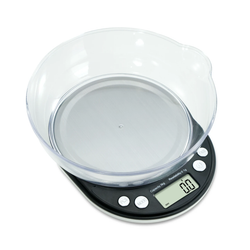
A pocket scale for candle making is most useful when ingredients are
too light for a large kitchen or wax scale to measure with the detail
you need. Fragrance oil, liquid dye, powdered colorants, additives, and
small experimental wax batches can all benefit from a compact scale with
finer readability.
The challenge is choosing the right combination of capacity and
resolution. A 100g x 0.01g scale provides very fine readings, but a
moderately heavy glass cup can consume most of its capacity. A 500g x
0.1g scale provides much more container flexibility but cannot display
hundredths of a gram.
American Weigh Scales' best scale for candle making and fragrance
oils
guide recommends matching the scale to the ingredient range rather than
simply buying the model with the most decimal places.
For most candle makers looking specifically for a compact precision
scale, a strong starting point is 200--500g x 0.1g for everyday
fragrance and additive weighing, or 100--500g x 0.01g for genuine
sub-gram formulation work.
A pocket scale should usually complement---not replace---a larger scale
for bulk wax.
Quick Capacity and Resolution Guide
Main use Suggested capacity Suggested readability
Tiny dye/additive tests 100--200g 0.01g
Small fragrance trials 100--500g 0.01g--0.1g
Everyday fragrance oil 200--500g 0.1g
Small wax tests 500g--1kg 0.1g
Formula development 200--500g 0.01g--0.1g
Bulk wax 3--5kg+ 0.1g--1g
What Does Capacity Mean?
Capacity is the maximum physical load a scale can support. If a pocket
scale is rated 500g x 0.1g, 500g is maximum capacity and 0.1g is the
smallest displayed increment.
AWS explains this notation in What Does 500g x 0.01g Mean on a Digital
Scale?.
Capacity includes the container, fragrance oil, wax, dye, tray, weighing
paper, and anything else resting on the platform.
Container Weight Changes the Capacity You Need
Suppose you need 30g of fragrance oil. If the cup weighs 20g, gross load
is 50g and a 100g scale has enough capacity. If the glass container
weighs 120g, gross load becomes 150g and the 100g model cannot support
it.
This is why a 500g pocket scale can be more versatile than a 100g model
even when the ingredient itself is light.
Tare Does Not Increase Capacity
Tare resets the display to zero after the empty container is placed on
the scale. It does not physically remove the container.
If a 500g scale supports a 250g glass cup, approximately 250g of
physical capacity remains after taring.
Leave Capacity Headroom
Avoid routinely operating at maximum capacity. A normal 490g load on a
500g scale leaves almost no room for a heavier cup, larger test,
accidental overpour, or additional ingredient.
Choose enough capacity that normal work remains comfortably below the
limit.
100g Pocket Scale
A 100g scale is best for tiny fragrance samples, dyes, powdered
colorants, and lightweight additives. Its main limitation is container
mass.
Choose it when ingredients and containers are consistently light and
fine readability matters more than flexibility.
200g Pocket Scale
A 200g model offers more flexibility while remaining compact. It can
work well for fragrance samples, dye, additives, and small formula
tests.
A 200g x 0.01g scale is particularly useful when hundredth-gram readings
genuinely matter.
For example, a 40g cup plus 25g fragrance produces a 65g gross load. A
200g scale provides plenty of room. A 150g cup plus 40g fragrance
produces 190g, leaving almost no headroom.
500g Pocket Scale
For many candle makers, 500g is the most versatile pocket-scale
capacity.
It can accommodate fragrance cups, small glass containers, fragrance
oil, dyes, additives, and small wax tests. It also gives you more
freedom to choose containers without constantly approaching the scale's
limit.
If you want one compact precision scale for a candle-making workstation,
500g is an excellent capacity target.
Is 1kg Better?
A 1kg compact scale may help with larger test candles, heavier
containers, or larger fragrance quantities. However, capacity alone does
not make a scale better.
A 1kg x 1g model is much coarser than a 500g x 0.1g model. For precision
candle formulation, the lower-capacity model may be more useful.
What Does Resolution Mean?
In product descriptions, "resolution" often refers to the smallest
displayed increment. In weighing specifications, readability is the
more precise term.
Common options are 1g, 0.1g, 0.01g, and 0.001g. For candle-making pocket
scales, the main comparison is usually 0.1g vs. 0.01g.
Is 0.1g Enough?
For many candle-making tasks, yes. A 0.1g scale can display 30.0g
fragrance, 15.5g fragrance, 5.2g additive, 2.7g dye, or 125.4g wax.
It is particularly practical when most ingredients weigh more than 1g.
When Is 0.01g Better?
Choose 0.01g when ingredients regularly fall below 1g, you use
concentrated colorants, conduct tiny fragrance experiments, or need to
distinguish formulation differences smaller than 0.1g.
AWS's 0.001g vs. 0.01g scales
guide
explains why precision should be matched to the job.
Do You Need 0.001g?
Usually not. Milligram readability is rarely necessary for ordinary
fragrance oil, wax, or dye measurements and makes the scale more
sensitive to drafts, static, vibration, surface movement, and
temperature changes.
For most candle makers, 0.1g or 0.01g is more practical.
Readability Is Not Accuracy
Readability is the smallest displayed increment. Accuracy concerns
agreement with an appropriate reference within stated performance.
Repeatability concerns consistency when the same load is measured
repeatedly.
A 0.01g display does not automatically guarantee ±0.01g accuracy. Review
manufacturer specifications.
Minimum Usable Load
A scale displaying 0.01g increments does not necessarily perform ideally
with a 0.01g item. If you routinely measure extremely light additives,
review the manufacturer's minimum-load, tolerance, accuracy, and
repeatability information.
Pocket Scales for Fragrance Oil
Fragrance oil is one of the strongest applications for a compact scale
because fragrance quantities are often much smaller than wax quantities.
CandleScience recommends weighing fragrance oil rather than measuring
it by
volume,
noting that different fragrance oils can vary in volume.
Place a suitable cup on the platform, tare it, and add fragrance to the
target mass.
Fragrance Oil Calculation Example
If a tested formula uses fragrance equal to 6% of wax mass:
500g wax x 0.06 = 30g fragrance
250g wax x 0.06 = 15g fragrance
100g wax x 0.06 = 6g fragrance
CandleScience's fragrance calculation
guidance
uses wax mass multiplied by the selected fragrance percentage.
A 0.1g scale is practical for these quantities. For a tiny 25g wax test
at 6%, the target is 1.5g; 0.1g can still work, while 0.01g becomes more
useful as tests become smaller.
Always follow the appropriate wax and fragrance guidance rather than
assuming one percentage applies to every formulation.
Pocket Scale for Liquid Dye
If normal dye targets are 3.0g, 2.5g, or 1.8g, 0.1g readability provides
useful control. If quantities regularly fall below 1g, 0.01g may be
worthwhile.
Pocket Scale for Powdered Colorants
Fine powders can benefit from compact precision weighing. Use a
lightweight tray or suitable container and pay attention to static,
airflow, platform cleanliness, and stable zero.
Pocket Scale for Additives
Choose readability based on the smallest meaningful amount in the real
formula. Several-gram additives may only need 0.1g readability.
Fractions of a gram may justify 0.01g.
Pocket Scale for Small Wax Tests
A 500g pocket scale can handle small experimental wax blends.
Example:
Wax A = 120.0g
Wax B = 80.0g
Fragrance = 12.0g
This creates a documented formulation rather than an approximate blend.
Pocket Scale for Formula Development
Compact scales are especially valuable during product development
because small formulation changes can be documented precisely.
A test record can include wax mass, fragrance mass, dye mass, additive
mass, vessel, wick, relevant process temperatures, cure time, and
burn-test observations.
Can a Pocket Scale Be Your Only Candle Scale?
For very small batches, possibly. For most regular candle making, no.
Pocket scales are limited by capacity, platform size, container size,
heat exposure, and physical stability. A full pouring pitcher can easily
exceed the capacity of a compact scale.
Pocket Scale vs. Kitchen Scale
A pocket scale is best for fragrance oil, dyes, additives, small wax
tests, and formula development.
A kitchen or bench scale is better for bulk wax, pouring pitchers,
larger batches, and production quantities.
AWS's Pocket Scale vs. Kitchen
Scale
guide explains why compact precision and higher-capacity scales serve
different weighing ranges.
Best Two-Scale Setup
For broad candle-making capability:
Main scale: 3--5kg+ x 0.1g--1g
Use it for wax, pouring pitchers, and larger batches.
Pocket precision scale: 200--500g x 0.1g
Use it for fragrance oil, dyes, additives, and small tests.
Or choose 100--500g x 0.01g when genuine sub-gram work is common.
Platform Size
The cup should sit fully on the platform, remain stable, avoid touching
the counter, and leave the display visible.
If your normal container overhangs dramatically, a compact bench scale
may be more practical than a pocket model.
Protective Cover
A cover can protect the platform from dust, scratches, storage pressure,
and small tools. Some covers can also serve as weighing trays when
appropriate.
Display Visibility
Look for clear digits, backlighting, strong contrast, an obvious decimal
point, and a useful viewing angle. This is especially important with
0.01g scales.
Response and Settling
The scale should respond as material is added and then settle to a
stable value. Slow down as you approach the target and wait for the
final reading to stabilize.
Tare Function
Tare is essential for fragrance and additive work.
CandleScience's fragrance weighing
instructions
instruct makers to place a suitable cup on the scale, tare it, and then
add the fragrance oil.
Calibration
Choose a scale with clear calibration instructions. AWS's How to
Calibrate a Digital Scale for Accurate
Results
explains the general process.
Use the reference mass specified by the manufacturer rather than coins,
wax, fragrance bottles, or random household objects.
NIST's Calibration of Mass
Standards
explains the broader measurement principle of establishing mass values
and appropriate uncertainty using suitable standards.
When to Check Performance
Follow manufacturer instructions, but consider checking performance
after the scale has been moved, dropped, overloaded, stored for a long
period, or begins producing unexpected readings.
Before recalibrating, check batteries, zero, platform cleanliness,
surface stability, airflow, and vibration.
Repeatability Test
Place the scale on a hard surface, confirm zero, weigh the same stable
object, remove it, wait for zero, and repeat several times.
AWS discusses common environmental causes of inconsistent readings in
Why Does My Digital Scale Give Different
Readings?.
Use a Hard, Level Surface
Do not use a precision pocket scale on towels, soft mats, flexible
trays, unstable tables, or uneven shelves.
A rigid base becomes increasingly important at 0.01g readability.
Control Airflow
Keep fine scales away from fans, open windows, and strong HVAC vents. A
draft that barely matters to a 5kg x 1g scale can affect a finer
precision model.
Reduce Vibration
Foot traffic, flexible worktables, melting equipment, and nearby
machinery can make readings fluctuate. Relocate the scale if necessary.
Watch Temperature
Do not place a hot pouring pitcher on a pocket scale unless the
manufacturer explicitly permits it. Compact scales are better suited to
fragrance, additives, and suitable-temperature ingredients.
Keep It Clean
Fragrance residue, wax, and powders can collect around the platform. Use
proper containers and follow manufacturer cleaning instructions. Do not
pour liquids directly onto the scale.
Power and Auto-Off
Look for a low-battery indicator, easy battery replacement, and auto-off
behavior that fits your workflow.
Formula development often includes pauses for calculations and
recordkeeping, so an overly aggressive auto-off timer can be
inconvenient.
100g vs. 200g
Choose 100g when ingredients are tiny, containers are extremely
light, and compactness matters most.
Choose 200g when you want more headroom for fragrance samples and
additives.
For most candle makers, 200g is easier to use.
200g vs. 500g
Choose 200g when the scale is dedicated to tiny ingredients and
lightweight cups.
Choose 500g when you want broader fragrance capacity,
heavier-container compatibility, and the ability to run small wax tests.
For a single candle-making pocket scale, 500g is usually more versatile.
500g vs. 1kg
Choose 500g when fragrance and additives are the main purpose and
fine readability matters.
Choose 1kg when test batches and containers are larger.
Always compare readability before choosing extra capacity.
0.1g vs. 0.01g
Choose 0.1g when most ingredients exceed 1g, you mainly weigh
fragrance oil, and you want versatile everyday precision.
Choose 0.01g when ingredients frequently fall below 1g, concentrated
additives require finer measurement, or 0.1g is too coarse for the
experiment.
Why More Resolution Is Not Always Better
Higher-resolution scales often have lower capacity, smaller platforms,
greater environmental sensitivity, and more demanding setup
requirements.
If the smallest important quantity is 5g, a reliable 0.1g scale may be
more practical than a milligram scale.
Why More Capacity Is Not Always Better
A 10kg scale can be excellent for production wax but may be too coarse
for a 1.5g additive. Capacity should match the stage of the process.
Best Pocket Scale Setup for Beginners
A beginner who already owns a kitchen scale should consider 500g x
0.1g for fragrance oil and small tests.
If sub-gram additives become part of the workflow later, add a 0.01g
model.
Best Setup for Hobby Candle Makers
A frequent hobby maker can benefit from 200--500g x 0.1g for
everyday fragrance and additives.
Choose 0.01g when tiny formulation experiments are routine.
Best Setup for Product Development
Product developers may benefit from 200--500g x 0.01g when
experiments involve genuinely small differences.
Also prioritize repeatability, stable zero, clear calibration
procedures, a suitable platform, and a controlled working environment.
Best Setup for Small Candle Businesses
Use separate tools for separate jobs:
Bulk scale: wax and production batches.
Pocket scale: fragrance, colorants, additives, and development.
Standardize units, containers, tare procedure, calibration checks, work
surfaces, and batch records.
Why Weight-Based Records Matter
CandleScience's candle-making
guidance
emphasizes weighing wax and fragrance on a scale rather than relying on
volume.
Weight-based records make it easier to repeat successful formulas, scale
tests up or down, compare fragrance percentages, and document wax-blend
experiments.
A scale does not determine whether a formula will perform safely or
successfully; it helps control the quantities being tested. Supplier
guidance and appropriate finished-candle testing remain essential.
Formula Logging
Record wax type and mass, fragrance and mass, dye, additive mass,
vessel, wick, relevant temperatures, cure time, and burn-test
observations.
A pocket scale is most valuable when the measurement becomes part of a
repeatable formula.
Common Pocket-Scale Mistakes
Buying by decimal places alone
More digits are not automatically more useful.
Ignoring container weight
The cup counts toward capacity.
Assuming tare restores capacity
It does not.
Choosing 100g with a heavy glass cup
The container can consume the entire range.
Using a pocket scale for a large pitcher
Use a higher-capacity scale.
Letting the container touch the counter
The scale must support the complete load.
Using a soft surface
Use a hard, stable base.
Working under a fan
Fine scales can respond to drafts.
Assuming 0.01g readability means ±0.01g accuracy
Check manufacturer specifications.
Ignoring minimum load
The smallest display division is not necessarily the ideal minimum
usable quantity.
Calibrating with random objects
Use the specified reference mass.
Putting hot wax vessels on a pocket scale
Follow manufacturer limits.
Pocket Scale Buying Checklist
Before buying, ask:
-
What is my smallest ingredient?
-
What is my largest precision quantity?
-
How much does my normal container weigh?
-
What is the maximum gross load?
-
Is 100g enough?
-
Would 200g provide more flexibility?
-
Is 500g the better all-around choice?
-
Do I need 1kg?
-
Is 0.1g readability enough?
-
Do I genuinely need 0.01g?
-
Is 0.001g unnecessary?
-
Does the scale have tare?
-
Does it measure grams?
-
Is the platform large enough?
-
Can I see the display?
-
Does it settle promptly?
-
Does it return reliably to zero?
-
Are repeated measurements consistent?
-
Can it be calibrated?
-
What reference mass does it require?
-
Is a calibration weight included?
-
Does it have a protective cover?
-
Is it easy to clean?
-
Is the battery setup convenient?
-
Will auto-off interrupt my workflow?
-
Do I already have a larger wax scale?
Frequently Asked Questions
What is the best pocket scale capacity for candle making?
For many candle makers, 500g is the most versatile compact capacity
because it provides room for fragrance cups, additives, and small tests.
Is a 100g pocket scale enough?
It can be for tiny ingredients, but container weight can make it
restrictive.
Is 200g enough?
Yes for many fragrance samples and additives when lightweight containers
are used.
Is 500g better?
For an all-around candle-making pocket scale, 500g generally provides
more useful flexibility.
Do I need a 1kg pocket scale?
Only if containers or test batches regularly exceed the comfortable
range of a 500g model.
What resolution do I need?
For most fragrance and additive work, 0.1g is practical. Choose 0.01g
for genuine sub-gram measurements.
Is 0.1g precise enough for fragrance oil?
Yes for many candle formulas where fragrance quantities are several
grams or more.
When should I choose 0.01g?
Choose it for tiny trials, concentrated additives, and quantities below
1g where tenths of a gram are too coarse.
Do I need 0.001g?
Usually not for ordinary candle making.
Can I weigh wax on a pocket scale?
Small wax tests may fit. Bulk wax and full pouring pitchers generally
require a larger scale.
Does tare increase capacity?
No. Tare changes the displayed net value, but the container still
contributes to the physical load.
Should fragrance oil be weighed?
CandleScience recommends weighing fragrance oil rather than measuring it
by volume because oils can vary in volume.
Should I calibrate my pocket scale?
Follow the manufacturer's calibration and performance-check
instructions.
Why does my pocket scale fluctuate?
Airflow, vibration, weak batteries, unstable surfaces, temperature
changes, static, debris, or calibration issues can affect fine readings.
Should I use a pocket scale or kitchen scale?
Use a pocket scale for small ingredients and a kitchen or bench scale
for wax and larger loads. Many regular candle makers benefit from both.
Final Verdict: What Capacity and Resolution Do You Need?
For most candle makers, the best pocket scale is the one that provides
enough capacity for the container plus ingredient and enough
readability for the smallest quantity that matters.
For one broadly useful pocket scale for fragrance oil, dyes, additives,
and small formulation tests, start with:
500g x 0.1g
It offers a strong balance of capacity and practical precision.
If candle development regularly involves sub-gram ingredients, consider:
100--500g x 0.01g
Choose the exact capacity according to container weight.
A 100g scale is compact but restrictive. A 200g scale is useful for
lightweight precision work. A 500g scale gives substantially more
flexibility. A 1kg compact scale can be useful for larger tests but
should not sacrifice the readability the formulation requires.
For bulk wax, use a separate:
3--5kg+ x 0.1g--1g main scale
CandleScience recommends weighing wax and fragrance for consistent
formulas, and its fragrance guidance uses tared containers and
weight-based calculations. NIST's mass-calibration framework reinforces
the importance of suitable reference standards when checking measurement
equipment.
The most practical setup is therefore:
Main scale: 3--5kg+ x 0.1g--1g for wax and pitchers
Pocket scale: 200--500g x 0.1g for fragrance and additives
or
Pocket scale: 100--500g x 0.01g when sub-gram formulation work
genuinely requires it
Choose capacity first from the complete physical load. Then choose
resolution from the smallest meaningful ingredient. That produces a
scale setup that is both precise and practical.