
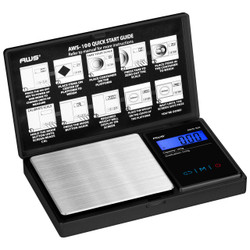
A pocket scale for coins should give you enough resolution to make
useful measurements without sacrificing the capacity you need for coins,
holders, capsules, trays, tokens, medals, or small groups. For many
collectors, the most practical combination is 0.01g resolution with
approximately 100g to 500g of capacity.
The key is choosing both specifications together.
A 100g x 0.01g scale may be excellent for individual coins. A 250g x
0.01g model adds useful headroom for holders and small groups. A 500g x
0.01g scale can accommodate larger groups, bullion pieces, medals, and
containers while retaining hundredth-of-a-gram readability.
American Weigh Scales offers compact models across these ranges in its
digital pocket scales collection.
This guide explains exactly how capacity and resolution affect coin
weighing and how to choose the right combination for your collection.
Quick Answer: What Capacity and Resolution Do You Need?
For many coin collectors:
Best all-around target: 200--250g x 0.01g
For more capacity:
500g x 0.01g
For individual coins and maximum portability:
100g x 0.01g
For specialized very-low-mass work:
0.001g resolution, but only when thousandth-of-a-gram readings are
genuinely useful.
Coin Scale Capacity and Resolution Chart
Application Suggested capacity Suggested resolution
Individual circulating coins 100g+ 0.01g
Individual collectible coins 100--250g 0.01g
Gold coins 100--250g 0.01g
Silver coins 100--250g 0.01g
Coins in capsules 100--250g 0.01g
Small coin groups 200--500g 0.01g
Tokens 250--500g 0.01g
Small medals 250--500g 0.01g
Bullion groups 500g+ 0.01g
Large coin batches 500g+ 0.01g or 0.1g
Specialized tiny pieces Application-dependent 0.001g
These ranges are starting points. Your actual requirement depends on the
heaviest complete load and the measurement detail you need.
What Does Capacity Mean on a Pocket Scale?
Capacity is the maximum total mass the scale is designed to support.
A scale labeled:
250g x 0.01g
has a nominal capacity of 250 grams and displays measurements in
increments of 0.01 gram.
AWS explains this notation in What Does 500g x 0.01g Mean on a Digital
Scale?.
The important word is total.
If your scale has a 250g capacity and you place a 30g tray on it, the
tray consumes part of that physical capacity even if you press tare and
the display returns to zero.
What Does Resolution Mean?
In consumer scale discussions, resolution commonly refers to the
smallest displayed increment, often called readability.
Examples:
-
0.1g = tenths of a gram
-
0.01g = hundredths of a gram
-
0.001g = thousandths of a gram
For coins, smaller increments provide more measurement detail.
But finer resolution is not automatically better for every application.
Resolution vs. Accuracy
Resolution or readability is not the same as accuracy.
A scale that displays three decimal places is not automatically
guaranteed accurate to the last digit.
When choosing a scale, also consider:
-
Manufacturer accuracy specifications
-
Repeatability
-
Calibration
-
Minimum usable load
-
Environmental sensitivity
-
Proper operating range
The number of decimal places is only one part of the instrument's
performance.
Why 0.01g Is Usually Best for Coin Collectors
A 0.01g pocket scale displays readings such as:
-
2.50g
-
5.00g
-
5.67g
-
11.34g
The U.S. Mint currently publishes these nominal weights for several
circulating U.S. denominations, illustrating why hundredth-of-a-gram
readings are useful for coin comparison.
A scale reading only to 1g would discard much of that detail.
A 0.1g scale would show tenths rather than hundredths.
A 0.01g scale offers a useful middle ground between detailed readings
and practical capacity.
AWS similarly identifies coins and collectibles as applications for
0.01g pocket scales in its Best Pocket Scales for Jewelry, Coins,
Coffee and
Crafts
guide.
When Is 0.1g Enough?
A 0.1g scale can be sufficient when you are weighing:
-
Large groups of coins
-
Heavy medals
-
Bulk collections
-
Objects where hundredths are unnecessary
For an individual collectible coin, however, 0.01g provides more useful
detail.
Consider a nominal 5.67g quarter.
A 0.1g scale provides a reading to the nearest tenth displayed by the
instrument.
A 0.01g scale provides another decimal place of information.
That difference matters when the goal is comparison with detailed
specifications.
Do You Need 0.001g for Coins?
Most collectors do not.
A 0.001g milligram scale can be useful for:
-
Very tiny numismatic pieces
-
Specialized research
-
Extremely low-mass objects
But finer readability comes with practical tradeoffs.
A milligram scale can be more sensitive to:
-
Drafts
-
Vibration
-
Static electricity
-
Temperature
-
Surface instability
It may also have:
-
Lower capacity
-
Smaller weighing pan
-
More demanding calibration requirements
For ordinary U.S. coins, world coins, silver coins, gold coins, and
common tokens, 0.01g is generally the more versatile choice.
100g x 0.01g: Best for Individual Coins
A 100g x 0.01g pocket scale is compact and well suited to individual
coins.
It provides enough capacity for most:
-
Pennies
-
Nickels
-
Dimes
-
Quarters
-
Half dollars
-
Dollar coins
-
Individual silver coins
-
Individual gold coins
-
Small tokens
The primary advantage is portability.
The primary limitation is reduced flexibility for groups and larger
accessories.
Is 100g Enough for Silver Coins?
For most individual silver coins, yes.
Even relatively substantial individual silver coins are well below 100g.
But if you weigh several pieces together, capacity can disappear
quickly.
For example, multiple one-ounce-class bullion pieces plus a tray can
approach or exceed a low-capacity scale's limit.
Collectors who regularly weigh groups should consider 250g or 500g.
Is 100g Enough for Gold Coins?
For individual gold coins, 100g is generally ample capacity.
If your scale is also used for:
-
Multiple coins
-
Jewelry
-
Bullion groups
-
Holders
-
Containers
then additional capacity may be worthwhile.
200g x 0.01g: A Balanced Option
A 200g x 0.01g scale offers more flexibility while remaining
compact.
It is suitable for:
-
Individual coins
-
Capsules
-
Holders
-
Small groups
-
Tokens
-
Small medals
For collectors who want one pocket scale without jumping to 500g, 200g
is a practical middle ground.
250g x 0.01g: The Collector Sweet Spot
For many collectors, 250g x 0.01g is arguably the most versatile
pocket-scale configuration.
It provides:
-
Fine hundredth-of-a-gram readings
-
Enough capacity for individual coins
-
Room for small groups
-
Capacity for holders and trays
-
Portability
-
Useful headroom
AWS highlights 250g-class 0.01g pocket scales as useful for coin
collecting in its current content.
This range is especially attractive if you want one scale for coins plus
other small collectibles.
500g x 0.01g: Maximum Flexibility
A 500g x 0.01g pocket or compact precision scale is a strong choice
when capacity matters.
It is useful for:
-
Larger coin groups
-
Multiple bullion pieces
-
Heavy tokens
-
Medals
-
Trays
-
Mixed collectibles
The important point is that moving from 200g or 250g to 500g does not
necessarily mean giving up 0.01g readability.
AWS discusses this distinction in its 200g vs. 500g Pocket Scale
comparison.
Is 500g Too Much for Individual Coins?
No.
A scale's maximum capacity does not mean you must weigh objects close to
that limit.
If a 500g scale has appropriate 0.01g readability and suitable
performance specifications, it can still be used for individual coins.
The benefit is headroom.
The tradeoff may be a larger footprint or different design compared with
the smallest pocket models.
How Much Headroom Should You Leave?
Avoid choosing a scale that will routinely operate at its maximum
capacity.
Imagine:
-
Coins = 210g
-
Tray = 25g
-
Holder or accessory = 5g
Total physical load:
240g
A 250g scale leaves only 10g of nominal headroom.
A 500g model is more comfortable for this workflow.
When estimating capacity, calculate the heaviest realistic combination
rather than the average coin.
Why Tare Does Not Restore Capacity
Suppose a tray weighs 40g.
You place it on a 250g scale and press tare.
The display shows:
0.00g
But the scale is still physically supporting 40g.
You do not suddenly regain the full 250g load range.
This distinction is important when weighing groups.
Best Capacity for Pennies
For a single penny, 100g is far more than necessary.
For groups of pennies, capacity becomes important.
A collector sorting or comparing small groups may prefer:
-
200g
-
250g
-
500g
depending on batch size.
The current U.S. Mint specification lists the one-cent coin at 2.50g.
Best Capacity for Nickels
The U.S. Mint currently lists the nickel at 5.00g.
A 100g scale easily handles an individual nickel and can accommodate a
number of them before reaching capacity.
For larger batches, 250g or 500g provides more flexibility.
Best Capacity for Dimes
Dimes are lightweight, so individual pieces require little capacity.
The benefit of a 0.01g scale here is not high capacity but measurement
detail.
Collectors weighing groups can choose capacity based on batch size.
Best Capacity for Quarters
The current U.S. Mint specification lists the quarter at 5.67g.
A 100g scale is sufficient for individual quarters.
A 250g or 500g scale is more versatile for groups.
Best Capacity for Half Dollars
Half dollars are heavier but still easily fit within a 100g scale
individually.
The U.S. Mint currently lists the half dollar at 11.34g.
Collectors weighing several at once may prefer 250g or 500g.
Best Capacity for Dollar Coins
The current U.S. Mint specification lists Native American and American
Innovation dollar coins at 8.10g.
Again, individual coins require modest capacity.
Groups and containers determine whether you need 100g, 250g, or 500g.
For current U.S. specifications, consult the U.S. Mint Coin
Specifications
page.
Best Pocket Scale for Silver Coins
For individual silver coins:
100--250g x 0.01g
is a strong starting point.
For multiple silver coins:
250--500g+ x 0.01g
provides more headroom.
Useful features include:
-
Gram mode
-
Troy-ounce mode
-
Tare
-
Calibration
-
Protective cover
-
Stable platform
Historical silver coins vary by issue, so use an authoritative reference
for the specific coin.
Best Pocket Scale for Gold Coins
For individual gold coins:
100--250g x 0.01g
is generally a versatile range.
Gold coin collectors may also value:
-
Troy ounces
-
Pennyweight
-
Tare
-
Calibration
-
Repeatability
Weight can support an evaluation but cannot establish gold purity or
authenticity by itself.
Best Pocket Scale for Bullion Coins
Bullion collectors should pay particular attention to total capacity.
One piece may fit easily on a 100g scale.
Several pieces together may require:
-
250g
-
500g
-
Higher capacity
A 500g x 0.01g scale can be particularly useful when the same instrument
is used for both individual coins and small bullion groups.
Best Pocket Scale for Ancient Coins
Ancient coins can be very small.
A 0.01g scale is useful for many ancient coins, but specialized tiny
pieces may justify 0.001g readability.
If choosing 0.001g, be prepared to control:
-
Air movement
-
Vibration
-
Static
-
Temperature
Weight should be combined with diameter, metal, style, fabric,
provenance, and expert evaluation. The BIPM SI
Brochure is the
international reference for the SI measurement framework used for
standardized mass units.
Best Pocket Scale for Tokens
Tokens vary greatly in size and weight.
A 250--500g x 0.01g scale is a flexible choice.
Check platform dimensions in addition to capacity.
A large token must fit securely on the weighing surface.
Best Pocket Scale for Medals
Medals may require more capacity than ordinary coins.
For smaller medals:
250--500g
may be sufficient.
For larger medals, a higher-capacity bench scale can be more practical.
Resolution requirements depend on why the medal is being weighed.
Capacity vs. Platform Size
A scale can have enough numerical capacity but still have a platform
that is too small for the object.
This matters for:
-
Medals
-
Large tokens
-
Trays
-
Coin groups
The complete load should be supported.
If an object touches the surrounding table, part of its weight is being
supported elsewhere.
Resolution vs. Minimum Usable Load
Another common mistake is assuming that a 0.01g display means every
object above 0.01g can be measured reliably.
The smallest display increment and the minimum useful load are different
concepts.
Check the manufacturer's specifications for:
-
Minimum load
-
Accuracy
-
Repeatability
-
Operating range
This becomes particularly important with 0.001g scales.
Why Repeatability Matters
A coin scale should produce consistent results when the same coin is
measured repeatedly under the same conditions.
A simple test:
-
Confirm zero.
-
Place the coin in the center.
-
Record the reading.
-
Remove it.
-
Wait for zero.
-
Repeat.
If readings vary, investigate the environment and instrument.
AWS explains common causes in Why Does My Digital Scale Give Different
Readings?.
Calibration and Resolution
Finer resolution makes proper calibration increasingly important.
A precision scale should have:
-
Clear calibration instructions
-
Specified calibration mass
-
Stable operating surface
-
Appropriate environmental conditions
AWS provides a complete walkthrough in How to Calibrate a Digital Scale
for Accurate
Results.
Do not use a random coin as a substitute for the manufacturer's
specified calibration mass.
Environmental Effects on 0.01g Scales
A 0.01g scale should be used on:
-
Hard surface
-
Level surface
-
Stable table
-
Draft-free location
Avoid:
-
Fans
-
HVAC vents
-
Open windows
-
Wobbly tables
-
Heavy vibration
These basic precautions help improve repeatability.
Environmental Effects on 0.001g Scales
At 0.001g readability, environmental control becomes even more
important.
Potential influences include:
-
Tiny air currents
-
Static
-
Table vibration
-
Temperature changes
-
Handling effects
This is another reason milligram resolution should be selected because
it is needed, not simply because it appears more impressive on a
specification sheet.
Resolution and Battery Condition
Electronic scales depend on stable power.
If readings become unusual:
-
Check the surface.
-
Eliminate drafts.
-
Check batteries.
-
Check calibration.
-
Inspect the platform.
-
Repeat the measurement.
Weak batteries are one potential cause of unstable operation.
Resolution and Protective Covers
A protective cover helps keep the weighing platform protected during
storage and transport.
For a coin-show scale, this is particularly useful.
Some covers can also serve as trays depending on model design.
If used as a tray, remember that its physical mass counts toward total
capacity.
Choosing a Pocket Scale for Coin Shows
For travel, a particularly useful specification is:
200--250g x 0.01g
Why?
It offers:
-
Enough capacity for individual coins
-
Room for holders
-
Capacity for small groups
-
Compact size
-
Useful resolution
-
Easy battery operation
A 500g model may be preferable if you routinely handle medals, bullion
groups, or larger loads.
Choosing a Pocket Scale for Home Collecting
At home, portability may be less important.
You can prioritize:
-
Larger platform
-
500g capacity
-
Stable design
-
Clear display
-
Calibration access
-
Multiple units
If your collection includes both coins and heavier collectibles,
additional capacity can make one scale more versatile.
Choosing a Scale for a Coin Dealer
Dealers may need more than one scale depending on their workflow.
A portable 0.01g pocket scale can be useful for inspection and
cataloging.
A higher-capacity scale may be needed for bulk lots.
If weight is used to determine price in a commercial transaction,
applicable weights-and-measures rules may apply.
The current 2026 NIST Handbook
44
provides technical requirements for regulated weighing and measuring
devices and is adopted by many state, local, and some federal
weights-and-measures authorities.
Personal Collecting vs. Commercial Weighing
A collector comparing a quarter with a published specification is not
the same as a business buying precious metal by weight.
Commercial applications may require:
-
Approved equipment
-
Appropriate accuracy class
-
Inspection
-
Sealing
-
Minimum-load compliance
-
Legal-for-trade status
Verify requirements with the relevant state or local authority before
using a scale to determine transaction value. NIST's Weighing and
Scales FAQs
provide additional guidance on scale selection and commercial weighing
considerations.
Can Coin Weight Prove Authenticity?
No.
Weight is useful because authentic coins are produced to defined
specifications, but a matching weight does not prove a coin is genuine.
A counterfeit could potentially approximate expected mass.
Authentication can also involve:
-
Diameter
-
Thickness
-
Composition
-
Edge
-
Surface details
-
Die characteristics
-
Provenance
-
Professional evaluation
Use weight as one measurement, not a complete authentication system. For
issue-specific U.S. coin research, PCGS
CoinFacts can provide additional
collector reference information.
Why Coins Can Differ From Nominal Weight
A measured coin may differ from a published nominal specification
because of:
-
Wear
-
Corrosion
-
Deposits
-
Damage
-
Cleaning
-
Alteration
-
Manufacturing tolerance
-
Scale/environmental effects
A difference should be investigated in context.
How to Weigh Coins Correctly
Use a consistent procedure:
-
Put the scale on a hard, level surface.
-
Keep it away from drafts.
-
Turn it on with the platform empty.
-
Allow the reading to stabilize.
-
Select grams.
-
Confirm zero.
-
Tare a tray if needed.
-
Place the coin near the center.
-
Wait for stability.
-
Record the reading.
-
Remove the coin.
-
Confirm return to zero.
-
Repeat important measurements.
Consistency improves comparison quality.
Capacity Calculation Example
Suppose you want to weigh:
-
8 silver coins at approximately 31g each
-
Tray weighing 25g
Approximate total load:
8 × 31g = 248g
Then:
248g + 25g = 273g
A 250g scale is not sufficient.
A 500g scale is the appropriate class among those two choices.
This is why capacity should be calculated from the complete workflow,
not from the weight of one coin.
Resolution Selection Example
Suppose you mainly weigh individual U.S. coins and compare them with
published specifications.
A 1g scale is too coarse for detailed comparison.
A 0.1g scale provides moderate detail.
A 0.01g scale provides hundredth-of-a-gram readings and is generally the
practical choice.
A 0.001g scale adds another decimal place but may provide little
practical benefit for ordinary collecting while demanding greater
environmental control.
The sensible choice is therefore often 0.01g.
Should You Own Two Coin Scales?
Some collectors benefit from a two-scale setup.
Scale 1: Precision Pocket Scale
200--250g x 0.01g
Use for:
-
Individual coins
-
Small groups
-
Tokens
-
Portable work
Scale 2: Higher-Capacity Scale
500g+
Use for:
-
Larger groups
-
Medals
-
Containers
-
Bulk lots
Collectors with specialized tiny coins might instead pair a 0.01g pocket
scale with a 0.001g milligram scale.
Capacity and Resolution Buying Checklist
Before buying, answer:
-
What is the lightest coin I expect to weigh?
-
What is the heaviest individual object?
-
Will I weigh multiple coins together?
-
Will I use trays or holders?
-
What is the heaviest complete load?
-
Is 100g capacity enough?
-
Would 200--250g provide better flexibility?
-
Do I need 500g?
-
Do I need more than 500g?
-
Is 0.01g resolution sufficient?
-
Is there a genuine reason for 0.001g?
-
What accuracy does the manufacturer specify?
-
What is the minimum usable load?
-
Is the scale repeatable?
-
Can it be calibrated?
-
Does it have tare?
-
Does it measure grams?
-
Do I need troy ounces?
-
Is the platform large enough?
-
Will I travel with it?
-
Does it have a protective cover?
-
Will it be used commercially?
Common Capacity Mistakes
Choosing Capacity for One Coin Only
Your future workflow may include groups and containers.
Forgetting the Tray
Tare does not physically remove tray mass.
Operating Near Maximum Capacity
Leave reasonable headroom.
Ignoring Platform Dimensions
Capacity does not guarantee physical fit.
Assuming Higher Capacity Means Lower Quality
A 500g model can still offer 0.01g readability.
Common Resolution Mistakes
Assuming More Decimal Places Are Always Better
Finer resolution may be unnecessary.
Confusing Resolution With Accuracy
They are not the same specification.
Ignoring Repeatability
A stable 0.01g scale can be more useful than an unstable finer-reading
instrument.
Ignoring the Environment
Finer measurements require better control of drafts, vibration, and
static.
Buying a Kitchen Scale for Detailed Coin Work
Many kitchen scales are too coarse for individual coin comparison.
Frequently Asked Questions
What is the best pocket scale capacity for coins?
For many collectors, 200--250g provides a strong balance. Choose 500g if
you weigh groups, medals, bullion, or containers.
What resolution should a coin scale have?
0.01g is a practical general-purpose choice for most coin collectors.
Is 0.1g enough?
It can be sufficient for bulk groups or larger objects, but 0.01g
provides more detail for individual collectible coins.
Do I need 0.001g?
Usually not for ordinary collecting. It is more appropriate for
specialized very-low-mass applications.
Is 100g capacity enough?
For individual coins, usually yes.
Is 200g enough?
It is enough for individual coins and many small groups, holders, and
tokens.
Is 250g a good coin scale capacity?
Yes. It is one of the most versatile capacities for a portable 0.01g
collector scale.
Is 500g better?
It is better when you need additional capacity. It is not automatically
more accurate.
Can a 500g scale still read to 0.01g?
Yes, depending on the model. Capacity and readability are separate
specifications.
What does 500g x 0.01g mean?
It indicates a 500g nominal maximum capacity with readings displayed in
0.01g increments.
Does tare increase capacity?
No. Tare changes the displayed net value but the container still
physically loads the scale.
Should I leave headroom?
Yes. Avoid designing your normal workflow around the absolute maximum
load.
What capacity do I need for silver coins?
100--250g is sufficient for many individual silver coins. Groups may
justify 250--500g or more.
What capacity do I need for gold coins?
100--250g is generally ample for individual gold coins.
What capacity do I need for bullion?
It depends on how many pieces are weighed simultaneously. Small groups
can quickly require 250--500g or more.
Can a pocket scale authenticate coins?
No. Weight is one useful measurement but cannot prove authenticity.
What unit should I use?
Grams are the most convenient general-purpose unit for comparison with
many official coin specifications.
What is the best scale for coin shows?
A covered, battery-powered 200--250g x 0.01g pocket scale is a versatile
travel choice.
Final Verdict: What Capacity and Resolution Do You Need?
For most coin collectors, 0.01g resolution is the practical sweet
spot.
Then choose capacity according to the heaviest complete load:
-
100g x 0.01g: individual coins and maximum portability
-
200g x 0.01g: individual coins, holders, and small groups
-
250g x 0.01g: excellent all-purpose collector configuration
-
500g x 0.01g: groups, bullion, medals, trays, and extra headroom
-
0.001g: specialized tiny objects where milligram readings are
genuinely useful -
500g+ / higher-capacity scale: bulk groups and heavier
collectibles
For a collector buying one pocket scale, 200--250g x 0.01g is an
excellent starting point. If you regularly weigh multiple bullion
pieces, heavy medals, or groups of coins, 500g x 0.01g is the more
flexible choice.
Capacity and resolution should always be chosen together. Enough
capacity prevents overload and accommodates the complete weighing setup,
while appropriate resolution gives you the measurement detail your
collecting work actually requires.
The goal is not to buy the scale with the biggest number or the most
decimal places. It is to choose the measuring range that best fits your
coins.