
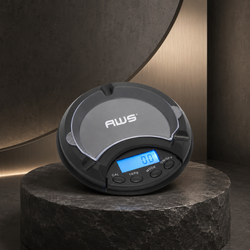
A pocket scale for epoxy pigments should have enough capacity for your container and materials while providing enough resolution to measure the smallest pigment quantities you actually use.
For many resin makers, a practical starting point is:
100–500g capacity × 0.01g readability
For maximum flexibility, a:
500g × 0.01g pocket scale
can be particularly useful.
It provides enough capacity for many pigment cups, trays, small resin samples and jewelry-sized batches while displaying measurements in hundredths of a gram.
But that does not mean every epoxy artist automatically needs a 500g × 0.01g scale.
Some pigment workflows can use:
0.1g readability
while very specialized applications may require:
0.001g readability
The right combination depends on two fundamental questions:
How much weight must the scale physically support?
and:
What is the smallest meaningful change you need the scale to display?
Those two specifications are called:
capacity and readability — often casually called resolution.
Choosing them correctly is more important than simply buying the pocket scale with the most decimal places.
Quick Answer: What Pocket Scale Do You Need for Epoxy Pigments?
Use this table as a practical starting point:
| Epoxy Pigment Task | Suggested Capacity | Suggested Readability |
|---|---|---|
| Tiny pigment tests | 100–200g | 0.01g |
| Mica powder | 100–500g | 0.01g |
| Concentrated colorants | 100–500g | 0.01g |
| Metallic powders | 100–500g | 0.01g |
| Glitter and larger additives | 200–500g | 0.01–0.1g |
| Resin jewelry pigments | 200–500g | 0.01g |
| Small resin color samples | 200–500g | 0.01g |
| General pigment formulation | 500g | 0.01g |
| Larger additive quantities | 500g+ | 0.1g where appropriate |
| Milligram-level formulation | Appropriate low capacity | 0.001g when genuinely required |
These ranges are starting points rather than universal requirements.
The best scale depends on the actual masses you need to measure.
What Does Pocket Scale Capacity Mean?
Capacity is the maximum physical load a scale is designed to support.
If a pocket scale is labeled:
500g × 0.01g
the:
500g
represents maximum capacity.
The:
0.01g
represents readability.
American Weigh Scales explains this notation in more detail in What Does 500g × 0.01g Mean on a Digital Scale?.
Capacity should always be calculated from the complete physical load, not simply the pigment.
The Pigment Container Counts Toward Capacity
Suppose you are measuring mica powder.
Your quantities are:
Pigment cup: 35g
Resin sample: 100g
Mica powder: 1.5g
Additional pigment: 0.5g
The scale is physically supporting:
35 + 100 + 1.5 + 0.5 = 137g
A 100g pocket scale would not be large enough.
A 200g scale could support the load, although it would provide relatively little capacity headroom.
A 500g scale would give you substantially more room.
This is why choosing a pigment scale based only on the weight of the pigment can lead to buying too little capacity.
Does Tare Give You More Capacity?
No.
Suppose you place a 50g cup on a 500g pocket scale.
You press tare.
The display changes to:
0.00g
But the scale is still physically supporting the 50g cup.
Tare changes the displayed value.
It does not increase the scale's physical capacity.
If the scale has a 500g maximum capacity, the container is still part of that limit.
This principle matters especially when you weigh pigments directly into a resin container.
How Much Capacity Do You Need?
For most epoxy pigment applications, pocket scales tend to fall into several useful capacity groups:
100g
200g
500g
and sometimes higher.
The correct choice depends on both the pigment and the container.
100g Pocket Scale for Epoxy Pigments
A 100g precision scale can work for:
-
Tiny pigment tests
-
Very lightweight trays
-
Small mica quantities
-
Small formulation experiments
It can be attractive because low-capacity scales often provide fine readability.
But capacity can disappear quickly.
For example:
Cup = 30g
Resin sample = 60g
Pigment = 2g
Total:
92g
You are already close to the 100g maximum.
A 100g scale is therefore best when your entire workflow is genuinely lightweight.
200g Pocket Scale for Epoxy Pigments
A 200g scale provides more flexibility.
It can work well for:
-
Pigment testing
-
Mica powder
-
Small jewelry batches
-
Small resin samples
-
Color-formulation experiments
Suppose:
Container = 40g
Resin = 100g
Pigment and additives = 3g
Total load:
143g
A 200g scale can support that example.
However, there is still limited room for larger cups or samples.
500g Pocket Scale for Epoxy Pigments
For many resin makers, 500g is the most versatile pocket-scale capacity for pigment work.
It can accommodate:
-
Heavier pigment cups
-
Small resin containers
-
Jewelry batches
-
Color-test batches
-
Multiple pigments
-
Mica
-
Glitter
-
Metallic powder
-
Lightweight additives
When combined with:
0.01g readability
a 500g scale can cover both tiny pigment quantities and substantially larger complete loads.
That is why the 500g × 0.01g specification is such a useful general-purpose range for pigment work.
Is More Than 500g Necessary?
Sometimes.
If you want your pocket scale to support:
-
Larger resin cups
-
Larger jewelry batches
-
Multiple-hundred-gram resin samples
you may eventually need more than 500g capacity.
However, as capacity increases, very fine readability can become less common.
For larger resin quantities, it may make more sense to use a second scale instead.
A higher-capacity scale can handle resin and hardener while the precision pocket scale remains dedicated to pigments.
AWS discusses the broader distinction between compact precision scales and larger weighing platforms in Pocket Scale vs. Kitchen Scale: Which One Should You Buy?.
What Does Resolution Mean on a Pocket Scale?
In everyday shopping language, people frequently use resolution to describe how finely a digital scale displays weight.
Scale manufacturers may more precisely refer to this as:
readability
or:
division size
Common pigment-scale options include:
1g
0.1g
0.01g
0.001g
For epoxy pigments, 1g is generally too coarse for many small formulation tasks.
The real decision is often:
0.1g vs. 0.01g
with 0.001g reserved for genuinely tiny quantities.
0.1g Resolution for Epoxy Pigments
A 0.1g pocket scale displays tenths of a gram.
Examples:
1.1g
1.2g
1.3g
1.4g
This can work well when:
-
Pigment quantities are several grams
-
Glitter quantities are larger
-
You work with larger resin batches
-
Differences smaller than 0.1g are not meaningful to your formulation
For example, if you normally measure:
8.5g
of pigment, 0.1g may be perfectly practical.
But if your normal amount is:
0.35g
0.1g is much coarser relative to the ingredient quantity.
0.01g Resolution for Epoxy Pigments
A 0.01g scale displays hundredths of a gram.
Examples:
0.25g
0.38g
0.72g
1.46g
This level of readability is particularly useful for:
-
Mica powder
-
Concentrated colorants
-
Small resin pigments
-
Metallic powders
-
Small formulation tests
-
Resin jewelry colors
-
Multi-pigment blends
If you want to reproduce a successful color formula later, 0.01g can provide substantially more useful measurement detail than 0.1g.
For pigment-focused work, this is often the best balance between precision and practicality.
0.001g Resolution for Epoxy Pigments
A 0.001g scale displays thousandths of a gram.
For example:
0.125g
0.126g
0.127g
This is milligram-level readability.
It can be useful when your actual ingredient quantities require it.
However, a 0.001g scale is generally more sensitive to:
-
Drafts
-
Vibration
-
Static
-
Temperature changes
-
Movement
-
Surface instability
It may also offer substantially less capacity.
For ordinary mica powder and resin pigment applications, 0.01g is often more practical.
AWS explains this tradeoff in 0.001g vs. 0.01g Scales: Which Precision Do You Need?.
0.1g vs. 0.01g: Which Should You Choose?
Choose 0.1g if:
-
Your pigment amounts are relatively large
-
You normally measure several grams
-
You need more scale capacity
-
Hundredth-of-a-gram measurements add little value
Choose 0.01g if:
-
Your pigments regularly fall below 1g
-
You make small resin batches
-
You formulate jewelry colors
-
You combine multiple pigments
-
You want repeatable color formulas
For a dedicated epoxy pigment pocket scale, 0.01g is often the stronger choice.
Do More Decimal Places Mean More Accuracy?
No.
This distinction is critical.
A scale with:
0.01g readability
displays weight in 0.01g increments.
That does not automatically mean every reading is guaranteed accurate to ±0.01g.
You also need to consider:
-
Accuracy specifications
-
Repeatability
-
Minimum usable load
-
Calibration
-
Linearity where specified
-
Environmental conditions
Readability is only one part of measurement performance.
NIST's Calibration of Mass Standards provides broader metrology context for how reference masses, uncertainty and calibration relate to dependable mass measurement.
Minimum Load Matters With Pigments
Suppose your pocket scale is:
500g × 0.01g
Its display can show changes of 0.01g.
That does not automatically mean:
0.01g
is the ideal minimum quantity to weigh.
The smallest displayed increment is not necessarily the same as the smallest reliable working load.
When working with extremely small pigment quantities, examine the manufacturer's information about:
-
Minimum usable load
-
Accuracy
-
Repeatability
-
Tolerance
If your ingredient quantity regularly falls below the useful range of a 0.01g scale, then a 0.001g model may become appropriate.
Why Repeatability Matters for Epoxy Pigments
Imagine creating a successful resin color:
Mixed resin: 50.00g
Blue mica: 0.55g
Pearl pigment: 0.22g
Metallic additive: 0.14g
You want to create exactly the same product again.
A pocket scale should provide consistent readings under similar conditions.
That allows you to record formulas based on mass rather than vague descriptions such as:
“half a scoop”
or:
“a little silver.”
AWS discusses factors that can interfere with consistent readings in Why Does My Digital Scale Give Different Readings?.
Why Tare Is Essential on a Pigment Pocket Scale
Tare lets you remove the displayed weight of your container.
A typical pigment workflow can be:
-
Place the empty cup on the scale.
-
Wait for a stable reading.
-
Press tare.
-
Confirm 0.00g.
-
Add Pigment A.
-
Record the mass.
-
Tare again if appropriate.
-
Add Pigment B.
-
Record the mass.
-
Continue building the formulation.
This can make multi-pigment formulas dramatically easier to document.
Platform Size Matters Too
Pocket scales are compact.
That is both an advantage and a limitation.
Before choosing one, make sure your container:
-
Fits fully on the platform
-
Remains centered
-
Does not touch the counter
-
Does not rest on the scale housing
-
Does not block the display
A 500g capacity rating does not help if your normal pigment cup cannot sit correctly on the weighing platform.
Do You Need a Weighing Tray?
A tray can be extremely useful for:
-
Mica powder
-
Glitter
-
Metallic pigments
-
Dry colorants
-
Small additives
Some pocket-scale protective covers can also function as weighing trays.
If you use a tray, place it on the scale and tare it before adding the material.
Remember:
the tray still counts toward physical capacity.
Use a Hard, Level Surface
Precision pocket scales should be placed on a:
hard, rigid, stable surface
Avoid:
-
Carpet
-
Fabric
-
Towels
-
Foam
-
Flexible mats
-
Wobbly tables
The more finely a scale reads, the more important a stable environment becomes.
Avoid Drafts When Weighing Pigments
Mica powder is lightweight.
A 0.01g or 0.001g scale is sensitive.
Strong airflow can therefore make fine weighing more difficult.
Avoid placing your scale directly beside:
-
Fans
-
HVAC vents
-
Open windows
-
Air purifiers
-
Strong air-conditioning airflow
Wait for the display to stabilize before recording the result.
Keep the Scale Away From Vibration
Precision measurements can also be affected by:
-
Sanders
-
Compressors
-
Rotary tools
-
Drills
-
Speakers
-
Nearby machines
-
Unstable workbenches
Perform pigment measurements while nearby vibrating equipment is off whenever practical.
Calibration Matters
Your pocket scale should have a clear procedure for calibration or performance checking.
Different models may require different:
-
Calibration masses
-
Button sequences
-
Procedures
-
Setup conditions
Do not assume that every 500g pocket scale uses the same calibration procedure.
AWS explains the basics in How to Calibrate a Digital Scale for Accurate Results.
NIST's Calibration Procedures for Weights and Measures Laboratories provides additional technical background on standardized calibration procedures and traceability.
A craft workspace does not need laboratory-level metrology procedures, but using the correct reference weight and following a defined calibration procedure remain important principles.
Do Not Use Random Objects as Calibration Weights
Avoid calibrating a pocket scale with:
-
Coins
-
Pigment jars
-
Resin bottles
-
Jewelry
-
Tools
-
Cured resin pieces
Use the calibration reference specified by the manufacturer.
For broader regulatory and technical context related to weighing equipment, NIST publishes the current NIST Handbook 44.
Hobby resin scales are not automatically subject to commercial legal-for-trade requirements, but the broader principle remains useful: weighing performance depends on understood specifications and appropriate measurement practices.
One Pocket Scale or Two Scales?
A pocket scale can be excellent for epoxy pigments.
It may not be the correct scale for your complete resin workflow.
For many makers, a two-scale setup is more practical.
Pigment Scale
Consider:
100–500g × 0.01g
Use for:
-
Mica
-
Pigments
-
Colorants
-
Metallic powders
-
Lightweight additives
-
Formula development
Main Resin Scale
Consider:
2–5kg × 0.1g
Use for:
-
Resin
-
Hardener
-
Mixing cups
-
Coasters
-
Molds
-
Larger batches
This setup avoids forcing one scale to cover everything from sub-gram pigment quantities to multi-kilogram resin pours.
The broader selection principles are covered in AWS's Best Digital Scale for Resin.
Can You Use a Pocket Scale for Resin and Hardener?
Yes, if:
-
The complete batch fits within capacity
-
Your container fits properly
-
The scale's specifications suit the amount being measured
-
The resin manufacturer provides or approves measurement by weight
However, do not assume that every resin system should be mixed using the numerical ratio shown for volume.
A resin labeled:
2:1 by volume
does not necessarily use:
2:1 by weight
because the densities of the resin and hardener may differ.
TotalBoat's guide to mixing epoxy by weight illustrates why epoxy manufacturers provide product-specific weight ratios.
Its additional explanation of measuring epoxy by weight versus volume reinforces the same point: follow the measurement basis specified for the exact epoxy system.
A scale measures mass.
It does not determine the correct mixing ratio.
Best Pocket Scale Capacity for Mica Powder
For mica powder, consider:
100–500g
depending on the size of your:
-
Container
-
Resin sample
-
Pigment quantity
For standalone pigment measurement, 100–200g may be enough.
For more flexibility:
500g
provides greater capacity headroom.
Pairing that with:
0.01g readability
creates a versatile mica-weighing setup.
Best Pocket Scale Resolution for Mica Powder
For many mica applications:
0.01g
is a practical choice.
It allows you to record:
0.35g
instead of simply:
0.3g or 0.4g
which can be helpful when developing repeatable colors.
If you routinely add several grams of mica and hundredth-of-a-gram differences are irrelevant, 0.1g may be sufficient.
Best Pocket Scale for Concentrated Colorants
Concentrated pigments can require relatively small quantities.
If your formulation frequently involves:
0.20g
0.35g
0.75g
then:
0.01g readability
is useful.
If your measurements become genuinely milligram-sized, investigate whether a 0.001g scale is appropriate.
Best Pocket Scale for Resin Jewelry Pigments
Jewelry work is particularly well suited to a precision pocket scale because both:
-
Resin batch size
-
Pigment quantity
can be relatively small.
A:
200–500g × 0.01g
scale can be useful for:
-
Earrings
-
Pendants
-
Rings
-
Small charms
-
Small molds
-
Pigment blends
A 500g model gives you additional room for the resin container.
Why 500g × 0.01g Is Often the Best All-Around Choice
If you want one compact scale primarily for pigment and small formulation work:
500g × 0.01g
is difficult to beat as a general starting specification.
It combines:
Useful capacity
Enough for many trays, pigment cups and small resin samples.
Fine readability
Hundredth-of-a-gram displayed increments.
Versatility
Useful for mica, pigments, colorants, additives and jewelry-scale work.
Practical size
Available in compact pocket-scale formats.
It also gives you substantially more capacity than many very-low-capacity precision scales.
Common Mistakes When Choosing a Pocket Scale for Epoxy Pigments
Buying the Lowest Capacity Possible
Remember the container.
Ignoring Capacity Headroom
Avoid designing your workflow around constantly reaching the maximum capacity.
Assuming Tare Restores Capacity
It does not.
Choosing 0.1g for Sub-Gram Formulas
0.01g may provide more useful detail.
Choosing 0.001g Without Needing It
Additional resolution also brings additional environmental sensitivity.
Confusing Readability With Accuracy
They are not the same.
Ignoring Minimum Load
Very small pigment quantities require an appropriate working range.
Buying a Platform Too Small for Your Cup
Test your container dimensions.
Blocking the Display
Make sure you can read the measurement while adding pigment.
Weighing on a Soft Surface
Use a hard, stable work surface.
Working Beside a Fan
Fine scales are more susceptible to airflow.
Ignoring Vibration
Precision measurement requires stability.
Using Random Calibration Objects
Use the correct reference mass.
Pocket Scale for Epoxy Pigments Buying Checklist
Before buying, ask:
-
What is my smallest pigment quantity?
-
What is my largest pigment quantity?
-
How much does my weighing cup weigh?
-
Will I also weigh resin samples?
-
What is my maximum complete load?
-
Is 100g enough?
-
Would 200g provide sufficient headroom?
-
Would 500g be more versatile?
-
Is 0.1g readability sufficient?
-
Do I need 0.01g?
-
Do I genuinely need 0.001g?
-
What minimum usable load is specified?
-
What accuracy information is available?
-
Is repeatability suitable?
-
Does the scale have tare?
-
Does it measure grams?
-
Is the platform large enough?
-
Does my container fit completely?
-
Can I see the display?
-
Is the display backlit?
-
Does the scale include a tray?
-
Does it include a protective cover?
-
Can it be calibrated?
-
What calibration mass does it require?
-
Is that calibration mass included?
-
Can I protect it from pigment dust?
-
Can I protect it from resin spills?
-
Is battery operation convenient?
-
Is my workspace stable?
-
Would a second high-capacity scale improve my setup?
Frequently Asked Questions
What capacity pocket scale do I need for epoxy pigments?
For many applications:
100–500g
is a useful range.
A 500g scale provides more room for containers and small resin samples.
What resolution should a pigment scale have?
For many epoxy pigment applications:
0.01g
is a useful starting point.
Is 0.1g accurate enough for mica?
It can provide sufficient readability when the mica quantities are several grams or larger.
For sub-gram measurements, 0.01g is generally more useful.
Do I need 0.001g?
Usually not for ordinary resin pigment work.
Use milligram readability when your actual ingredient quantities require it.
Is 500g × 0.01g good for resin pigments?
Yes. It provides a useful combination of capacity and fine readability for many pigment formulations.
Is a 100g scale enough?
It can be for very small pigment tests using lightweight containers.
However, capacity can be consumed quickly once the container and resin sample are included.
Is a 200g pocket scale enough?
It can be a good choice for small pigment and jewelry work.
A 500g model provides greater headroom.
Does tare increase capacity?
No.
The container remains part of the physical load.
Is resolution the same as accuracy?
No.
Resolution or readability describes the smallest displayed increment.
Accuracy is a separate performance characteristic.
Why is minimum load important?
The smallest displayed increment is not necessarily the smallest ideal quantity the scale can measure reliably.
Can I use the same scale for resin?
Yes, provided the entire batch and container remain within capacity and the scale's other specifications are appropriate.
Should I buy a pocket scale or kitchen scale?
For small pigments and additives, a precision pocket scale is often more useful because finer readability is commonly available.
For larger resin batches, a larger-capacity scale is generally more practical.
Should I own two scales?
If you routinely weigh both sub-gram pigments and multi-kilogram resin batches, yes.
A practical combination is:
100–500g × 0.01g pigment scale
plus:
2–5kg × 0.1g main resin scale
Final Verdict: What Capacity and Resolution Do You Need?
Choosing a pocket scale for epoxy pigments comes down to balancing:
capacity
with:
readability.
Start by calculating your maximum physical load:
container + resin sample + pigment + additives
Then determine your smallest meaningful ingredient quantity.
For very small standalone pigment tests:
100–200g × 0.01g
may work well.
For broader pigment, mica, jewelry and formulation work:
500g × 0.01g
is a particularly versatile choice.
Choose:
0.1g
when your ingredients are larger and hundredth-of-a-gram measurement is unnecessary.
Choose:
0.01g
when you routinely measure sub-gram pigments or want more detailed repeatable formulas.
Choose:
0.001g
only when your actual formulation requires milligram-level measurement.
And do not evaluate a scale by those two specifications alone.
Also consider:
-
Accuracy specifications
-
Repeatability
-
Minimum usable load
-
Tare
-
Calibration
-
Platform size
-
Display visibility
-
Environmental stability
For many resin makers, the most practical setup remains:
500g × 0.01g pocket scale for pigments
plus:
2–5kg × 0.1g scale for resin and hardener.
That gives you enough capacity for your main resin batches while preserving the fine readability needed for the small amounts of pigment that can determine the final color.