
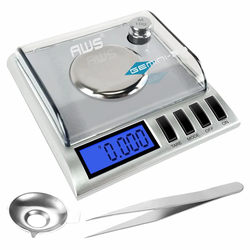
Choosing a pocket scale for gold and silver comes down to two specifications that should always be considered together: capacity and resolution.
Capacity tells you the maximum total load the scale is designed to support. Resolution, often described as readability, tells you the smallest increment shown on the display. A scale labeled 500g x 0.01g, for example, has a nominal capacity of 500 grams and displays measurements in 0.01-gram increments.
For many individual gold and silver jewelry pieces, coins, findings, and small precious-metal samples, a 0.01g pocket scale with 100g to 500g of capacity is a practical starting point. Tiny fragments can require finer 0.001g resolution, while grouped silver jewelry and larger scrap batches can exceed the useful capacity of a pocket scale altogether.
American Weigh Scales offers compact pocket scales designed for small-object weighing. The correct model is not necessarily the scale with the highest capacity or the most decimal places. It is the scale whose measuring range matches the objects you actually handle.
This guide explains how to choose the right combination.
Capacity vs. Resolution: The Difference
Capacity and resolution answer two completely different questions.
Capacity: How much total mass can the scale support?
Resolution/readability: What is the smallest increment the display can show?
Consider these three hypothetical specifications:
| Specification | Maximum capacity | Display increment |
|---|---|---|
| 200g x 0.01g | 200g | 0.01g |
| 500g x 0.01g | 500g | 0.01g |
| 500g x 0.1g | 500g | 0.1g |
The first two scales provide the same display resolution but different capacities. The second and third provide the same capacity but different resolution.
This distinction is important because gold and silver applications can require very different combinations. A jeweler weighing individual rings may value 0.01g readability more than a huge capacity. Someone sorting larger batches of silver may need substantially more capacity while having no practical need for thousandths of a gram.
AWS explains this notation in What Does 500g x 0.01g Mean on a Digital Scale?.
Quick Capacity and Resolution Guide
| Gold or silver application | Suggested starting capacity | Suggested resolution |
|---|---|---|
| Gold rings | 100–200g | 0.01g |
| Gold earrings | 100–200g | 0.01g |
| Gold pendants | 100–250g | 0.01g |
| Lightweight gold chains | 100–250g | 0.01g |
| Heavy gold chains | 250–500g+ | 0.01g |
| Silver rings and earrings | 100–250g | 0.01g |
| Silver chains and bracelets | 200–500g+ | 0.01g |
| Gold coins | 100–500g | 0.01g |
| Silver coins | 200–500g+ | 0.01g |
| Tiny gold fragments | 20–100g | 0.001g |
| Very small findings | 20–250g | 0.001g or 0.01g |
| Small scrap-gold lots | 250–500g+ | 0.01g |
| Small scrap-silver lots | 500g+ | 0.01g or 0.1g |
| Larger silver batches | 1,000g+ | Application-dependent |
These ranges are general selection guidelines, not universal performance specifications. Always check the individual scale's manufacturer specifications and intended operating range.
What Does 100g Capacity Mean?
A 100g pocket scale can support up to its specified maximum load, including anything used as a container.
This capacity can work well for lightweight objects such as:
-
Rings
-
Earrings
-
Small pendants
-
Individual coins
-
Findings
-
Small gold samples
-
Lightweight chains
A 100g x 0.01g scale may be compact and convenient for users who rarely weigh anything heavy.
The drawback is limited headroom. A watch, substantial chain, multiple coins, or a weighing tray can quickly consume the available capacity.
If your normal loads routinely approach 100g, consider moving to 200g or more.
Is 200g Capacity Enough for Gold?
For many individual gold jewelry applications, 200g is more than enough capacity.
A 200g x 0.01g pocket scale can accommodate many:
-
Rings
-
Earrings
-
Pendants
-
Chains
-
Bracelets
-
Coins
-
Findings
-
Small samples
It also leaves substantial headroom when the item itself weighs only a few grams or a few dozen grams.
A 200g scale becomes less suitable when you frequently use heavy trays, weigh groups of items together, or handle substantial chains and watches.
AWS discusses the practical differences in its 200g vs. 500g pocket scale guide.
Is 250g Capacity Worth It?
A 250g pocket scale occupies a useful middle ground.
The additional 50g over a 200g model can matter when you use:
-
Small weighing trays
-
Heavier chains
-
Multiple rings
-
Groups of coins
-
Bracelets
-
Small scrap lots
If two scales have the same 0.01g resolution, capacity alone should not determine the decision. Also compare platform dimensions, calibration requirements, available units, display quality, protective cover, power source, and physical size.
When Does 500g Capacity Make Sense?
A 500g pocket scale offers substantially more flexibility than a 100g or 200g model.
It is useful when you expect to weigh:
-
Heavy gold chains
-
Larger silver chains
-
Bracelets
-
Watches
-
Multiple jewelry pieces
-
Groups of coins
-
Jewelry in trays
-
Small scrap-metal lots
-
Jewelry-making materials
AWS currently lists precision models with a 500g x 0.01g specification, demonstrating that higher pocket-scale capacity does not necessarily require giving up hundredth-of-a-gram readability.
A 500g scale is not automatically the right choice for everyone, however. If your largest item weighs 20g and you never weigh grouped objects, most of that capacity may remain unused.
200g vs. 500g: Which Should You Choose?
Choose approximately 200g x 0.01g when your priority is:
-
Individual jewelry
-
Coins
-
Lightweight objects
-
Compact portability
-
Hundredth-of-a-gram readings
Choose approximately 500g x 0.01g when your priority is:
-
Heavy chains
-
Watches
-
Multiple pieces
-
Larger containers
-
Groups of coins
-
Small scrap lots
-
Additional capacity headroom
The most important question is not “Which capacity is better?”
It is:
What is the heaviest complete load I realistically expect to place on the scale?
Remember the Weight of the Container
One of the most common capacity mistakes is forgetting that a tared container still weighs something.
Suppose you have:
-
Silver jewelry: 165g
-
Tray: 30g
The physical load is 195g.
A 200g scale technically accommodates it, but leaves almost no headroom.
If you press tare after placing the tray on the scale, the display returns to zero. That does not mean the 30g tray has disappeared from the load cell. The scale is still physically supporting it.
Calculate capacity as:
precious metal + container + reasonable headroom
How Much Capacity Headroom Do You Need?
Avoid choosing a scale that will operate near its maximum capacity during normal use.
If your typical complete load is 190g, a 200g scale is a poor long-term fit even though the load is technically below the nominal limit.
Additional headroom helps accommodate:
-
Heavier-than-normal pieces
-
Different trays
-
Multiple items
-
Future applications
-
Accidental variations in load
NIST Handbook 44 states that a scale should not be used for loads above its nominal capacity.
For noncommercial personal use, manufacturer instructions remain the primary reference for the specific device.
Is 0.1g Resolution Enough?
A 0.1g scale displays tenths of a gram.
Example:
24.6g
rather than:
24.63g
This may be sufficient for:
-
Larger silver objects
-
Heavy jewelry
-
Bulk scrap
-
Larger precious-metal batches
-
Applications where hundredths of a gram do not affect the task
For individual gold jewelry, 0.1g may be too coarse when the goal is to document smaller weight differences.
The correct resolution is the smallest increment that is meaningful for your actual application.
Why 0.01g Is a Popular Choice
A 0.01g scale displays hundredths of a gram.
Examples include:
-
4.26g
-
17.83g
-
105.41g
This is a practical level of detail for many:
-
Gold rings
-
Silver rings
-
Earrings
-
Pendants
-
Chains
-
Bracelets
-
Coins
-
Findings
-
Small scrap lots
For this reason, 0.01g is often a useful general-purpose resolution for precious-metal pocket scales.
AWS's Pocket Scale for Jewelry guide provides additional jewelry-specific capacity and resolution guidance.
When Do You Need 0.001g?
A 0.001g scale displays thousandths of a gram.
That finer resolution can be useful for:
-
Tiny gold fragments
-
Very small findings
-
Lightweight components
-
Fine samples
-
Tasks where hundredths of a gram are too coarse
But finer resolution comes with practical tradeoffs.
Milligram scales are generally more sensitive to:
-
Air movement
-
Vibration
-
Temperature
-
Static electricity
-
Surface instability
They may also have significantly lower capacity.
AWS's guide to 0.001g milligram scales is useful when deciding whether a separate milligram scale makes sense.
0.01g vs. 0.001g for Gold
For ordinary finished gold jewelry, 0.01g is usually the more versatile format because it combines useful detail with practical capacity.
Choose 0.001g when the actual objects are tiny enough that hundredth-of-a-gram increments no longer provide sufficient information.
For users handling both categories, a two-scale setup can be more practical:
Scale 1: 0.01g pocket scale for rings, chains, coins, bracelets, and ordinary scrap.
Scale 2: 0.001g milligram scale for tiny fragments, findings, and low-mass components.
This avoids forcing one scale to cover incompatible measurement ranges.
Resolution Is Not Accuracy
A scale displaying three decimal places is not automatically accurate to ±0.001g.
Resolution describes the smallest increment shown on the display.
Accuracy concerns how close a measurement is to the relevant reference value within the instrument's stated performance.
When comparing scales, evaluate:
-
Manufacturer accuracy/tolerance specifications
-
Repeatability
-
Calibration procedure
-
Minimum usable load
-
Intended operating range
-
Environmental requirements
The number of decimals is only one part of the specification. The BIPM SI Brochure provides the international framework for the SI system of units.
Repeatability Matters
Repeatability is the ability to obtain consistent measurements when the same stable object is weighed repeatedly under similar conditions.
A simple check:
-
Place the scale on a hard, stable surface.
-
Confirm zero.
-
Place an appropriate reference mass in the center.
-
Record the result.
-
Remove it.
-
Allow the display to return to zero.
-
Repeat several times.
If results vary unexpectedly, investigate environmental conditions, battery condition, calibration, contamination, or load placement.
AWS explains common causes in Why Does My Digital Scale Give Different Readings?.
Minimum Usable Load Matters
Maximum capacity gets most of the attention, but the lower end of the measuring range matters too.
A 0.01g display does not automatically mean every 0.01g sample can be measured reliably.
NIST's scale guidance emphasizes considering both maximum capacity and minimum load when selecting equipment for regulated commercial applications.
This is particularly relevant when dealing with:
-
Tiny fragments
-
Very small findings
-
Metal flakes
-
Lightweight components
For extremely low-mass samples, review the manufacturer's performance specifications rather than assuming the displayed increment defines the minimum useful load.
Gold Rings: What Capacity and Resolution?
For most individual gold rings, a practical starting point is:
100–200g capacity x 0.01g resolution
This offers ample capacity for the ring itself while providing hundredth-of-a-gram readings.
A higher-capacity model can make sense if the same scale will also be used for chains, watches, grouped jewelry, or containers.
Gold Earrings
Individual earrings and pairs are generally lightweight.
A practical specification is often:
100–200g x 0.01g
If you work with extremely small components separately, a 0.001g milligram scale may complement the general-purpose pocket scale.
Gold Pendants
For individual pendants:
100–250g x 0.01g
is a flexible range.
If pendants are weighed with chains attached, calculate capacity based on the complete piece.
Gold Chains
Chains require more thought because their weights vary significantly.
For lightweight chains:
100–250g x 0.01g
For heavier chains:
250–500g+ x 0.01g
Platform size matters as much as capacity. If the chain hangs over the platform and touches the counter, another surface supports part of its weight.
Use a suitable lightweight tray when necessary.
Silver Rings and Earrings
For most individual silver rings and earrings:
100–250g x 0.01g
provides substantial capacity.
If you routinely weigh multiple pieces together, move toward 250g or 500g.
Silver Chains and Bracelets
Silver chains and bracelets can be significantly heavier.
A practical range is:
200–500g+ x 0.01g
Larger pieces may exceed pocket-scale capacity, at which point a higher-capacity bench scale becomes more appropriate.
Gold Coins
Coins are convenient for pocket scales because they are compact and easy to center.
For individual gold coins and small groups:
100–500g x 0.01g
provides a broad useful range.
Weight can be compared with published specifications, but weight alone does not prove authenticity.
Silver Coins
Silver coins can produce heavier grouped loads.
For individual coins and small groups:
200–500g x 0.01g
is a practical starting range.
If weighing rolls, sets, or larger groups, calculate the expected combined weight before selecting capacity.
Scrap Gold
Scrap gold can range from tiny fragments to heavy groups of broken jewelry.
A useful setup may include:
-
0.001g milligram scale for tiny fragments
-
0.01g pocket scale for ordinary scrap
-
Higher-capacity scale for larger lots
Always include the sorting container in the capacity calculation.
Scrap Silver
Silver scrap can exceed pocket-scale limits quickly.
A 500g pocket scale may work for small lots, but larger batches may require:
-
1,000g
-
2,000g
-
5,000g
-
Greater capacity
At higher batch weights, 0.1g resolution may be entirely sufficient depending on the purpose.
Platform Size Is Part of the Capacity Decision
A scale can technically have enough capacity while still being physically unsuitable for the object.
This matters for:
-
Long chains
-
Bracelets
-
Watches
-
Multiple coins
-
Scrap cups
-
Sorting trays
The entire load must be supported by the weighing platform or a properly positioned container resting entirely on it.
Never allow part of the object to rest on the surrounding counter.
Tare Is Essential
Tare allows the scale to display the net weight of the gold or silver without the container.
To use tare:
-
Put the empty container on the platform.
-
Wait for a stable reading.
-
Press tare.
-
Confirm zero.
-
Add the precious metal.
-
Record the net result.
Tare does not create additional capacity.
If a tray weighs 50g on a 500g scale, the scale is already supporting 50g before the precious metal is added.
Calibration
A precision scale should be calibrated or verified according to the manufacturer's instructions.
Use the specified calibration mass rather than:
-
Coins
-
Jewelry
-
Batteries
-
Random household objects
The required calibration mass varies by model.
AWS provides additional guidance in How to Calibrate a Digital Scale for Accurate Results.
Calibration or verification is particularly worth checking after:
-
Transportation
-
Impact
-
Accidental overload
-
Long storage
-
Major temperature changes
-
Unexpected repeatability problems
Grams, Pennyweight and Troy Ounces
The units you need depend on your workflow.
Grams
Grams are broadly useful for jewelry, coins, scrap, repairs, manufacturing, and inventory.
NIST provides an official reference for SI units of mass.
Pennyweight
Pennyweight is abbreviated dwt and remains useful in parts of the jewelry and precious-metals trade.
If your workflow already uses dwt, direct pennyweight mode reduces manual conversion.
Troy Ounces
Precious metals are commonly associated with troy ounces, abbreviated ozt.
Do not confuse:
-
oz — avoirdupois ounce
-
ozt — troy ounce
If your workflow uses troy weight, direct ozt mode is convenient.
Carat Is Not Karat
A carat is a unit of gemstone mass.
The Gemological Institute of America states that one metric carat equals 0.2 gram.
A karat describes gold purity, such as 10K, 14K, 18K, or 24K.
A pocket scale measures mass. It cannot determine gold purity simply by weighing an object.
Can a Pocket Scale Tell Whether Gold Is Real?
No.
Mass can be one useful data point, but a scale cannot independently identify material composition.
Two objects made from different materials can have the same mass.
Gold authentication can require other information or testing, such as:
-
Dimensions
-
Density
-
Hallmarks
-
Appropriate professional testing
-
Instrumental analysis
Do not treat scale weight alone as proof of authenticity.
Can It Tell Whether Silver Is Real?
No.
Weight can help compare an item with expected specifications, but it cannot independently establish silver purity or authenticity.
Composition requires other appropriate evaluation.
Drafts and Air Movement
Fine-resolution scales can respond to moving air.
Avoid weighing directly beside:
-
Fans
-
HVAC vents
-
Open windows
-
Doors
-
Strong air currents
Environmental control becomes increasingly important as resolution becomes finer.
A 0.001g milligram scale may benefit from a draft shield.
Vibration
Use a hard, rigid, stable surface.
Avoid:
-
Wobbly tables
-
Flexible shelves
-
Machinery benches
-
Surfaces affected by frequent impacts
Vibration can cause unstable final digits even when the object itself is stationary.
Temperature
Allow a scale to acclimate after significant temperature changes.
A scale moved from a hot vehicle into an air-conditioned room may need time to reach stable operating conditions before precise measurements are made.
Follow the manufacturer's operating-temperature guidance.
Static Electricity
Static can influence lightweight samples, particularly with:
-
Plastic trays
-
Dry environments
-
Tiny fragments
-
Milligram scales
If the display remains unstable after controlling drafts and vibration, static is another factor worth investigating.
Protective Cover
A protective cover is useful for a portable scale because it helps protect the weighing platform during storage and transport.
Some scale covers can also function as weighing trays.
If you use a cover as a tray, remember that its weight still contributes to total capacity even after tare is pressed.
Battery and Power Considerations
Portable scales commonly use replaceable batteries, while some models offer AC or other power options.
Weak batteries can contribute to unusual behavior in electronic scales.
If readings suddenly become unstable, check:
-
Battery condition
-
Power connection
-
Surface stability
-
Calibration
-
Environmental conditions
before assuming the weighing sensor is defective.
Pocket Scale vs. Bench Scale
A pocket scale is a strong choice when you prioritize:
-
Portability
-
Compact storage
-
Individual jewelry
-
Coins
-
Small precious-metal samples
-
Moderate capacity
A larger bench scale is better when you routinely handle:
-
Large silver pieces
-
Heavy trays
-
Bulk scrap
-
Multi-kilogram batches
-
Large platforms
Some users benefit from owning both.
A Practical Two-Scale Setup
For a jewelry or precious-metal workflow that spans tiny components and ordinary finished pieces, consider:
General Scale
200–500g x 0.01g
Use it for:
-
Rings
-
Chains
-
Bracelets
-
Coins
-
Finished jewelry
-
Small scrap lots
Fine Scale
Lower-capacity x 0.001g
Use it for:
-
Tiny fragments
-
Small findings
-
Lightweight components
This setup gives you practical capacity without giving up access to milligram-level resolution when it is genuinely needed.
A Practical Three-Scale Setup
Users handling bulk silver or large scrap lots may benefit from three ranges:
-
0.001g milligram scale for tiny components.
-
0.01g pocket scale for ordinary jewelry and coins.
-
Higher-capacity scale for large silver pieces and bulk scrap.
Each instrument can then be selected for the range where it performs most appropriately.
Commercial Gold and Silver Transactions
A pocket scale used for personal collecting, jewelry making, internal inventory, or non-transactional measurements is not automatically suitable for a transaction where weight determines the price paid or received.
The current 2026 NIST Handbook 44 contains specifications, tolerances, and technical requirements for weighing and measuring devices. NIST says these requirements support accurate, repeatable measurements and transparent transactions.
The NIST Weighing and Scales FAQ also notes that scales used for commercial applications must comply with the laws of the state in which they are used.
If you buy or sell gold or silver by weight, verify:
-
State requirements
-
Local weights-and-measures rules
-
Device certification
-
Inspection requirements
-
Applicable accuracy class
-
Legal-for-trade status
Do not assume that a consumer pocket scale is automatically approved for commercial transactions. Businesses marketing jewelry should also review the FTC's Jewelry Guides for federal guidance on jewelry representations.
How to Calculate the Capacity You Need
Use this simple process.
Step 1: Find Your Heaviest Item or Batch
Do not use the average weight.
Use the largest realistic load you expect to measure.
Step 2: Add the Container
Include the heaviest tray, cup, or sorting dish you normally use.
Step 3: Add Headroom
Choose a scale whose capacity is comfortably above the result.
Example
Heavy chain: 165g
Tray: 35g
Complete load: 200g
A 200g scale leaves no practical headroom.
A 250g or 500g scale is a better choice.
How to Calculate the Resolution You Need
Resolution should be based on the smallest weight difference that matters.
Ask:
-
Do whole grams matter?
-
Do tenths matter?
-
Do hundredths matter?
-
Do thousandths matter?
If hundredths are meaningful, choose 0.01g.
If only tenths matter, 0.1g may be sufficient.
If thousandths genuinely matter for tiny samples, consider 0.001g.
Then confirm that the scale's accuracy, repeatability, minimum useful range, and capacity also meet the application.
Capacity Is Not Precision
A 500g scale is not inherently more precise than a 200g scale.
Likewise, a 100g scale is not automatically more precise than a 500g scale.
Capacity simply describes the upper load limit.
Always read the complete specification.
Resolution Is Not Precision Either
Resolution is one component of scale performance, but the word “precision” is often used casually in product descriptions.
A high-resolution display is useful only when the instrument's overall performance, calibration, repeatability, and operating environment support the measurement.
For gold and silver, choose based on the complete specification rather than a marketing phrase.
Common Mistakes When Buying a Gold and Silver Pocket Scale
Mistake 1: Choosing Capacity Without Checking Resolution
A 500g scale may read to 0.01g or 0.1g. Read both numbers.
Mistake 2: Choosing Resolution Without Checking Capacity
A 0.001g scale may not support the loads you normally weigh.
Mistake 3: Forgetting Container Weight
Tare does not eliminate physical load.
Mistake 4: Buying Exactly Enough Capacity
Leave useful headroom.
Mistake 5: Assuming More Decimal Places Mean Greater Accuracy
Readability and accuracy are different concepts.
Mistake 6: Ignoring Minimum Load
The smallest displayed increment does not automatically equal the smallest reliable sample.
Mistake 7: Letting Chains Touch the Counter
The entire load must be supported by the scale.
Mistake 8: Using Random Calibration Objects
Use the reference mass specified by the manufacturer.
Mistake 9: Confusing Troy and Ordinary Ounces
Check the unit symbol.
Mistake 10: Confusing Carat and Karat
Carat is gemstone mass; karat describes gold purity.
Mistake 11: Assuming Weight Proves Authenticity
It does not.
Mistake 12: Assuming Every Pocket Scale Is Legal for Trade
Commercial requirements may apply when price is determined by weight.
Pocket Scale Buying Checklist
Before purchasing, answer these questions:
-
What is the lightest sample I need to weigh?
-
What is the smallest weight difference that matters?
-
What is the heaviest item or batch?
-
Will I use a tray or container?
-
What does the container weigh?
-
How much capacity headroom do I need?
-
Do I need 0.1g, 0.01g, or 0.001g?
-
What accuracy or tolerance does the manufacturer specify?
-
What is the minimum useful load?
-
How repeatable is the scale?
-
Can it be calibrated?
-
Which calibration mass is required?
-
Does it have tare?
-
Does it support grams?
-
Do I need pennyweight?
-
Do I need troy ounces?
-
Is the platform large enough?
-
Do I need a protective cover?
-
Will I travel with the scale?
-
Do I need a draft shield?
-
What power source does it use?
-
Will it be used for internal purposes or commercial transactions?
Frequently Asked Questions
What is the best pocket scale capacity for gold?
For many individual gold jewelry pieces, 100–250g provides sufficient capacity. Heavy chains, watches, grouped pieces, or trays can make 500g more practical.
What is the best pocket scale capacity for silver?
Around 200–500g can cover many individual silver pieces. Grouped jewelry and scrap may require significantly greater capacity.
Is 200g enough for gold jewelry?
Yes, for many rings, earrings, pendants, coins, and lightweight chains.
Is 500g better than 200g?
It provides more capacity, but it is not automatically more accurate. Choose based on your heaviest complete load.
Is 0.01g resolution good for gold?
For many jewelry, coin, and small precious-metal applications, 0.01g is a practical general-purpose resolution.
Do I need 0.001g for gold?
Usually only when tiny fragments, findings, or components require milligram-level readings.
Is 0.1g enough for silver?
It can be appropriate for larger pieces and bulk batches when hundredth-of-a-gram detail is unnecessary.
What does 500g x 0.01g mean?
It means a nominal maximum capacity of 500 grams and display increments of 0.01 gram.
Does tare give me more capacity?
No. A tared container still contributes to the physical load.
Should a gold scale measure pennyweight?
If your workflow uses dwt, direct pennyweight mode can be convenient.
Should a silver scale measure troy ounces?
If your workflow uses troy weight, direct ozt mode can reduce conversions.
Can a pocket scale test gold purity?
No. It measures mass, not composition or karat purity.
Can a pocket scale prove a silver coin is authentic?
No. Weight is only one characteristic and cannot independently prove authenticity.
Can I use any pocket scale to buy gold from customers?
No. Commercial transactions based on weight may require approved equipment and compliance with applicable weights-and-measures laws.
Final Verdict: What Capacity and Resolution Do You Need?
For many everyday gold and silver applications, 0.01g resolution combined with 200g to 500g of capacity provides a useful balance.
Use this framework:
-
100–200g x 0.01g: rings, earrings, pendants, individual coins, lightweight chains
-
200–250g x 0.01g: broader jewelry use with additional headroom
-
500g x 0.01g: heavier chains, bracelets, watches, grouped jewelry, trays, coins, and small scrap lots
-
0.001g milligram scale: tiny fragments, findings, and lightweight components
-
Higher-capacity 0.1g or 0.01g scale: larger silver pieces and bulk precious-metal batches
Capacity and resolution should never be selected independently.
Also compare:
-
Accuracy specifications
-
Repeatability
-
Minimum usable load
-
Calibration
-
Tare
-
Platform dimensions
-
Grams
-
Pennyweight
-
Troy ounces
-
Protective design
-
Environmental sensitivity
-
Commercial approval when required
The right pocket scale for gold and silver is the one whose capacity comfortably covers your largest complete load while its resolution captures the smallest weight difference that genuinely matters in your work.