
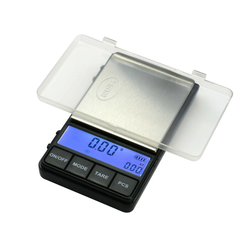
A pocket scale for sourdough can be extremely useful, but only if
you understand what a compact scale is---and is not---supposed to do.
Sourdough baking involves a wide range of masses. You may measure 2.5g
of salt for a tiny test dough, 20g of starter for a small feeding, 500g
of flour for a loaf, and more than 2kg once a mixing bowl and complete
dough are placed on a scale.
A pocket scale is best suited to the small end of that range.
For most sourdough bakers, the sweet spot is 200--500g capacity with
0.1g readability. This combination is useful for salt, small starter
experiments, spices, malt, hybrid formulas containing tiny quantities of
commercial yeast, and other low-mass ingredients.
If you routinely measure below 1g, 0.01g readability may be
worthwhile. If you want to weigh heavy starter jars, flour, water, or
complete dough, a larger kitchen scale is the better tool.
King Arthur Baking recommends weighing sourdough starter ingredients
because starter volume can vary depending on consistency and whether it
has been stirred down. Its current sourdough starter recipe puts
ingredient weights first and specifically recommends a scale for
accurate and consistent starter measurement.
American Weigh Scales' pocket
scales are designed for compact
precision weighing and can complement a larger kitchen scale in a
sourdough workflow.
Quick Answer: What Capacity and Resolution Do You Need?
For most sourdough precision work:
Best all-around pocket scale: 200--500g x 0.1g
For salt and very small ingredients:
100--200g x 0.1g
For small starter builds:
200--500g x 0.1g
For specialized sub-gram experiments:
100--200g x 0.01g
For starter jars, flour, water, and complete dough:
Use a larger 3--5kg+ kitchen scale.
Capacity and Resolution Chart
Sourdough task Suggested capacity Suggested readability
Salt 100--200g 0.1g
Spices and malt 100--200g 0.1g
Small starter experiment 200--500g 0.1g
Small levain build 200--500g 0.1g
Hybrid commercial yeast 100--200g 0.1g or 0.01g
Tiny test dough ingredients 200--500g 0.1g
Sub-gram specialty work 100--200g 0.01g
Routine starter jar 1--3kg+ 1g
Flour and water 3--5kg+ 1g
Complete dough 5kg+ 1g
These are practical starting points rather than universal requirements.
What Does Capacity Mean?
Capacity is the maximum total mass the scale is designed to support.
If a scale is labeled:
500g x 0.1g
then:
-
500g is the maximum capacity.
-
0.1g is the displayed increment or readability.
AWS explains this notation in What Does 500g x 0.01g Mean on a Digital
Scale?.
For sourdough, capacity must include the container.
Container Weight Is Critical
Suppose you want to weigh:
20g starter
If your container weighs 30g, the gross load is:
50g
A 100g scale works.
But if your glass jar weighs 450g, the gross load becomes:
470g
Now a 100g or 200g pocket scale cannot support the setup.
This is why sourdough bakers must think about the container before
choosing capacity.
What Does Resolution Mean?
Resolution or readability describes the smallest change shown on the
display.
Common choices include:
-
1g --- whole grams
-
0.1g --- tenths of a gram
-
0.01g --- hundredths of a gram
-
0.001g --- thousandths of a gram
For a sourdough pocket scale, 0.1g is the most useful general
choice.
Why 0.1g Is the Sweet Spot
Sourdough's major ingredients do not need extreme resolution.
A normal formula may contain:
-
500g flour
-
350g water
-
100g starter
-
10g salt
A large kitchen scale with 1g readability handles those quantities well.
A pocket scale becomes valuable when the formula shrinks or when you
want finer control over the smallest ingredients.
For example, a quarter-size dough might contain only:
2.5g salt
A 0.1g scale can display that target directly.
Is 1g Enough?
For most starter, flour, water, and full dough measurements, yes.
For tiny ingredients, 1g can be relatively coarse.
Suppose your target is:
2.5g salt
A whole-gram scale cannot display 2.5g directly.
A 0.1g pocket scale can.
This is the fundamental reason to pair a precision pocket scale with a
larger kitchen scale.
When 0.01g Makes Sense
Choose 0.01g when you routinely work with quantities such as:
-
0.25g
-
0.40g
-
0.55g
-
0.75g
This may occur when:
-
Scaling formulas dramatically down
-
Conducting tiny fermentation experiments
-
Using a very small amount of commercial yeast in hybrid sourdough
-
Testing small quantities of specialty ingredients
-
Sharing the scale with other precision tasks
For ordinary sourdough, however, 0.01g is usually unnecessary.
Do You Need 0.001g?
Generally no.
Milligram resolution is much finer than normal sourdough formulas
require.
It can also make the scale more sensitive to:
-
Drafts
-
Static
-
Vibration
-
Temperature changes
-
Small disturbances
For most bakers, a stable 0.1g scale is more practical.
Readability Is Not Accuracy
Readability tells you the smallest increment displayed.
Accuracy concerns how closely the indicated measurement agrees with an
appropriate reference within the scale's specified performance.
Repeatability concerns how consistently the scale measures the same
stable load under similar conditions.
A scale showing 0.01g is not automatically more accurate than every
scale showing 0.1g.
Repeatability Matters
Sourdough baking is about reproducing formulas.
If you weigh the same stable object several times under the same
conditions, the readings should behave consistently within the scale's
stated performance.
A simple check is:
-
Confirm zero.
-
Place the same stable object on the scale.
-
Record the reading.
-
Remove it.
-
Wait for zero.
-
Repeat.
AWS discusses common causes of inconsistent measurements in Why Does My
Digital Scale Give Different
Readings?.
100g Capacity: When It Works
A 100g pocket scale can be excellent for dedicated small-ingredient
work.
It can handle:
-
Salt
-
Spices
-
Commercial yeast
-
Malt
-
Tiny starter samples
The main limitation is the container.
If you use a 20g weighing dish, a 100g scale leaves plenty of room for a
few grams of salt.
If you use a 90g ramekin, capacity becomes restrictive.
200g Capacity: Excellent for Precision Baking
A 200g scale is a strong dedicated sourdough precision format.
It provides enough room for:
-
Salt
-
Spices
-
Small starter portions
-
Tiny levain builds
-
Hybrid yeast
-
Lightweight dishes
For bakers who already own a high-capacity kitchen scale, 200g can be an
excellent companion capacity.
500g Capacity: Best All-Around Flexibility
A 500g pocket scale provides much more container flexibility.
It can handle:
-
Salt
-
Spices
-
Small starter builds
-
Small levain builds
-
Lightweight starter containers
-
Small flour portions
-
Other precision kitchen tasks
For many sourdough bakers, 500g x 0.1g is the best all-around
pocket-scale combination.
Is 1kg Better?
A 1kg compact scale can be useful if you want to support larger starter
containers.
However, once your workflow regularly involves heavy glass jars, mixing
bowls, or complete dough, moving to a full kitchen scale becomes more
practical.
A pocket scale should not be forced to replace a high-capacity baking
scale.
Capacity Headroom
Avoid choosing a scale that will routinely operate at its maximum.
Suppose:
-
Scale capacity = 500g
-
Container = 460g
-
Starter = 30g
-
Total = 490g
The load technically fits, but there is almost no headroom.
A lighter container or larger scale is preferable.
Tare Does Not Give You More Capacity
Suppose:
-
Scale capacity = 500g
-
Container = 400g
You place the container on the platform and press tare.
The display becomes:
0.0g
But the scale is still physically supporting 400g.
You do not suddenly have another 500g available.
Tare changes the displayed net value, not the physical load.
Why Tare Is Essential
A pocket scale workflow is simple:
-
Place the weighing dish on the platform.
-
Press tare.
-
Confirm zero.
-
Add the ingredient.
-
Stop at the target mass.
This is especially convenient for salt, spices, and small starter
portions.
Calibration
A precision pocket scale should have a clear calibration procedure.
Look for:
-
User-accessible calibration when appropriate
-
Specified calibration mass
-
Clear instructions
-
Information about whether a calibration weight is included
AWS provides practical guidance in How to Calibrate a Digital Scale for
Accurate
Results.
NIST's Calibration of Mass
Standards
explains the broader principle that calibration relies on suitable mass
standards and an understood measurement relationship.
Why Calibration Matters More as Quantities Shrink
A 0.1g difference relative to:
500g flour
is proportionally tiny.
A 0.1g difference relative to:
2.5g salt
is much larger.
That does not mean a baker needs laboratory-grade calibration. It means
a precision scale should be used according to the manufacturer's
instructions and on an appropriate surface.
Use the Correct Calibration Reference
Do not calibrate with:
-
Starter
-
Flour
-
Salt
-
Coins
-
Packaged foods
-
Measuring spoons
Use the reference mass specified by the scale manufacturer.
Why Grams Work So Well for Sourdough
Grams integrate naturally with baker's percentages and starter feeding
ratios.
NIST's SI Units -- Mass
identifies the kilogram as the SI base unit of mass and explains how
gram-based decimal multiples and submultiples relate to it.
For practical baking, grams allow one consistent mass-based system
across the formula.
Baker's Percentage Example
Suppose:
-
Flour = 500g
-
Salt = 10g
Salt percentage:
10 ÷ 500 × 100 = 2%
Now reduce the formula.
At 250g flour:
250 × 0.02 = 5g salt
At 125g flour:
125 × 0.02 = 2.5g salt
At 75g flour:
75 × 0.02 = 1.5g salt
This is exactly where 0.1g readability becomes useful.
Why a Scale Is Important for Starter
King Arthur Baking's sourdough starter
recipe
recommends weighing sourdough starter ingredients because starter volume
can vary with consistency and how fully it has been stirred down. Its
2026 recipe puts weights first for improved measurement accuracy.
This matters because an active, bubbly starter can occupy substantially
more volume than the same mass after stirring.
Mass gives you a more consistent basis for feeding.
Small Starter Feeding Example
Suppose you maintain:
-
20g starter
-
20g water
-
20g flour
Total ingredient mass:
60g
A 200g pocket scale can handle this easily if you use a lightweight
container.
King Arthur Baking's smaller sourdough starter
guide
uses 20g starter, 20g water, and 20g flour, illustrating how useful gram
measurement becomes at reduced quantities.
Standard Starter Feeding Example
Suppose you maintain:
-
50g starter
-
50g water
-
50g flour
King Arthur Baking's starter maintenance
guide
uses 50g quantities and recommends weighing for consistency.
Ingredient mass:
150g
Now add the container.
If the container weighs 250g:
Gross load = 400g
A 500g scale works.
A 200g scale does not.
Starter Jar Example
Suppose:
-
Glass jar = 450g
-
Starter = 50g
-
Water = 50g
-
Flour = 50g
Gross load:
600g
A 500g pocket scale is insufficient.
This is why routine starter maintenance in a heavy jar is often better
performed on a larger kitchen scale.
Pocket Scale for Starter Discard
A pocket scale can be useful when you want to retain a precise small
amount of starter.
For example:
-
Retain 10g
-
Retain 20g
-
Retain 25g
A lightweight dish plus 0.1g readability makes small starter maintenance
easy.
Pocket Scale for Levain
A small levain build may fit comfortably on a 500g scale.
Example:
-
20g starter
-
50g water
-
50g flour
Ingredient mass:
120g
With a 100g dish:
Gross load = 220g
A 500g scale handles it comfortably.
Pocket Scale for Salt
Salt is one of the strongest reasons to own a sourdough pocket scale.
A standard loaf may use around 10g.
A small test loaf may use 5g or 2.5g.
A 0.1g scale gives you much better control over these reduced quantities
than a whole-gram scale.
Pocket Scale for Hybrid Sourdough
Some formulas combine sourdough starter with a small amount of
commercial yeast.
In this workflow:
Use the large scale for:
-
Flour
-
Water
-
Starter
Use the pocket scale for:
-
Commercial yeast
-
Salt
-
Spices
A 0.1g scale works for many hybrid formulas.
A 0.01g model may be useful if the commercial yeast target falls below
1g.
Pocket Scale for Sourdough Pizza
Sourdough pizza is another good precision application.
A large kitchen scale can handle:
-
Flour
-
Water
-
Starter
-
Dough-ball division
A pocket scale can handle:
-
Salt
-
Tiny additions
-
Hybrid yeast
-
Formula testing
This division of labor makes the workflow efficient.
Pocket Scale for Recipe Development
Recipe development is about controlled comparisons.
Instead of recording:
"about 5g salt"
you can compare:
-
4.6g
-
4.8g
-
5.0g
-
5.2g
The point is not to make sourdough unnecessarily complicated.
The point is to know what changed between test batches.
Pocket Scale for Small Batches
Small batches magnify the usefulness of fine resolution.
Suppose a full formula uses:
10g salt
Half batch:
5g
Quarter batch:
2.5g
Eighth batch:
1.25g
A 0.1g pocket scale remains useful throughout this range.
Pocket Scale for Spices and Add-Ins
A compact precision scale can also measure:
-
Cinnamon
-
Caraway
-
Malt
-
Specialty salts
-
Powdered flavorings
-
Small seed quantities
-
Other low-mass additions
The appropriate resolution depends on the recipe.
Platform Size
Pocket scales have small platforms.
That is fine for:
-
Small dishes
-
Silicone cups
-
Lightweight trays
-
Weighing paper
It is less suitable for:
-
Large bowls
-
Heavy jars
-
Wide containers
The container should sit completely on the platform without touching the
countertop.
Protective Cover
A protective cover is useful for a scale stored with baking tools.
It helps protect against:
-
Flour dust
-
Scratches
-
Pressure
-
Utensils
Some covers can also serve as weighing trays.
Display Clarity
Look for:
-
Large digits
-
Backlighting
-
Clear decimal point
-
Easy gram mode
When measuring 2.5g, decimal visibility matters.
Stable Zero
Before adding an ingredient, the scale should show a stable zero.
If it does not, check:
-
Surface stability
-
Battery condition
-
Debris
-
Airflow
-
Calibration
-
Whether the dish touches another surface
Response and Settling
A pocket scale should settle promptly after an ingredient is added.
Sourdough precision ingredients are generally static, so ultra-fast
response is unnecessary.
Stable readings matter more.
Hard, Level Surface
Use a precision scale on:
-
Solid countertop
-
Stone surface
-
Stable table
Avoid:
-
Towels
-
Soft mats
-
Flexible cutting boards
-
Wobbly tables
Airflow
Fine-resolution scales can respond to air movement.
This is particularly relevant at 0.01g.
Avoid placing the scale directly beneath:
-
Fans
-
HVAC vents
-
Open windows
A 0.1g model is generally easier to use under normal kitchen conditions.
Flour Dust and Cleaning
Flour can collect around the platform.
Use a removable dish and wipe the scale after baking.
Do not allow wet starter or dough to dry around moving components.
Battery Power
Pocket scales are often battery powered, making them easy to:
-
Store
-
Move
-
Travel with
-
Use beside a larger scale
If readings become unusual, battery condition is one of the first things
to check.
Auto-Off
Auto-off saves battery life.
However, a very short timeout can interrupt recipe development.
Check how the scale behaves if you pause between ingredients.
Best Capacity for Salt Only
For salt and spices:
100--200g
is plenty when using a lightweight dish.
Best Capacity for Small Starter Builds
For small starter or levain builds:
200--500g
provides more flexibility.
Remember to include the container.
Best Capacity for Multi-Purpose Precision Use
For salt, starter samples, spices, hybrid yeast, and general kitchen
precision:
500g
is the most versatile pocket-scale capacity.
Best Resolution for Everyday Sourdough Precision
For most bakers:
0.1g
is the best choice.
Best Resolution for Tiny Experiments
If your target regularly falls below 1g:
0.01g
may be worthwhile.
100g vs. 200g
Choose 100g if:
-
You measure only tiny ingredients
-
Your dish is very light
-
Maximum compactness matters
Choose 200g if:
-
You want more headroom
-
You measure starter samples
-
You also weigh spices and salt
200g vs. 500g
Choose 200g if:
-
You already own a main kitchen scale
-
You use lightweight containers
-
The pocket scale is dedicated to small ingredients
Choose 500g if:
-
You want heavier containers
-
You want small starter builds
-
You want broader kitchen utility
-
You prefer more capacity headroom
For most sourdough bakers, 500g is the stronger all-around pocket-scale
choice.
0.1g vs. 0.01g
Choose 0.1g if:
-
Most measurements are 1g or more
-
You measure salt
-
You make small starter builds
-
You want easy everyday operation
-
You want more capacity options
Choose 0.01g if:
-
You frequently measure below 1g
-
You conduct tiny experiments
-
You use extremely small commercial-yeast quantities
-
Fine resolution matters more than capacity
Pocket Scale vs. Kitchen Scale
Pocket Scale
Best for:
-
Salt
-
Spices
-
Small starter samples
-
Small levain builds
-
Hybrid yeast
-
Recipe experiments
Kitchen Scale
Best for:
-
Starter jars
-
Flour
-
Water
-
Mixing bowls
-
Complete dough
-
Dough division
AWS's Pocket Scale vs. Kitchen
Scale
guide explains why the two formats serve different weighing ranges.
The Ideal Two-Scale Sourdough Setup
Precision Pocket Scale
200--500g x 0.1g
Use for:
-
Salt
-
Spices
-
Small starter experiments
-
Hybrid yeast
-
Tiny additions
Main Kitchen Scale
5kg+ x 1g
Use for:
-
Starter jars
-
Levain
-
Flour
-
Water
-
Bowls
-
Complete dough
-
Dough division
This is the most versatile setup for serious home sourdough baking.
Can a Pocket Scale Be Your Only Sourdough Scale?
Usually not.
A 500g pocket scale may be excellent for small ingredients, but complete
sourdough workflows frequently exceed its capacity.
If you want only one scale, a 3--5kg+ kitchen scale is generally more
practical.
If that larger scale also offers 0.1g readability, it may cover a very
broad range.
How to Weigh Salt on a Pocket Scale
-
Put the scale on a hard surface.
-
Turn it on.
-
Select grams.
-
Place a small dish on the platform.
-
Press tare.
-
Confirm zero.
-
Add salt slowly.
-
Stop at the target.
-
Add the salt to the dough.
How to Weigh a Small Starter Build
-
Choose a lightweight container.
-
Confirm that its mass plus ingredients will remain below capacity.
-
Put the container on the scale.
-
Press tare.
-
Add starter.
-
Tare if desired.
-
Add water.
-
Tare.
-
Add flour.
-
Mix.
How to Scale a Formula
Suppose:
-
Flour = 500g
-
Salt = 10g
Salt percentage = 2%
For 300g flour:
300 × 0.02 = 6g
For 200g flour:
200 × 0.02 = 4g
For 125g flour:
125 × 0.02 = 2.5g
A pocket scale with 0.1g readability handles these reduced quantities
easily.
Pocket Sourdough Scale Buying Checklist
Before buying, ask:
-
What is my smallest normal ingredient?
-
Do I regularly measure below 1g?
-
Is 0.1g sufficient?
-
Do I genuinely need 0.01g?
-
Is 0.001g unnecessary?
-
How heavy is my weighing dish?
-
Will I weigh starter directly in a jar?
-
Is 100g enough?
-
Would 200g provide better headroom?
-
Would 500g be more versatile?
-
Do I need 1kg?
-
Does the scale have tare?
-
Does it measure grams?
-
Are repeated readings stable?
-
Does it return reliably to zero?
-
Can it be calibrated?
-
What calibration mass is required?
-
Is the platform large enough?
-
Is the display clear?
-
Does it have a protective cover?
-
Is it easy to clean?
-
Is the power source convenient?
-
Will auto-off interrupt my workflow?
-
Do I already own a high-capacity kitchen scale?
-
Would a two-scale setup be more practical?
Common Mistakes
Buying by Decimal Places Alone
More digits do not automatically mean better sourdough measurements.
Buying Too Little Capacity
Always include the container.
Forgetting the Starter Jar
A heavy glass jar can exceed pocket-scale capacity before much starter
is added.
Assuming Tare Restores Capacity
It does not.
Using a 1g Scale for Tiny Ingredients
Whole grams can be coarse for small salt quantities or hybrid yeast.
Buying 0.001g for Ordinary Sourdough
Milligram readability is generally unnecessary.
Ignoring Repeatability
Consistent formulas require consistent measurements.
Ignoring Platform Size
Large containers may not sit correctly on a pocket scale.
Using an Unstable Surface
Fine scales need a solid base.
Ignoring Drafts
Air movement can affect fine measurements.
Letting Flour Build Up
Keep the platform clean.
Trying to Weigh Complete Dough
A pocket scale is a precision companion, not a replacement for a
high-capacity kitchen scale.
Frequently Asked Questions
What is the best pocket scale capacity for sourdough?
For most precision sourdough tasks, 200--500g is a practical range.
What resolution do I need?
0.1g is the best general choice for salt, small starter builds, spices,
and recipe development.
When should I choose 0.01g?
Choose it if you routinely measure below 1g or conduct specialized
experiments.
Do I need 0.001g?
Generally no.
Is 100g enough?
Yes for salt, spices, and tiny ingredients with a lightweight dish.
Is 200g enough?
Yes for many precision tasks and small starter samples.
Is 500g better?
It provides more headroom and allows small starter or levain builds with
lightweight containers.
Can I weigh a starter jar on a pocket scale?
Only if the jar plus contents remain below the maximum capacity.
Does tare increase capacity?
No.
Why weigh sourdough starter?
Starter volume changes with consistency and aeration, so mass provides a
more repeatable basis for feeding. King Arthur Baking specifically
recommends scale-based starter measurement.
Can I use a pocket scale for flour?
For small flour quantities, yes. For normal bread formulas, a larger
kitchen scale is more practical.
Can I use a pocket scale for complete dough?
Usually not. Complete dough plus a bowl will normally exceed
pocket-scale capacity.
Should a pocket scale be calibrated?
Follow the manufacturer's instructions for calibration and performance
checking.
Why use grams?
Grams integrate naturally with baker's percentages, starter feeding
ratios, and formula scaling.
Should sourdough bakers own two scales?
For bakers who want both high capacity and fine small-ingredient
measurements, a two-scale setup is highly practical.
Final Verdict: What Capacity and Resolution Do You Need?
For most bakers choosing a pocket scale for sourdough, start with
0.1g readability.
Then choose capacity according to your containers and intended tasks:
-
100g x 0.1g: salt, spices, and tiny ingredients
-
200g x 0.1g: excellent dedicated precision scale
-
500g x 0.1g: best all-around pocket-scale range for sourdough
precision -
100--200g x 0.01g: specialized sub-gram experiments
-
0.001g: generally unnecessary
-
3--5kg+ x 1g: better for starter jars, flour, water, bowls, and
complete dough
For most sourdough bakers, 200--500g x 0.1g is the ideal
pocket-scale range.
For more guidance on choosing compact precision capacity and readability
for small baking ingredients, see AWS's How to Choose a Scale for
Baking
Yeast.
King Arthur Baking's current sourdough guidance recommends weighing
starter ingredients because starter volume can vary with consistency and
aeration, and its small-starter guidance demonstrates how useful gram
measurements become when maintaining reduced quantities.
A pocket scale should complement---not replace---a high-capacity kitchen
scale. Use the pocket scale where tenths of a gram genuinely help, and
use the larger scale where container and dough mass dominate the
measurement.
The right sourdough pocket scale is the one with enough resolution for
your smallest meaningful ingredient, enough capacity for the actual
container you plan to use, and enough repeatability to help you
reproduce the same formula consistently.