
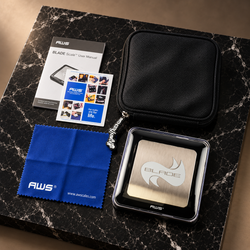
The best precision scale for beads is not necessarily the model with the most decimal places.
For bead weighing, the most important features are:
-
Appropriate readability
-
Enough capacity
-
Repeatability
-
Tare
-
Platform size
-
Calibration
-
Stable zero
-
Minimum usable load
-
Container compatibility
-
Portability
For many jewelry makers, bead sellers and crafters:
500 g × 0.01 g
is one of the most practical all-around configurations.
It offers enough capacity for:
-
Seed beads
-
Glass beads
-
Gemstone beads
-
Crystal beads
-
Findings
-
Small containers
-
Finished jewelry
while displaying weight in:
0.01 g increments.
For heavier bead batches where hundredths of a gram are not important:
0.1 g readability
may be sufficient.
For exceptionally small components where 0.01 g does not provide enough detail:
0.001 g
may be useful, although this finer resolution comes with lower capacity and greater sensitivity to the weighing environment.
American Weigh Scales offers multiple pocket scales covering these different precision ranges.
The best choice should begin with:
what beads you weigh, how much you weigh at once, and how small a weight difference actually matters.
Quick Answer: Which Features Matter Most?
For most bead weighing, prioritize:
| Feature | Why It Matters |
|---|---|
| Readability | Determines the smallest displayed weight increment |
| Capacity | Determines the maximum total load |
| Tare | Removes container weight from the displayed result |
| Repeatability | Helps ensure measurements remain consistent |
| Platform size | Determines whether trays and containers fit properly |
| Calibration | Helps maintain measurement performance |
| Stable zero | Important for lightweight batches |
| Minimum usable load | Important for very tiny bead quantities |
| Display quality | Makes small decimal readings easier to record |
| Protective cover | Useful for portable scales |
| Battery operation | Helpful for craft fairs and mobile sellers |
For most bead and jewelry-making workflows:
0.01 g readability + approximately 500 g capacity
is a strong starting point.
Feature 1: Readability
Readability is the smallest increment shown by the scale.
Common bead-scale options include:
-
1 g
-
0.1 g
-
0.01 g
-
0.001 g
For general bead work, the most relevant choices are usually:
0.1 g and 0.01 g.
AWS currently identifies 0.01 g readability as a practical general jewelry format, including for beads and findings, while 0.1 g can be sufficient for larger batches and heavier materials. (awscales.com)
Is 1 g Too Coarse for Beads?
For many small bead packages:
yes.
Suppose you are preparing:
10 g seed-bead packages.
A whole-gram scale may show:
9 g
10 g
11 g
That means one display increment represents:
10% of the target package weight.
A finer scale provides much better control.
Feature 2: 0.1 g Readability
A:
0.1 g
scale displays tenths of a gram.
Examples:
24.8 g
24.9 g
25.0 g
25.1 g
This may be perfectly adequate for:
-
Heavy gemstone beads
-
Metal beads
-
Bulk findings
-
Larger bead batches
-
Finished jewelry
-
General craft materials
The advantage is that 0.1 g scales often offer:
-
Higher capacity
-
Larger platforms
-
Less sensitivity to environmental effects
Feature 3: 0.01 g Readability
A:
0.01 g
scale displays hundredths of a gram.
Examples:
24.97 g
24.98 g
24.99 g
25.00 g
This gives ten times finer displayed resolution than a 0.1 g scale.
For bead businesses, 0.01 g can be especially useful for:
-
Seed-bead packages
-
Small findings
-
Small retail quantities
-
Gemstone bead batches
-
Jewelry components
-
Finished jewelry
AWS's guide on how to choose a scale for jewelry similarly positions 0.01 g as a practical balance between precision and usable capacity for general jewelry work.
Feature 4: 0.001 g Readability
A:
0.001 g
scale reads in thousandths of a gram.
That level can be useful for:
-
Extremely tiny findings
-
Very lightweight components
-
Individual micro-components
-
Specialized fine weighing
But most ordinary bead work does not require it.
A milligram scale can also be:
-
More sensitive to airflow
-
More sensitive to vibration
-
More sensitive to static
-
Lower in capacity
-
Smaller in platform size
For most bead makers:
0.01 g is the more practical first choice.
0.1 g vs. 0.01 g vs. 0.001 g
| Readability | Best For | Main Advantage | Main Limitation |
|---|---|---|---|
| 0.1 g | Bulk beads, heavy components | Higher capacity | Less detail |
| 0.01 g | General bead work | Excellent balance | Moderate capacity |
| 0.001 g | Extremely small components | Very fine resolution | Greater environmental sensitivity |
Do not choose the finest resolution simply because it appears more precise.
Choose the resolution that matches:
the smallest meaningful difference in your actual bead workflow.
Feature 5: Minimum Usable Load
This feature is often overlooked.
The smallest display increment does not automatically equal the smallest amount the scale can reliably measure.
A scale that displays:
0.01 g
should not automatically be assumed to reliably measure an entire object weighing only:
0.01 g.
AWS explicitly notes this distinction in its precision-jewelry guidance.
This matters when weighing:
-
One tiny seed bead
-
Very small findings
-
Ultra-light plastic components
-
Individual micro-parts
When working near the bottom of a scale's usable range, check the manufacturer's specifications.
Feature 6: Capacity
Capacity tells you the maximum total physical load the scale can support.
Common capacities for bead work include:
-
100 g
-
200 g
-
500 g
-
1,000 g
-
2,000 g+
The best capacity depends on:
beads + tray + container.
Why 500 g Is a Strong General Choice
Five hundred grams provides enough capacity for many:
-
Seed-bead quantities
-
Multiple bead strands
-
Gemstone beads
-
Findings
-
Small trays
-
Plastic containers
-
Finished jewelry
without forcing you into a large bench scale.
That is why:
500 g × 0.01 g
is such a useful middle ground.
Example: 500 g × 0.01 g
The SC501g Precision Digital Pocket Scale provides:
-
500 g capacity
-
0.01 g readability
-
Tare
-
Multiple units
-
Stainless-steel weighing platform
-
Expansion trays
This format works well when you want one compact scale for both:
beads and general jewelry work.
Feature 7: Capacity Includes the Container
A common mistake is to calculate only the weight of the beads.
Suppose:
Beads = 350 g
Container = 175 g
Total physical load:
525 g.
A 500 g scale would not provide enough capacity.
Always calculate:
beads + container + tray = total load.
Feature 8: Tare
Tare is one of the most useful bead-scale features.
Suppose an empty tray weighs:
38.42 g.
Place it on the scale.
Press:
TARE.
The display returns to:
0.00 g.
Now add beads.
The display shows the net bead weight.
This simplifies:
-
Packaging
-
Batch comparison
-
Inventory control
-
Recipe-style jewelry kits
Tare Does Not Increase Capacity
This is important.
If:
Scale capacity = 500 g
Container weight = 150 g
and you tare the container:
you do not regain 150 g of physical capacity.
Approximately:
350 g
of additional physical load remains available.
Tare changes:
the displayed zero.
It does not change:
the maximum load.
Feature 9: Repeatability
Repeatability describes how consistently the scale measures the same object under similar conditions.
Suppose the same bead tray repeatedly measures:
25.16 g
25.16 g
25.16 g
That suggests stable behavior.
If the readings are:
24.93 g
25.27 g
25.04 g
something may need attention.
Possible causes include:
-
Vibration
-
Airflow
-
Static
-
Calibration
-
Temperature
-
Weak battery
-
Uneven surface
Repeatability matters especially when preparing multiple packages intended to be similar in weight.
Feature 10: Calibration
Calibration is another core feature.
A scale should be calibrated according to:
the manufacturer's procedure for that exact model.
The National Institute of Standards and Technology discusses the importance of appropriate reference standards, calibration procedures and weighing-error sources in its balance and scale calibration guidance.
For practical bead work:
use the calibration weight specified by the scale manufacturer.
Calibration Weight Is Model-Specific
Do not assume every 500 g scale uses the same calibration procedure.
A model might require:
-
100 g
-
200 g
-
500 g
or another reference mass.
Check the instructions for the exact model.
Do Not Calibrate With Beads
A bag labeled:
50 g beads
should not be used as a calibration standard.
The package weight may:
-
Include packaging
-
Have manufacturing tolerance
-
Differ from nominal weight
Use the correct calibration reference.
Do Not Use Coins as Calibration Standards
Coins can vary due to:
-
Manufacturing tolerance
-
Wear
-
Dirt
-
Damage
-
Corrosion
Use a proper calibration weight rather than an object whose exact mass is only assumed.
Feature 11: Stable Zero
A good precision scale should settle at zero before the beads are added.
If the empty scale moves between:
0.00 g
0.03 g
-0.02 g
0.01 g
investigate the setup.
Possible causes include:
-
Air movement
-
Vibration
-
Static
-
Uneven surface
-
Calibration issues
This becomes increasingly important as resolution becomes finer.
Feature 12: Platform Size
Platform size can matter as much as numerical capacity.
A scale may support:
500 g
but still be inconvenient if your bead bowl is much larger than the platform.
Consider:
-
Tray width
-
Container shape
-
Workbench space
-
Display visibility
The container should fit securely without interfering with the scale.
Feature 13: The Container Should Not Touch Anything Else
Your bead tray should not rest against:
-
Scale housing
-
Table
-
Another container
-
Your hand
External contact can interfere with proper weight measurement.
Feature 14: Larger Platform for Bulk Beads
If you regularly use:
-
Wide trays
-
Bowls
-
Larger bead containers
a bench scale may be more convenient.
The AMW-500I Compact Digital Bench Scale provides:
500 g × 0.1 g
with a larger weighing platform.
This can be more practical than a pocket scale when:
container size matters more than hundredth-of-a-gram readability.
Feature 15: Portability
Pocket scales are useful for bead sellers who work at:
-
Craft shows
-
Jewelry markets
-
Trade shows
-
Classes
-
Shared studios
Useful portable features include:
-
Battery operation
-
Protective cover
-
Compact size
-
Easy tare
-
Clear display
Feature 16: Protective Cover
A protective cover can help shield:
-
Platform
-
Display
-
Controls
during transport.
Some pocket-scale covers can also function as lightweight weighing trays, depending on the model.
This can be particularly convenient for mobile bead work.
Feature 17: Clear Display
A bead scale should have a display that is easy to read.
This matters when distinguishing readings such as:
18.06 g
from:
18.60 g.
Look for:
-
Clear decimal placement
-
Large digits
-
Good contrast
especially if the scale is used repeatedly for packaging.
Feature 18: Useful Weighing Units
For bead work:
grams are usually the most important unit.
Other useful units may include:
-
oz
-
ct
-
gn
-
dwt
depending on whether the scale is also used for:
-
Gemstones
-
Precious metals
-
Jewelry
For ordinary bead packaging:
grams should be the primary reference.
Feature 19: Stable Work Surface
Place a precision bead scale on a:
-
Hard
-
Flat
-
Level
-
Stable
surface.
Avoid:
-
Flexible craft tables
-
Wobbly folding tables
-
Shelves that move when touched
A scale cannot provide stable measurements if the work surface itself moves.
Feature 20: Airflow Control
At 0.01 g—and particularly 0.001 g—airflow can affect readings.
Avoid placing the scale directly under:
-
Ceiling fans
-
HVAC vents
-
Desk fans
-
Open windows
This matters less for 0.1 g work but is still good weighing practice.
Feature 21: Static Awareness
Tiny beads and plastic containers can generate static.
Static can become more noticeable as resolution becomes finer.
Possible contributors include:
-
Plastic trays
-
Poly bags
-
Synthetic clothing
-
Dry indoor air
If readings remain unstable after checking calibration, surface stability and airflow, static may be worth considering.
Feature 22: Easy-to-Clean Platform
Bead work can be messy.
Tiny items can fall onto or around the scale.
A smooth platform is easier to:
-
Inspect
-
Wipe
-
Clear between batches
Use a tray whenever possible to keep loose beads away from gaps around the housing.
Feature 23: A Tray Is Often Better Than Direct Weighing
Loose beads can:
-
Roll away
-
Fall into openings
-
Mix with another batch
-
Become difficult to retrieve
Use a lightweight tray or container.
Then:
tare the container before adding beads.
Feature 24: Suitability for Seed Beads
Seed beads are often packaged in small gram quantities.
That makes:
0.01 g readability
particularly useful.
A 500 g capacity provides ample room for:
-
Multiple small packages
-
Containers
-
Inventory batches
Seed Bead Size Varies
Seed beads are available in many different sizes and shapes.
Fire Mountain Gems publishes a seed bead sizing reference covering commonly used bead formats and dimensions.
This matters because:
weight per piece is not constant across bead sizes.
Feature 25: Suitability for Gemstone Beads
Gemstone beads may be heavier than glass or plastic beads of comparable dimensions.
Natural materials also vary in:
-
Density
-
Shape
-
Drilling
-
Size
A 500 g × 0.01 g scale provides a useful balance for many gemstone-bead strands and small batches.
Feature 26: Suitability for Metal Beads
Metal beads can become heavy quickly.
For larger quantities:
capacity may matter more than 0.01 g readability.
If you routinely weigh several hundred grams or more:
a larger bench scale may be preferable.
Feature 27: Suitability for Glass Beads
For small glass-bead packages:
0.01 g
provides fine portion control.
For larger wholesale quantities:
0.1 g
may be more efficient.
Feature 28: Suitability for Plastic Beads
Plastic and acrylic beads are lightweight.
This shifts the priority toward:
resolution rather than capacity
when packaging small quantities.
For most work:
0.01 g should provide ample detail.
Feature 29: Weight-Based Inventory Estimates
A precision scale can also help estimate bead count.
Suppose:
100 beads weigh 4.50 g.
Average:
4.50 ÷ 100 = 0.045 g per bead.
If the remaining batch weighs:
45 g
estimated count:
45 ÷ 0.045 = 1,000 beads.
This can be much faster than counting manually.
Why Bead Counts by Weight Are Estimates
Weight per bead can vary because of:
-
Size
-
Shape
-
Hole diameter
-
Finish
-
Material
-
Manufacturing variation
For better estimates:
calculate the average from a representative sample of the exact bead SKU.
Use a Larger Sample
Instead of weighing one bead:
weigh:
50 or 100 beads.
A larger sample provides a more useful average.
The process is:
-
Count the sample.
-
Weigh it.
-
Divide weight by quantity.
-
Record average mass.
-
Weigh the larger batch.
-
Divide batch mass by average bead mass.
Feature 30: Suitability for Finished Jewelry
A bead scale may also need to weigh:
-
Bracelets
-
Necklaces
-
Earrings
-
Pendants
This is another reason 500 g capacity can be useful.
The AWS best digital scale for jewelry guide notes that jewelry applications often require balancing fine readability against sufficient capacity.
Precision Pocket Scale vs. Bench Scale
Pocket Scale
Best when you value:
-
Portability
-
Compact size
-
0.01 g readability
-
Small trays
-
Mobile use
Bench Scale
Best when you value:
-
Larger platform
-
Larger containers
-
Greater batch capacity
-
Permanent workstation use
There is no single format that is ideal for every bead business.
One Scale or Two?
A two-scale setup can be useful for businesses handling both:
small retail bead packages and larger bulk batches.
Precision Scale
500 g × 0.01 g
Use for:
-
Small packages
-
Seed beads
-
Findings
-
Retail portions
-
Finished jewelry
Higher-Capacity Scale
1,000–2,000 g+ × 0.1 g
Use for:
-
Bulk inventory
-
Large bead batches
-
Heavy gemstone strands
-
Metal beads
This avoids forcing one scale to cover two very different jobs.
Best Precision Scale for Seed Beads
Prioritize:
-
0.01 g readability
-
200–500 g+ capacity
-
Tare
-
Stable zero
-
Small lightweight tray
-
Repeatability
Best Precision Scale for Gemstone Beads
Prioritize:
-
0.01 g readability
-
Around 500 g or more capacity
-
Larger tray if needed
-
Tare
-
Calibration
Best Precision Scale for Bulk Beads
Prioritize:
-
Higher capacity
-
Larger platform
-
0.1 g readability if sufficient
-
Tare
-
Container compatibility
Best Precision Scale for Jewelry Makers
Jewelry makers commonly handle:
-
Beads
-
Findings
-
Chains
-
Components
-
Gemstones
-
Finished jewelry
For this mixed use:
500 g × 0.01 g
is one of the strongest general-purpose configurations.
AWS's Jewelry Scale Buying Guide similarly recommends matching readability and capacity to the actual jewelry task rather than simply choosing the scale with the finest display.
Commercial Weight Claims
If products are sold or advertised by:
-
Weight
-
Quantity
-
Material
-
Size
those claims should be accurate.
The FTC's Jewelry Guides state that marketers should truthfully represent characteristics including quantity, size and weight.
For businesses selling bead and jewelry products:
use weighing procedures appropriate to the claim being made.
Common Mistakes When Choosing a Precision Bead Scale
Choosing the Most Decimal Places
More digits do not automatically make the scale better for your application.
Buying 0.001 g When 0.01 g Is Enough
This can unnecessarily reduce capacity and increase sensitivity.
Using 1 g Resolution for Small Packages
Whole-gram weighing may be too coarse for lightweight bead portions.
Ignoring Minimum Usable Load
The smallest displayed increment is not automatically the smallest reliably measurable total load.
Buying Too Little Capacity
Remember the container.
Forgetting Tray Weight
Everything on the platform counts.
Assuming Tare Restores Capacity
It does not.
Ignoring Platform Size
A numerical capacity is useless if the container does not fit properly.
Letting the Tray Touch the Scale Housing
This can interfere with measurement.
Ignoring Repeatability
A precision scale should produce reasonably consistent measurements under stable conditions.
Ignoring Calibration
Fine readability still requires proper calibration.
Calibrating With Coins
Use the correct reference weight.
Pouring Loose Beads Directly Onto the Scale
Use a tray.
Assuming Weight Equals Exact Piece Count
Bead weights can vary.
Using One Average for Different Bead SKUs
Calculate averages separately.
Ignoring Airflow
Drafts can affect fine measurements.
Using a Wobbly Craft Table
Vibration reduces stability.
Precision Bead Scale Buying Checklist
Before buying, ask:
-
What type of beads will I weigh?
-
What is my smallest package?
-
What is my largest batch?
-
Is 0.1 g enough?
-
Would 0.01 g be more useful?
-
Do I genuinely need 0.001 g?
-
What is the scale's minimum usable load?
-
Is 200 g enough capacity?
-
Would 500 g be better?
-
Do I need more than 500 g?
-
What container will I use?
-
How much does it weigh?
-
Have I included it in total capacity?
-
Does the scale have tare?
-
Is the platform large enough?
-
Can my bead tray sit freely?
-
Is calibration supported?
-
What calibration weight is required?
-
Are repeated measurements stable?
-
Does zero remain stable?
-
Will airflow affect the scale?
-
Is my workbench stable?
-
Could static affect lightweight beads?
-
Is the display easy to read?
-
Do I need battery operation?
-
Will I transport the scale?
-
Does it have a protective cover?
-
Will I estimate bead counts by weight?
-
Will I also weigh finished jewelry?
-
Would two scales better fit my workflow?
Frequently Asked Questions
What is the best precision scale for beads?
For most jewelry and bead applications:
500 g × 0.01 g
is an excellent starting point.
Is 0.01 g precise enough for beads?
For most:
-
Seed beads
-
Gemstone beads
-
Glass beads
-
Findings
-
Small packages
yes.
Is 0.1 g enough for beads?
It can be sufficient for:
-
Larger batches
-
Heavy gemstone beads
-
Metal beads
-
Bulk materials
Do I need 0.001 g?
Usually not for ordinary bead weighing.
It becomes useful when working with extremely lightweight components where 0.01 g does not provide enough detail.
Is 500 g capacity enough?
For many jewelry makers:
yes.
It provides substantial room for beads, small containers and finished jewelry.
Does tare increase capacity?
No.
It only resets the displayed net value.
Should I weigh beads directly on the platform?
Using a tray is generally safer.
Can I count beads using weight?
You can estimate quantities from the average weight of a representative sample.
Is counting beads by weight exact?
Not necessarily.
Individual bead weights can vary.
Does 0.01 g readability mean ±0.01 g accuracy?
No.
Readability is the smallest displayed increment, not a universal accuracy guarantee.
Why does my bead scale fluctuate?
Possible causes include:
-
Airflow
-
Vibration
-
Static
-
Temperature
-
Calibration
-
Battery condition
Can I calibrate using coins?
Use the manufacturer's specified calibration reference instead.
What is the best scale for seed beads?
A:
200–500 g × 0.01 g
scale is a strong general choice.
What is the best scale for gemstone beads?
For many gemstone-bead applications:
500 g × 0.01 g
offers a useful combination of precision and capacity.
What about bulk beads?
A larger:
1,000–2,000 g+ × 0.1 g
scale may be more practical.
Should jewelry makers own two scales?
It can be useful.
Use:
500 g × 0.01 g
for precise small batches
and a:
higher-capacity × 0.1 g
scale for bulk work.
Final Verdict: Which Features Matter Most?
The best precision scale for beads should match the actual bead workflow rather than simply offering the most decimal places.
For most jewelry makers and bead sellers:
0.01 g readability
provides the best balance of precision and practicality.
Pair it with approximately:
500 g capacity
and you have enough range for:
-
Seed beads
-
Glass beads
-
Gemstone beads
-
Findings
-
Small retail packages
-
Finished jewelry
For larger bulk batches:
0.1 g readability
may be entirely sufficient and can provide:
-
Greater capacity
-
Larger platforms
-
Easier container handling
Use:
0.001 g
only when the actual work requires measurement finer than 0.01 g.
When comparing bead scales, prioritize:
appropriate readability → sufficient capacity → minimum usable load → repeatability → tare → calibration → platform size → stable zero → portability.
Remember:
readability is not the same as accuracy.
The container counts toward capacity.
Tare does not restore physical capacity.
Weight-based bead counting is usually an estimate.
For most users, the strongest general-purpose choice remains:
500 g × 0.01 g.
It provides the flexibility needed for precise bead packaging without sacrificing the capacity required for real jewelry-making work.