
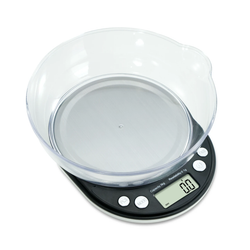
Choosing the right soap making scale is a balance between three core
requirements: accuracy, capacity, and calibration.
Capacity determines whether the scale can physically support your
containers and ingredients. Readability determines how finely the
display changes as weight is added. Accuracy and repeatability determine
whether the measurements are useful and consistent. Calibration provides
a way to check or adjust the instrument according to the manufacturer's
procedure.
Soap making makes these factors especially important because the
weighing range can be wide. A bowl containing oils may weigh several
kilograms, while fragrance, colorants, or other additives may be
measured in much smaller quantities.
American Weigh Scales' Best Scale for Soap Making: Precision for Small
Batches
recommends matching capacity and readability to the ingredient range.
For many small-batch makers, approximately 2,000--3,000g capacity with
0.1g readability offers a useful balance. Larger batches may require
5kg or more, while very small formulation tests can benefit from a
separate 0.01g precision scale.
For many regular soap makers, the most versatile arrangement is:
Main scale: 3--5kg+ x 0.1g--1g
Precision scale: 500g--2kg x 0.1g
Optional fine scale: 100--500g x 0.01g
This buying guide explains how to choose between those ranges and which
specifications matter beyond the number printed on the box.
Quick Buying Guide
Task Suggested capacity Suggested readability
Tiny colorant/additive tests 100--500g 0.01g
Fragrance and essential oils 500g--1kg 0.01g--0.1g
Lye for small batches 500g--2kg 0.1g
Water for small batches 1--3kg 0.1g--1g
Oils for small/medium batches 2--5kg 0.1g--1g
Larger soap batches 5kg+ 1g may be suitable
These are equipment-selection ranges rather than recipe instructions.
The actual scale must fit the validated formula, container weight, and
manufacturer's performance specifications.
The Three Specifications to Understand First
Before comparing models, understand:
-
Capacity
-
Readability
-
Accuracy
Calibration and repeatability then help you maintain confidence in the
measurement process.
What Is Scale Capacity?
Capacity is the maximum physical load the scale is designed to support.
If a scale is marked:
5,000g x 1g
its capacity is 5,000g.
If it is marked:
500g x 0.01g
its capacity is 500g.
AWS explains this notation in What Does 500g x 0.01g Mean on a Digital
Scale?.
Capacity Includes the Container
This is one of the most important concepts in scale selection.
Suppose:
Mixing bowl = 850g
Oils = 2,000g
Gross physical load:
850g + 2,000g = 2,850g
A 3kg scale technically supports the load, but it leaves only 150g of
headroom.
A 5kg scale is the more practical choice.
Tare Does Not Increase Capacity
Tare resets the displayed net value to zero.
It does not remove physical load.
If a 700g bowl is sitting on a 3,000g scale and you press tare, the
scale is still supporting 700g. Approximately 2,300g of physical
capacity remains.
Never calculate capacity from the tared display alone.
Why Capacity Headroom Matters
Operating near maximum capacity leaves little room for:
-
Heavier containers
-
Slightly larger batches
-
Additional ingredients
-
Accidental overpour
-
Future production growth
If your normal gross load is 2,900g, a 3kg scale is not a comfortable
long-term choice.
Is 2kg Enough?
A 2kg scale can work for:
-
Small batches
-
Lightweight bowls
-
Lye
-
Water
-
Fragrance
-
Smaller oil quantities
It can become restrictive if the mixing bowl itself is heavy.
Is 3kg Enough?
Three kilograms is a strong small-batch capacity.
It can handle many hobby workflows while remaining compact.
AWS currently identifies roughly 2--3kg as a useful range for many
small-batch soap makers when paired with appropriate readability.
Is 5kg Better?
Five kilograms offers more flexibility for:
-
Heavier bowls
-
Larger oil quantities
-
Water
-
Multi-ingredient weighing
-
Growing batch sizes
For a general-purpose main scale, 5kg is an excellent capacity target.
When Do You Need More Than 5kg?
Choose more than 5kg when your real gross loads approach or exceed 5kg.
Production-scale soap making may involve:
-
Large oil containers
-
Larger water quantities
-
Heavy stainless vessels
-
Masterbatch ingredients
Do not choose excessive capacity without checking readability. A very
high-capacity scale may be too coarse for smaller ingredients.
What Is Readability?
Readability is the smallest increment shown by the display.
Common soap-making options include:
-
1g
-
0.1g
-
0.01g
-
0.001g
Readability is sometimes called resolution in consumer scale
descriptions.
Is 1g Readability Enough?
For larger quantities of oils and water, it can be.
The relative significance of a 1g increment changes with the size of the
ingredient:
1g is 0.1% of 1,000g.
1g is 1% of 100g.
1g is 10% of 10g.
That is why a whole-gram scale can be useful for bulk ingredients but
less suitable for small lye, fragrance, or additive quantities.
Why 0.1g Is So Useful
For many small-batch soap makers, 0.1g readability is the practical
sweet spot.
A 0.1g scale can display:
-
125.0g
-
82.4g
-
35.7g
-
12.3g
-
3.2g
It provides finer control without the extreme environmental sensitivity
of milligram-scale equipment.
It is particularly useful for:
-
Lye
-
Fragrance
-
Essential oils
-
Smaller oil quantities
-
Colorants
-
Additives
-
Formula-development batches
When Should You Choose 0.01g?
Choose 0.01g when:
-
Important ingredients regularly fall below 1g
-
You make tiny experimental batches
-
Concentrated colorants are used in small quantities
-
Additive changes need hundredth-gram control
-
0.1g is too coarse for the actual formulation
AWS's 0.001g vs. 0.01g scales
guide
explains why finer readability should match a real measurement need.
Do You Need 0.001g?
Usually not for normal soap making.
A 0.001g scale is designed for milligram-level measurement and is much
more sensitive to:
-
Airflow
-
Vibration
-
Static
-
Temperature
-
Surface movement
For routine oils, water, lye, fragrance, and additives, 0.1g or 0.01g is
generally more practical.
What Does Accuracy Mean?
Accuracy is not the same as readability.
A display that shows 0.01g increments does not automatically mean every
result is accurate to ±0.01g.
When evaluating a scale, review:
-
Manufacturer accuracy specification
-
Tolerance
-
Repeatability
-
Minimum load
-
Calibration instructions
-
Operating conditions
More decimal places alone do not establish measurement quality.
Readability vs. Accuracy vs. Repeatability
These terms answer different questions.
Readability
What is the smallest display increment?
Accuracy
How closely does the indication agree with an appropriate reference
within the stated performance?
Repeatability
Does the same stable load produce similar readings when measured
repeatedly under similar conditions?
All three matter.
Why Repeatability Matters for Soap Making
A successful formula should be reproducible.
If the same reference object produces noticeably different readings each
time, investigate the setup.
AWS discusses common causes in Why Does My Digital Scale Give Different
Readings?.
Possible causes include:
-
Drafts
-
Vibration
-
Weak batteries
-
Unstable surfaces
-
Temperature changes
-
Static
-
Debris
-
Overload
-
Calibration problems
A Simple Repeatability Check
-
Put the scale on a hard, level surface.
-
Confirm zero.
-
Place the same suitable stable object on the platform.
-
Record the result.
-
Remove it.
-
Wait for the scale to return to zero.
-
Repeat several times.
The readings should behave consistently within the scale's stated
performance.
Minimum Usable Load
The smallest display increment is not necessarily the smallest
dependable working quantity.
A scale displaying 0.1g does not automatically mean 0.1g is an ideal
ingredient load.
For tiny formulation components, check:
-
Minimum load
-
Accuracy specification
-
Repeatability
-
Tolerance
-
Manufacturer guidance
This is particularly important when buying a 0.01g precision scale
specifically for sub-gram ingredients.
What Is Calibration?
Calibration is the process of comparing a measuring instrument against
an appropriate reference and, depending on the instrument and procedure,
determining or adjusting its indication.
For consumer digital scales, manufacturers often provide a calibration
mode using a specified reference weight.
AWS's How to Calibrate a Digital Scale for Accurate
Results
explains the practical process.
Always follow the instructions for the specific model.
Why Calibration Matters
Scale performance can be affected by:
-
Transportation
-
Impact
-
Accidental overload
-
Long storage
-
Temperature changes
-
Environmental changes
-
Mechanical wear
Calibration and performance checks help identify whether the scale is
behaving as expected.
NIST's Calibration of Mass
Standards
describes the formal mass-measurement framework in which calibration
establishes mass values with appropriate uncertainty and traceability.
A soap workshop does not need laboratory-level metrology, but the
principle remains useful: use appropriate known references and
documented procedures.
Calibration Does Not Fix Every Problem
Calibration cannot repair:
-
Bent platforms
-
Damaged load cells
-
Chemical contamination
-
Corroded electronics
-
Broken housings
-
Severe overload damage
If a scale is physically damaged or remains unstable after correct
setup, replace or service it according to manufacturer guidance.
What Calibration Weight Do You Need?
The required mass depends on the scale.
A model may specify:
-
100g
-
200g
-
500g
-
1kg
-
Another nominal mass
Use the value specified by the manufacturer.
NIST's Standards for Laboratory
Weights
provides broader background on mass standards used in analytical
measurement.
Do Not Calibrate With Random Objects
Avoid:
-
Coins
-
Soap bars
-
Bottles
-
Packaged ingredients
-
Household hardware
These are not appropriate substitutes for the reference specified by the
manufacturer.
How Often Should You Check Calibration?
Follow the scale manufacturer's instructions.
Additional checks may be sensible after:
-
Moving the scale
-
Dropping it
-
Accidental overload
-
Long storage
-
Major temperature changes
-
Unexpected readings
For more formal context, NIST's Calibration Procedures for Weights and
Measures
Laboratories
describes standardized procedures designed to support metrological
traceability and calibration uncertainty.
A soap maker does not need to reproduce those laboratory procedures.
They illustrate why calibration should use defined methods and suitable
references.
Best Scale for Base Oils
Base oils usually require capacity more than ultra-fine readability.
A strong main-scale range is:
3--5kg+ x 0.1g--1g
Look for:
-
Large platform
-
Clear tare
-
Visible display
-
Stable controls
-
Easy-clean surface
-
Comfortable capacity headroom
Best Scale for Water
Water can usually be weighed on the main scale.
A 1--3kg+ scale can cover many small and medium batch quantities.
Choose capacity based on the water plus the dedicated container.
Best Scale for Lye
Lye generally benefits from finer readability.
For many small batches:
500g--2kg x 0.1g
is a useful starting range.
Capacity must include the dedicated compatible container.
A scale helps reproduce the amount specified by a validated recipe. It
does not determine the correct lye requirement.
Different oils have different saponification requirements, so use a
reputable soap calculator and recalculate whenever the formula changes.
Best Scale for Fragrance
Fragrance quantities are usually smaller than bulk oils.
A 500g x 0.1g scale is a practical choice for many formulations.
For tiny development batches, 0.01g may be useful.
Best Scale for Essential Oils
Choose capacity and readability from the validated target quantity.
Do not use scale precision as a substitute for determining an
appropriate formulation rate.
Follow relevant supplier and formulation guidance.
Best Scale for Colorants
If colorant targets are several grams, 0.1g may be suitable.
If targets regularly fall below 1g, consider 0.01g.
Fine powders also make airflow and static more important.
Best Scale for Additives
Additives can vary widely in quantity.
The correct readability depends on the actual formula.
Do not assume that every additive requires milligram-level measurement.
One Scale vs. Two Scales
One-scale setup
A 3kg x 0.1g scale can cover a broad range of small-batch work when its
platform, minimum load, and accuracy are suitable.
Two-scale setup
For more flexibility:
3--5kg+ x 0.1g--1g main scale
plus
500g--2kg x 0.1g precision scale
Three-scale setup
For product development:
Add
100--500g x 0.01g
for genuine sub-gram formulation work.
Pocket Scale vs. Kitchen Scale
A pocket scale typically offers:
-
Finer readability
-
Compact storage
-
Small platform
-
Lower capacity
A kitchen or bench scale typically offers:
-
Higher capacity
-
Larger platform
-
Better support for bowls
-
Coarser readability on some models
AWS's Pocket Scale vs. Kitchen
Scale
explains the general tradeoff.
For soap making, the best answer is often to use both formats for
different ingredient ranges.
Why Platform Size Matters
A scale can have enough capacity but still be physically unsuitable.
The container should:
-
Sit securely
-
Remain centered
-
Be fully supported
-
Avoid touching the counter
-
Leave the display visible
If a bowl touches another surface, the scale is no longer supporting the
entire load.
Display Visibility
Look for:
-
Large digits
-
Clear decimal point
-
Backlight
-
Good contrast
-
Useful viewing angle
Test the display with your actual bowl or container on the platform.
Tare Function
Tare is essential for soap making.
A typical workflow:
-
Place the empty dedicated container on the scale.
-
Wait for stability.
-
Press tare.
-
Confirm zero.
-
Add the ingredient slowly.
-
Stop at the target.
-
Record the mass.
Remember that the container still counts toward physical capacity.
Response Time
A scale should respond as ingredient is added and settle predictably.
As the target approaches:
-
Pour more slowly
-
Pause
-
Let the display settle
-
Confirm the final value
This is especially important for lye, fragrance, and small additives.
Stable Zero
Before weighing, the scale should settle at zero.
If it drifts, inspect:
-
Batteries
-
Platform cleanliness
-
Work surface
-
Airflow
-
Vibration
-
Temperature
-
Calibration
Fine-resolution scales reveal environmental disturbance more readily.
Use a Hard, Level Surface
Avoid placing a scale on:
-
Towels
-
Soft pads
-
Flexible silicone mats
-
Wobbly tables
-
Uneven shelves
Use a rigid, stable surface.
Control Airflow
Keep 0.01g precision scales away from:
-
Fans
-
Open windows
-
Strong HVAC vents
Drafts can disturb fine measurements.
Reduce Vibration
Possible sources include:
-
Foot traffic
-
Flexible tables
-
Stick blenders
-
Nearby appliances
-
Moving equipment
Move the precision scale away from vibration when necessary.
Temperature and Heat
Use the scale within the manufacturer's specified operating conditions.
Do not place hot containers on the platform unless the manufacturer
permits it.
When practical, weigh ingredients before heating.
Cleaning and Chemical Protection
Use dedicated containers rather than placing ingredients directly on the
platform.
Keep materials away from:
-
Buttons
-
Platform gaps
-
Battery compartments
-
Charging ports
-
Electronics
Follow manufacturer cleaning instructions.
Dedicated Soap-Making Equipment
Keep soap-making equipment separate from food preparation, particularly
equipment that may contact lye, fragrance, colorants, or raw formulation
materials.
Clearly label scales and containers.
Power Options
Useful features include:
-
Low-battery indicator
-
Easy battery replacement
-
Rechargeable battery
-
Approved adapter option
-
Predictable startup
Weak batteries can contribute to unstable readings.
Auto-Off
Auto-off saves power but can interrupt weighing.
Soap making can involve pauses while you:
-
Check the formula
-
Prepare a container
-
Put on protective equipment
-
Record a quantity
-
Organize the next ingredient
Choose timeout behavior that fits the workflow.
2kg vs. 3kg
Choose 2kg when:
-
Batches are small
-
Containers are light
-
Gross loads remain well below 2kg
Choose 3kg when:
-
Oil quantities are larger
-
Bowls are heavier
-
You want more headroom
3kg vs. 5kg
Choose 3kg for regular small batches with moderate containers.
Choose 5kg for:
-
Larger oil batches
-
Heavier bowls
-
Growth
-
More capacity headroom
For a main scale, 5kg is often the more flexible long-term choice.
5kg vs. 10kg
Choose 10kg only when the actual gross load requires it.
Higher capacity is not automatically better if readability becomes too
coarse for your application.
1g vs. 0.1g
Choose 1g primarily for larger bulk quantities.
Choose 0.1g for smaller ingredients where whole-gram rounding is too
coarse.
For many small-batch soap makers, 0.1g is the most versatile precision
level.
0.1g vs. 0.01g
Choose 0.1g when:
-
Most meaningful quantities exceed 1g
-
Lye and fragrance are the main precision tasks
-
You want useful capacity
-
You prefer less environmental sensitivity
Choose 0.01g when:
-
Ingredients regularly fall below 1g
-
Tiny formulation tests are common
-
Concentrated additives need finer control
Why More Decimal Places Are Not Always Better
A finer display can come with tradeoffs:
-
Lower capacity
-
Smaller platform
-
Greater sensitivity to airflow
-
Greater sensitivity to vibration
-
More demanding setup
Choose the resolution that matches the formula rather than the maximum
number of digits available.
Why More Capacity Is Not Always Better
A 10kg or 20kg scale may be excellent for bulk production but too coarse
for small ingredients.
Capacity and readability must be considered together.
Best Setup for Beginners
A beginner can consider:
3--5kg main scale
plus
500g--1kg x 0.1g precision scale
This covers a broad range of oils, water, lye, fragrance, and additives
without introducing unnecessary complexity.
Best Setup for Frequent Hobby Makers
Consider:
5kg main scale
plus
1--2kg x 0.1g precision scale
This provides more headroom for heavier containers and larger batches.
Best Setup for Product Development
Consider:
3--5kg+ x 0.1g--1g for bulk ingredients
500g--2kg x 0.1g for lye and smaller ingredients
100--500g x 0.01g for genuine sub-gram tests
Also prioritize:
-
Repeatability
-
Minimum load
-
Calibration support
-
Stable zero
-
Controlled work surface
-
Detailed batch records
For additional mass-measurement context, NIST's Selected Laboratory and
Measurement Practices and Procedures to Support Basic Mass
Calibrations
compiles good measurement practices and procedures used in mass
metrology. Soap makers do not need to reproduce a calibration
laboratory, but stable conditions, documented checks, and appropriate
references are useful principles at any scale.
Best Setup for a Growing Soap Business
As production grows, standardize:
-
Which scale handles each ingredient range
-
Units
-
Containers
-
Tare procedures
-
Calibration checks
-
Performance checks
-
Work surfaces
-
Recipe versions
-
Batch records
Measurement consistency becomes part of process consistency.
For businesses that want a deeper technical reference, NIST's Precision
Laboratory Standards of Mass and Laboratory
Weights
provides historical context on mass standards used to calibrate weighing
equipment and for precision analytical work.
Keep Batch Records
Record:
-
Oil types
-
Oil masses
-
Water mass
-
Lye type
-
Lye mass
-
Fragrance
-
Fragrance mass
-
Colorants
-
Additives
-
Batch size
-
Recipe version
-
Process notes
-
Cure observations
Good records help you reproduce successful formulas and investigate
unexpected batches.
Calibration Records for Small Businesses
A small soap business may benefit from documenting:
-
Scale identification
-
Calibration/check date
-
Reference weight used
-
Result
-
Adjustment performed
-
Person performing the check
-
Next scheduled check
The appropriate level of documentation depends on the business and
applicable quality requirements, but a simple consistent record is
better than relying on memory.
A Scale Does Not Replace a Soap Calculator
A digital scale measures mass.
It does not calculate the sodium hydroxide or potassium hydroxide
required for an oil blend.
Different oils have different saponification characteristics.
Recalculate the formula whenever the oil composition changes.
Accuracy Does Not Make an Unsafe Formula Safe
Even a perfectly functioning scale cannot correct:
-
Wrong oil selection
-
Incorrect lye calculation
-
Wrong lye type
-
Incorrect unit conversion
-
Unsafe fragrance usage
-
Poor handling procedures
Measurement is one part of a controlled soap-making process.
Common Buying Mistakes
Buying by capacity alone
A high-capacity scale may be too coarse for small ingredients.
Buying by decimal places alone
More digits do not guarantee accuracy.
Ignoring container weight
Capacity includes the container.
Assuming tare restores capacity
It does not.
Choosing no headroom
Avoid routine operation at maximum capacity.
Confusing readability with accuracy
Review manufacturer specifications.
Ignoring repeatability
Consistent formulas require consistent readings.
Ignoring minimum load
A display increment is not necessarily a dependable minimum quantity.
Using an undersized platform
The container must be fully supported.
Blocking the display
Check the real container geometry.
Using a soft work surface
Use a rigid, level surface.
Ignoring airflow and vibration
Fine scales are sensitive to the environment.
Calibrating with random household objects
Use the specified reference weight.
Treating calibration as a repair
Calibration cannot fix physical damage.
Using one scale for an impractically wide range
A two-scale setup is often better.
Soap Making Scale Buying Checklist
Before buying, ask:
-
What is my largest batch?
-
What is my heaviest container?
-
What is my maximum gross load?
-
How much headroom do I need?
-
Is 2kg enough?
-
Would 3kg work?
-
Would 5kg be better?
-
Do I need more than 5kg?
-
What is my smallest meaningful ingredient?
-
Is 1g readability sufficient?
-
Would 0.1g be better?
-
Do I need 0.01g?
-
Is 0.001g unnecessary?
-
What accuracy does the manufacturer specify?
-
What tolerance is stated?
-
Is repeatability information available?
-
What is the minimum usable load?
-
Does the scale have tare?
-
Does it measure grams?
-
Is the platform large enough?
-
Can I see the display?
-
Does the reading settle promptly?
-
Does it return reliably to zero?
-
Can it be calibrated?
-
What reference mass is required?
-
Is the calibration weight included?
-
Is the scale easy to clean?
-
Is the power source practical?
-
Is auto-off suitable?
-
Would two scales cover my range better?
Frequently Asked Questions
What is the best scale for soap making?
For many makers, a 3--5kg main scale paired with a 500g--2kg x 0.1g
precision scale provides a versatile setup.
What capacity do I need?
Add the heaviest expected ingredient load to the container weight and
choose capacity with comfortable headroom.
Is 3kg enough?
Three kilograms works well for many small batches.
Is 5kg better?
Five kilograms provides more flexibility for heavier bowls and larger
oil quantities.
Is 1g readability accurate enough?
Whole-gram readability can be suitable for larger bulk quantities, but
smaller ingredients may need 0.1g or 0.01g.
Is 0.1g good for soap making?
Yes, 0.1g is a practical precision level for many small-batch lye,
fragrance, and additive quantities when the scale's other specifications
are appropriate.
When do I need 0.01g?
Choose 0.01g when meaningful quantities regularly fall below 1g or when
0.1g is too coarse for formulation work.
Do I need 0.001g?
Usually not for ordinary soap making.
What is the difference between readability and accuracy?
Readability is the smallest displayed increment. Accuracy concerns
agreement with an appropriate reference within the scale's stated
performance.
What is repeatability?
Repeatability describes how consistently the same stable load is
measured under similar conditions.
Does tare increase capacity?
No. The container still contributes to the physical load.
Should I calibrate my soap scale?
Follow the manufacturer's calibration and performance-check
instructions.
What calibration weight should I use?
Use the nominal reference mass specified for the scale.
Can I calibrate with coins?
Use the specified reference weight rather than improvised household
objects.
How often should I check calibration?
Follow manufacturer guidance and consider additional checks after
transport, impact, overload, long storage, major environmental changes,
or unexpected readings.
Why does my scale drift?
Possible causes include weak batteries, drafts, vibration, temperature
changes, static, unstable surfaces, debris, overload, or calibration
issues.
Can one scale handle everything?
Possibly for small batches, but separate high-capacity and precision
scales often provide a better working range.
Final Verdict: Accuracy, Capacity and Calibration
A good soap-making scale should be chosen in this order:
First, calculate capacity.
Include the complete physical load: container plus ingredient.
Second, choose readability.
Use 1g for suitable bulk quantities, 0.1g for many small-batch precision
tasks, and 0.01g when genuine sub-gram formulation work requires it.
Third, evaluate accuracy and repeatability.
Do not assume the number of decimal places tells the whole story.
Fourth, review minimum load.
Make sure the smallest ingredient falls within the scale's useful
measurement range.
Fifth, check calibration.
Use the manufacturer's procedure and specified reference weight.
For many soap makers, the strongest overall setup is:
3--5kg+ x 0.1g--1g main scale
paired with
500g--2kg x 0.1g precision scale
and, when truly necessary,
100--500g x 0.01g fine precision scale.
AWS currently recommends matching scale capacity and readability to the
actual soap-making task, with approximately 2--3kg x 0.1g offering a
useful balance for many small batches and 5kg+ capacity for larger
batches.
NIST's mass-calibration resources reinforce the broader measurement
principle behind this advice: dependable weighing depends on appropriate
standards, defined procedures, and understood instrument performance.
The best soap-making scale is therefore not simply the highest-capacity
model or the one with the finest resolution. It is the scale---or
combination of scales---that supports your heaviest container and batch,
provides useful detail for your smallest meaningful ingredient, remains
stable in your workspace, and can be checked using an appropriate
calibration procedure.
Choose the measurement range first. Then choose the features that help
you reproduce it consistently.